

There are people who accumulate diplomas, degrees, certificates, honorary memberships, embossed stationery, and enough letters after their names to exhaust the alphabet, yet still begin every opinion with, “I’m probably wrong about this, but…”
Abraham Lincoln appears to have gone in another direction.
Lincoln had almost no formal education. He never attended college. He never attended an academy. By his own estimate, if you gathered together every day he ever spent in school and put them end to end, the total amounted to less than one year.
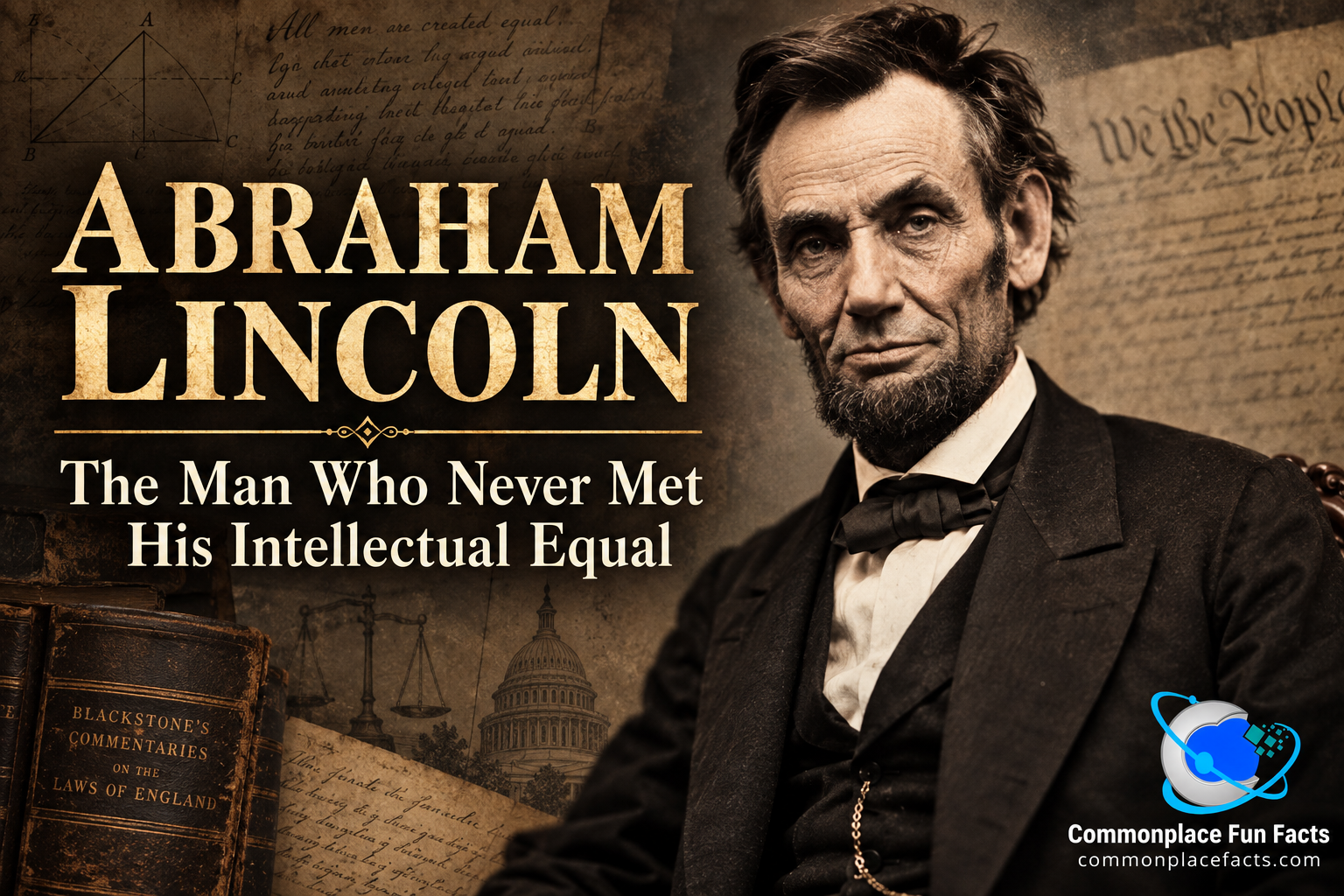
And yet historian David Herbert Donald described the young Lincoln as possessing something rather remarkable: “the self-confidence of a man who has never met his intellectual equal.”
That is quite a sentence to attach to someone whose educational résumé essentially consisted of “some school, here and there, when farm work permitted.”
It is also one of the more revealing observations ever made about Abraham Lincoln.
Contents
Abraham Lincoln’s Education, Such As It Was
Lincoln was unusually candid about the deficiencies in his schooling. In an autobiographical sketch preserved by the National Park Service, he described the schools of his Indiana childhood as places where teachers were expected to know little beyond “readin, writin, and cipherin.” Anyone wandering through the neighborhood with a working knowledge of Latin, he joked, would have been regarded as a “wizzard.”

Lincoln estimated that all of his schooling combined “did not amount to one year.” He had never attended a college or academy and, according to his own account, had never even been inside such a building until after he had received his law license.
What education he possessed, Lincoln explained, he had simply “picked up.”
That phrase considerably understates the amount of picking involved.
After leaving his father’s household in his early twenties, Lincoln studied English grammar on his own. He read whenever he could get his hands on books. He taught himself enough law to become an attorney, eventually developing the substantial legal practice that produced, among other things, the bizarre murder case that inspired Abraham Lincoln to become a published mystery writer.
Even success did not persuade him that the educational project was finished. Lincoln later recalled that after serving a term in Congress he studied Euclid and “nearly mastered” the first six books.
Think about that for a moment. Plenty of people return from Congress convinced they have learned everything worth knowing. Abraham Lincoln returned from Congress and apparently thought, “I really ought to brush up on geometry.”
“The Learned Boy Among Us Unlearned Folks”
Lincoln’s lack of formal schooling did not apparently produce much intellectual insecurity. Quite the opposite.
Recollections from people who knew him as a boy consistently describe someone who recognized very early that his mind worked differently from those around him. One schoolmate remembered Lincoln as “the learned boy among us unlearned folks.” Another childhood friend, Nathaniel Grigsby, recalled that Lincoln’s mind and ambition “soared above us.” While the other boys played, Lincoln read.
That did not necessarily mean young Abraham was quietly sitting beneath a tree radiating future-presidential solemnity. He was also a storyteller, joke teller, mimic, wrestler, and enthusiastic participant in the social life around him. The solemn marble figure at the Lincoln Memorial came later. The actual Lincoln was considerably more animated, as we have seen before in his remarkable mixture of humor and seriousness during the Civil War.
But from childhood onward, he seems to have developed a strong conviction that when confronted with an argument, a problem, or a complicated idea, he could work it out for himself.
That conviction would eventually be tested by men whose formal qualifications dwarfed his own.
Then Came the Men With Better Résumés
Consider William Henry Seward.
Seward had graduated from Union College in 1820. He had been a lawyer, a New York state senator, governor of New York, and United States senator. By 1860, he was one of the most prominent Republicans in the country and the frontrunner for the Republican presidential nomination.

Lincoln, meanwhile, was much less nationally known. The two men had arrived at roughly the same destination by spectacularly different routes. Seward had the education, the national reputation, the experience, and the résumé. Lincoln had less than a year of scattered schooling and had spent much of his youth splitting rails, operating a flatboat, tending a store, and teaching himself whatever he needed to know next.
Then Lincoln beat Seward for the presidential nomination.
The contest was not insignificant. On the first ballot at the Republican convention, Seward received 173½ votes to Lincoln’s 102. Lincoln gained strength on subsequent ballots and secured the nomination on the third. You can read more about the unlikely path that put Lincoln in that position in our look at how Abraham Lincoln and Jefferson Davis traveled remarkably different roads from Kentucky to the leadership of opposing governments.
After winning the presidency, Lincoln did something else worth noticing: he asked Seward to become secretary of state.
This is approximately where the phrase “self-confidence of a man who has never met his intellectual equal” becomes much more than a clever description.
William Seward Has a Suggestion
Lincoln took office on March 4, 1861. The country was coming apart. Seven Southern states had already declared their secession, additional states were considering doing the same, and the federal government faced an immediate crisis over installations including Fort Sumter.
Less than a month into the new administration, Seward decided the president might benefit from some advice.
Quite a lot of advice, actually.
On April 1, 1861, Seward handed Lincoln an extraordinary memorandum titled “Some thoughts for the President’s consideration”. It began with an observation unlikely to brighten any new president’s morning: “We are at the end of a month’s administration, and yet without a policy either domestic or foreign.”
Seward proceeded to propose one.
He recommended shifting the national debate away from slavery and toward the question of Union versus disunion, presenting the crisis as a matter of patriotism rather than party politics. His foreign policy recommendations were considerably more adventurous. Seward proposed demanding explanations from European powers about their activities in the Western Hemisphere and, if Spain and France failed to provide satisfactory answers, asking Congress to declare war against them. Apparently, the solution to having one national crisis was to consider acquiring several international ones. Whatever policy was chosen, Seward insisted, someone needed to pursue and direct it continuously.
Either the president should do that himself, Seward explained, or the responsibility should be delegated to a member of the Cabinet.
Seward did not add, “And purely by coincidence, I happen to know such a Cabinet member.” He was apparently confident that Lincoln could solve that particular riddle without assistance.
Lincoln Explains Who the President Is
There were several possible ways Lincoln could have reacted. He could have exploded. He could have fired Seward. He could have summoned the Cabinet, publicly humiliated his secretary of state, and demonstrated that there was only one person in Washington entitled to sit in the big chair.
Instead, Lincoln composed a calm, carefully reasoned reply. Whether he actually delivered it to Seward remains uncertain, although the original manuscript survives. What is beyond dispute is that Lincoln had a remarkably clear understanding of who was supposed to be running the administration.
He took Seward’s arguments one by one. To the charge that the administration lacked a domestic policy, Lincoln pointed back to his inaugural address and the orders he had already issued concerning federal installations. To the suggestion that there was no foreign policy, he explained that the administration had been preparing diplomatic instructions for American representatives abroad, all without anyone previously suggesting that the country was operating without a foreign policy.
Then he reached Seward’s suggestion that one person needed to direct the administration’s policy.
Lincoln’s answer was wonderfully economical: “I remark that if this must be done, I must do it.”
That settled the matter as far as Lincoln was concerned.
Lincoln’s complete April 1 response survives in the Abraham Lincoln Papers at the Library of Congress. Whether Seward ever read those precise words remains an open question, but the document is revealing nonetheless. Lincoln rejected the premise that his administration lacked direction and asserted his authority without resorting to insults, threats, or any visible display of anxiety. For a president who had been in office less than a month, it was an impressive demonstration of confidence.
Seward had the college education. Seward had been governor of New York. Seward had spent more than a decade in the United States Senate. Seward had entered the 1860 convention expecting to become the Republican nominee for president.
None of that appears to have intimidated Lincoln in the slightest.
Lincoln did not need to belittle Seward to establish his authority. Even in a response that may never have left his desk, he avoided personal insults and concentrated on the substance of Seward’s arguments. He explained the administration’s policies, challenged Seward’s assumptions, and made his own position unmistakable. Whatever Seward’s qualifications, the American people had elected one president, and it was not William Henry Seward.
Confidence Without Omniscience
There is another part of Lincoln’s reply that is easy to overlook, and it may be the most revealing part of all.

Immediately after asserting that ultimate direction of policy belonged to him, Lincoln added something equally revealing: as questions arose, he wanted—and believed he was entitled to receive—the advice of the entire Cabinet.
That distinction matters.
Lincoln’s confidence was not based on the belief that he already knew everything. We know that because he spent much of his life trying to learn things he did not know. The man who could confidently overrule one of the nation’s most experienced politicians was the same man who regretted his inadequate education, taught himself grammar, studied law independently, and sat down with Euclid after serving in Congress because apparently becoming a lawyer and congressman still left a few troubling gaps in the old curriculum.
He could listen without surrendering judgment.
That is a rather different thing from simply assuming oneself to be the smartest person in the room.
The Man Who Never Met His Intellectual Equal
David Herbert Donald’s line should not necessarily be read as a literal declaration that Abraham Lincoln wandered through nineteenth-century America and objectively defeated every person he encountered in some imaginary intelligence tournament. History, mercifully, does not provide standardized test scores for everyone in Civil War-era government.
Donald was describing Lincoln’s self-confidence.
That confidence developed under peculiar circumstances. Lincoln grew up among people with little formal education and discovered early that he could learn faster, remember more, tell stories better, and reason through problems that challenged the people around him. Instead of producing complacency, that discovery seems to have fueled an enormous appetite for further learning.
Eventually he entered rooms occupied by men with vastly more impressive educational and political credentials. He listened to them. He employed them. He sometimes changed his mind because of them.
But he never seems to have assumed that their credentials meant they were entitled to do his thinking for him.
That may be the most interesting thing about the boy who received less than a year of formal schooling and somehow emerged from it, as Donald put it, with “the self-confidence of a man who has never met his intellectual equal.”

Leave a Reply