
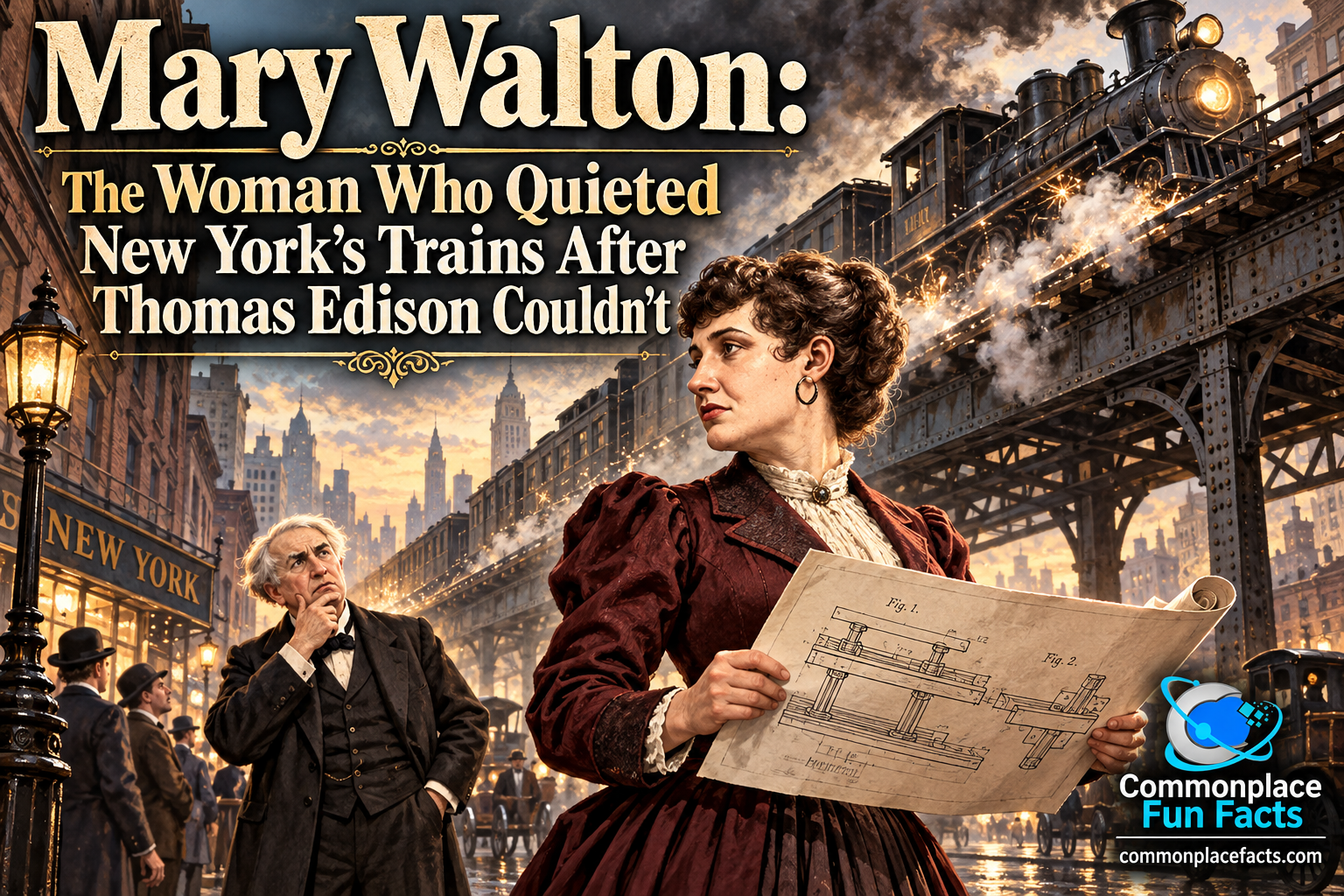

In the late 1870s, New York City had a noise problem. Actually, New York City had several noise problems, but one of the most persistent was traveling directly past people’s bedroom windows several times an hour, pulled by a steam locomotive and accompanied by enough clattering, screeching, and rattling to make ordinary conversation an ambitious undertaking.
The city’s elevated railroads were revolutionizing transportation. Unfortunately, they were also revolutionizing the experience of having a train thunder past your home while you were attempting to sleep, eat dinner, or maintain a functioning nervous system.
The noise was so bad that the problem attracted the attention of some of America’s most accomplished inventors. Among them was Thomas Edison, who reportedly investigated the racket without finding a satisfactory solution. It was an unusually stubborn problem, even for a man accustomed to making troublesome machinery do what he wanted.
Then a woman who operated a boardinghouse near the tracks decided that enough was enough.
Her name was Mary Walton. She was not a famous engineer, did not operate an industrial research laboratory, and lacked the sort of institutional prestige ordinarily associated with transforming American transportation.
What she did have was a mechanical mind, an excellent reason to hate noisy trains, and a willingness to conduct her own experiments.
Walton eventually patented a remarkably practical method of reducing railway noise by surrounding the rails with sound-dampening materials, particularly sand. Her invention attracted the attention of the Metropolitan Elevated Railway, which acquired rights to the design for a substantial sum. The woman who had set out to make her neighborhood a little quieter had managed to turn an everyday annoyance into a commercially valuable invention.
And because solving one of the great annoyances of the Industrial Revolution wasn’t quite enough, Walton also patented an ingenious system intended to reduce smoke from locomotives and industrial chimneys.
The woman running the boardinghouse had become an early pioneer of environmental engineering.
Contents
New York’s Elevated Railroads Were Progress at an Unreasonable Volume
To appreciate Walton’s accomplishment, we need to return to Manhattan in the 1870s, when the city was undergoing one of the most dramatic transportation transformations in its history.

New York was growing rapidly. Horse-drawn streetcars and other surface transportation struggled to accommodate the swelling population, and narrow streets were crowded with pedestrians, carts, carriages, and horses performing the essential nineteenth-century service of depositing unpleasant things in public thoroughfares.
Elevated railroads offered an enticing alternative. By placing railroad tracks above street level, engineers could move passengers through the city without forcing trains to compete with ordinary traffic.
Early experiments with elevated railways eventually gave way to expanding networks operated by companies such as the New York Elevated Railroad and the Metropolitan Elevated Railway. By the late 1870s, steam-powered trains were becoming a familiar feature of Manhattan transportation, carrying passengers above streets already struggling to accommodate everyone attempting to travel at ground level.
For passengers, the advantages were obvious. Travel became faster and more predictable, and commuters could avoid much of the chaos below.
For people who lived along the tracks, the advantages were less immediately apparent.
The structures were built above existing streets, sometimes placing trains alarmingly close to upper-floor windows. Steam locomotives belched smoke and sparks. Wheels hammered against metal rails; wooden ties and structural supports vibrated; and brakes produced the sort of shrieking noise that suggested the machinery was strongly opposed to being stopped.
The whole arrangement functioned rather like a transportation system that doubled as an enormous percussion instrument.
The Elevated Railway Created Problems Beyond Noise
The trains also blocked sunlight, interfered with air circulation, and placed clouds of smoke and soot directly alongside people’s homes and businesses.
Residents complained about darkness, filth, loss of privacy, declining property values, and the endless rumble of passing locomotives. The elevated lines provided an excellent service to people who needed to travel across Manhattan, while occasionally giving the impression that the comfort of everyone else was somebody else’s problem.
The dispute eventually reached the courts.
In 1882, the New York Court of Appeals decided Story v. New York Elevated Railroad Company, a landmark case involving the property rights of owners whose buildings stood beside elevated railroad structures.
In a closely divided decision, the court recognized that the adjoining property owner’s easements involving light, air, and access to the street constituted legally protected property interests. Interference with those rights could amount to a compensable taking, even though the railroad’s construction had been authorized by the legislature. In other words, government permission to build an elevated railroad did not necessarily include permission to appropriate the neighbors’ property rights without paying for them.
The case helped unleash extensive litigation over the elevated railroads. New Yorkers were discovering that a transportation system could be both an engineering triumph and an ongoing source of lawsuits.
Walton approached the same urban conflict from another direction. Instead of asking whether the railroads should compensate people for making their lives miserable, she wondered whether somebody might make the trains a little less miserable in the first place.
Meet Mary Walton, an Inventor Without a Famous Laboratory
Much of Mary Walton’s biography has been lost or remains uncertain. Unlike Edison, whose career generated an enormous body of correspondence, laboratory notes, publicity, and business records, Walton left a comparatively thin documentary trail.

That is unfortunate because the surviving evidence suggests she was an unusually resourceful and determined woman.
One revealing detail comes from an 1884 newspaper account quoted in the MIT Lemelson program’s biography of Walton. She recalled that her father, who had no sons, placed considerable importance on educating his daughters and spared neither effort nor expense in providing them with opportunities to learn.
That attitude was not typical of every nineteenth-century household. Women could certainly be educated, but technical and scientific careers remained overwhelmingly associated with men. A girl who developed an interest in mechanical engineering was unlikely to encounter a well-established professional path encouraging her to pursue it.
Walton nevertheless became fascinated with practical problems and mechanical solutions.
By the late 1870s, she was operating a boardinghouse near Sixth Avenue and West Twelfth Street in Manhattan, close to the elevated railway. The passing trains provided ample opportunities to become familiar with the shortcomings of modern transportation.
Some people confronted with such circumstances would complain to the railroad. Others would move. Walton, who had already demonstrated an inventive streak, decided to investigate the problem herself. If the railroad companies couldn’t make their trains quieter, perhaps a woman running a boardinghouse could show them how.
Thomas Edison Tries to Solve the Noise Problem
The story becomes particularly appealing because another person reportedly investigating the railway noise was Thomas Edison.
In the late 1870s, Edison was already a celebrated inventor and experimenter. His work with telegraphy, telephones, sound recording, and electrical equipment had established him as someone capable of tackling problems that other people barely understood. New York’s elevated railways presented another challenge, although their operators were about to discover that even Edison’s ingenuity had its limits.

Noise was a natural subject for his attention. Edison was intensely interested in the physical properties of sound, and contemporary accounts describe his attempts to study the vibrations generated by elevated trains.
Research conducted for the New York Transit Museum, discussed in Elysia Segal’s historical study of Mary Walton, recounts Edison’s experiments involving the recording and physical observation of railway vibrations. Some accounts describe him studying vibrating surfaces and even using physical contact with objects to perceive vibrations.
These experiments make sense in light of Edison’s broader scientific interests. As we explored in the history of the earliest recording of the human voice, nineteenth-century inventors were learning to transform invisible sound waves into physical traces that could be examined and studied.
But studying a problem and solving it are not quite the same thing.
Later historical accounts say Edison worked on the railroad-noise problem for approximately six weeks before abandoning the effort. Some retellings give longer periods, and the precise extent of his involvement deserves caution. The surviving evidence does not establish that Edison and Walton participated in a formal competition or even met.
Nevertheless, his reported efforts demonstrate that the problem had attracted attention well beyond the irritated residents of Sixth Avenue.
Then Walton approached it from a rather different perspective.
Mary Walton Rides the Rails and Listens
Instead of beginning with an elaborate machine, Walton began by observing the existing one.
Accounts of her experiments describe her spending several days riding the elevated trains, sometimes positioning herself near the rear of a car so she could listen carefully to the sounds made by the wheels and tracks.

She wasn’t merely asking whether the trains were noisy. Everybody already knew that. She wanted to understand where the sound originated and why it became so loud.
According to the historical accounts, Walton concluded that the track structure itself was an important part of the problem. The rails and their supports transmitted vibrations, and surrounding structural elements helped carry the resulting noise through the elevated framework.
That distinction was crucial.
If the only problem had been the locomotive, the obvious solution might have involved redesigning the engine, changing its operation, or somehow persuading the crew to conduct railway transportation more quietly.
If, however, the structure supporting the rails contributed to the racket, perhaps the solution was not to silence the entire train. Perhaps it was to interrupt the transmission of the vibrations.
Walton reportedly constructed a model of the railway track in her basement, where she experimented with different materials to determine which ones could reduce the noise. It was a practical approach to engineering, although one imagines her boardinghouse guests wondering why the woman who wanted quieter trains had begun building a railroad underneath them.
The Solution Was Hiding in a Pile of Sand
The key material in Walton’s invention was sand.
Historical accounts connect the idea with an experience from her childhood. According to Walton’s recollections, her father had once reduced the noise of a nearby blacksmith’s shop by arranging for anvils to be set in sand rather than on supports that transmitted their repeated blows.
Walton recognized that the same underlying principle might help with elevated railways.
The idea was not that sand possessed some miraculous ability to abolish sound. Rather, placing suitable materials around the rails could help absorb, dampen, and interrupt vibrations that otherwise traveled through the track and supporting structure.
She experimented with a framework around the rails, combining wooden components and sound-deadening materials. Historical descriptions often summarize the invention as wooden boxes lined with cotton, waterproofed with tar, and filled with sand. Her actual patent was more flexible, however, describing sand or similar materials surrounding the rails, waterproof coverings to protect the enclosed structure, and optional cotton batting treated with coal tar.
The challenge was not simply finding materials that absorbed vibrations, but arranging them in a way that could withstand exposure to weather and function safely alongside an operating railway. Walton’s design had to reduce noise without compromising the movement of trains. After all, making a railroad quieter by causing its trains to derail would hardly qualify as a successful engineering solution.
Mary Walton’s 1881 Patent Shows Exactly How It Worked
On February 8, 1881, the United States Patent Office issued Patent No. 237,422 to Mary E. Walton of New York. Titled “Elevated Railway,” the patent described her innovative approach to reducing the vibrations and noise generated by trains traveling on elevated tracks.
The original patent is particularly useful because it removes much of the guesswork surrounding her invention.
Walton described arrangements in which flooring, partitions, guard timbers, and other elements formed longitudinal enclosures around and beneath the rails. Those spaces were filled with sand or another sound-deadening material, bringing the material into contact with the rails and parts of the track structure.
The sand was intended to deaden vibration and reduce the noise produced by rolling train wheels.

Walton also addressed the obvious problem of putting loose sand into an elevated railway exposed to rain and snow. Her design included asphalt or another waterproof covering intended to keep the sand dry and protect the enclosed components from weather damage.
The specification also permitted tar-treated cotton batting around the rails, either with or without sand.
This flexibility is important. Walton wasn’t claiming that every railroad had to be surrounded by one precise combination of sand, cotton, and tar. She patented particular structural arrangements for bringing sound-deadening materials into effective contact with the rails.
The patent contained five claims describing different aspects of the invention. One specifically covered a separate longitudinal trough beneath each rail containing sound-deadening material that partly surrounded it.
It was a thoughtful attempt to address both the acoustical and practical problems of elevated railway construction.
And, unlike some more spectacular nineteenth-century inventions, it did not depend upon invisible electrical fluids, perpetual motion, or an unusually cooperative collection of trained animals.
The Invention Had Been in Development Longer Than the Patent Date Suggests
Walton’s railway patent contains a chronological detail that is easy to overlook. Although Patent No. 237,422 was issued in February 1881, she had filed the application on January 7, 1879. That means her invention was already sufficiently developed to describe formally at the beginning of 1879. The later date marks the government’s issuance of the patent, not the moment Walton suddenly conceived the idea.
This distinction becomes especially useful when discussing her other major invention, because Walton obtained her first issued patent for smoke control in November 1879, even though her railroad-noise application had been filed earlier that year.
The two projects were evidently part of a period in which she was investigating more than one environmental problem.
And they shared a common objective: make industrial technology less unpleasant for people who had to live with it.
New York’s Railroad Company Pays Attention
Walton did more than secure a patent. She successfully attracted commercial interest in the design.
Historical accounts agree that the Metropolitan Elevated Railway acquired rights to her noise-reduction invention. The commonly reported price was $10,000, a substantial amount in the early 1880s.
Some later accounts also describe continuing royalties, although the precise contractual terms are less securely documented than the patent itself. The safest conclusion is that Walton succeeded in turning her technical solution into a valuable commercial arrangement.
For a woman working outside the established engineering profession, that was an impressive achievement.
The Lemelson Foundation’s history describes the invention as influential in the development of railway noise-control practices. It is difficult to measure precisely how extensively Walton’s particular patented arrangement was installed, but her basic principle was commercially practical and addressed a real infrastructure problem.
Later retellings sometimes assign remarkable percentage reductions to her system or imply that every elevated railway adopted it. Such claims deserve better documentation before being accepted. Walton’s achievement does not need imaginary performance statistics.
She identified a significant source of railway noise, designed a mechanism to reduce it, patented that mechanism, and persuaded a railroad company to acquire the rights.
That is a respectable engineering career even without the benefit of a celebrity inventor standing nearby looking disappointed.
Mary Walton Had Already Taken On Air Pollution
As remarkable as the noise-control invention was, Walton had another patent to her credit.
On November 18, 1879, she received U.S. Patent No. 221,880, “Improvement in Locomotive and Other Chimneys.” This invention addressed another unpleasant consequence of nineteenth-century industrial growth: smoke.
Steam engines and industrial furnaces depended heavily upon burning coal. The resulting emissions included soot, ash, sparks, and various gases and vapors, much of which escaped into the surrounding atmosphere.
People living in industrial cities could hardly avoid the consequences. Buildings accumulated grime, laundry became dirty, windows required continual cleaning, and breathing the air was not always the wholesome experience recommended by physicians.
As we explored in the Great Stink of London in 1858, industrializing cities had an impressive ability to produce environmental disasters and then act mildly surprised when residents complained.
Walton decided that smoke should be dealt with before it escaped from the chimney.
That may seem obvious now. In the nineteenth century, it was a sufficiently interesting engineering proposition to justify a patent.
Her Smoke-Control Invention Used Water to Capture Pollution
Walton’s 1879 patent described a chimney arrangement that redirected combustion products into a tube leading to a tank of water.

In the locomotive version, a specially shaped cap and internal tubes directed smoke and other products of combustion downward. Walton intended a stream of cooler incoming air to help force those emissions into a water tank, where particles and some gases or vapors could be collected, condensed, or absorbed rather than discharged directly into the atmosphere. The patent described the proposed mechanism, although it did not provide the sort of independently verified performance data that modern environmental regulators would undoubtedly insist upon.
The patent also described a means of recirculating material that had not been captured on its first passage.
For stationary chimneys and furnaces, Walton also proposed arrangements that could conduct combustion products into sewers or other channels rather than releasing them directly into the surrounding air. Such an arrangement might have reduced pollution at the chimney, although it would not necessarily eliminate the contaminants. Moving pollution somewhere else, after all, is not quite the same thing as making it disappear.
In principle, Walton’s invention resembled an early version of what engineers now call wet scrubbing, a process that uses liquids to remove pollutants from industrial exhaust gases. The basic idea was straightforward: instead of allowing smoke and other combustion products to escape untreated, direct them through a system designed to capture at least some of the contaminants.
There are limits to the comparison. Walton did not invent the modern industrial scrubber, and the patent alone cannot establish that her apparatus removed every harmful pollutant or achieved the efficiency sometimes claimed in modern summaries.
But the underlying idea was unmistakable. Instead of allowing combustion products to enter the atmosphere untreated, the system attempted to intercept and separate them before discharge.
It was an early effort to make industrial machinery responsible for at least some of the mess it created.
This was not a universally popular philosophy among nineteenth-century industrialists, whose usual method of handling pollution involved building a taller smokestack and distributing the problem among more people.
Walton’s Response to a Helpful Suggestion From Her Son
One of the most revealing stories about Walton concerns her determination to receive credit for her own inventions.
Research conducted for the New York Transit Museum uncovered contemporary accounts suggesting that Walton had earlier suffered the loss of credit for an invention after her husband disclosed it to another man.
When she later prepared to patent her railway invention, her son reportedly suggested that the patent be placed in his name, because people might regard a woman seeking patents and pursuing engineering work as excessively assertive.
Walton was not receptive.
According to the account preserved in Elysia Segal’s research on Walton’s life, she told him to make his own inventions if he wanted his name on patents.
The exchange is preserved through historical reporting rather than a surviving transcript of the family conversation, so the exact dialogue warrants some caution. Nevertheless, it fits the determination evident in Walton’s documented actions.
Her patents were issued in her own name. She did the engineering work, claimed the inventions, and pursued their commercial value. As far as Walton was concerned, there was no compelling reason for a man to receive the credit merely because the Patent Office was more accustomed to dealing with male inventors. Her son was welcome to obtain patents of his own, provided he first performed the minor preliminary task of inventing something.
When a Woman’s Brain Did the Work
Walton’s accomplishment was noticed by advocates for women’s achievements in science and industry.
Years after her railway invention, The Woman’s Journal celebrated her success, noting that prominent inventors had examined the problem unsuccessfully before Walton found an answer.
The publication treated her work as evidence that mechanical ability was not the exclusive possession of men, a proposition that ought to have required considerably less demonstration than nineteenth-century society frequently demanded.
Walton’s story has parallels with other overlooked female inventors. In our examination of Margaret Knight and the invention of the modern flat-bottomed paper bag, we encountered a woman who had to defend her invention after a man attempted to claim the machinery as his own.
Likewise, Josephine Cochrane’s development of the practical dishwasher involved overcoming considerable resistance from men who had difficulty accepting that a woman might understand complicated mechanical equipment better than they did. Evidently, inventing a machine was only part of the challenge. Convincing the men hired to build it that she knew what she was talking about could be another engineering problem entirely.
These women were not all working on the same kind of machinery, and their circumstances were not identical. What they shared was the determination to solve practical problems rather than accept that existing technology was good enough. Once they had succeeded, however, they faced another challenge: persuading other people to take them seriously. One suspects that building the machines was sometimes the easier part.
A Different Kind of Inventor
Walton’s career challenges our familiar image of how inventions happen. We tend to imagine scientific breakthroughs emerging from established laboratories, universities, government research programs, or the workshops of famous inventors surrounded by assistants and expensive equipment. Those places have produced extraordinary accomplishments, of course, but innovation has also emerged from factories, farms, private homes, boardinghouses, and occasionally wherever somebody has reached the end of their patience.
Walton’s approach followed a recognizable scientific pattern. She identified a problem, observed the equipment responsible, formulated an explanation, experimented with materials, developed a design, and pursued legal protection for the result.
Walton did not need to invent a new law of physics. She needed to recognize how existing physical properties could be put to better use, combining familiar materials in a way that solved an old problem more effectively. That distinction matters because some of history’s most useful inventions have involved not the discovery of something entirely new, but the realization that ordinary things could accomplish extraordinary results if somebody arranged them correctly.
Sand, timber, waterproofing, and cotton were hardly revolutionary nineteenth-century materials. Walton’s innovation was in how she arranged them around the rails and supporting structure to interrupt the transmission of noise.
Sometimes progress requires an extraordinary new substance.
Sometimes it requires someone to figure out where to put the sand.
Where Mary Walton’s Story Gets a Little Murky
Reconstructing Walton’s biography comes with an unfortunate complication: the historical record is thin, and later accounts occasionally disagree with one another. Some give conflicting dates for her inventions, while others incorrectly identify her railway patent as No. 327,422 rather than 237,422. Still others repeat claims about her earnings, the duration of Edison’s investigations, or the widespread adoption of her invention without identifying contemporary documentation.
Fortunately, the original patent records settle the most important questions about what Walton invented and when. Her railway patent was issued in February 1881, and her smoke-control patent in November 1879, although the railway application had been filed first. The documents establish her technical accomplishments without requiring us to accept every colorful detail added by subsequent storytellers. Nineteenth-century history has quite enough genuine eccentricity without our inventing additional material.
Other matters remain less certain. The surviving accounts do not provide a complete personal biography, and the precise commercial terms of the railroad transaction would benefit from contemporary contract documentation.
Fortunately, we do not need to fill those gaps with speculative details. The patents themselves demonstrate Walton’s technical accomplishments, while historical accounts substantiate her broader efforts to improve the urban environment.
For someone whose surviving personal records are relatively scarce, having two substantial patents issued in her own name is a rather effective way to leave evidence of what she was capable of.
Mary Walton Was Solving Environmental Problems Before Environmentalism Had a Name
One of the most striking aspects of Walton’s work is how familiar her concerns remain today. Noise pollution and air pollution continue to trouble cities throughout the world, while transportation systems still force difficult choices involving mobility, infrastructure costs, environmental consequences, and the quality of life of people living nearby. More than a century later, we are still wrestling with many of the problems that prompted Walton to begin experimenting in her basement.
Railroad engineers still consider noise and vibration when designing tracks, wheels, supports, and surrounding structures. Environmental engineers continue to develop ways of controlling industrial emissions before they enter the atmosphere.
Walton’s particular nineteenth-century devices are not the same as the sophisticated modern systems used today. It would be an exaggeration to claim that every contemporary rail noise barrier or industrial scrubber descends directly from her patents.
But her work belongs to the long history of engineers recognizing that technological progress should include some responsibility for its consequences.
New York needed its elevated railways. Workers needed transportation, businesses needed customers, and the city needed ways to move enormous numbers of people efficiently.
None of those needs required the conclusion that residents simply had to tolerate unlimited smoke and noise.
Walton refused to accept that choice.
The Woman Who Made Progress a Little More Bearable
Thomas Edison became one of the most famous inventors in history. His name remains inseparable from the development of electric lighting, recorded sound, motion pictures, and numerous other technologies.
Mary Elizabeth Walton never achieved anything approaching that level of fame.
Nevertheless, her inventions addressed two of the most immediate and unpleasant consequences of industrialization: the noise of heavy machinery and the pollution produced by burning fuel.
She tackled the problems not because they promised worldwide celebrity, but because they affected the daily lives of people around her.
The elevated railroads represented progress. So did steam-powered machinery, industrial furnaces, and the enormous expansion of American manufacturing.
Walton’s contribution was to ask whether progress might occasionally be persuaded to keep its voice down and clean up after itself.
That is a rather admirable approach to invention.
And there is something particularly satisfying about the contrast. One of America’s greatest inventors reportedly struggled to quiet New York’s elevated trains, while a woman operating a boardinghouse studied the problem, experimented in her basement, and developed a patented solution using ordinary materials.
Edison had laboratories, assistants, and international fame.
Walton had sand.
Sometimes sand is enough.
You may also enjoy…

Josephine Cochrane: The Woman Who Invented the Dishwasher and Revolutionized the Kitchen
Discover how Josephine Cochrane, a trailblazing inventor, revolutionized domestic life with her groundbreaking dishwasher. Learn about her journey, challenges, and enduring legacy.

Margaret Knight: The Woman Who Reinvented the Paper Bag—and Had to Prove It
Meet Margaret Knight, the overlooked inventor who revolutionized the flat-bottom paper bag and fought a patent battle to prove the machine was hers.

Meet Ralph Teetor: The Amazing Blind Inventor Who Revolutionized the Way We Drive
Discover the inspiring story of Ralph Teetor, the blind inventor who created cruise control and transformed modern driving. Learn how his remarkable touch, vision, and ingenuity revolutionized the way we move.


Leave a Reply