
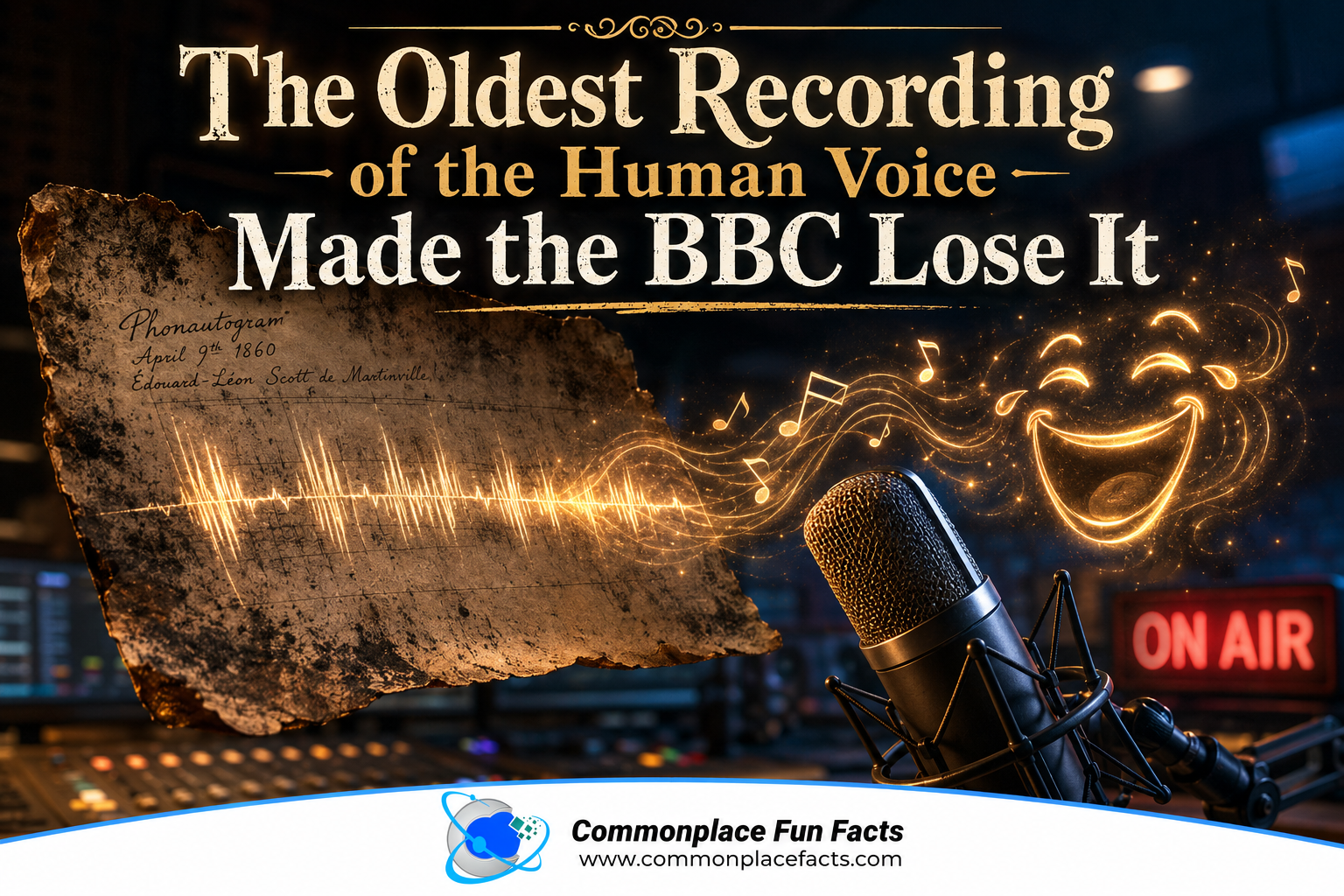

What’s So Funny About the Oldest Recording of a Human Voice?
There are few human experiences more dangerous than trying not to laugh when laughter is absolutely forbidden. The harder you try to behave like a mature adult, the more your brain behaves like a raccoon trapped in a trash can.
Maybe it happened to you during an important presentation at work. Perhaps it struck during a solemn prayer at church. Possibly it occurred when Mrs. Smethels was interrogating the class to find out who had placed a whoopee cushion on her chair during parent/teacher conferences. EDITOR’S NOTE: This is a completely random and hypothetical example. It should not be construed as an admission of guilt. Also, we are reasonably confident the statute of limitations has expired, so please stand down, Mrs. Smethels.
Whatever your personal experience with forbidden giggling may be, you probably did not have millions of people listening when it happened. Charlotte Green did.
In March 2008, the respected BBC Radio 4 newsreader introduced listeners to one of the most extraordinary artifacts in audio history: the oldest recording of the human voice that could be clearly recognized and played back. Then, because history enjoys slapstick when you least expect it, she promptly lost a battle with the giggles.
Contents
The Oldest Recording of the Human Voice Was Not Made by Thomas Edison
For a long time, Thomas Edison got most of the credit for bringing recorded sound into the world. That is understandable, since Edison’s phonograph could both record sound and play it back, which is a fairly important feature in a sound-recording machine. Without playback, you have essentially invented a voice mailbox that only communicates through soot scratches and academic disappointment.
But Edison was not the first person to capture sound. That honor belongs to a French inventor named Édouard-Léon Scott de Martinville, who patented the phonautograph in 1857. Scott’s invention could record sound waves visually, tracing them onto paper or glass blackened by soot. A vibrating stylus followed the motion of sound and left behind a visible pattern called a phonautogram.

Scott’s device was a remarkable invention, but it had one teensy limitation: no one could listen to the recordings. The phonautograph captured sound the way a seismograph captures earthquakes. It made a visual record. It did not produce audio. Scott had recorded history, but history had to sit quietly for nearly 150 years because nobody had invented the proper “play” button.
On April 9, 1860, Scott recorded someone singing the French folk song “Au Clair de la Lune.” The result was a few seconds of sound preserved as squiggly lines. The phonautogram predated Edison’s 1877 phonograph by 17 years, which is long enough for Edison to grow up, become Edison, and begin collecting patents the way other people collect spoons from tourist traps.
How Scientists Finally Heard “Au Clair de la Lune”
For more than a century, Scott’s recordings were silent historical curiosities. They were important, yes, but in the same way a locked treasure chest is important before anyone finds the key. Scholars knew the phonautograms mattered. They just could not hear what was trapped inside them.
That changed in 2008, when modern researchers used high-resolution scans and computer processing to convert the visual wave patterns back into sound. In other words, they treated the soot scratches as audio data and let software do what Scott’s own century could not.
The sound that emerged was not exactly a high-fidelity studio recording. No one was going to confuse it with a remastered Beatles album. It was faint, eerie, scratchy, and brief. Still, it was astonishing. A human voice from 1860 could be heard again.
That alone should have made the story memorable. The oldest recording of the human voice had finally spoken. The past, for once, was not merely being read from brittle paper or interpreted from stern portraits of men with complicated facial hair. It was singing.
Then the BBC played it on the radio, and history took an unexpected detour through the comedy department.
Charlotte Green and the BBC Radio 4 Giggle Fit
Charlotte Green was a veteran BBC Radio 4 newsreader, the sort of calm and composed voice that suggests civilization might survive after all. If the world were ending, you would want someone like Green reading the bulletin. She would make the apocalypse sound properly punctuated.
During the Today program in March 2008, Green introduced the story of Scott’s recovered recording and played the clip of “Au Clair de la Lune.” The recording was scientifically extraordinary. It was also, to modern ears, deeply strange. One colleague reportedly described it off-air as sounding like a bee buzzing in a bottle.
That was the fatal phrase.
Once “bee buzzing in a bottle” entered Green’s mind, it refused to leave. This is one of the fundamental laws of human psychology: the thought you are not supposed to think immediately pulls up a chair, orders coffee, and becomes your entire personality.
Unfortunately, the next item was not an amusing one. Green had to report the death of Abby Mann, the Academy Award-winning screenwriter best known for Judgment at Nuremberg. This was a serious story requiring a serious tone.
She began appropriately enough. Then the bee returned.
Green tried to continue. She made it a few words. Then came the unmistakable sound of a professional broadcaster being ambushed by her own nervous system. Her voice cracked. The giggles escaped. A colleague stepped in while she attempted to recover, but by then the damage had been done. The oldest recording of the human voice had just caused one of the most famous on-air giggle fits in BBC history.
Why Inappropriate Laughter Is So Hard to Stop
Part of what makes the Charlotte Green giggle fit so funny is that it was not mean-spirited. She was not laughing at Abby Mann. She was not treating the obituary lightly. She was trapped in the terrible human machinery of inappropriate laughter, where the seriousness of the moment only makes the laughter more powerful.
Anyone who has ever tried not to laugh in a funeral, courtroom, classroom, church service, staff meeting, or other socially hazardous environment understands the problem. The more solemn the setting, the more your brain becomes convinced that now would be the perfect time to remember something absurd.
Green later described herself as having been “ambushed by the giggles,” which may be the most accurate description ever given of the phenomenon. Giggles do not arrive politely. They do not knock. They breach the perimeter and take hostages.
The BBC made clear that no disrespect was intended toward Mann or his family, and listeners largely seemed to understand. Many found the moment funny precisely because it was so recognizably human. The voice of professional composure had momentarily become one of us: a person desperately trying to behave while her brain threw crockery in the background.
From Soot Scratches to Viral Audio
The whole episode is a perfect little collision of past and present. In 1860, Scott de Martinville captured sound but could not play it back. In 2008, scientists recovered that sound with computers. Moments later, modern broadcasting preserved Charlotte Green’s reaction for an audience far larger than Scott could ever have imagined.
Scott wanted to make sound visible. Edison made sound playable. Digital technology made Scott’s recording audible. The internet made Green’s giggle fit immortal. This is progress, apparently.
There is something wonderfully appropriate about the oldest recording of the human voice leading to such a deeply human moment. The recovered song is important because it lets us hear across time. Green’s laughter is memorable because it reminds us that people have always been people. We invent machines, preserve history, digitize archives, and decode the past with lasers and software. Then someone says something sounds like a bee in a bottle, and the entire dignity of civilization collapses into wheezing.
Fortunately, technology has advanced considerably since the phonautograph. We can now hear the earliest recognizable recording of the human voice, and we can also hear the moment it reduced a BBC newsreader to helpless laughter. History rarely gives us both a scientific breakthrough and a blooper reel in the same package, so we should be grateful when it does.
You may also enjoy…

Laughing to Death Over Royalty
The Scottish aristocrat Thomas Urquhart (1611-1660) was a noted polymath and first translator of French Renaissance writer Francois Rabelais into English. It is said that one of the greatest signs of genius is the ability to find humor in all situations. If that is true, then Urquhart was a genius to the extreme. When he…

How the UK Depends on the BBC Show “Today” to Prevent Doomsday
Why the BBC Show “Today” Helps Hold Doomsday at Bay If you are a fan of the BBC, the thought of your favorite program going off the air might seem like a sign of the end of the world. If that favorite program happens to be the radio show Today, brace yourself; if it isn’t on…

The Tanganyika Laughter Epidemic of 1962: When Giggles Shut Down a Nation
In 1962, the Tanganyika Laughter Epidemic shut down schools across East Africa. Explore why strange epidemic wasn’t funny.



Leave a Reply