
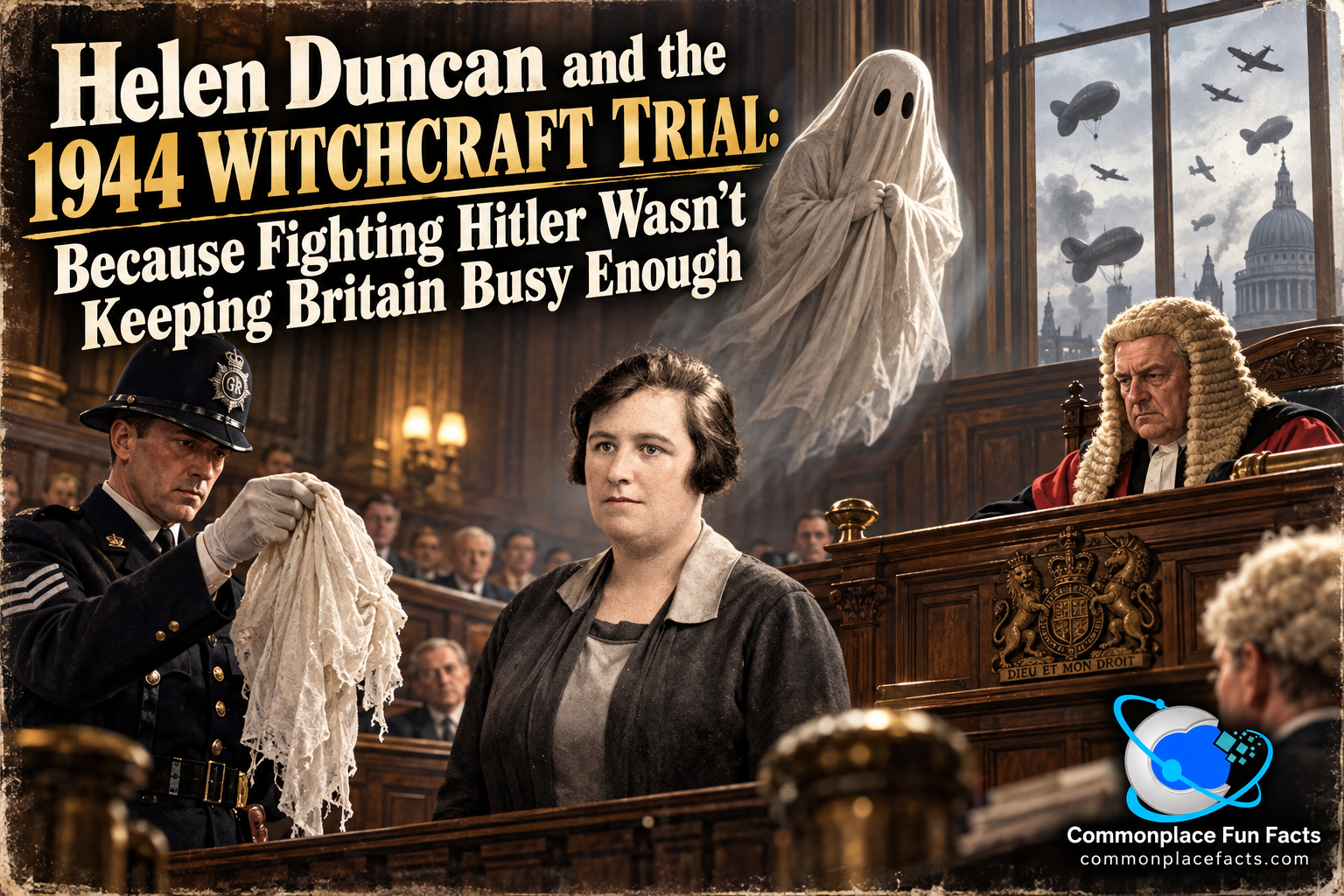

On January 19, 1944, a British police officer attended a séance in Portsmouth, England, with a rather unusual assignment: investigate a ghost.
The officer was attending a gathering conducted by Helen Duncan, a Scottish spiritualist who claimed she could communicate with the dead. According to testimony subsequently reported in TIME magazine, when a ghostly figure appeared, the officer attempted to seize it. Instead of capturing a visitor from the afterlife, he testified that he saw Duncan stuffing white cloth down the front of her dress. Curiously, the supposedly incriminating fabric was never recovered, leaving the prosecution to rely on eyewitness testimony rather than an actual ghost costume.
It would seem the supernatural visitor had decided that a police investigation was an excellent reason to return to the laundry basket.
What followed was considerably stranger than the séance itself. Duncan was arrested, prosecuted at London’s Old Bailey, and sentenced to nine months in prison under Britain’s Witchcraft Act of 1735.
Yes, witchcraft. In 1944.
At that very moment, Britain was fighting Nazi Germany, Allied commanders were preparing the invasion of Normandy, and Prime Minister Winston Churchill was attempting to coordinate one of the most complicated military operations in history.
Meanwhile, the British judicial system was occupied with determining whether a Scottish woman had been improperly manufacturing ghosts.
The prosecution eventually attracted Churchill’s attention. He demanded to know why an eighteenth-century witchcraft law was being used in a modern courtroom, describing the proceedings as “obsolete tomfoolery.”
But the truly extraordinary part of the story is that Duncan wasn’t actually accused of possessing supernatural powers. She was prosecuted under a law that effectively assumed supernatural powers didn’t exist.
And somewhere in the background was a sunken British battleship, a closely guarded wartime secret, and a persistent theory that the government had imprisoned Duncan to prevent her from revealing the plans for D-Day.
It was quite a lot of trouble for a woman whose principal professional equipment included cheesecloth.
Contents
Meet Helen Duncan, Britain’s Most Inconvenient Medium
Victoria Helen MacFarlane was born on November 25, 1897, in Callander, Scotland. From an early age, she reportedly claimed unusual psychic abilities, including seeing spirits and predicting future events. Her childhood behavior earned her the nickname “Hellish Nell,” which was not exactly the sort of moniker one hopes to see printed beneath one’s photograph in the high school yearbook.

In 1916, she married Henry Duncan, and the couple eventually raised six children. By the 1920s, Helen was earning money as a professional spiritualist medium, conducting séances for people who hoped to communicate with deceased relatives and friends.
She had entered a surprisingly lucrative profession.
Spiritualism had flourished during the nineteenth century, and the devastating losses of World War I gave the movement renewed appeal. Millions of families were grieving the deaths of soldiers, and many desperately wanted reassurance that their loved ones continued to exist somewhere beyond the grave.
Mediums promised to provide precisely that reassurance, often for a fee. Some claimed to receive messages from the departed, while others offered the considerably more impressive service of making the departed appear in person.
Duncan specialized in the latter.
During her séances, she would enter a trance, often seated behind curtains in a dimly illuminated room. Her spirit guides, including entities identified as Peggy and Albert, supposedly helped her establish contact with the other side.
What made her performances particularly famous was a substance she appeared to produce from her mouth and nose.
It was called ectoplasm.
To spiritualists, ectoplasm was a mysterious substance that enabled otherwise invisible spirits to assume a physical form. It might emerge as a vaporous cloud, a stringy material, or a white mass that gradually developed into the recognizable appearance of a deceased person. Moviegoers familiar with Ghostbusters may recognize the concept, although Duncan’s version was considerably less likely to involve a proton pack, a containment unit, or Bill Murray complaining about being slimed.
To skeptics, it looked suspiciously like something available at a reasonably well-stocked fabric store.
Ectoplasm: The Supernatural Substance with a Laundry Problem
In the early twentieth century, spiritualists frequently claimed that ectoplasm provided tangible evidence of communication with the dead. Photographs of supposed manifestations showed ghostly shapes emerging from mediums’ bodies, sometimes taking the appearance of faces, limbs, or entire figures.

As we explored in Optograms, Spirit Photos, and Fritz Angerstein, the Killer Who Couldn’t Escape a Snapshot, nineteenth-century spirit photographers had already demonstrated that a camera, a double exposure, and an audience eager to believe could produce remarkably convincing visitors from the afterlife. Ectoplasm simply brought the special effects out of the darkroom and into the séance parlor, where the medium could dispense with the camera and produce the ghosts herself. Talk about cutting out the middleman.
Unfortunately, some of these manifestations bore a remarkable resemblance to ordinary cloth, paper, and homemade theatrical props.
Duncan’s performances attracted the attention of investigators, including the well-known paranormal researcher Harry Price. In 1931, Price participated in examinations of Duncan’s abilities and concluded that her manifestations were fraudulent.
Investigators associated with the London Spiritualist Alliance also challenged the authenticity of her ectoplasm. Materials identified in examinations of her performances included cheesecloth, paper, and egg white. Price believed that Duncan could swallow prepared fabric and subsequently regurgitate it during a séance, creating the impression that something supernatural was emerging from her body.
This was admittedly an impressive physical trick, although it did raise certain questions about the wisdom of swallowing one’s stage equipment.
Photographs taken during earlier séances by Harvey Metcalfe were equally unflattering to Duncan’s supernatural reputation. Supposedly materialized spirits appeared to include crude figures and artificial faces rather than convincing evidence of visitors from another dimension.
In 1933, Duncan was convicted of fraudulent mediumship in Edinburgh and fined £10. The conviction did little to end her career, however, and she continued to attract believers who insisted that her abilities were genuine.
This conflict between believers and skeptics was hardly unique to Britain. As explored in our article The Houdini Death Prophecy and the Senate Showdown Over Spiritualists, the famous escape artist Harry Houdini devoted much of his later career to exposing fraudulent mediums. His campaign even brought him before Congress, where the resulting hearings featured allegations of deception, extraordinary predictions, and enough theatrical behavior to make an actual séance seem comparatively restrained.
There was, however, one significant difference between Houdini’s American campaign and the case developing around Helen Duncan.
In Britain, an ancient law provided prosecutors with a weapon that the country’s lawmakers had apparently forgotten to put away.
The Witchcraft Law That Didn’t Believe in Witches
To understand Duncan’s prosecution, we must travel back to 1736, when the British Parliament enacted what is known as the Witchcraft Act of 1735. The discrepancy in dates reflects the calendar conventions of the time, but the legislation’s significance was unmistakable: Parliament was adopting a rather revolutionary position concerning witchcraft.
It decided, essentially, that witches weren’t real.
This was a substantial departure from earlier centuries, when British courts had treated witchcraft as a genuine supernatural offense. Under older legislation, accused witches could face prosecution, imprisonment, and execution for supposedly invoking evil spirits or using magical powers to injure others.
The results had been tragic. Throughout Britain and Europe, thousands of people had been accused of supernatural crimes, often on evidence that would be laughable if the consequences hadn’t been so horrifying.
We explored some of that grim history in Malleus Maleficarum: How the “Hammer of Witches” Helped Turn Fear into a Death Sentence, including the remarkable legal and theological assumptions that helped sustain centuries of persecution.
By the eighteenth century, however, attitudes were changing. Parliament’s Witchcraft Act of 1735 repealed earlier witchcraft statutes and replaced them with a law punishing people who claimed or pretended to exercise magical powers.
Under the new approach, someone could no longer be punished merely because neighbors believed that person had supernatural abilities. Instead, the law targeted those who professed to exercise witchcraft, sorcery, enchantment, or similar occult powers.
The statute allowed imprisonment for up to one year.
There was an important distinction between this law and modern fraud legislation. Under the old statute, prosecutors did not necessarily have to demonstrate a calculated scheme to deceive someone for money. A claim to exercise supernatural powers could itself provide the foundation for prosecution.
In effect, Parliament had announced that witchcraft was imaginary but that pretending to practice it could still land someone in prison.
It was rather like declaring that dragons don’t exist and then making it a criminal offense to advertise dragon-training services.
Remarkably, that legislation remained available to British prosecutors more than two centuries later.
And in 1944, they decided to use it.
The Battleship That Returned from the Dead
There was another element in Duncan’s story that made her activities potentially more troubling than an ordinary case of fraudulent mediumship.
On November 25, 1941, the Royal Navy battleship HMS Barham was sailing in the Mediterranean when the German submarine U-331 struck it with three torpedoes.
The damage was catastrophic. The battleship rapidly capsized, and its ammunition magazines exploded in an enormous blast. Some 862 members of its crew were killed.
British authorities faced a serious wartime dilemma. Although a German submarine had torpedoed HMS Barham, the Germans did not initially know whether the battleship had actually sunk. Publicly confirming its destruction would provide valuable intelligence to the enemy and potentially undermine British morale. The Admiralty therefore withheld the news for more than two months, hoping to preserve the enemy’s uncertainty while making necessary military arrangements. The decision was subsequently explained in an official Admiralty communiqué issued on January 27, 1942.
Families of the missing sailors were eventually notified, but they were instructed to maintain secrecy. The loss was not publicly announced until January 27, 1942.
According to accounts that subsequently became part of Duncan’s legend, she conducted a séance before the official announcement in which the spirit of a deceased sailor supposedly materialized and revealed that he had gone down with HMS Barham. The story became one of the most frequently cited examples of Duncan’s alleged psychic abilities, although the precise date, circumstances, and details of the supposed revelation are difficult to establish independently.
For those attending the séance, the revelation was astonishing.
For British authorities, it raised a potentially uncomfortable question: How had Helen Duncan learned about a naval disaster that the government had not yet publicly acknowledged?
Duncan’s supporters presented the incident as evidence of her extraordinary abilities. Skeptics offered more conventional explanations, including the possibility that information about the sinking had circulated among naval personnel, relatives, and acquaintances despite official requests for secrecy.
The latter explanation is hardly implausible. Thousands of people were connected to the ship’s crew, and the families had been receiving official notifications. Maintaining absolute secrecy under those circumstances would have required considerably more than a polite request from the Admiralty.
It is also worth remembering that later retellings of the séance do not always agree about precisely when the revelation occurred or exactly what Duncan said.
What can be established is that HMS Barham sank in November 1941, that its loss was initially withheld from the public, and that Duncan became associated with claims of having disclosed the disaster before its official announcement.
The precise route by which the information reached her remains uncertain.
There is, of course, a fundamental difference between possessing classified information and receiving that information from a ghost. British intelligence officers were presumably rather more concerned about the first possibility.
A Police Raid, an Old Bailey Trial, and Some Very Uncooperative Ghosts
By early 1944, Duncan was conducting séances in Portsmouth, an important naval city. Among those who became suspicious of her activities was Royal Navy Lieutenant Stanley Worth, who attended a sitting and questioned her authenticity.

Worth reportedly became especially skeptical when one supposed apparition claimed to be his sister, who was very much alive. Another purported to be an aunt, although Worth had no deceased aunt matching the description. Producing messages from the dearly departed is impressive enough, but summoning relatives who are still alive and perfectly capable of disputing the experience presents certain occupational difficulties for a professional medium.
Worth helped arrange further investigation, and on January 19, 1944, a police officer attended another séance. During the proceedings, the officer intervened, and Duncan was arrested.
The incident produced conflicting accounts, particularly concerning what the officer had actually witnessed. Contemporary testimony described a supposed apparition and suspicious white fabric, while Duncan’s defenders maintained that the police had not demonstrated that her manifestations were fraudulent.
The disagreement eventually became part of a much larger legal controversy.
Duncan was initially dealt with under the Vagrancy Act of 1824, which had frequently been used against fortune-tellers and mediums. But prosecutors subsequently turned to the much older Witchcraft Act.
She and three associates—Frances Brown and Ernest and Elizabeth Homer—faced charges connected with conspiring to contravene the 1735 legislation. Additional allegations involved obtaining money by false pretenses and public mischief.
Her trial began at the Old Bailey in London on March 23, 1944.
The proceedings became a sensation. Newspapers published accounts of the supposed supernatural activities, while supporters of spiritualism insisted that the government was persecuting a woman for exercising genuine psychic abilities.
Defense witnesses described extraordinary experiences. Some claimed to have seen spirits materialize, touched ghostly visitors, or witnessed manifestations that could not be explained by ordinary deception.
One reported apparition was none other than Mary, Queen of Scots, who must have concluded that being dead for several centuries was no obstacle to accepting social engagements.
Duncan’s defense even proposed demonstrating her alleged powers in court. Although the judge initially resisted the suggestion, he eventually allowed the jury to decide whether it wanted to witness a séance. The jurors declined, apparently concluding that they already had enough to consider without inviting the spirit world to participate in the proceedings. Consequently, Duncan’s alleged supernatural abilities remained untested in the courtroom.
On March 31, the jury returned a guilty verdict on the conspiracy charge involving the Witchcraft Act. The judge did not require verdicts on the remaining alternative counts.
On April 3, 1944, Duncan was sentenced to nine months in prison. Her associate Frances Brown received four months, while the Homers were bound over.
The Recorder of London, Sir Gerald Dodson, treated the jury’s verdict as establishing dishonesty rather than resolving any philosophical debate about whether spiritual communication was possible.
Duncan was eventually imprisoned at Holloway Prison in London after her appeal failed.
As a legal proceeding, the case was serious. As a headline during World War II, it was almost impossible to believe.
Winston Churchill Was Not Amused
Prime Minister Winston Churchill had a considerable number of things demanding his attention in the spring of 1944.
Allied forces were preparing to invade German-occupied France. The British government was coordinating military operations across several theaters of war. Enemy bombing remained a threat, and enormous national resources were devoted to defeating the Axis powers.

Under those circumstances, news that British courts had spent days conducting a witchcraft prosecution apparently struck Churchill as an especially questionable use of government time.
On April 3, 1944, he sent a memorandum to Home Secretary Herbert Morrison demanding an explanation for the use of the Witchcraft Act.
He asked why the statute had been employed in a modern court, questioned the expense of transporting and accommodating witnesses from Portsmouth, and objected to the diversion of judicial resources from other necessary work.
His complaint included the memorable phrase “obsolete tomfoolery,” a particularly revealing glimpse of the Prime Minister’s opinion of the proceedings. Considering the rather substantial problems confronting Britain in April 1944, Churchill evidently believed the courts had more pressing matters to attend to than determining whether ghosts were being improperly manufactured in Portsmouth.
Churchill’s objection was not a declaration that Duncan possessed genuine supernatural powers. Nor was it an announcement that exploiting grieving people should be perfectly acceptable, provided the exploitation involved a sufficiently dramatic ghost.
His concern was that the government had resurrected an antiquated legal provision and devoted substantial wartime judicial resources to enforcing it.
The irony was difficult to overlook.
Churchill had famously encouraged Britain to use every available means to defeat Germany. As we previously explored in The Exploding Rats of World War II: Britain’s Strangest Successful Failure, British intelligence had even experimented with disguising explosives inside dead rodents.
Churchill could tolerate the idea of weaponizing a rat, but prosecuting a woman for pretending to summon spirits under a law from 1735 was pushing things a bit too far.
Was Helen Duncan Imprisoned to Protect the D-Day Invasion?
The timing of Duncan’s prosecution has produced one of the most persistent mysteries surrounding the case.
She was arrested in January 1944 and sentenced in April. On June 6, Allied forces launched Operation Overlord, the invasion of Normandy.

The preparations for D-Day were among the most closely guarded military secrets of the entire war. Allied commanders went to extraordinary lengths to conceal the invasion’s timing, location, and intended objectives.
Could British intelligence have considered Duncan a security risk?
Some supporters have argued that her apparent knowledge of HMS Barham demonstrated an ability to obtain information through unconventional channels. Whether the information came from naval gossip, careless disclosures, or something her believers considered supernatural, they contend that officials might have wanted her safely confined before the invasion.
In the most dramatic version of the theory, the witchcraft prosecution was essentially a national-security operation disguised as an ordinary criminal case.
It is certainly an entertaining possibility. Unfortunately, the historical evidence does not establish that it happened.
Historian Francis Young has cautioned that direct evidence supporting the alleged D-Day connection is lacking. The unusual prosecution and its timing are genuine, but those facts alone do not prove that intelligence officials orchestrated Duncan’s imprisonment to protect the invasion plans.
There is a much simpler possible explanation. Police believed Duncan was engaged in deceptive activity, prosecutors selected a statute that could support a conviction, and the case proceeded through the courts during a period of heightened wartime sensitivity.
Her reputation for discussing military losses might have made officials particularly attentive to her activities, but that is different from demonstrating a deliberate conspiracy to imprison her for reasons unrelated to the charges.
For a story involving spiritual manifestations, wartime intelligence, and a two-century-old statute, the temptation to add a secret government conspiracy is understandable.
It is also unnecessary.
A prosecution for pretending to summon the dead in the middle of World War II is already quite strange enough.
Was Helen Duncan Really Britain’s Last Convicted Witch?
Helen Duncan frequently appears in historical accounts as Britain’s last witch, its last convicted witch, or the last person prosecuted under the Witchcraft Act.
Those descriptions require some qualification.
Duncan was the last person imprisoned under the Witchcraft Act of 1735, but she was not the last person convicted under it.
That distinction belongs to Jane Rebecca Yorke, another spiritualist medium who was prosecuted later in 1944.
Yorke, a 72-year-old widow living in East London, held séances for people hoping to contact deceased relatives. Her activities eventually attracted police attention, and undercover officers attended her sittings to test her claims.
The investigators reportedly sought messages involving fictitious or otherwise misleading family circumstances. Yorke nevertheless purported to obtain supernatural information, creating evidence that prosecutors used against her.
In September 1944, she was convicted under the same legislation that had been used against Duncan.
Unlike Duncan, however, Yorke was not sent to prison. Taking account of her age and circumstances, the court bound her over in the sum of £5 to be of good behavior for three years. She was also expected to abandon her séances. Consequently, Yorke escaped imprisonment, although the court had made its opinion of her supernatural abilities abundantly clear.
Consequently, Yorke holds the distinction of being the last person convicted under Britain’s Witchcraft Act, while Duncan remains the last person imprisoned under it.
It is a subtle legal distinction, but an important one.
History has a habit of bestowing memorable titles upon people whose actual accomplishments are considerably more complicated. The legal profession has an equally persistent habit of insisting upon technical distinctions, even when those distinctions interfere with a perfectly good headline.
The Battle of Britain Commander Who Helped Bury the Witchcraft Act
The extraordinary career of Helen Duncan did not end with her conviction. Although sentenced to nine months, she was released later in 1944, and her supporters continued to argue that the prosecution had been unjust.

For the spiritualist movement, the case exposed a fundamental problem with British law.
If someone genuinely believed that communicating with the dead was possible, should that belief itself expose the person to criminal prosecution? Or should the government have to prove that the individual was deliberately deceiving others?
By 1950, supporters of legal reform had introduced legislation to repeal the Witchcraft Act and replace it with a law specifically directed at fraudulent mediumship.
One of the most prominent supporters was a man whose earlier career had little apparent connection with supernatural phenomena.
His name was Hugh Dowding.
During World War II, Air Chief Marshal Hugh Dowding had commanded RAF Fighter Command during the Battle of Britain. His leadership helped organize the fighter defenses that resisted the Luftwaffe’s campaign against Britain in 1940.
Dowding subsequently became a member of the House of Lords, where he developed a prominent role as an advocate of spiritualism.
Yes, the man who had helped organize Britain’s air defenses against German bombers was now helping organize Parliament’s response to psychic mediums.
It was an unexpected transition, although perhaps no stranger than some of the other career changes experienced by retired military officers.
The Fraudulent Mediums Bill had been introduced in the House of Commons in November 1950 by Labour MP Walter Monslow. After passing the Commons, it reached the House of Lords, where Dowding took responsibility for guiding it through the upper chamber. On May 3, 1951, he moved its second reading. In his parliamentary speech, preserved in Hansard, Dowding explained that the Witchcraft Act had created an unreasonable situation. Under its wording, prosecutors could proceed against a person for claiming supernatural abilities without necessarily establishing intentional fraud. Dowding argued that the law should distinguish between deliberate deception and sincerely held spiritualist beliefs.
The legislation was not intended to give fraudulent mediums a free pass. Quite the opposite: it established substantial penalties for those who, while acting for financial reward or other valuable consideration, deliberately deceived people by claiming supernatural powers or employed fraudulent devices while supposedly exercising those powers. The difference was that prosecutors now had to establish the statutory elements of fraudulent conduct rather than simply point to someone’s profession of supernatural abilities.
But it also required a more meaningful legal foundation for criminal liability.
The Fraudulent Mediums Act received royal assent on June 22, 1951.
The new law repealed the Witchcraft Act of 1735 and made it an offense to act as a spiritualist medium with intent to deceive, or to use fraudulent devices while purporting to possess supernatural powers, when acting for financial reward or other valuable consideration.
It also expressly exempted activities conducted solely for entertainment.
The complete Fraudulent Mediums Act of 1951 demonstrates how Parliament attempted to separate beliefs about the supernatural from the criminal exploitation of those beliefs. The replacement statute was itself repealed in 2008 as Britain moved toward more general consumer-protection legislation.
The legal system had finally found a way to address dishonest psychic services without first requiring Parliament to determine whether ghosts existed.
It had taken Britain more than two centuries to conclude that criminal prosecutions involving supposed supernatural abilities should focus on demonstrable fraud rather than the mere profession of magical powers. Better late than never, although in this particular case, “late” was doing a remarkable amount of work.
Whatever Happened to Helen Duncan?
Despite her conviction, imprisonment, and the considerable controversy surrounding her performances, Duncan did not permanently abandon spiritualism.
She continued conducting séances after her release, although her circumstances and reputation had changed. Supporters remained convinced that she was a genuine medium and regarded her prosecution as an injustice.
In November 1956, police reportedly interrupted another of Duncan’s séances, this time in Nottingham. Accounts differ concerning exactly what happened during the intervention, but her supporters maintained that the disruption had seriously affected her health. Duncan, who had experienced health problems for years, died on December 6, 1956, at the age of 59.
Some supporters subsequently claimed that the interruption of her trance had contributed to her death. The claim became another part of the mythology surrounding her career, although there is no reliable medical evidence that a disrupted supernatural manifestation caused her death.
Efforts to obtain a posthumous pardon continued for decades, with advocates arguing that Duncan had been unfairly prosecuted for her spiritualist beliefs.
The case remains a source of disagreement. Those who believe Duncan possessed genuine abilities see her as a victim of persecution. Skeptics point to her earlier fraud conviction, the questionable physical manifestations, and the opportunities her performances provided for exploiting grieving families.
But even if Duncan was engaged in deliberate deception, that does not necessarily mean the government selected an appropriate legal instrument to prosecute her. That was the issue exposed by her case, and it was precisely the sort of problem Parliament attempted to address in 1951.
The Witch Who Helped Make Witchcraft Obsolete
Helen Duncan’s story occupies an unusual intersection of legal history, military intelligence, religious belief, and theatrical absurdity.
She was a professional medium whose séances featured ghostly apparitions and a substance that investigators suspected was made from ordinary household materials. She became associated with the sinking of a British battleship whose loss the government had temporarily concealed. She was prosecuted under an eighteenth-century statute in the middle of the Second World War and sentenced to imprisonment only weeks before the Allied invasion of Normandy.
Her trial attracted the attention of Winston Churchill, whose government was simultaneously engaged in defeating Nazi Germany and explaining why British courts were still enforcing laws about pretending to summon spirits.
And when Parliament finally repealed the statute, one of its leading advocates was Hugh Dowding, the former commander of RAF Fighter Command.
It would be difficult to assemble a more improbable collection of historical characters without holding a séance yourself.
Yet beneath the absurdity lies a genuine lesson about the persistence of outdated laws.
In 1736, Parliament attempted to end the legal persecution of supposed witches by enacting what became known as the Witchcraft Act of 1735. By rejecting the premise that witchcraft constituted a genuine supernatural crime, the legislation represented a significant step away from the deadly assumptions of earlier centuries.
But the law that replaced those earlier statutes created problems of its own. By criminalizing claims to supernatural powers, it left the government with a legal tool that could be used against people without requiring the ordinary elements of intentional deception associated with fraud.
Two centuries later, prosecutors discovered that the old tool still worked, even if practically everyone agreed that it belonged in a museum.
It took an extraordinary wartime prosecution, the irritation of a prime minister, and the parliamentary efforts of a retired air marshal to bring the underlying problem into focus.
Britain had spent centuries prosecuting people because the authorities believed in witches. Then it spent another two centuries maintaining a law that could punish people precisely because the authorities didn’t believe in witches.
Helen Duncan managed to demonstrate the awkwardness of that arrangement from a prison cell.
And perhaps that is the most remarkable thing about Britain’s last imprisoned “witch”: she never had to prove that she could summon a ghost to leave an enduring mark on British legal history.
She merely had to encounter a government still haunted by its own statutes.
You may also enjoy…

The Houdini Death Prophecy and the Senate Showdown Over Spiritualists
Discover Houdini’s intense battle against fraudulent spiritualists, his historic Senate showdown, and the chilling Houdini death prophecy that proved to be true. A captivating journey through history’s veil of mystery and intrigue.

Optograms, Spirit Photos, and Fritz Angerstein, the Killer Who Couldn’t Escape a Snapshot
Discover the bizarre history of optograms and spirit photography, and how they collided in the shocking 1924 Fritz Angerstein murder case. Pseudoscience, ghosts, and forensic failure await.

The Salem Witch Trials and Its Surprising Influential Witness: Bathshua Pope
The Salem Witch Trials in 1692 were marked by mass hysteria in Salem, Massachusetts, leading to the imprisonment of over 150 people and the execution of nineteen. Central to the trials was Bathshua Pope, whose accusations influenced many executions. The trials ended when Governor Phips intervened, recognizing the injustice.



Leave a Reply