
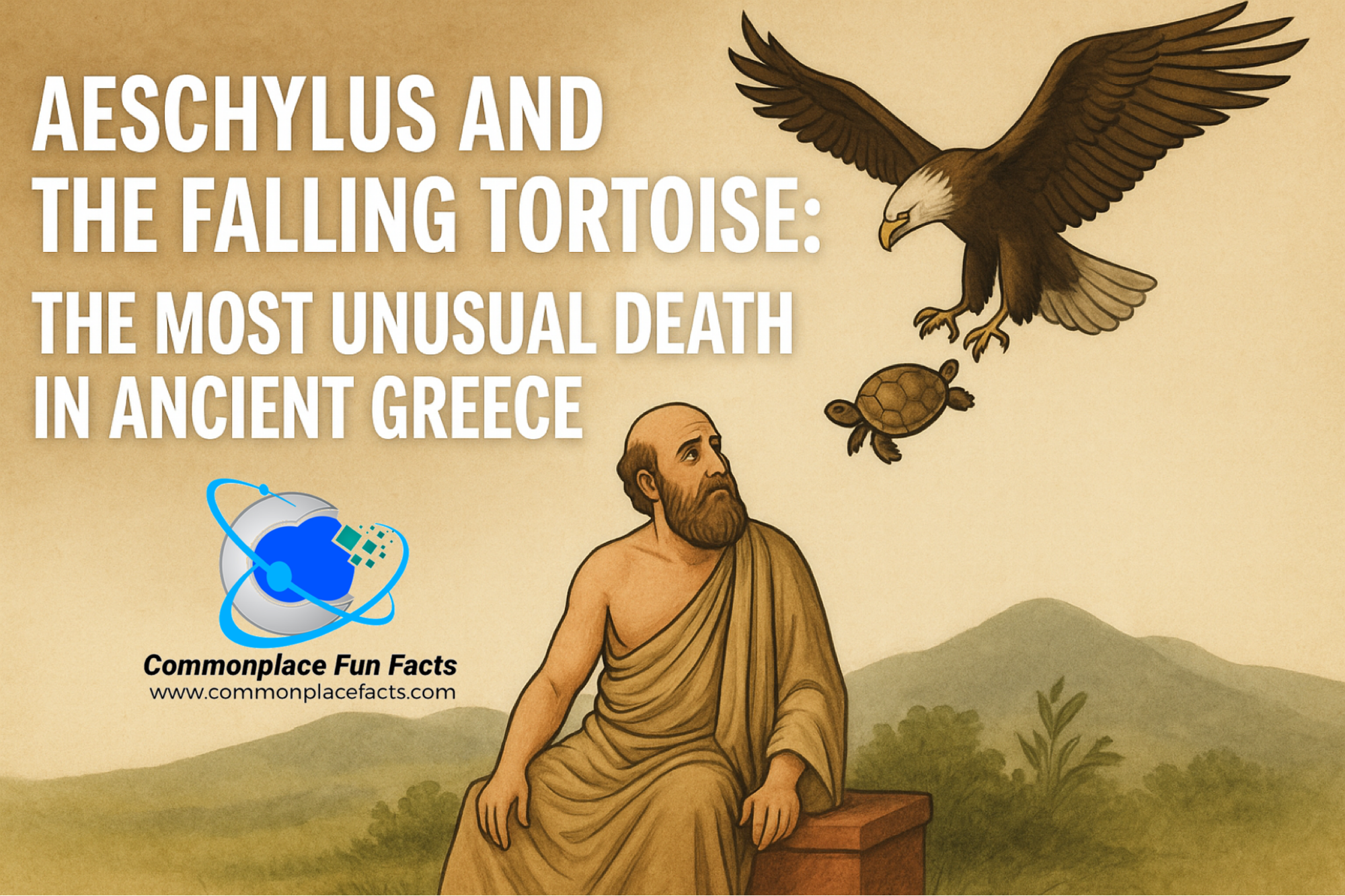

If you ever find yourself worrying about the usual hazards of daily life—slippery sidewalks, erratic drivers, expired yogurt—take comfort. Whatever your fate may be, you are almost certainly not going to be killed by a falling tortoise dropped by a careless eagle. Aeschylus, widely considered the father of tragedy, was not so lucky.
Contents
A Quick Reminder: Aeschylus Was Kind of a Big Deal
Born around 525 BC, Aeschylus helped shape what we now think of as classical Greek drama. He introduced the second actor, expanded theatrical dialogue, and gave the world such cheerful little numbers as Prometheus Bound and The Oresteia. The man practically invented the tragic showdown.
He also managed to live long enough to fight at Marathon (490 BC) and possibly at Salamis, surviving actual battles only to be undone by avian-adjacent physics.
The Day the Sky Literally Fell

The best version of the story comes from Pliny the Elder in his Naturalis Historia. According to him, in 455 BC an eagle carrying a tortoise—because apparently this was the Bronze Age version of DoorDash—mistook Aeschylus’ bald head for a convenient rock. Eagles, being clever but not that clever, habitually drop hard-shelled prey onto stones to crack them open.
The tortoise fell. Gravity did what gravity does. And the world lost its greatest tragedian to the ancient equivalent of a poorly aimed airdrop.
The Prophecy He Tried to Outsmart
The real plot twist? Pliny says Aeschylus was spending extra time outdoors because a seer had warned him he would be killed by a falling object. The man tried to avoid the indoors to keep his ceiling from betraying him.
It’s the kind of logic we can all admire. Why worry about beams, tiles, and crumbling masonry when you can simply go outside and let the sky take a crack at you?
Was This Really How He Died?
Ancient historians were not above a little dramatic flourish, so scholars occasionally debate whether this story is literal fact or ancient gossip upgraded to legend. But here’s the thing: ancient writers loved a poetic ending, and what could be more poetic than the greatest tragedian being undone by the world’s most low-budget stage prop?
Even the Greek biographer Valerius Maximus repeats the story, which means it had traction. It was too good not to pass along, and frankly, we’re grateful. Without it, history would be missing one of its greatest “you’ll never believe this” moments.
Bonus Fun Facts You Didn’t Ask For (But Absolutely Deserve)
1. Aeschylus may have had a tragic family streak.
His brother Cynegeirus famously died grabbing the stern of a Persian ship with his bare hands. Heroic? Yes. OSHA-approved? Not even close.
2. His epitaph doesn’t mention his plays at all.
Despite being the Shakespeare of his age, his epitaph boasts only about his military service at Marathon. Apparently “wrote the entire foundation of Western drama” came in second to “stood on a battlefield once.” Of course, Thomas Jefferson’s tombstone neglects to mention that he was President of the United States, so sometimes less is more.
3. Eagles really do drop things.
This part is absolutely real and still happens today, such as in the case of a woman whose windshield was shattered by a falling cat. Two tragedies separated by 2,500 years, united by eagles with slippery talons.
4. The “bald head rock confusion” has precedent in nature.
Certain bird species have been known to mistake shiny objects (or dome-shaped ones) for stones. Aeschylus may simply have been a victim of ancient Mediterranean glare conditions and could have benefitted from Calvin Coolidge’s method for dulling the glare from one of his predecessor’s hairless dome.
The Legacy of a Man Outwitted by an Eagle
Aeschylus left behind over 70 plays, though only seven survive in full. He helped turn religious festivals into genuine theater, expanded the emotional vocabulary of tragedy, and paved the way for Sophocles and Euripides to do their thing.
His death is tragic, absurd, ironic, and unexpectedly on-brand for a man whose characters were constantly blindsided by fate. In the end, Aeschylus proved that even the greats cannot escape destiny—or the occasional badly aimed tortoise.
You may also enjoy…

Going Out With a Granted Wish
The American revolutionary James Otis Jr. hoped his death would come by a bolt of lightning and often told his friends and relatives about it. His sister reported him telling her, “My dear sister, I hope, when God Almighty in His righteous providence shall take me out of time into eternity that it will be…

The Tragic Tale of Pythagoras and the Deadly Beans
How Did Beans Cause the Death of Pythagoras Pythagoras (c. 570 – c. 495 B.C.) is most-commonly remembered for the geometric formula that bears his name. What is less-well remembered about him is the way beans contributed to his untimely death. During his life, Pathagoras developed a cult following. Known more for being a philospher…

Michelangelo and the Foul Footwear
Michelangelo, despite being a legendary creative genius, had poor personal hygiene habits. His biographer Ascanio Condivi described how he often slept in his clothes and boots due to cramp, leading to skin issues. Giorgio Vasari remarked that his long-worn dog-skin buskins were so bonded to his legs they became part of him.





Leave a Reply