
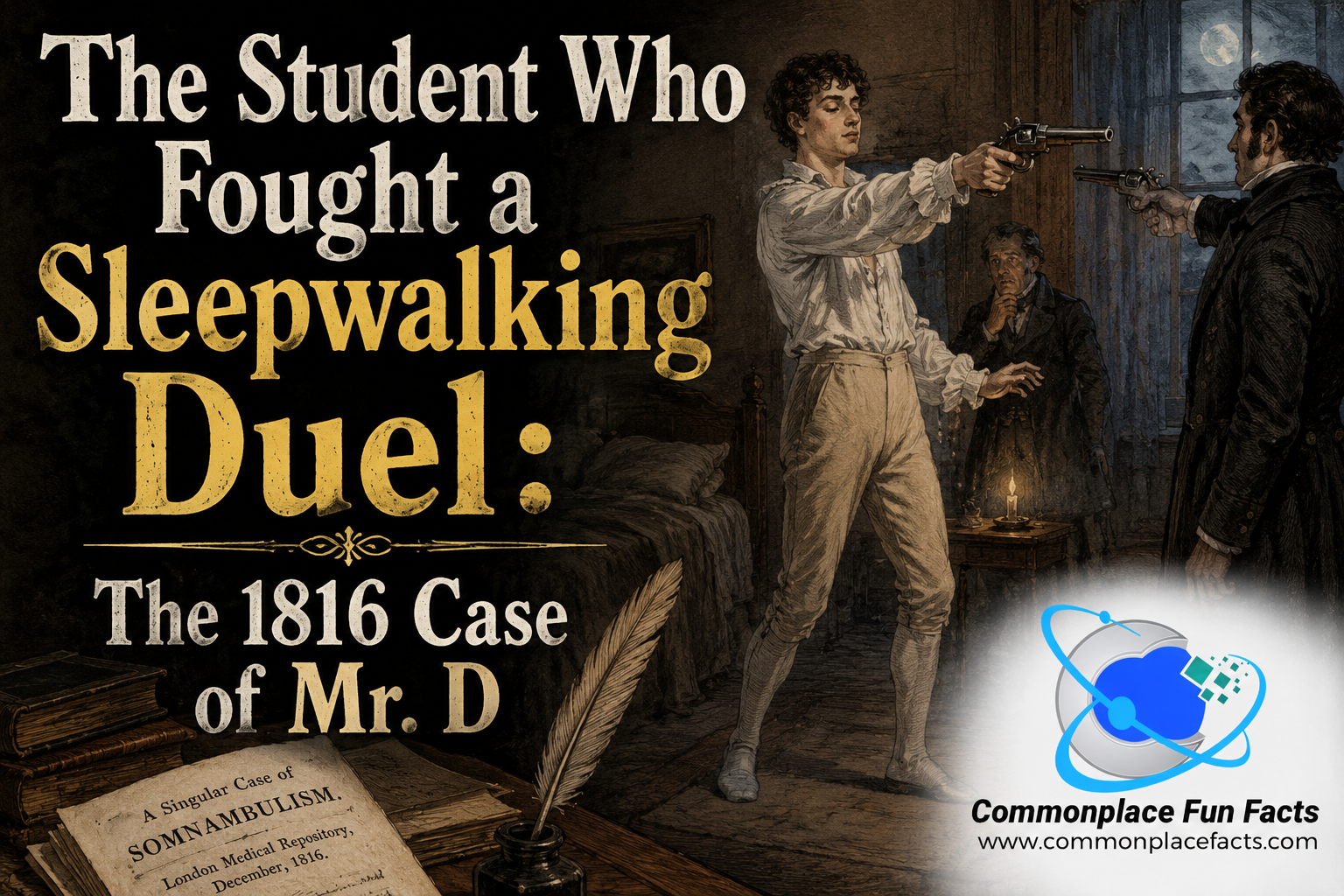

The Curious Case of the Sleepwalking Duel
Human beings have always had an uneasy relationship with sleep.
Most of us close our eyes at night hoping for a few hours of peace and restoration. Instead, the human brain occasionally decides to stage a one-man theatrical production involving anxiety, unresolved emotions, random childhood memories, and at least one dream where you are suddenly taking a math test while wearing only your underwear and a growing feeling of inevitable mortification.
Then there are sleepwalkers.
Sleepwalking has fascinated and terrified humanity for centuries because it raises a deeply uncomfortable possibility: what if your body decides to continue operating while the management has clocked out for the evening?
In 1816, a London medical journal published one of the strangest sleepwalking cases ever recorded. It involved a Dutch student identified only as “Mr. D.”
Mr. D. did not merely wander around the house muttering incoherently or attempt to cook eggs at three in the morning.
He fought a duel.
While asleep.
And according to the witnesses, he lost.
Which may make him history’s first recorded example of a man suffering defeat in an imaginary armed conflict conducted entirely within his own subconscious while still requiring medical treatment afterward.
The account appeared in The London Medical Repository in December 1816 under the title “A Singular Case of Somnambulism.”
Contents
When Sleepwalking Decided to Become Competitive
The patient was a young Dutch student identified as Mr. D. He does not appear to be an ancestor of Mr. T., which is a shame, because we really want to hear him say, “I duel the fool who wakes me before dawn.”
Mr. D. was lodging with a family while studying abroad. Upon arrival, he politely informed his hosts that he occasionally walked in his sleep.
This was considerate of him.
It also ranks among history’s great understatements.
Modern sleepwalkers sometimes wander into kitchens, attempt conversations, or stand motionless in hallways like low-budget horror movie extras. Mr. D., however, approached sleepwalking the way Victorian polymaths approached hobbies. He apparently felt that unconsciousness should be productive.

According to the journal account, he performed complicated activities while asleep with astonishing precision. One evening his landlord heard noises downstairs and discovered Mr. D. unpacking books sent by his parents.
In complete darkness.
While asleep.
He was not merely handling the books randomly. He was cataloguing them accurately, identifying titles, authors, editions, and publication information. Witnesses claimed he made no mistakes.
There are fully awake people who cannot locate the television remote while it is in their hand. Meanwhile, this man was operating as a human Dewey Decimal System during REM sleep.
The incidents escalated.
Mr. D. reportedly played cards while asleep. He composed letters in Latin. He delivered speeches. He performed memorized tasks with precision and confidence. At one point he allegedly visited another room to request a specific piece of music be played on the piano.
Imagine being awakened at two in the morning by a sleepwalking foreign student politely asking for live musical accompaniment while unconscious.
That is the sort of situation that either becomes a fascinating medical case study or the beginning of one of your father’s stories about why he went through so many roommates during his freshman year of college.
The Duel
Then came the night of the duel.
According to the account, Mr. D. suddenly entered into an elaborate dream in which he believed he had quarreled with a former fellow student from Utrecht. The dispute escalated to the point that honor demanded satisfaction.

The early nineteenth century had a remarkably flexible definition of “reasonable conflict resolution.” Modern society generally discourages classroom disputes from ending in ritualized pistol combat at dawn. The nineteenth century often treated this as a regrettable but understandable social inconvenience.
Still asleep, Mr. D. enlisted his landlord, identified in the report as “Mr. H.,” to serve as his second. He then carefully paced out the dueling ground.
Again: asleep.
Not stumbling.
Not vaguely wandering around.
He was apparently unconscious while simultaneously following formal dueling etiquette more competently than many conscious aristocrats.
The witnesses played along with the bizarre episode rather than waking him abruptly. This was partly curiosity and partly caution. Medical understanding of sleepwalking at the time was primitive, and many physicians believed suddenly awakening a sleepwalker could be dangerous.
Victorian medicine had an unfortunate tendency to approach strange phenomena with a combination of legitimate scientific interest and the energy of people poking an unidentified sea creature with a stick just to see what would happen.
Mr. D. took his position.
The imaginary opponent did the same.
The imaginary signal was apparently given.
Mr. D. “fired.”
Then he suddenly staggered backward and collapsed dramatically, convinced that he himself had been shot in the side.
This is where the story somehow becomes even stranger.
The Fake Surgery
At this point, the witnesses summoned a surgeon.
Now, a modern doctor encountering a sleepwalking patient pretending to have been wounded in an imaginary duel would likely focus on safely waking the patient and assessing neurological causes.
The early nineteenth-century response was considerably more theatrical.

The surgeon decided to participate in the hallucinated medical emergency.
He examined the unconscious duelist and announced that a bullet had indeed lodged in Mr. D.’s side. The physician then pantomimed an operation to remove the nonexistent projectile.
One suspects there was at least a tiny professional temptation involved here. If you are a surgeon in 1816 and somebody presents you with an opportunity to perform pretend battlefield surgery on a sleeping law student, there is probably no chapter in medical ethics explicitly covering the situation.
After the imaginary operation concluded, Mr. D. reportedly asked whether his opponent had survived.
When informed that the rival student was alive, he expressed relief.
And then he woke up.
That was the moment the entire elaborate subconscious production finally collapsed.
One imagines the awakening must have been profoundly confusing.
“Why am I on the floor?”
“Why is there a surgeon here?”
“Why does everyone look emotionally exhausted?”
“And why do I suddenly feel as though I owe a bunch of people an apology?”
The Nineteenth Century Loved This Sort of Thing
The story spread because nineteenth-century readers were absolutely fascinated by somnambulism. The period sat at an awkward crossroads between superstition and modern neuroscience. Sleepwalking existed in a strange cultural space where medicine, psychology, spiritualism, mesmerism, and gothic fiction all collided into one giant fog bank.
Doctors were trying to understand the sleeping mind while the general public was busy turning every unusual neurological condition into either a horror story or a stage act.
Victorian audiences adored accounts of unconscious behavior because such stories raised unsettling philosophical questions:
- Could the mind operate independently of conscious awareness?
- Did this sleepwalking duel disqualify him from being a lawyer or holding public office in Kentucky?
- Could people commit crimes while asleep?
- Was sleepwalking evidence of hidden mental powers?
- Or was the human brain simply a chaotic raccoon rummaging through psychological garbage cans after midnight?
Even today, sleepwalking remains poorly understood in many respects. Researchers classify it as a parasomnia, meaning the brain becomes trapped in a bizarre halfway state between sleep and wakefulness. Parts of the brain appear active while others remain deeply asleep.
In other words, the brain occasionally boots up in safe mode.
Most sleepwalking episodes are harmless. People may sit up, mumble, walk around, or perform simple activities.
Some cases, however, become extraordinarily complex.
There are documented instances of people cooking meals, driving vehicles, sending emails, rearranging furniture, and engaging in lengthy conversations while technically asleep.
Human beings are apparently capable of functioning on disturbingly low levels of actual consciousness. Which, to be fair, also explains several corporate meetings.
The Legal Nightmare of Sleepwalking
Cases like Mr. D.’s eventually raised legal questions that remain controversial even now.
If somebody commits an act while asleep, are they responsible?

Courts have wrestled with this issue for generations. There have been real criminal cases involving sleepwalking defenses in assaults, thefts, and even homicide cases.
Because nothing comforts a jury quite like hearing the phrase, “My client was unconscious during the stabbing.”
Some courts have accepted sleepwalking as a legitimate defense under the concept of automatism, meaning the defendant acted without conscious control.
Others have viewed such claims with skepticism for reasons that should be fairly obvious to anyone who has ever witnessed human beings attempting to avoid consequences.
“Your honor, I did not rob the bank. My subconscious was simply very entrepreneurial that afternoon.”
Still, the underlying scientific question is real and deeply unsettling. How much of human behavior actually requires conscious awareness?
Cases like Mr. D.’s suggest the answer may be: less than we would prefer.
The Brain Is Weird
The most unsettling aspect of the story is not the duel itself.
It is the sophistication.

Mr. D. did not merely thrash around in bed imagining combat. His sleeping mind constructed a coherent narrative complete with social protocol, emotional stakes, spatial awareness, physical movement, and dramatic consequences.
His unconscious brain wrote, directed, choreographed, and starred in a miniature psychological war film while his conscious self remained entirely offline.
That realization has fascinated neuroscientists ever since.
The sleeping brain is not inactive. It is astonishingly busy. Memory processing, emotional regulation, rehearsal of learned tasks, and pattern recognition all continue during sleep.
Sometimes the machinery partially wakes up while the rest remains asleep.
And occasionally that produces a man fighting an imaginary duel in his boarding house while a confused landlord watches nearby, silently counting the days until the lease expires.
The Legacy of Mr. D.
The 1816 account of Mr. D. survives because it sits perfectly at the intersection of science, absurdity, and existential discomfort.
It is funny.
It is bizarre.
It is also deeply unnerving.
Most people like to believe they are firmly in charge of their own minds. Stories like this suggest the relationship may be more of a loose subcontracting arrangement.
Somewhere beneath our conscious awareness sits an older, stranger system capable of navigating rooms, performing memorized tasks, constructing narratives, and occasionally engaging in imaginary pistol duels without informing management.
Which means the next time you wake up tired for no obvious reason, there is at least a tiny possibility that your subconscious spent the night cataloguing books, delivering speeches in Latin, and defending your honor at dawn.
Sleep is mysterious.
The human brain is weirder than we like to admit.
And somewhere in the history of medicine sits a baffled nineteenth-century surgeon who once pretended to remove a nonexistent bullet from a sleeping law student because apparently that counted as healthcare in 1816.
You may also enjoy…

The Otto Von Bismarck Sausage Duel: A Tale of Brains, Bravado, and Bratwurst
Discover the bizarre (and possibly true) tale of the 1865 Otto von Bismarck sausage duel—a deliciously absurd chapter in Prussian history involving trichinosis, pride, and bratwurst.

Kentucky Lawyers and Politicians Are Required to Disavow Dueling
Kentucky lawyers and politicians are required to disavow dueling. Find out why.

The Ironic End of the Scientist Who Discovered R.E.M. Sleep
Although we spend, on average, one-third of our lives sleeping, the scientific study of the activity is relatively new. Officially known as somnology, the study of sleep began in earnest in 1936 with the discovery of different stages of sleep. It wasn’t until 1953 that the research really took off with the discovery of the…




Leave a Reply