
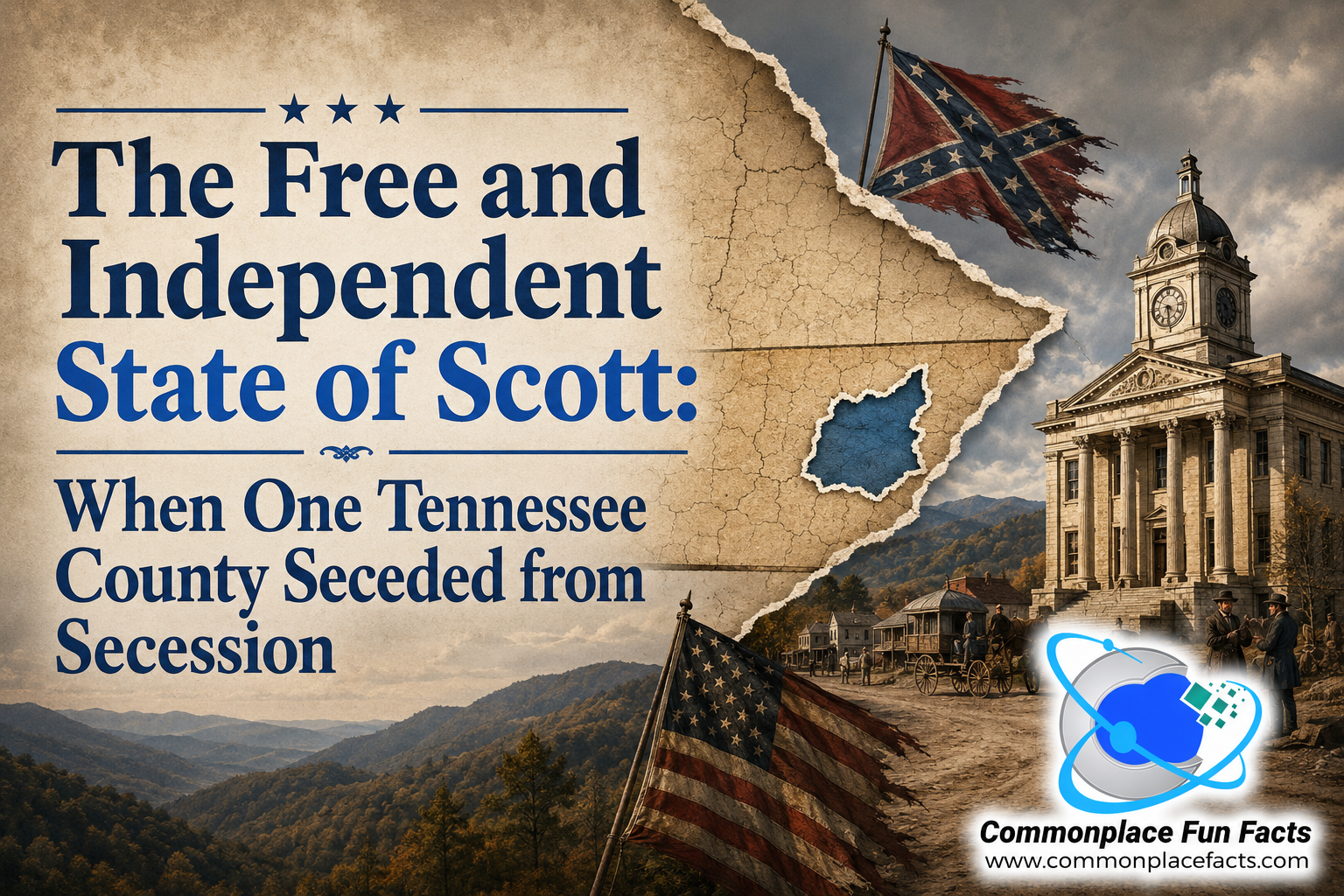

In 1861, Tennessee looked at the United States and said, “We’re leaving.”
Scott County looked at Tennessee and said, “Funny. We were just about to say the same thing.”
Thus was born one of the strangest footnotes of the Civil War: the Free and Independent State of Scott, a tiny, mountainous, deeply Unionist county in northern Tennessee that attempted to secede from the state after Tennessee joined the Confederacy. It was not recognized by Tennessee. It was not recognized by the Confederacy. It was not recognized by the United States. We’re not entirely sure it was even recognized by passing livestock.
But Scott County recognized it, and sometimes that is enough to keep a historical oddity alive for 125 years.
Yes, 125 years.
Because Scott County did not formally “rejoin” Tennessee until 1986, which is either a charming local commemoration, a legal nullity, or the greatest delayed paperwork correction in American county government history.
Contents
Tennessee Was Not Exactly Sprinting Toward Secession
To understand Scott County’s dramatic little “no thank you” to the Confederacy, we first need to remember that Tennessee was not one of the early secession states. South Carolina, Mississippi, Florida, Alabama, Georgia, Louisiana, and Texas had already left the Union before Tennessee got around to making its decision.
Tennessee was divided. Deeply divided.
West Tennessee, with its stronger ties to plantation agriculture and slavery, leaned heavily toward secession. East Tennessee, mountainous, less plantation-based, and generally more suspicious of planter politics, remained strongly pro-Union. Middle Tennessee, fulfilling its sacred geographic duty as the middle child, wavered.

In February 1861, Tennessee voters rejected the idea of holding a secession convention. Statewide, the vote was 69,452 against and 57,745 in favor. Scott County was not subtle about its feelings. It voted 385 to 29 against the convention.
This was not a close call. This was not “after further review, the ruling on the field stands.” This was Scott County pointing at secession and saying, “This is a really bad idea, and we want the record to show that we said it was a really bad idea.”
But then Fort Sumter happened. In April 1861, Confederate forces fired on the federal fort in Charleston Harbor. President Abraham Lincoln called for troops to put down the rebellion. Suddenly, many Tennesseans who had been hesitant about secession became furious at the idea of sending men to fight fellow Southerners.
Governor Isham Harris, who had been pushing Tennessee toward secession, called for another vote.
On June 8, 1861, Tennessee voters approved secession by a statewide vote of 108,274 to 47,247. Tennessee became the last state to leave the Union and join the Confederacy.
Scott County, however, remained stubbornly unimpressed.
Scott County Votes “Absolutely Not”
Scott County sits on the northern Cumberland Plateau, along the Kentucky border. In 1861, it was rural, mountainous, and economically distant from the plantation world that dominated much of the secession debate. The county had very few enslaved people compared to other Tennessee counties. According to the 1860 census, only 61 enslaved people were recorded in Scott County, the fewest of any county in the state.

That mattered. A war to defend slavery sounded much less appealing in a place where the institution had relatively little local footprint. It is generally harder to persuade people to die for someone else’s business model, even if the business model comes wrapped in speeches about honor, sovereignty, and other words that tend to appear right before everyone starts shooting.
Scott County’s resistance also reflected the broader Unionism of East Tennessee. Many residents of the region believed Tennessee had no business leaving the United States. They saw the Union not as an invading enemy, but as the nation their fathers and grandfathers had fought to create. Add to that a healthy distrust of wealthy planters, state politicians, and distant authorities telling mountain people what to do, and you get a recipe for constitutional fireworks.
Four days before Tennessee’s second secession vote, U.S. Senator Andrew Johnson came to Huntsville, the county seat of Scott County, and delivered a speech against secession. Johnson was a complicated figure, which is historian-speak for “please clear your afternoon.” He was a Southern Democrat, a slaveholder, a fierce Unionist, later military governor of Tennessee, then vice president, then president, then the star of one of the more exhausting chapters in Reconstruction politics, and is remembered for being the first president to be impeached — one of the charges being that he talked too much.

Talking is exactly why, on June 4, 1861, in Scott County, Johnson made his appearance. He was there to argue that Tennessee should remain in the Union.
Scott County listened.
When the referendum came four days later, Scott County voted against secession by an overwhelming margin. The commonly cited tally is 521 to 19. Some sources give it as 541 to 19, because when it comes to elections, even the historical record occasionally enjoys finding votes that no one counted on election day. Either way, the result was clear: Scott County rejected secession by roughly 97 percent.
It was the strongest anti-secession vote in Tennessee.
Tennessee left the Union anyway.
Scott County was not amused.
East Tennessee Wanted Out, Too
Scott County was not alone in its anger. Many East Tennesseans wanted no part of the Confederacy. After Tennessee voted to secede, Unionist leaders gathered at Greeneville and asked the state legislature to allow East Tennessee to separate from Tennessee and form its own Union-aligned state.
This was not as far-fetched as it sounds. States had been carved out of other states before. Kentucky had once been part of Virginia. Maine had once been part of Massachusetts. And during the Civil War, western Virginia would separate from Confederate Virginia and become West Virginia.
East Tennessee hoped for something similar.
Governor Harris and the Tennessee government said no.
Because when Tennessee wanted to leave the Union, that was a sacred expression of self-government. When East Tennessee wanted to leave Tennessee, that was apparently rebellion, treason, chaos, and an unacceptable breach of proper seating arrangements.
This is one of those moments when history pauses, looks directly at the camera, and raises one eyebrow.
The Free and Independent State of Scott
Denied the chance to separate as part of a larger East Tennessee movement, Scott County decided to make its own statement.
Later in 1861, the Scott County Court passed a resolution declaring the county independent from Tennessee. The county styled itself the Free and Independent State of Scott.

Was this legally valid?
No.
Was it constitutional?
Also no.
Was it hilarious, defiant, and historically irresistible?
Absolutely.
Scott County’s argument was basically this: if Tennessee could secede from the United States, then Scott County could secede from Tennessee. This is not exactly how constitutional law works, but it has a certain playground logic that is hard not to admire. Tennessee had opened the “we are leaving because we said so” door, and Scott County simply walked through it wearing muddy boots.
One local story captures the mood perfectly. According to later accounts, an old farmer at the courthouse meeting supposedly stood up and declared, in less delicate language, that if Tennessee could secede from the Union, Scott County could secede from Tennessee.
That may not be a verbatim transcript. It has the pleasing shape of a story polished by many tellings over many years. But even if the exact wording is uncertain, the sentiment was real. Scott County was not trying to become a fully functioning international power. It was making a point.
A very loud point.
With a courthouse resolution.
Nashville Does Not Send a Congratulations Basket
Governor Harris, shockingly, did not respond by saying, “Fair enough. Enjoy your new sovereign state.”
According to Scott County tradition and local histories, the state sent soldiers toward the county to suppress the defiance and possibly arrest the county officials involved. The details are wrapped in some local legend, as Civil War mountain stories often are, but the broader point is clear: Tennessee did not recognize Scott County’s independence and was not inclined to let this act of defiance pass unnoticed.
Scott County was difficult terrain, however, both geographically and politically. The mountains of East Tennessee were not ideal territory for anyone hoping to march in, issue orders, and be obeyed with cheerful efficiency. Local Unionists resisted Confederate authority throughout the war. Some joined Union forces. Others sheltered deserters, resisted Confederate conscription, or participated in guerrilla conflict.
Scott County became part of the broader wartime chaos that gripped East Tennessee. Families were divided. Neighbors turned on neighbors. Armed bands moved through mountain communities. Military occupation, raids, arrests, looting, and retaliation became part of daily life.
It is tempting to treat the Free and Independent State of Scott as a funny little constitutional prank, and in some ways it was. But the world around it was not funny. Scott County’s declaration came in the middle of a brutal civil war, and East Tennessee paid dearly for its divided loyalties.
The Battle of Huntsville
One of the clearest examples of wartime violence in Scott County came on August 13, 1862, when Confederate troops seized Huntsville, the county seat.
Union forces were driven back. Confederate soldiers occupied the town for a time, looted it, and reportedly searched for members of the county court who had supported Scott County’s secession from Tennessee.
That detail tells us something important. The Free and Independent State of Scott may not have been legally recognized, but Confederate authorities took the county’s Unionism seriously. A courthouse resolution might not create a state, but it can certainly create a list of people your enemies would like to find.
Scott County’s defiance was not merely symbolic in the harmless “let’s print souvenir postcards, issue novelty passports, and wait for the tourism board to notice” sense of something like the Conch Republic. It was part of a real and dangerous conflict over loyalty, identity, and power in Civil War Tennessee.
Was Scott County Really a State?
No, but also sort of.
Incidentally, the legal opinion behind that last sentence came with an invoice for $863.12 from the Commonplace Fun Facts Department of Abandon All Hope, Ye Who Enter Here Legal Department.
Legally, the Free and Independent State of Scott was never a state. It was not admitted to the Union. It had no recognized government beyond the county structures that already existed. It had no senators, no representatives, no foreign policy, and no known embassy, unless someone’s front porch was doing impressive double duty.

There was also a wonderfully tangled constitutional problem lurking underneath the whole thing. From the Union’s point of view, Tennessee had never legally left the United States. Secession was illegal, void, and constitutionally ineffective. That meant Scott County was, in one sense, trying to secede from a state in order to protest that state’s attempted secession, even though the state itself had no legal right to secede in the first place. It was secession all the way down, except every layer came with a legal footnote saying, “Nope.”
That is what makes Scott County’s move so fascinating. It was not a valid act of state creation. It was a local protest built on the logic of Tennessee’s own rebellion. If Tennessee could claim the right to walk away from the Union, Scott County was essentially asking why it could not walk away from Tennessee. Constitutionally speaking, both arguments had problems. Politically speaking, Scott County’s point was hard to miss.
But as a historical identity, the State of Scott mattered.
Scott County was hardly the only place in American history where people looked at an existing map and decided it needed aggressive editing. The proposed State of Absaroka made a similarly bold attempt in the 1930s, when parts of Wyoming, Montana, and South Dakota flirted with becoming a new state. Like Scott, Absaroka never achieved legal statehood, but it did achieve the next best thing: a wonderfully stubborn place in the museum of American political oddities.
The State of Scott movement expressed Scott County’s refusal to accept Tennessee’s secession. It aligned the county symbolically with the Union. It gave local people a way to say, in effect, “Tennessee may have joined the Confederacy, but the politicians in Nashville do not speak for us.”
That distinction matters. The Confederacy often presented secession as the will of “the South,” as though the region spoke with one voice. It did not. Large areas of the South contained strong Unionist populations, especially in Appalachia. Eastern Tennessee, western North Carolina, northern Alabama, parts of Arkansas, and other mountain or upland regions had many residents who opposed secession, resisted Confederate authority, or supported the Union outright.
Scott County’s declaration was one of the more dramatic examples of that resistance.
It was not a state in the constitutional sense.
It was a state of mind.
And possibly a state of mild legal indigestion.
And if you’re thinking the “State of Scott” is a bit odd for nomenclature, think again. It’s far from being the strangest naming decision in history. After all, astronomer William Herschel once tried to name Uranus after King George III, which would have given us a planet named George. Compared with that, a state named Scott seems almost restrained. Almost.
Tennessee Had Seen This Movie Before: The State of Franklin
Scott County was not Tennessee’s first flirtation with “actually, we’re independent now.”
Long before the Civil War, before Tennessee was even Tennessee, settlers in what is now East Tennessee attempted to create the State of Franklin. In the 1780s, after North Carolina ceded its western lands to the federal government and then complicated matters by changing course, settlers in the region organized their own government and sought admission as a new state.
They named it Franklin, hoping to flatter Benjamin Franklin into supporting them, because apparently the proud American tradition of naming something after a famous person in hopes of gaining influence began early.
The State of Franklin had more structure than the State of Scott. It had a governor, John Sevier, who would later become the first governor of Tennessee. It had officials, courts, laws, and ambitions of formal statehood. But it never gained enough support from Congress, struggled with internal divisions and conflicts with North Carolina, and eventually collapsed. The region later became part of the Southwest Territory and then the state of Tennessee.
So when Scott County declared independence in 1861, it was not inventing Tennessee separatist weirdness from scratch. It was participating in a proud regional tradition of looking at the current political arrangement and saying, “Have we considered not doing that?”
The difference is that Franklin was a serious statehood movement. Scott was more of a Civil War protest with excellent branding.
Both, however, remind us that Tennessee history has never lacked for people willing to draw a line on a map and then argue about it with tremendous conviction.
The Longest Unrecognized Independence Streak in County History
After the Civil War, Tennessee returned to the Union. Scott County remained part of Tennessee in every practical and legal sense. Taxes were collected. State laws applied. County government functioned. Nobody was checking passports at the county line, although it would be delightful to imagine a bored official asking travelers whether they had anything to declare besides livestock and opinions.

Still, the legend of the Free and Independent State of Scott endured.
For more than a century, Scott County’s symbolic secession remained part of local identity. It was a story of Union loyalty, mountain independence, and the county’s willingness to tell Tennessee exactly where it could file its Confederate paperwork.
Then came 1986.
As part of Tennessee’s Homecoming celebration, Scott County decided to formally resolve the matter. The county commission adopted a resolution dissolving the Free and Independent State of Scott and returning to Tennessee. Governor Lamar Alexander signed the resolution, symbolically readmitting Scott County to the state.
This was not legally necessary, because Tennessee had never recognized Scott County’s departure in the first place. You cannot technically rejoin something you never legally left. But that is exactly what makes it wonderful. It was a ceremonial end to a symbolic rebellion, complete with official action, historical memory, and just enough bureaucratic absurdity to make the whole thing sparkle.
After 125 years, Scott County came home.
Or, more accurately, Scott County acknowledged that it had been sitting in the living room the whole time, refusing to make eye contact.
Why the State of Scott Still Matters
The Free and Independent State of Scott is easy to treat as a quirky Civil War footnote. To be fair, it is a quirky Civil War footnote. It practically arrives wearing a sash that says, “Local Government Oddity: Set Aside for Future Use by Commonplace Fun Facts.”
But it also reveals something important about the Civil War.
The war was not simply North versus South. It was also neighbor versus neighbor, region versus region, class versus class, and sometimes county versus state. The Confederacy claimed to speak for the South, but many Southerners rejected secession. Some did so because they opposed slavery. Some did so because they loved the Union. Some did so because they distrusted wealthy planters and state politicians. Some did so because they had no interest in being conscripted into a war that seemed designed to benefit people far richer than themselves.
Scott County’s declaration reminds us that maps can lie by oversimplifying. A state shaded gray on a Civil War map did not mean every person inside it supported the Confederacy. East Tennessee is one of the clearest examples of that reality.
Scott County’s Unionist streak did not vanish when the war ended. In the 1868 and 1872 presidential elections, Ulysses S. Grant received more than 90 percent of the vote in Scott County. The county then went on to vote Republican in virtually every presidential election afterward, with the notable exception of 1912, when it backed the Progressive Party. The Democratic nominee hasn’t made a decent showing in the election returns since the Civil War. In other words, Scott County did not just have a brief wartime flirtation with Unionism. It bought the ring, booked the venue, and remained committed long after everyone else had stopped arguing over the seating chart.
Scott County did not have the power to stop Tennessee from seceding. It did not have the legal authority to become its own state. It could not change the course of the war.
But it could refuse to be silent.
And it did.
The County That Seceded from Secession
In the end, the Free and Independent State of Scott was not a nation, not a state, and not a constitutional success story.
It was something stranger and maybe more interesting.
It was a county-sized act of defiance.
It was a Unionist protest in Confederate Tennessee.
It was a mountain community applying Tennessee’s own secession logic back at Tennessee and watching the state suddenly become much less enthusiastic about the principle.
Most of all, it was a reminder that history is rarely as neat as the textbook map makes it look. Tennessee seceded from the Union. Scott County seceded from Tennessee. Tennessee ignored Scott County. Scott County ignored the ignoring. Everyone eventually moved on, except for the paperwork, which waited patiently until 1986 to receive its ceremonial little bow.
For 125 years, Scott County carried the title “Free and Independent State of Scott,” not because the law recognized it, but because memory did.
And honestly, as historical acts of stubbornness go, that is pretty hard to beat.
You may also enjoy…

Absaroka — the State that Never Was
Learn how portions of South Dakota, Wyoming, and Montana proposed creating a new state named Absaroka to protest New Deal policies during the Great Depression.

How the Republic of Indian Stream Became a Country Between the United States and Canada
Canada and the USA share a unique history with the Republic of Indian Stream being a brief independent territory between them. Disputes over borders and taxation led to its proclamation of sovereignty in 1832. Despite brief independence, it eventually requested annexation by the United States in 1835, leading to a clarified border in 1842.

The Toledo War and the Michigan Border Drama: How the Upper Peninsula Became a Consolation Prize
Explore dramatic story of the Michigan Border and statehood, from post-1812 border disputes with Ohio over the Toledo Strip to gaining the Upper Peninsula. Learn how Michigan lost Toledo but won statehood in 1837 amid heated territorial conflicts.



Leave a Reply