
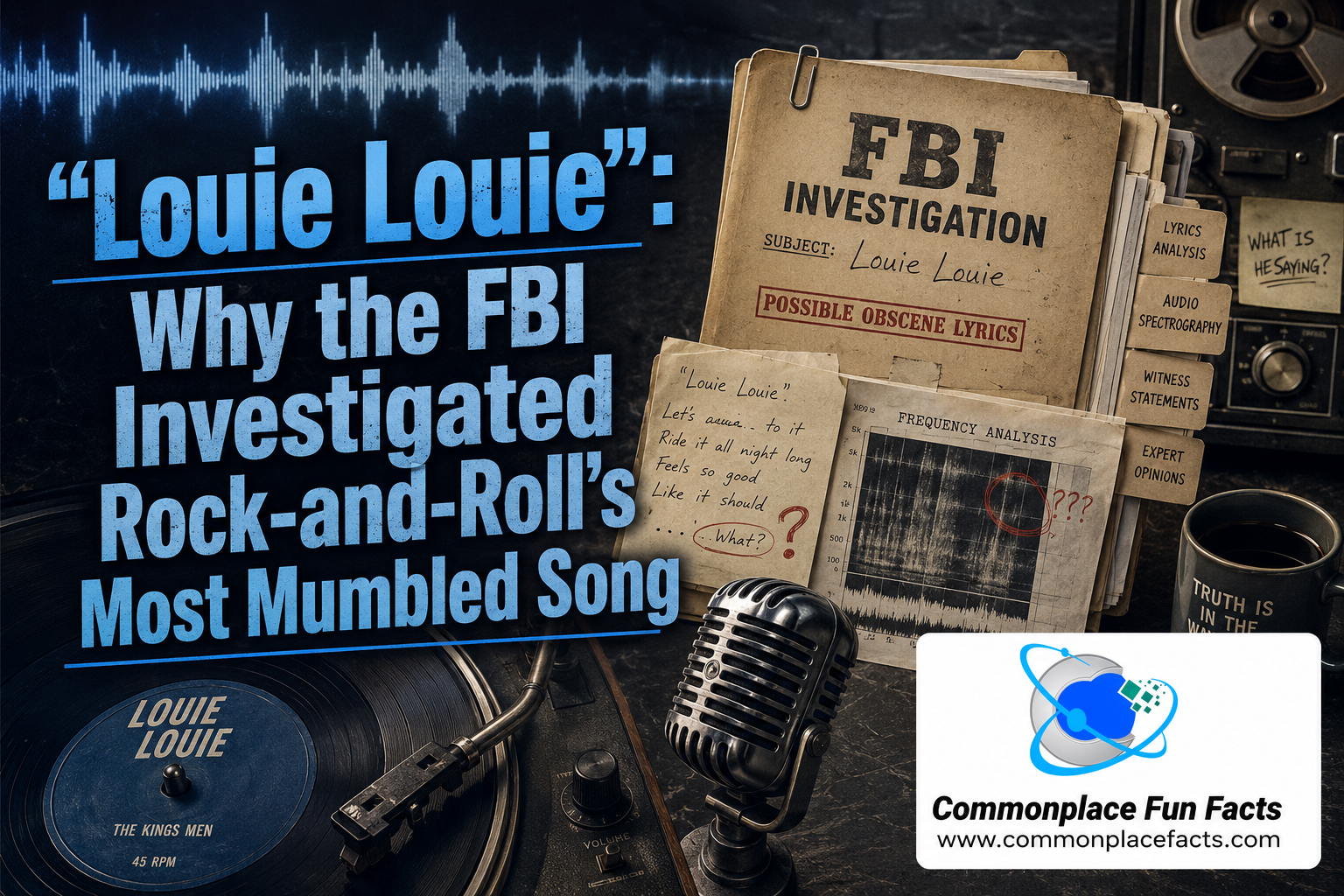

There are moments in American history when the machinery of government rises to meet a grave national crisis. Pearl Harbor. The Cuban Missile Crisis. Watergate. And, naturally, the time the Federal Bureau of Investigation spent months trying to determine whether a garage band from Portland, Oregon had secretly hidden dirty lyrics inside a song that mostly sounds like a man singing through a mouthful of upholstery foam.
We are speaking, of course, of “Louie Louie,” the 1963 hit by The Kingsmen, a record so raw, sloppy, infectious, and gloriously unintelligible that it became one of the most famous rock songs in history. It also became the subject of an FBI investigation.
Yes, that FBI.
The same agency tasked with tracking spies, bank robbers, organized crime, and threats to national security also found itself listening to “Louie Louie” at different speeds to determine whether obscenity or merely poor enunciation was responsible for corrupting America’s teenagers.
As scandals go, this one had everything: anxious parents, nervous politicians, mysterious lyric sheets, teenage rumor networks, federal investigators, laboratory analysis, and a final conclusion that can be summarized as: “We listened carefully and still have no idea what this man is saying.”
Contents
Before the Panic: The Innocent Origins of “Louie Louie”
The song itself did not begin life as a scandal. “Louie Louie” was written by Richard Berry in the 1950s and released in 1957. In its original form, it was a rhythm-and-blues tune about a sailor talking to a bartender named Louie. The sailor is homesick, lovesick, and eager to return to his girl. That is basically it.

Louie Louie, oh no, you take me to where ya gotta go, yeah, yeah, yeah, yeah, yeah, baby
Louie Louie, oh baby, take me to where ya gotta goA fine little girl, she waits for me
Me catch a ship across the sea
Me sailed that ship all alone
Me never think I’ll make it homeLouie Louie, oh no no no, take me to where ya gotta go, oh no
Louie Louie, oh baby, take me to where ya gotta goThree nights and days I sailed the sea
Me think of girl constantly
On that ship, I dream she there
I smell the rose in her hairLouie Louie, oh no, take me to where ya gotta go, yeah, yeah, yeah, yeah, yeah, baby
Louie Louie, oh baby, take me to where ya gotta go
Okay, let’s give it to ’em right nowMe see
Me see Jamaica, the moon above
It won’t be long me see me love
Me take her in my arms and then
I tell her I’ll never leave againLouie Louie, oh no, take me to where ya gotta go, yeah, yeah, yeah, yeah, yeah, baby
Louie Louie, oh baby, take me to where ya gotta go
I said me gotta go now
Let’s hustle on out of here
Let’s go
There is no elaborate plot. No coded manifesto. No invitation to overthrow public morals. Just a guy telling Louie that he has to go, because somewhere across the sea there is a woman waiting for him. Frankly, compared with large portions of popular music before and since, this is practically a hymn to emotional commitment and maritime transportation.
But the song had something more powerful than lyrical complexity. It had a riff.
That three-chord stomp made “Louie Louie” irresistible to Northwest rock bands. It was simple enough for young musicians to play, catchy enough for crowds to recognize, and loose enough to survive almost any amount of enthusiastic abuse. This made it perfect garage-band material. It was the kind of song that did not require perfection. In fact, perfection might have ruined it.
Enter The Kingsmen.
The Kingsmen Step Up to the Microphone, Sort Of
In 1963, The Kingsmen recorded their version of “Louie Louie” in Portland, Oregon. The recording was not exactly an exercise in polished studio elegance. This was not a room full of velvet ropes, expensive producers, and musicians nodding solemnly over the emotional arc of take forty-seven.The Kingsmen’s “Louie Louie” sounds like what might happen if a party broke out in a basement, someone found a microphone, and the drummer announced he had another appointment in twenty minutes.
That was not entirely accidental. When The Kingsmen recorded the song, the microphone was suspended several feet above Jack Ely, because apparently “audio engineering” that day meant “let’s make the singer perform toward the ceiling like he is addressing a suspicious attic.” Ely was also wearing dental braces, which are not traditionally listed among the recommended tools for crisp vocal delivery. Meanwhile, the rest of the band clustered around him in a circle and played loudly, because subtlety had already left the building and was waiting in the car.
The result was a vocal performance that did not so much deliver lyrics as hint at their general location. Ely became famous for singing a song that was already nearly pop Esperanto: universally recognized, enthusiastically performed, and understood mostly through context, rhythm, and blind confidence.
Musically, the whole thing is almost insultingly simple: A, D, E minor. That is the chord progression. Three chords, no waiting. As for the lyrics, those are more of a suggestion than a requirement. You should probably begin somewhere in the neighborhood of “Louie Louie / Oh no / Me gotta go,” but after that, the song becomes a participatory democracy with very loose election laws.
Sing the actual lyrics. Sing your grocery list. Recite the names of minor vice presidents. Mutter something about gumbo and maritime longing. The riff will carry you. The audience will shout along. The FBI will come along later and take notes.
Lead singer Jack Ely delivered the vocals in a famously garbled style. Part of the problem was the recording setup. Part of it was the energy of the performance. Part of it may have been the fact that rock-and-roll singers in 1963 were not always aiming for the diction of a Shakespearean actor explaining zoning ordinances.
Whatever the cause, the result was magnificent. And magnificently consequential.
The words came out blurred, swallowed, stretched, and battered by the band behind him. Ely sounded less like he was singing lyrics than urgently reporting from inside a running clothes dryer. The band crashed forward. The guitar riff snarled. The drums lurched along. Somewhere in the chaos, a classic was born.
It was raw. It was exciting. It was messy. It was also nearly impossible to understand.
And that, dear reader, is where the trouble began.
Teenagers Discover the Most Dangerous Force in America: Suggestion
Teenagers have many gifts. They can detect hypocrisy at three hundred yards. They can transform perfectly ordinary slang into a new language before breakfast. They can also convince adults that civilization is ending by saying, “You know what that song is really saying, right?”

That appears to be what happened with “Louie Louie.”
At some point after The Kingsmen’s version became popular, rumors began circulating that the lyrics were obscene. Not merely suggestive. Not merely a little spicy. Obscene. Filthy. The sort of thing that would cause cardigan-wearing parents to clutch nearby furniture and wonder where America went wrong after Eisenhower.
The rumor gained strength because the record was so hard to understand. If a lyric is clear, there is only so much room for conspiracy. If a singer plainly says, “I miss my girl and must return across the sea,” the moral panic committee has to look elsewhere for snacks.
But if the singer sounds like “Ah blahh mmph yahh Louie Louie oh baby we gotta go,” the human brain starts filling in the blanks. And if someone hands you a typed sheet of supposedly “real” dirty lyrics, suddenly you may begin hearing them.
This is not because the lyrics are there. It is because suggestion is powerful, especially when combined with fear, music, and teenagers who are clearly enjoying themselves too much.
Parents began hearing things. Students began sharing alleged lyric sheets. Rumors spread from school to school and town to town. The song became more than a record. It became a test of moral alertness. Were you the sort of responsible adult who could detect hidden depravity through a fog of distorted vocals? Or were you just going to let young people dance?
Obviously, something had to be done.
Indiana Has Concerns
One of the most famous episodes in the “Louie Louie” panic came from Indiana, where Governor Matthew Welsh publicly objected to the song. He reportedly considered it pornographic and urged broadcasters not to play it.
This was a remarkable achievement for a record whose most clearly understood lyric is the title, repeated with the confidence of a man who has misplaced the rest of the sentence.
Welsh was not alone. Concerned citizens wrote letters. Parents complained. Officials were asked to intervene. One letter to Attorney General Robert F. Kennedy reportedly complained that the lyrics were so filthy the writer could not even include them. This is always a bold move in the history of censorship: “I cannot show you the evidence because the evidence is too dangerous, but please prosecute accordingly.”
Eventually, the matter reached the federal government.
The legal theory was not that The Kingsmen had personally offended every parent within radio range, although that seemed to be the emotional centerpiece of the matter. The issue was whether the record might violate federal law relating to the interstate transportation of obscene material.
In other words, if the song contained obscene words and those records were being shipped across state lines, there might be a federal case.
And so the FBI got involved.
The FBI Takes the Case
The FBI’s investigation into “Louie Louie” began in 1964. Let us pause here to appreciate the paperwork implications.

Somewhere, an FBI agent had to open a file involving a rock song. Someone had to type official memoranda about “Louie Louie.” Someone had to collect alleged dirty lyrics submitted by worried citizens. Someone had to review the record. Someone had to ask whether a garage-rock anthem constituted obscene matter in interstate commerce.
History often gives us towering monuments, preserved battlefields, and marble statues of solemn men pointing toward destiny. It also gives us federal agents trying to understand Jack Ely.
The Bureau gathered information. It collected supposed versions of the “real” lyrics. It examined complaints. It contacted people connected with the song. The record itself was turned over for analysis.
Because this was not merely a question of taste. This was science. Or at least as close as science gets when the experiment involves playing “Louie Louie” repeatedly and asking, “Did he just say what that parent from Indiana thinks he said?”
The Laboratory Analysis, or: CSI Garage Band
The FBI Laboratory listened to the recording at different speeds. The song was played at 78 rpm, 45 rpm, 33 1/3 rpm, and even slower speeds in an effort to determine what was being sung.
This is the part of the story where the absurdity becomes almost majestic.
Imagine being a federal audio expert, trained to analyze evidence, perhaps expecting to work on wiretaps, threats, ransom calls, and other serious matters. Then one day someone walks in and says, “We need you to listen to this teenage dance record and figure out what the heck they’re saying.”

So you do your duty. You slow it down. You speed it up. You compare sounds. You concentrate. You listen again.
And again.
And again.
Meanwhile, that three-chord progression and the only truly discernible words—“Louie, Louie… oh, oh… gotta go now”—have become an endlessly repeating earworm, the sort of musical squatter that moves into your brain, changes the locks, and keeps humming while you are trying to sleep.
At some point, the investigation becomes less about obscenity and more about endurance.
The alleged filthy lyrics did not reliably emerge. The official lyric sheets did not match what could be clearly heard. The song remained stubbornly unclear. “Louie Louie” resisted interpretation like a William Faulkner novel assigned to 9th grade students one week before spring break.
The conclusion of the FBI’s 119-page report was, in effect, that the song was unintelligible. Not innocent in the sense that every syllable had been proven wholesome. Not guilty in the sense that obscenity had been found. Just unintelligible.
And then, because history enjoys adding a punchline after the punchline, there may have been one actual obscenity on the record after all.
Ironically, later listeners have pointed out that the one actual obscenity on the record may not have been in Jack Ely’s famously garbled vocals at all. It was reportedly drummer Lynn Easton, who can faintly be heard around the fifty-five-second mark yelling a word that would guarantee a soapy aftertaste if my mother ever heard me say it. This reportedly followed some kind of stick-related mishap. Some accounts say he dropped a drumstick; others say he clacked his sticks together. Either way, the FBI apparently missed the clearest dirty word on the record while investigating the ones that probably weren’t there. History, as usual, has excellent comic timing.
It was the perfect legal outcome for a record built on joyful nonsense: the government could not prosecute because it could not understand the evidence.
Our Own Deeply Scientific Lyric Analysis
Naturally, once we learned that the FBI had spent actual government time trying to determine whether “Louie Louie” contained obscene lyrics, we felt professionally obligated to conduct our own investigation. We listened carefully. We considered the evidence. We consulted the rich history of mondegreens and misheard song lyrics, those delightful moments when the human ear hears one thing and the brain confidently turns it into something else while wearing a tiny judge’s robe.
Our conclusion? If you are listening for dirty lyrics, your brain can find dirty lyrics. If you are listening for innocent lyrics, your brain can find those, too. If you are listening for lyrics about soup, maritime logistics, or a federal agent slowly losing the will to live beside a record player, congratulations: “Louie Louie” is flexible enough to accommodate your needs.

Louie, Louie, we gotta know,
Did he say “girl,” or “gumbo”?
Louie, Louie, please speak slow,
The Bureau’s got forms to show.We played it fast, we played it slow,
At forty-five, then way down low.
Three agents leaned in, grim and tense,
And still it made no legal sense.Louie, Louie, case file grows,
Nobody knows how this thing goes.
Louie, Louie, final decree:
“Mumbled beyond obscenity.”
That is the great lesson of mondegreens: our ears do not merely receive sound; they negotiate with it. When lyrics are clear, the brain has less room to improvise. When they are muddy, muffled, or delivered with the crisp diction of a man singing through a damp gym sock, the brain starts filling in gaps like a bored committee drafting bylaws.
This is how Jimi Hendrix’s “kiss the sky” becomes “kiss this guy,” Creedence Clearwater Revival’s “bad moon on the rise” becomes “bathroom on the right,” and “Louie Louie” becomes whatever the listener has been warned to fear. The song did not need to contain secret obscenity. It only needed to sound unclear enough for rumor to do the rest.
In other words, the scandal may tell us less about what The Kingsmen sang and more about what people expected to hear. That is, admittedly, less exciting than discovering a secret code hidden in a song to communicate with kidnap victims, but it is much more revealing about human nature. Also cheaper than an FBI investigation, which is a sentence we should not have to type, yet here we are.
The Actual Lyrics Were Not the Problem
The funniest part is that the real lyrics to “Louie Louie” were not obscene. Richard Berry’s original words told a simple story. The sailor wants to return to his girl. He talks to Louie. He says he has to go. That is about the full dramatic arc.
Compared with what people imagined they heard, the real lyrics were almost disappointingly innocent. One can picture a censor finally reading them and saying, “Wait, this is it? We mobilized the moral emergency system for a man with transportation issues?”
The problem was not the words. The problem was the sound.
The Kingsmen’s version was chaotic enough that listeners could project nearly anything onto it. This is one of the reasons the panic became so durable. People were not reacting to the song so much as to the possibility of the song. The lyrics were a blank canvas, and anxious adults painted it with every fear they had about rock music, teenagers, dancing, and whatever else had recently appeared on television.
“Louie Louie” became a national Rorschach test with a backbeat.
The Investigation Ends With a Shrug in Triplicate
The core FBI investigation found no evidence that the song was obscene. The Bureau’s public summary describes the limited investigation as running from February to May 1964, though the file continued to accumulate related material afterward. By 1965, the lab analysis had produced the conclusion that has followed the song ever since: the lyrics were unintelligible.
That word is doing a lot of work.
“Unintelligible” is not a ringing declaration of artistic virtue. It is not a moral endorsement. It is not the government saying, “We have reviewed this cultural artifact and find it uplifting.” It is closer to: “After careful examination, we cannot determine what on earth is going on here.”
And that was enough.
No prosecution followed. No grand obscenity case reshaped American constitutional law. No jury had to sit solemnly while lawyers argued over whether “me gotta go” was a gateway to social collapse.
The song survived. The panic faded. The legend grew.
The Best Publicity The Kingsmen Never Asked For
The controversy did not destroy “Louie Louie.” Quite the opposite. It helped make the song immortal.
Nothing sells a record to teenagers quite like adults declaring it dangerous. Tell young people a song is so scandalous that the FBI is investigating it, and you might as well skip the marketing budget and start pressing more vinyl. The record becomes more than music. It becomes contraband with a chorus.

This is one of the great recurring laws of popular culture: if you want teenagers to ignore something, call it wholesome, educational, and suitable for supervised group activities. If you want them to memorize it by sunset, hint that adults are trying to keep it from them. Forbidden music has a way of becoming more powerful precisely because someone tried to forbid it. Just ask the Soviet teenagers who listened to smuggled Western music pressed onto discarded X-rays, turning medical waste into “bone records” because nothing says “youthful rebellion” like dancing to jazz on somebody’s old rib cage.
The alleged obscenity turned “Louie Louie” into a cultural dare. Kids listened harder. Parents worried more. Radio stations debated it. Newspapers mentioned it. Officials condemned it. Every attempt to suppress the song made it more famous, because apparently America’s youth did not respond to moral panic by saying, “Thank you, concerned adults, we shall now return to approved recreational activities.”
“Louie Louie” became not just a hit, but a ritual. It was played by bands everywhere because almost anyone could play it. It was sung by crowds because almost no one knew the words anyway. It became a garage-rock sacrament: three chords, maximum enthusiasm, minimum clarity.
Why This Story Still Matters
The FBI investigation of “Louie Louie” is funny because it is absurd. But it is also revealing.
It shows how moral panics often work. The panic did not require clear evidence. In fact, unclear evidence helped it grow. The less people could understand the song, the more room there was for fear. A garbled lyric became a national concern because enough people were ready to believe that rock-and-roll was corrupting the youth.
This was the early 1960s, when rock music was still treated by many adults as suspicious, unruly, and possibly contagious. The Beatles had not yet fully conquered America when the “Louie Louie” controversy began. The larger cultural battles over music, sexuality, youth rebellion, and censorship were just warming up.
“Louie Louie” arrived at exactly the right moment to become a symbol. It was loud enough to annoy parents, sloppy enough to offend musical traditionalists, and unclear enough to frighten people who were already prepared to be frightened.
It did not matter that the actual lyrics were tame. What mattered was what people thought the song represented.
And what it represented, to many anxious adults, was a generation slipping beyond their control. Naturally, the appropriate response was to ask the FBI to play the record slower.
The Great Lesson of “Louie Louie”
There is something oddly beautiful about the fact that the FBI could not crack “Louie Louie.” The full power of federal investigation met a two-minute-and-forty-something-second rock song and came away defeated by bad acoustics.
That may be the song’s greatest achievement.
“Louie Louie” is not famous because it is lyrically profound. It is not famous because it is technically perfect. It is famous because it captures something wonderfully primitive about rock-and-roll: the joy of making noise with friends, the thrill of a riff, the sense that the whole thing might fall apart at any moment but somehow does not.
The Kingsmen did not create a polished masterpiece. They created a glorious mess. And that mess was so powerful, so catchy, and so open to interpretation that grown adults convinced themselves it required federal intervention.
That is not merely a song. That is a civic achievement.
Final Verdict: Not Obscene, Just Incomprehensible
In the end, the FBI investigation of “Louie Louie” produced one of the most accidentally perfect conclusions in the history of American popular culture. The song was not declared obscene. It was not declared clean. It was declared unintelligible.
That is the only verdict that truly fits.
“Louie Louie” remains one of rock’s great monuments to joyful confusion. It is a song everyone knows and no one can quote with confidence. It launched rumors, terrified parents, irritated governors, occupied federal investigators, and still somehow managed to become beloved.
So the next time someone complains that modern music is too hard to understand, take comfort. This is not a new problem. In 1964, the FBI tried to solve it with laboratory analysis and still came up empty.
Sometimes history gives us noble speeches, heroic sacrifices, and profound turning points.
Sometimes it gives us federal agents playing “Louie Louie” at 33 1/3 rpm, trying to decide whether mumbling is a crime.
You may also enjoy…

Excuse Me While I Kiss This Guy: The Hilarious World of Mondegreens and Misheard Song Lyrics
Discover the funniest misheard song lyrics, or mondegreens, from classic rock, pop, and country hits. Find out why we misinterpret lyrics and enjoy hilarious musical mix-ups that have confused listeners for decades!

The Hidden History of Soviet ‘Bone Records’—How Russians Bootlegged Songs onto X-Rays During the Cold War
Discover the strange world of Soviet “bone records”—forbidden songs secretly pressed onto discarded X-rays during the Cold War. Explore their origins, risks, and legacy.

Prisencolinensinainciusol — The Nonsensical Hit Song that Sounds Like English to Non-English Speakers
Prisencolinensinainciusol: the Unlikely Nonsense Song Hit Italian pop star Adriano Celentano wrote a song that rose to hit No. 1 on Italy’s music charts but wasn’t in Italian. It was inspired by English, but its words weren’t from the English language. The lyrics, in fact, come from no language known to man, but the song…




Leave a Reply