
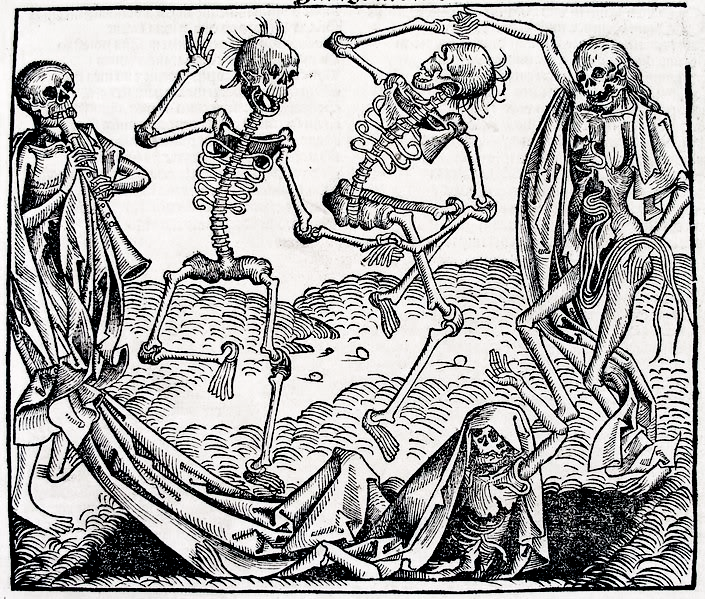

“Ring Around the Rosie” first appeared in Mother Goose in 1881. However, the origin of the poem may actually rest with the original Black Death outbreak of the mid-fourteenth century.
The Black Death struck Europe with a fury in 1347. The disease depopulated the world by at least 20% and killed between 30-60% of Europe’s population. The disease affected all areas of human life, including children’s rhymes.
The first line, “Ring around the Rosie,” describes the buboes that formed. A bubo is a swelling in the lymph node. This swelling is often circular making up the “ring.” The center turns black and is surrounded by a red rash. The “rosie” is the center of this reddish ring.
As the victim’s condition worsened, an odor emanated from them. The living began rotting before becoming a corpse. In response, healthy individuals used flowers to cover the odor. The poem recounts these attempts to disguise the smell in the second verse, “a pocket full of posies.” The posies represented fourteenth century air fresheners.
The third stanza continues to recount symptoms. In the British version, children sing “Atch chew! Atch-chew!” copying the unmistakable sound of a sneeze. The American version altered the sneeze to “Ashes! Ashes!” Some believe ashes represent cremation. However, it could simply be an Americanization of the tale.
After the disease runs its course, the victims usually die. The last line in the poem announces death’s arrival with a dramatic “we all fall down.”
You may also enjoy…

What is the Real Story of Humpty Dumpty?
One of the first rhymes learned by children is “Humpty Dumpty.” We all know that poor ol’ Humpty was an anthropomorphic egg who, despite his fragile physique, unwisely sat on a wall. The error of his ways was evident when he took a tumble and broke into bits. Also, for reasons never satisfactorily explained, the…

The Original Pinocchio Story: They All Lived Horribly Ever After
The original tale of Pinocchio differs from Disney’s adaptation. In the 1881 version, Pinocchio has a contentious relationship with Jiminy Cricket and suffers more tragic events. He burns his feet and faces near-death experiences due to his foolishness. The story’s dark tone was softened in later chapters, with Jiminy ultimately teaching Pinocchio a moral lesson.

Snow White: The Fairytale That Might Just Be a True Crime Story
Was Snow White a real person? Explore the dark origins of the classic fairy tale, from Grimm brutality to real-life German nobility, child miners, and poisoned apples. Discover the truth behind the fairest tale of them all.



Leave a Reply