
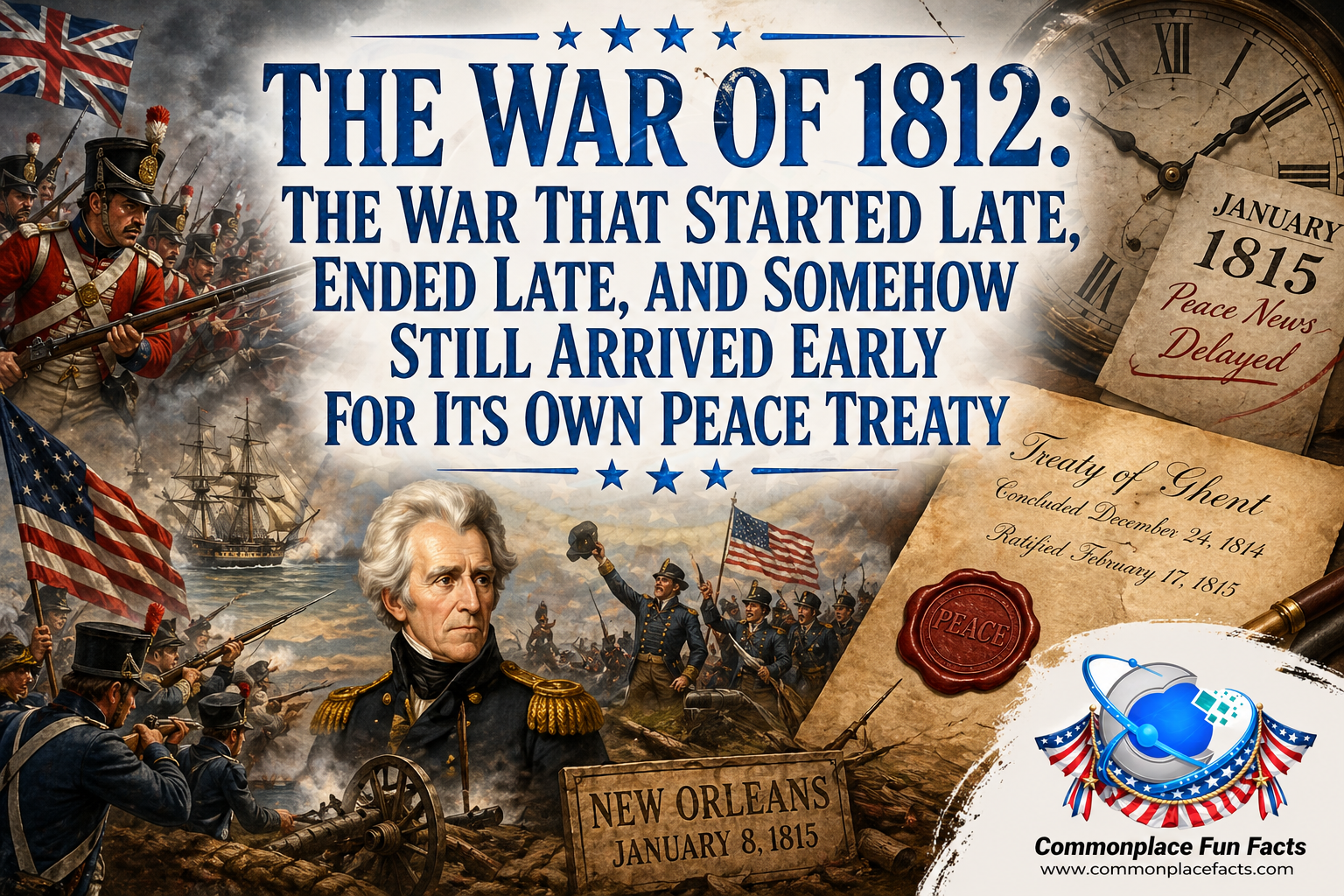

Some wars begin with a thunderclap. Some begin with a shot heard round the world. The War of 1812 began more like a badly coordinated flash mob.
Everyone was angry, nobody was entirely sure what the end goal was, and by the scheduled time for the performance, part of the reason for the whole thing had already changed.
Then, because history enjoys irony the way cats enjoy knocking things off tables, the war ended with its most famous battle being fought after the peace treaty had already been signed.
This is the story of a war that started with old news, ended with delayed news, and somehow managed to leave both sides feeling as if they had won. That last part may be the most American-British compromise imaginable.
Contents
A Young Nation With a Large Chip on Its Shoulder
By 1812, the United States was still a relatively new country. It had all the confidence of a teenager who had recently gotten his driver’s license and all the military preparedness of that same teenager attempting to parallel park a school bus.

The United States had won independence from Britain less than thirty years earlier, but the relationship between the two countries was still prickly. Britain was busy fighting Napoleon, which was the early nineteenth-century equivalent of having seventeen tabs open, all of them playing their own videos. France and Britain were locked in a global struggle, and both powers were perfectly willing to treat neutral American commerce as a mild inconvenience rather than a protected legal category.
American ships wanted to trade. Britain wanted to blockade France. France wanted to blockade Britain. Everyone wanted to claim legal superiority while seizing other people’s cargo. This is a very old diplomatic tradition known as “international relations.”
Two British policies especially enraged the United States. The first was the Orders in Council, a series of trade restrictions aimed at Napoleon’s Europe. These rules interfered with American commerce and made neutral trade feel less like neutral trade and more like participating in a game where Britain had written the rules, kept the ball, and had the referee on its payroll.
The second was impressment. The Royal Navy, desperate for sailors during its war against France, stopped American ships and took men it claimed were British subjects or deserters. Sometimes they were. Sometimes they were not. The distinction mattered tremendously to the unfortunate man being dragged onto a British warship and told, “Congratulations! You have just won an all-expenses-paid trip to maritime involuntary servitude.”
Americans called this an outrage against sovereignty and sailors’ rights. Britain called it a wartime necessity. The sailors probably had their own terminology, most of which would not be suitable for our family-friendly website.
The Orders in Council: The Problem That Left Just Before the War Arrived
Here is where the timing begins to get ridiculous.
One of the central American grievances against Britain was the Orders in Council. These trade restrictions had angered American merchants, damaged commerce, and helped push the United States toward war. President James Madison laid out American complaints against Britain, and Congress debated the question behind closed doors.
On June 18, 1812, the United States declared war on Great Britain.
There was one inconvenient thing about the timing. Two days earlier, on June 16, Britain had suspended the Orders in Council.
One of the chief complaints behind the war had already been addressed before the declaration of war was signed. Unfortunately, the Atlantic Ocean was still stubbornly pre-telegraph, and news moved at the speed of sailing vessels, weather, and whatever mood the prevailing winds happened to be in that week.
The American declaration was not based solely on the Orders in Council. That is important. Impressment remained unresolved. British interference with American ships remained a major grievance. Frontier tensions with Native nations and alleged British support for them also fueled anger in the western states. Some War Hawks looked at Canada and saw not so much a neighboring colony as a tempting real-estate opportunity with poor security.
Still, the timing is astonishing. The United States went to war partly over a policy Britain had just decided to suspend. It was not quite a war declared over a solved problem, but it was definitely a war declared before anyone had checked the latest mail.
Enter Lord Liverpool, Carrying a Bucket of Moderation Too Late
The timing becomes even more awkward when Lord Liverpool enters the picture.

Spencer Perceval, the British prime minister, was assassinated in May 1812. He remains the only British prime minister ever assassinated, a distinction that probably did not make his family feel better but does give him a permanent footnote in the “well, that escalated quickly” section of history.
After Perceval’s death, Lord Liverpool became prime minister. His government was more willing to reconsider the Orders in Council, partly because British merchants and West Indian interests had grown tired of the damage the restrictions were doing to British trade. In other words, Britain did not suddenly wake up and decide to be nice to the Americans. It simply discovered that one of its anti-American policies was also punching itself in the wallet.
Liverpool’s ministry suspended the Orders in Council on June 16, 1812. The U.S. Congress declared war on June 18. Neither side had the benefit of instant communication. The result was one of history’s great examples of bad timing: the diplomatic equivalent of sending an angry letter, then receiving the apology while the letter is already in the mailbox.
But impressment remained. Britain had not renounced the practice. The Royal Navy still claimed the right to recover British sailors from American vessels. The United States still saw that as a violation of national honor and independence. The “conscription issue,” if we use that phrase to describe impressment, was still very much alive.
So Lord Liverpool is connected to the irony, but he does not make the entire war vanish into absurdity. He helped remove one major grievance just before the shooting started. He did not remove all of them.
The First Declared War in American History
The War of 1812 was the first time the United States formally declared war on another country. This is one of those facts that sounds more impressive until you remember that the country was only about thirty-six years old and still figuring out where it had put the good silverware after the Revolution.
The vote was also deeply divided. The House approved war by a vote of 79 to 49. The Senate followed by 19 to 13. That is not exactly a nation marching forward in unanimous patriotic fervor. It is more like a nation saying, “Fine, but I want it noted in the minutes that this sounds like a terrible idea.”
New England Federalists strongly opposed the war. Their region depended heavily on trade, and war with Britain threatened their economy. Western and southern War Hawks, including figures such as Henry Clay and John C. Calhoun, tended to be more enthusiastic. They saw Britain as an arrogant empire still treating the United States as a rebellious adolescent rather than a sovereign nation. Thomas Jefferson advocated hiring arsonists to burn some of London’s most famous landmarks.
Both sides had a point. Britain had indeed been heavy-handed on the seas. The United States was also not exactly prepared to take on the world’s leading naval power while casually assuming that Canada might fall over if someone gave it a firm shove.
The Canada Plan, or “How Hard Could This Be?”
One of the great early assumptions of the war was that the United States could invade Canada without much trouble. Thomas Jefferson had famously suggested that taking Canada would be “a mere matter of marching.”

This turned out to be one of those predictions that belongs in the same category as “the check is in the mail” and “this meeting will only take five minutes.”
There had been an attempt in 1774 to invade Quebec and turn Canada into the 14th colony. The fact that we refer to the 13 colonies is a good indication that this plan did not succeed. There would later be a 1930s-era plan to invade Canada in case the U.S. ever went to war with Great Britain again. Fortunately, that plan never had to be dusted off and put to the test.
As it turned out, Canada was stubbornly uncooperative in 1812, as well. American invasions were poorly coordinated, unevenly led, and frequently embarrassing. British forces, Canadian militia, and Native allies resisted effectively. The United States discovered that geography, logistics, weather, and enemy soldiers all had a vote in the matter.
The war did produce some American naval victories that boosted morale, especially the USS Constitution, nicknamed “Old Ironsides,” whose successful engagements gave Americans something to cheer about besides congressional speeches and optimistic maps of Canada.
But on land, the war was often messy, improvised, and deeply uncomfortable. It was less “glorious second war of independence” and more “why is the supply wagon over there, the enemy over here, and the general apparently making decisions with a dartboard?”
Washington Burns, and Someone Saves the Portrait
The most humiliating moment for the United States came in August 1814, when British troops captured Washington, D.C., and burned public buildings, including the Capitol and the White House.
This was not Britain’s most subtle diplomatic communication. It was more of a flaming memo.

President Madison fled. Dolley Madison famously helped ensure that important items were removed from the White House before the British arrived, including the well-known portrait of George Washington. Read “When the British Burned the White House and Nature Fought Back: The War of 1812’s Weirdest Day” for more details about that chapter in the conflict.
The British then turned toward Baltimore. There, at Fort McHenry, American defenders withstood a British bombardment in September 1814. Francis Scott Key watched the attack and wrote the poem that became “The Star-Spangled Banner.”
This means the War of 1812 gave the United States both the burning of its capital and its national anthem. Few conflicts have been so committed to emotional whiplash.
Peace Talks in Ghent: Ending the War Without Solving the Original Problems
By late 1814, both sides had reasons to stop.
Britain had defeated Napoleon earlier that year and no longer needed to treat the American war as a sideshow to the great European struggle. The United States had endured invasion, financial strain, and political division. Neither side had achieved a crushing victory. Both had discovered that the war was expensive, irritating, and not especially productive, which is a discovery governments usually make shortly after the public already has.

Peace negotiations took place in Ghent, in present-day Belgium. The American delegation included John Quincy Adams, Henry Clay, Albert Gallatin, James A. Bayard, and Jonathan Russell. It was a formidable group, and those five men had a combined ego greater than that of most European royal courts, which is saying something in an era when hereditary monarchs still believed God had personally reviewed their job applications.
The British delegation included Lord Gambier, Henry Goulburn, and William Adams. The talks were difficult. Britain initially wanted concessions involving Native buffer territory and control of the Great Lakes. The United States resisted. Eventually, the two sides settled on a treaty that largely restored the prewar status quo.
That is the elegant Latin phrase status quo ante bellum, which means “the way things were before the war,” or, in less elegant English, “after all that, never mind.”
The Treaty of Ghent was signed on December 24, 1814. Merry Christmas, everyone. Please enjoy this peace treaty that answers almost none of the original questions.
The treaty did not force Britain to renounce impressment. It did not settle all maritime disputes in sweeping terms. It did not give the United States Canada. It did not give Britain major territorial gains. It mostly ended the shooting and restored captured territory.
In fairness, by the time the treaty was signed, impressment had become less urgent because Napoleon’s defeat reduced Britain’s need for sailors. The practical reason for the policy had faded. It is amazing how many moral awakenings arrive immediately after the logistical need disappears.
The Battle of New Orleans: The War’s Grand Finale After the Curtain Had Already Dropped
Then came New Orleans.
The Battle of New Orleans was fought on January 8, 1815, fifteen days after the Treaty of Ghent was signed. British forces under General Sir Edward Pakenham attacked American defenses commanded by Andrew Jackson near New Orleans. Jackson’s army was an unusual mix of regular soldiers, militia, free men of color, Choctaw fighters, frontier riflemen, and the privateers of Jean Lafitte.

Jean Lafitte deserves a special moment here because no war is truly complete until a pirate becomes a useful military contractor. Lafitte and his Baratarians had been smugglers and privateers operating around the Gulf Coast. The British tried to recruit him. Instead, Lafitte eventually cooperated with the Americans, offering men, supplies, and knowledge of the region.
Jackson, who was not generally known as a warm and cuddly judge of character, accepted the help. In war, yesterday’s pirate can become today’s valued logistical partner, provided he brings enough gunpowder.
The British attack on January 8 was a disaster. American forces were entrenched behind strong defensive works. The British advanced across open ground and were cut down by artillery and rifle fire. Pakenham was killed. British casualties were severe; American casualties were comparatively light. The result was a stunning American victory.
It was also completely useless in the narrow diplomatic sense, because the peace treaty had already been signed.
But that sentence needs a careful asterisk. The battle was fought after the treaty was signed, but not after the war was legally over. The treaty still had to be ratified. News of the agreement had not yet reached the armies. Communication across the Atlantic and then across the American interior took time. Nobody at New Orleans could simply refresh the State Department website and say, “Oh, look, we’re at peace. Awkward.”
The United States ratified the treaty in February 1815. Only then was the war formally ended for the United States. So the common statement that “the Battle of New Orleans was fought after the war ended” is not quite right. The better version is this: the Battle of New Orleans was fought after the peace treaty had been signed, but before the treaty had been ratified and before news had reached the armies.
That is less tidy, but history is often less tidy. It also has fewer banjos.
Why New Orleans Mattered Anyway
If the battle did not change the treaty, why did it matter?
Because perception matters. The United States had endured a war filled with frustration, division, invasion, and embarrassment. Then, at the very end, Andrew Jackson delivered a spectacular victory over veteran British troops. Americans celebrated New Orleans as proof that the republic had stood up to Britain and prevailed.
The timing actually made the victory more powerful in memory. Since news of the treaty and news of the battle arrived around the same general period, many Americans experienced peace and triumph almost together. The war did not feel like a muddled conflict ending in diplomatic exhaustion. It felt like a hard-fought contest capped by a smashing victory.
This was excellent for national morale. It was also excellent for Andrew Jackson, whose political career rose dramatically after New Orleans. Without that battle, Jackson might still have been a major military figure. With it, he became a national hero and eventually president.
The British, for their part, did not treat the War of 1812 as the defining national event Americans later made it. Britain had been fighting Napoleon, which was rather like battling a continent-sized final boss. The American war was serious, costly, and irritating, but it was not the main event from London’s point of view.
Canada remembered the war differently still. For Canadians, the successful defense against American invasion became an important part of national identity. The United States remembered the war as a second war of independence. Canada remembered it as the time the Americans showed up and were told, with varying degrees of politeness, to go home.
The Hartford Convention: When Timing Embarrassed the Critics, Too
The War of 1812’s bad timing was not limited to the battlefield.
New England Federalists, furious over the war’s damage to trade and opposed to what they saw as Republican mismanagement, gathered at the Hartford Convention in late 1814 and early 1815. Some critics later portrayed the convention as flirting with secession, though the actual proceedings were more cautious than the rumors suggested.
The delegates proposed constitutional amendments and complained about the political dominance of the southern and western states. Their grievances were not imaginary. New England had borne real economic costs from the war.
Then peace arrived. Then news of Jackson’s victory arrived. Suddenly, the Hartford Convention looked less like a principled protest and more like a group of people complaining about the music just as everyone else began dancing.
The Federalist Party never fully recovered from the stigma. The war helped produce a surge of nationalism and contributed to the so-called Era of Good Feelings. As political branding exercises go, “we met during the war and then our opponents won the victory parade” is not ideal.
Fun Facts From a War That Refused to Be Normal
The War of 1812 is sometimes neglected in American memory, perhaps because it resists easy summary. It was not a clean victory like Yorktown. It was not an obvious moral crusade. It was a complicated, regional, maritime, frontier, diplomatic, and political conflict wrapped in fog and delivered late.
But it is packed with odd details.
It gave the United States “The Star-Spangled Banner,” written by Francis Scott Key after the bombardment of Fort McHenry. It helped turn Andrew Jackson into a national celebrity. It damaged the Federalist Party. It confirmed that Canada would not be casually absorbed into the United States. It gave the USS Constitution some of its most famous victories. It included the burning of Washington, which remains one of the more dramatic reminders that national capitals should not assume enemy troops are too polite to visit.
It also produced a treaty that ended the war without directly resolving the issues that had supposedly caused it. The Orders in Council were already gone. Impressment faded as a practical issue after the Napoleonic Wars. Canada remained British. The United States remained independent. Britain remained Britain. Everyone went home and later claimed the outcome had validated their position.
That, too, is a kind of diplomatic achievement.
So Was the War Unnecessary?
Was the War of 1812 unnecessary because Britain had already suspended the Orders in Council before the United States declared war?
Not exactly.
That claim captures one piece of the irony, but it oversimplifies the causes. The Orders in Council were a major grievance, and their suspension just before the declaration of war is one of history’s great timing failures. But impressment remained unresolved. American anger over British maritime practices was real. Western resentment over frontier conflict was powerful. National honor mattered enormously in an age when countries behaved like duelists with tax systems.
So the war was not simply declared over a problem Britain had already fixed. It was declared over a bundle of problems, one of which had just been partially removed from the bundle without anyone in Washington knowing it yet.
Was the Battle of New Orleans pointless because the treaty had already been signed?
Again, not exactly.
Diplomatically, the battle did not shape the Treaty of Ghent, because the treaty had already been signed. Legally and militarily, however, the war was not yet formally over, and the armies did not know peace had been made. Politically and culturally, the battle mattered enormously. It transformed the way Americans remembered the war and turned Andrew Jackson into a national icon.
The Battle of New Orleans was unnecessary only in hindsight, which is one of hindsight’s favorite tricks. At the time, everyone involved was acting under the brutal limitations of nineteenth-century communication, wartime uncertainty, and the general human inability to know things before they happen.

The War That Became a Victory Because It Ended Well Enough
The War of 1812 began with delayed information and ended with delayed information. The United States declared war just after Britain had suspended one of the major policies that helped provoke it. The most famous American victory occurred after the peace treaty had been signed. The treaty itself restored the status quo while leaving the original grievances largely unaddressed.
On paper, that sounds like a draw wrapped in confusion and sealed with a wax stamp of bureaucratic exhaustion.
In memory, however, the war became something larger. Americans remembered standing up to Britain again. Canadians remembered resisting American invasion. The British mostly remembered Napoleon, which is understandable, since Napoleon had a habit of taking up most of the room in any historical conversation.
The real lesson of the War of 1812 may be that timing matters. News matters. Communication matters. Wars can begin because governments do not know what has just happened, and battles can be fought because armies do not know what has already been agreed.
It is tempting to laugh at the slowness of the age, but we should be careful. They had sailing ships and delayed dispatches. We have instant communication and still manage to misunderstand each other at speeds that would have astonished James Madison.
The War of 1812 was not merely a war of bad timing. But from its beginning to its end, bad timing shaped how it unfolded, how it was remembered, and how it turned a messy conflict into a national legend.
That may be the most War of 1812 thing imaginable: a war that started after one problem had already been addressed, ended before its most famous battle was fought, and still somehow convinced everyone afterward that they had gotten exactly what they came for.
You may also enjoy…

When the British Burned the White House and Nature Fought Back: The War of 1812’s Weirdest Day
Discover the fiery tale of the day the British burned the White House, Dolley Madison’s heroism, British mockery, a mythic tornado, and the truth behind the White House name. A wild chapter in U.S. history!

Shortest War Raged For 44 Minutes
What can you do with 45 minutes? You might watch an hour-long television program by skipping the commercials. You could walk three miles at an average pace. Your time could be spent whipping up a batch of chocolate chip cookies. You might choose to be truly creative and stage an accurate recreation of the Anglo-Zanzibar…

Old Hickory and the Profane Parrot
President Andrew Jackson was a colorful character. That description applies to his career in the military, his presidency, and his personal life. As it turns out, it also applied to his pets. Old Hickory retired to his home in Tennessee and kept a parrot as a pet. The bird was an excellent mimic. In addition…



Leave a Reply