
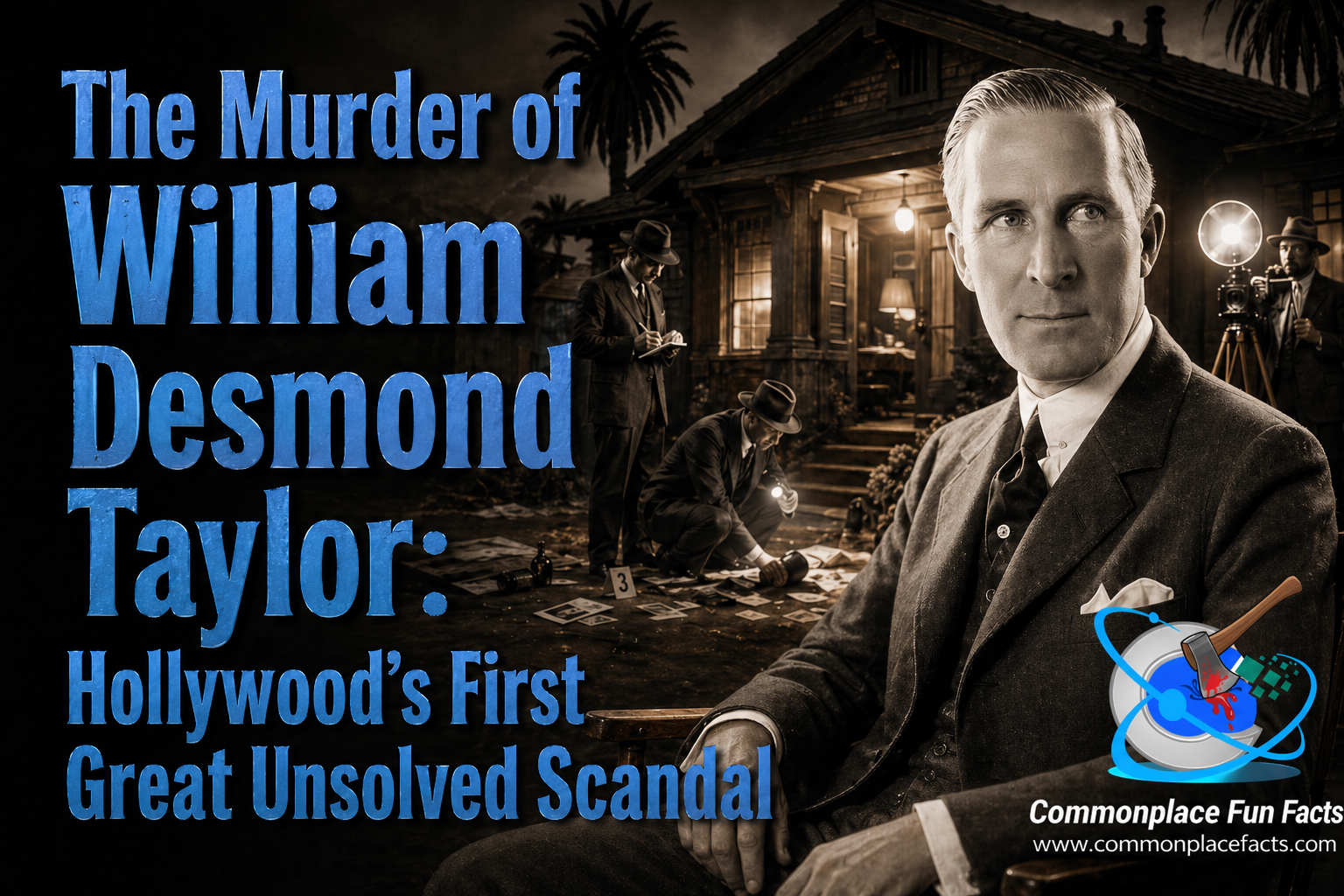

On the morning of February 2, 1922, a valet entered a handsome bungalow in Los Angeles and found one of Hollywood’s most successful directors lying dead on the floor.
It was murder, but at first, no one realized it.
This is generally considered a bad start to a homicide investigation.
The dead man was William Desmond Taylor, a respected silent-film director, former actor, wartime veteran, polished gentleman, and the sort of man people described with words like “cultured,” “disciplined,” and “mysterious,” which in old Hollywood usually meant “we are about to discover something extremely inconvenient.”
Taylor had been shot in the back inside his home at the Alvarado Court Apartments in Los Angeles. There were valuables still on his body. There was no obvious sign of a struggle. There was no smoking gun helpfully lying nearby, because real murder cases almost never have the decency to arrange themselves like stage props.
What followed was one of the most sensational scandals of early Hollywood: a murder mystery involving movie stars, secret pasts, love letters, missing evidence, drug rumors, a vanished valet, panicked studios, moral crusaders, and enough bad police work to make future detectives stare silently into the middle distance.
More than a century later, the murder of William Desmond Taylor remains unsolved.
Contents
Who Was William Desmond Taylor?
William Desmond Taylor was born William Cunningham Deane-Tanner (a name that sounds more like a prestigious law firm that bills in six-minute increments) in Ireland in 1872. That already gives us our first clue that this story is going to involve aliases, reinvention, and a lot of things going on beneath the surface.

Taylor came to America, married, had a daughter, and then—in 1908—vanished from his old life. He left behind his wife and child and eventually resurfaced under a new name. This is not ideal behavior, unless one is attempting to become the central figure in an unsolved Hollywood murder mystery, in which case it is pretty much spot on.
By the 1910s, Taylor had entered the motion picture business. He acted in films before becoming a director, and he proved very good at it. He directed dozens of silent pictures and became associated with some of the biggest names in the industry. He worked at Paramount, maintained a reputation for professionalism, and was regarded as one of the more respectable figures in a town that was already making respectability sweat through its collar.
He was elegant, reserved, well-read, and outwardly proper. He was also surrounded by people whose private lives were messy enough to make a gossip columnist sprain both wrists.
In other words, he was perfectly placed for tragedy.
The Night of February 1, 1922
On the evening of February 1, 1922, Taylor was at his bungalow at 404-B South Alvarado Street. He had visitors that day, including the actress Mabel Normand, one of the most famous women in silent comedy.
Normand later said she had stopped by to pick up a book. That detail has always given the story a strangely domestic flavor, as if the whole thing began as an innocent errand and then wandered into noir because Los Angeles was apparently short on restraint that week.
According to her account, she left Taylor’s home in the early evening. Taylor reportedly walked her to her car, and they parted on friendly terms. Not long afterward, he was shot.
His body was discovered the next morning by his valet, Henry Peavey. Taylor was lying on the floor. The first assumption was not murder. One person supposedly declared that Taylor had died of natural causes, possibly a stomach hemorrhage. Then investigators turned the body over and found the bullet wound.
That is a rather important diagnostic distinction.
“Natural causes” and “shot in the back” rarely occupy the same medical neighborhood.
The Crime Scene: A Master Class in What Not to Do

The Taylor case became famous not only because of who was involved, but because of how quickly the investigation became compromised.
In what would become something of a theme in Hollywood homicides, the crime scene descended into chaos. Before police fully secured the scene, people came and went. Studio representatives, friends, employees, and curious onlookers all had opportunities to disturb the area. Letters and personal items may have been removed. Evidence was handled. The body was moved. It was a far cry from what should have been a sterile forensic environment.
It was treated more like a very awkward open house.
This mattered because the murder had all the signs of a case that needed careful handling. Taylor’s valuables were still present, making robbery look unlikely. His money, watch, ring, and other items remained on or near him. That suggested the killer either had another motive or had been interrupted before taking anything.
There was no forced entry. Taylor may have known the person who killed him. Or the killer may have been someone familiar enough with Taylor’s household to approach without raising alarm.
There were witness statements, but they conflicted. Some neighbors reported hearing a sound. Some saw a person leaving. The details were murky, and the passing years have not made them clearer. History is inconsiderate that way.
Enter Mabel Normand
The first famous name attached to the case was Mabel Normand, one of silent Hollywood’s great comic stars and, by 1922, someone who had developed an unfortunate habit of being near the blast radius of major scandals.

To be clear, Normand was not the villain in these stories. She was never convicted of anything connected with them, and in the Taylor case police eventually ruled her out as a suspect. But if early Hollywood scandals were a parade, Mabel Normand somehow kept finding herself seated on the lead float, waving awkwardly while the newspapers sharpened their adjectives.
Her first major brush with scandal came through Roscoe “Fatty” Arbuckle, her frequent co-star and one of the biggest comedy stars in the world. Arbuckle was charged with manslaughter after the 1921 death of actress Virginia Rappe following a party in San Francisco. He was tried three times. The first two trials ended in hung juries; the third ended in acquittal, with the jury taking the unusual step of issuing a statement saying that a great injustice had been done to him.
That did not save his career. Arbuckle’s films were temporarily banned, and his reputation never fully recovered. Since Normand had made many of her best-known films with him, some of her own work was swept into the same public-relations bonfire. She had done nothing wrong, but guilt by association has always been one of Hollywood’s least charming supporting characters.
Then came William Desmond Taylor.
Normand and Taylor had developed a close friendship, reportedly based in part on their shared love of books. On the evening of February 1, 1922, she visited Taylor at his bungalow and left around 7:45 p.m., carrying a book he had lent her. Witnesses said she departed in good spirits, and Taylor walked her to her limousine. They reportedly blew kisses to each other as she drove away.
It was charming, affectionate, and, in hindsight, catastrophically inconvenient.
Normand became the last person known to have seen Taylor alive. The Los Angeles Police Department questioned her intensely but eventually ruled her out. Most later writers have done the same. Still, being cleared by police did not mean being cleared by the public, which has never required evidence when a perfectly good rumor is standing nearby looking employable.
Some writers have suggested that Taylor may have been trying to help Normand deal with an alleged cocaine dependency and may have been preparing to assist authorities in pursuing her suppliers. Under that theory, Taylor was killed by drug dealers who feared exposure. Other historians have been skeptical, arguing that the drug-dealer theory may have been encouraged by studio interests eager to steer attention away from more embarrassing suspects. Hollywood, when cornered, has never been shy about writing a better plot for itself.
Whatever the truth, Normand was devastated. George Hopkins, who sat beside her at Taylor’s funeral, later said she wept inconsolably.
And then, because apparently the universe had not finished using Mabel Normand as a scandal magnet, there was the Dines shooting.
In 1924, millionaire oil broker Courtland S. Dines was shot and wounded by Normand’s chauffeur, Joe Kelly. The weapon used was Normand’s pistol. Dines survived, but the damage to Normand’s career was immediate. Several theaters pulled her films, and Ohio’s state censorship board banned them.
So within a few short years, Normand had been connected—again, not as the perpetrator, but as a conspicuous nearby presence—to the Arbuckle trials, the Taylor murder, and the Dines shooting. That is not a criminal record. It is more like having history repeatedly spill soup on you and then blame you for standing too close to the kitchen.
Her career never fully recovered. Her health declined, and she died in 1930 at the age of 37. The Taylor murder did not kill Mabel Normand, but it helped bury the public image of one of silent film’s most talented performers under a heap of suspicion, innuendo, and newspaper ink.
Mary Miles Minter and the Love Letters
The second major actress pulled into the case was Mary Miles Minter.
Minter was a young silent-film star with a delicate, innocent screen image. She was marketed as sweet, pure, and girlish—the sort of actress audiences were encouraged to imagine had never encountered an improper thought, let alone a studio publicity department.

She was also reportedly infatuated with Taylor.
After the murder, letters from Minter to Taylor were discovered. The letters were emotional, intimate, and embarrassing enough that they became part of the mythology of the case. Depending on the version one reads, some of them were removed from the scene before police properly documented everything.
This is where the investigation begins to resemble a drawing-room farce, except that someone is dead and no one is being charming enough to justify the confusion.
Minter denied any involvement in Taylor’s death. She was never charged. Still, the scandal damaged her career. The image of innocent girlhood did not survive well in a case involving secret letters to a murdered older director.
Silent Hollywood was discovering one of the great laws of celebrity scandal: the public loves a fantasy until it discovers the human being underneath, at which point it feels personally betrayed and demands refunds from reality.
Charlotte Shelby: The Stage Mother With a Motive?
If Mary Miles Minter was the ingénue, her mother, Charlotte Shelby, was the formidable stage mother.
Shelby has long been one of the most discussed suspects in the Taylor case. She was intensely involved in her daughter’s career and reputedly protective, controlling, and deeply unhappy about Mary’s attachment to Taylor.
The theory is straightforward: Shelby feared that Taylor was damaging her daughter’s career, reputation, or emotional stability, and she decided to remove him from the equation.
There were rumors that Shelby owned a gun that may have matched the murder weapon. There were claims, accusations, and later recollections. Some writers have treated her as the most plausible suspect. Others have urged caution, noting how much of the case rests on unreliable testimony, gossip, delayed statements, and the irresistible human desire to organize chaos into a satisfying villain.
Shelby was never charged.
Still, as suspects go, she has always had dramatic advantages. A possessive mother, a vulnerable starlet daughter, a respected director, secret letters, and a murder at twilight—this is the kind of setup that would make even a mediocre screenwriter sit up and say, “Fine, I’ll take the meeting.”
Edward Sands: The Missing Valet
Then there was Edward F. Sands, Taylor’s former valet.

It would be almost too convenient if Edward Sands turned out to be the killer. After all, detective fiction had not yet fully beaten the phrase “the butler did it” into the carpeting, but Sands was close enough to qualify for the household-staff division. He had worked for Taylor, knew the layout of the home, had allegedly stolen from him, and then vanished with the sort of timing that makes police officers develop facial tics. If this were a mystery novel, an editor might reject him as too obvious. Unfortunately, real life has never felt obligated to avoid clichés.
He had motive. He had knowledge of Taylor’s home. He had a criminal background. He had a history with the victim. He vanished.
The problem is that “tempting” is not the same thing as “proven,” a distinction that has inconvenienced many a true-crime enthusiast.
Sands may have killed Taylor. He may have had nothing to do with it. He may have been dead by then, hiding under another name, or simply far away from Los Angeles and delighted that everyone was too busy staring at movie stars to find him.
His disappearance left behind a perfect vacuum, and history hates a vacuum. It fills it with theories.
Henry Peavey and the Ugly Side of the Investigation
Henry Peavey, Taylor’s valet at the time of the murder, discovered the body. He was also questioned and, like several others, came under public suspicion.

Peavey was Black and gay, living in a time when either fact could make a person vulnerable to police pressure, press cruelty, and public suspicion. Newspaper coverage of him was often mocking and demeaning. He was treated not merely as a witness but as a spectacle.
There were efforts to extract information from him, including sensational episodes that reflected more about the prejudices and investigative methods of the period than about the actual murder.
Peavey was never charged with Taylor’s killing. His role in the story is a reminder that scandal journalism has always been happy to turn vulnerable people into scenery.
Hollywood was not the only institution behaving badly in this case. It merely had better lighting.
Hollywood in Crisis
The Taylor murder came at a terrible time for the movie industry.
Only months earlier, Roscoe “Fatty” Arbuckle had been accused in connection with the death of actress Virginia Rappe after a party in San Francisco.
Then came Taylor’s murder.
Then came additional scandals involving drugs, sex, suspicious deaths, divorces, and the general realization that movie stars were not, in fact, handcrafted porcelain examples of middle-class virtue.
For moral crusaders, this was proof that Hollywood had become a modern Babylon. Or Sodom. Or Rome under one of the more flamboyantly terrible emperors. The metaphor varied depending on which civilization the editorial writer wished to accuse of insufficient zoning standards.
The public loved the movies. It also loved being scandalized by the people who made them. This created a useful cycle: audiences bought tickets to see stars, bought newspapers to read about their sins, and then complained that the whole system was corrupt. It was an early version of doomscrolling, except the paper could be folded and used to wrap fish.
The studios panicked. They feared government censorship and public backlash. They needed someone to reassure America that Hollywood could regulate itself.
Enter Will H. Hays.
The Hays Office and the Long Shadow of Scandal
In 1922, the film industry hired Will H. Hays, a former Postmaster General and Presbyterian elder, to clean up Hollywood’s image. This led to the Motion Picture Producers and Distributors of America and eventually to the Production Code system, often remembered as the Hays Code.

The Taylor murder did not single-handedly create Hollywood censorship. History is rarely that tidy, no matter how much we beg it to behave. But the case was part of the scandal atmosphere that pushed the industry toward self-regulation.
Hollywood’s problem was not merely that one director had been murdered. It was that the investigation seemed to confirm every suspicion critics already had: drugs, illicit romance, secret lives, missing evidence, studio interference, and movie stars behaving as if publicity departments were a substitute for commandments.
The studios understood something important: audiences could tolerate fictional sin, provided it was punished before the final reel. Real-life sin was trickier, especially when it involved famous people, dead bodies, and newspapers printing every rumor that could stagger into the composing room.
Why the Case Was Never Solved
The murder of William Desmond Taylor remains unsolved for several reasons.
First, the crime scene was mishandled. Evidence may have been removed or disturbed before police could properly evaluate it. That alone placed a permanent fog over the investigation.
Second, many of the people involved had reputations to protect. Actors, mothers, studio officials, employees, and friends all had reasons to shape the story in ways that made themselves or their employers look less disastrous.
Third, the newspapers were not passive observers. They were active participants in creating the legend. Sensational coverage encouraged witnesses to talk, exaggerate, hide, panic, or remember things that may not have happened.
Fourth, the technology of the era was limited. There was no modern forensic testing, no security footage, no cell phone data, no DNA evidence, and no convenient doorbell camera capturing the killer while he muttered, “This will surely remain unsolved for over a century.”
Finally, the case had too many plausible stories and not enough hard proof.
Was it Charlotte Shelby, trying to protect or control her daughter?
Was it Edward Sands, returning for revenge or robbery?
Was it someone connected to Mabel Normand’s drug problems?
Was it a jealous lover?
Was it someone else entirely?
All of these theories have had their defenders. None has produced the final, satisfying click of certainty.
The Curious Problem of Taylor Himself
Part of what keeps the Taylor case alive is that Taylor himself remains elusive.
He was respectable, but he had abandoned an earlier life. He was admired, but he had secrets. He was kind to some, stern with others, and apparently capable of inspiring deep loyalty, resentment, affection, and obsession.
He moved through Hollywood as a gentleman, but he had constructed himself from pieces of reinvention. That does not make him guilty of anything. It does make him fascinating.
In many murder mysteries, the victim is treated as a fixed object around whom suspects orbit. In Taylor’s case, the victim keeps shifting. Was he a reformer trying to help Mabel Normand escape drugs? Was he the object of Mary Miles Minter’s doomed affection? Was he a wronged employer seeking justice against Edward Sands? Was he a man whose hidden past finally caught up with him?
The answer may be yes, no, or “please stop asking; the files are already a mess.”
The Case That Became a Hollywood Template
The Taylor murder helped establish a pattern that Hollywood scandals would follow for the next century.
First comes the shocking event.
Then comes the official statement asking for privacy.
Then come the rumors.
Then the press discovers letters, parties, substances, relationships, private habits, strange employees, missing documents, and at least one person who has “left town unexpectedly.”
Then the public pretends to be horrified while reading every available detail.
Then the industry promises reform.
Then everyone waits for the next scandal.
The Taylor case did not create celebrity culture, but it revealed how powerful it had already become. People who had never met Taylor, Normand, Minter, or Shelby felt personally invested in the story because they knew their faces from the screen. Silent film made stars seem intimate. Scandal made them seem real.
That combination was irresistible.
So Who Killed William Desmond Taylor?
The honest answer is that we do not know.
Charlotte Shelby remains a favorite suspect for many writers. Edward Sands remains deeply suspicious. Other theories involve drug dealers, lovers, blackmailers, and unnamed figures moving through Taylor’s complicated private world.
Each theory has strengths. Each has weaknesses. Each requires the historian to step over gaps in the evidence with the confidence of a cat burglar crossing a rain gutter.
The official case remains unsolved.
That may be frustrating, but it is also why the story endures. A solved murder becomes history. An unsolved murder becomes mythology.
William Desmond Taylor’s death sits at the intersection of both: a real man killed in a real room, and a legend built from everything Hollywood wanted hidden and everything the public wanted exposed.
The Final Reel
William Desmond Taylor was buried at Hollywood Cemetery, now known as Hollywood Forever Cemetery. That name feels almost too on the nose, given how stubbornly his story has refused to die.
His murder damaged careers, fed gossip columns, strengthened moral crusades, and helped convince the movie industry that it needed to polish its public halo before someone else did it with a shovel.
The case remains one of early Hollywood’s defining mysteries not because it was the only scandal of the era, but because it had everything: fame, beauty, secrecy, panic, corruption, incompetence, and a dead man who had reinvented himself so thoroughly that even his life seemed to contain missing reels.
On February 1, 1922, someone walked into William Desmond Taylor’s bungalow and shot him.
That much we know.
Everything after that became Hollywood.
You may also enjoy…

The First Hollywood Murder Trial and the Fictional Lawyer It Inspired
The scandal captured the headlines of newspapers around the world. The Los Angeles celebrity was accused of trying to kill his wife. The evidence against him was overwhelming. It seemed only a matter of time before he would trade his wealth and fame for a prison cell and disgrace. Every lawyer recommended that he take…

Hollywood Before the Hays Code: The Party Before the Chaperone
Discover Pre-Hays Code Hollywood (1929–1934), when movies flaunted sex, crime, and scandal before censorship took hold. Explore the films, stars, and controversies that made this era unforgettable.

The Lana Turner Murder Scandal: The Sweater Girl Meets Hollywood Noir
A noir-era Hollywood tragedy: Lana Turner, the “sweater girl,” mob shadows, and the Johnny Stompanato killing that shattered studio-era illusions.




Leave a Reply