
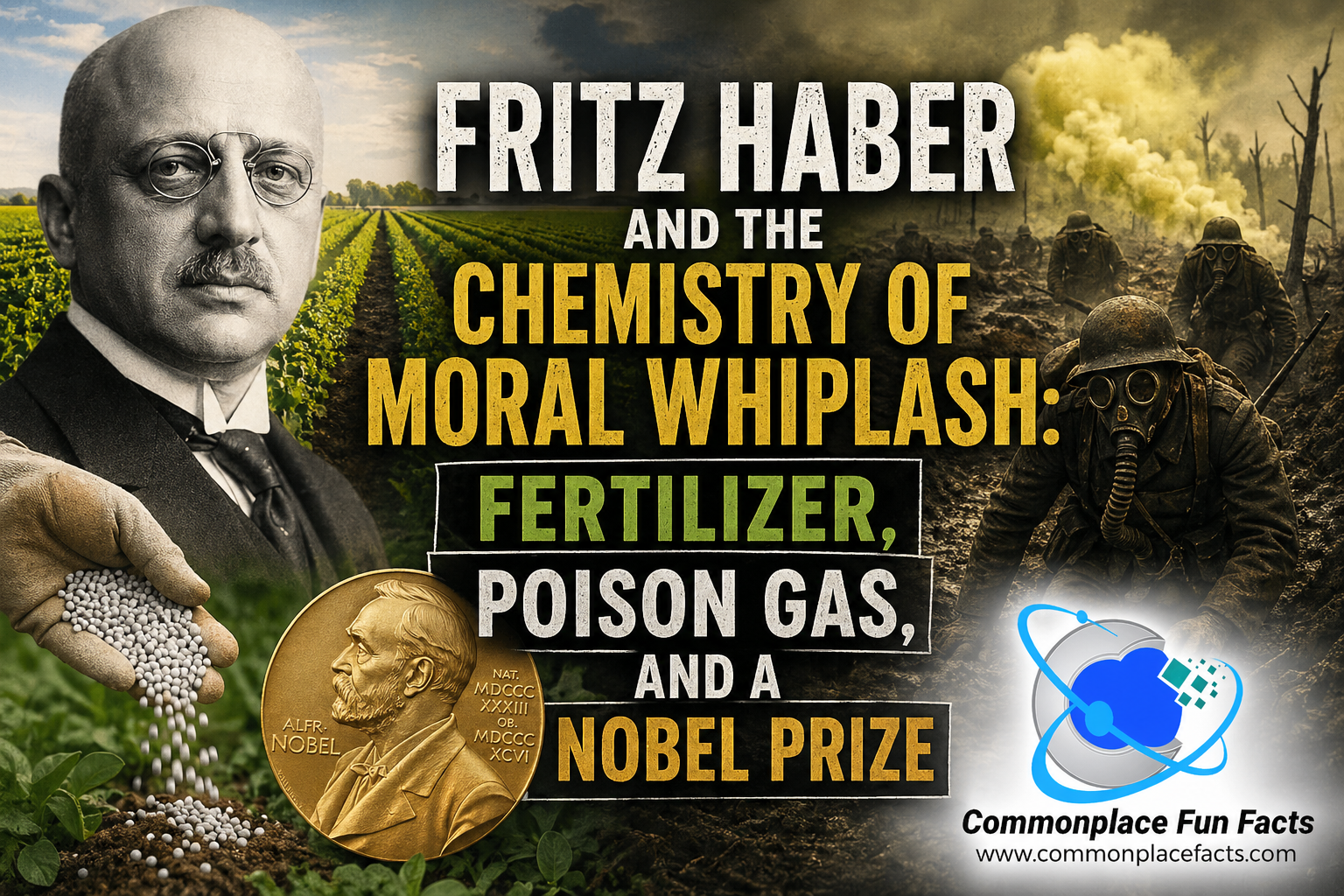

We like being able to give labels to people. Hero or villain. Philanthropist or sociopath. Good or evil. These labels create the comforting illusion that we can know everything about someone based on one or two of their deeds.
Unfortunately, it is exactly that: an illusion. Rarely do you find anyone who is entirely one thing or another. Even the noblest gentleman can be corrupted, and even the vilest fiend can perform an act of compassion.
Humans are stubbornly uncooperative when it comes to staying in a box.
Fritz Haber is one of those people. Try to place him in the “great benefactor of humanity” box, and the chlorine gas starts leaking out. Try to file him under “monster of modern warfare,” and suddenly half the modern world’s dinner plate starts waving from the evidence table.
Haber was the German chemist whose breakthrough with synthetic fertilizer was so important that modern agriculture still depends on it. His work helped humanity solve one of the great looming food crises of the early twentieth century. It also earned him the Nobel Prize in Chemistry.
He was also one of the central architects of chemical warfare in World War I. He championed the use of poison gas, helped develop it, and was personally involved in its battlefield deployment.
In other words, Fritz Haber used chemistry to pull food from the air and death from the same place. That is not the sort of résumé one submits without expecting follow-up questions.
Contents
The World Had a Nitrogen Problem
To understand why Haber was such a big deal, we need to talk about nitrogen, which is not usually how anyone begins a thrilling tale unless they are either a chemist, a farmer, or someone trapped in an elevator with both.

Nitrogen is essential for plant growth. Without it, crops struggle. With enough of it, fields become much more productive. The problem is that the atmosphere is mostly nitrogen, but plants cannot simply grab it out of the air and use it. Atmospheric nitrogen is chemically stubborn. It lounges around in the sky like the adult offspring who moves back into the parents’ basement and refuses to contribute toward the household expenses.
For centuries, farmers depended on natural sources of nitrogen: manure, compost, crop rotation, and later deposits of guano and nitrates. Guano, for those fortunate enough not to have built their vocabulary around bird poop, was immensely valuable as fertilizer. So valuable, in fact, that nations took a keen interest in remote islands covered in the stuff. Nothing says “civilization is progressing nicely” quite like imperial ambition directed at hardened seabird droppings.
By the late nineteenth and early twentieth centuries, however, the world was facing a serious question: how could modern agriculture keep feeding a growing population if natural nitrogen sources were limited? The concern was not imaginary. Scientists and policymakers worried that food production would eventually hit a wall. The world needed a way to make usable nitrogen on demand.
This is where Fritz Haber enters the story, wearing a lab coat and carrying both a solution and a future ethical migraine.
Turning Air Into Bread
Haber’s great achievement was figuring out how to synthesize ammonia from nitrogen and hydrogen. In simplified terms, he found a way to take nitrogen from the air and combine it with hydrogen under high pressure and high temperature, using a catalyst, to produce ammonia. Ammonia could then be used to make fertilizer.

This was not merely a clever laboratory trick. It was one of the most consequential chemical breakthroughs in human history. Once Carl Bosch and BASF scaled Haber’s laboratory process into industrial production, the Haber-Bosch process became the foundation of modern synthetic fertilizer.
That phrase — “synthetic fertilizer” — does not sound emotionally stirring. It sounds like a name for a rock band that rarely performs anywhere other than their garage. But the impact was enormous. Synthetic nitrogen fertilizer transformed agriculture. It made it possible to grow far more food on the same land. It helped feed billions of people. Modern population levels would be difficult, perhaps impossible, to sustain without it.
So if you ate today, there is a statistically uncomfortable chance that Fritz Haber had something to do with it.
This is the first half of the moral whiplash. Haber’s work helped rescue humanity from a looming food problem. He gave agriculture access to nitrogen on an industrial scale. He helped make the modern food supply possible. He turned air into bread.
That alone would have made him historically important. But history, never content to leave a good résumé unspoiled, kept going.
The Fertilizer Miracle Had a Darker Twin
The trouble with chemical breakthroughs is that molecules do not care about our moral categories. Ammonia can become fertilizer. Ammonia can also become explosives. Nitrogen compounds can nourish wheat or help manufacture munitions. The same industrial process that helped farmers could also help armies.
This is one of the recurring problems of modern science: the universe keeps handing us tools without attaching a “Good Use Only” sticker. Chemistry is particularly bad about this. It will help you grow potatoes in one room and manufacture battlefield horrors in the next, then stare blankly when asked to explain itself.
During World War I, the Haber-Bosch process became strategically valuable to Germany. Before the war, Germany relied heavily on imported nitrates, especially from Chile. Once the British naval blockade cut off many imports, synthetic ammonia became critically important. It helped Germany produce fertilizers, yes, but also explosives. Haber’s breakthrough helped keep Germany’s war machine running.
That does not erase the agricultural achievement, but it complicates the inspirational poster version. Haber did not merely make bread from air. He helped make war from air, too.
Still, even that is not the part that makes Haber’s legacy so profoundly disturbing. His ammonia work had military uses, but many scientific discoveries have military uses. The more direct issue is that Haber did not stop at dual-use chemistry. He became an enthusiastic advocate for a particularly troubling type of weapon.
If this all feels vaguely familiar, it should. The uneasy coexistence of “we feed the world” and “we helped invent new ways to ruin it” is not unique to Haber. American industry had its own version of this identity crisis. As explored in this look at DuPont’s efforts to polish its public image, the company spent years trying to remind people that it made useful, everyday products while quietly hoping everyone would stop bringing up its role in chemical warfare. It turns out that once your résumé includes both “improves daily life” and “participated in industrialized destruction,” the marketing department has its work cut out for it. Haber, lacking a corporate PR team and a reassuring radio program, had no such luxury.
Enter the Gas Cloud
World War I was already a slaughterhouse before poison gas became one of its signature horrors. Machine guns, artillery, barbed wire, and trench warfare had turned Europe into an industrialized meat grinder. Armies were searching for ways to break stalemates, and Haber believed chemistry could do what bullets and shells had not.
His answer was chlorine gas.

On April 22, 1915, during the Second Battle of Ypres (read “The Unkillable General Adrian Carton de Wiart” to learn more about some of the drama of that era), German forces released chlorine gas from thousands of cylinders positioned along the front. A greenish-yellow cloud drifted toward Allied lines. Soldiers who inhaled it found their lungs attacked by acid-forming chemistry. Chlorine reacts with moisture in the respiratory system, damaging tissue and making breathing agonizing. Men coughed, choked, panicked, and fled. The line broke.
It was one of the first large-scale uses of poison gas in modern warfare, and Haber had helped make it happen.
This was not a case of a scientist inventing something harmless that others later misused. Haber was not sitting in his laboratory saying, “Well, this will certainly improve municipal water treatment,” while generals twirled mustaches in the next room. He actively supported the weaponization of gas. He helped organize Germany’s chemical warfare program. He believed poison gas could be an effective military tool.
He also defended it morally.
Haber argued, in essence, that killing with gas was not fundamentally different from killing with bullets or artillery. War was war. Death was death. If poison gas could end the conflict more quickly, perhaps it was even defensible.
This is the kind of argument that can sound tidy when arranged on paper and monstrous when arranged across a battlefield full of choking men. It has the chilly elegance of a mind that can compare categories while politely ignoring screams.
The “Humane Weapon” Argument, Because Apparently We Needed That
One of the stranger and more unsettling aspects of Haber’s thinking was the idea that chemical weapons might be more humane than conventional weapons if they ended battles quickly. This was not an uncommon style of argument among advocates of new military technologies. Every generation seems to produce someone who insists that the latest way of killing people is actually merciful because it will make war so awful that everyone will stop doing it.
This theory has an impressive historical record of being immediately disproved by everyone continuing to do it.
After Ypres, chemical warfare did not end the war. It escalated. Both sides developed and deployed gas weapons. Chlorine was followed by phosgene and mustard gas. Gas masks became part of the grim wardrobe of trench warfare. The battlefield adapted, as battlefields tend to do, because war is very good at taking innovations meant to be decisive and turning them into one more layer of misery.
Haber’s confidence in chemical warfare came from his experience as a chemist and fostered the belief that technical superiority could solve human conflict. If the right formula is found, the right catalyst chosen, the right delivery system perfected, then perhaps victory can be manufactured. The trouble is that people keep being involved, and people are famously resistant to behaving like controlled laboratory materials.
Clara Immerwahr and the Tragedy at Home
No account of Fritz Haber can avoid Clara Immerwahr, his wife, though she deserves to be remembered as more than a tragic footnote in his biography.

Clara was a chemist herself, one of the first women in Germany to earn a doctorate in chemistry. That alone was a remarkable achievement at a time when higher education for women was still treated by many as a charming novelty, like teaching a cat to play chess. She was intelligent, scientifically trained, and deeply aware of what chemistry could become in the service of the state.
Her marriage to Haber was unhappy. Her own scientific career was largely submerged beneath the expectations placed on her as his wife and the mother of their son. Haber’s work consumed him, and the war consumed his work.
Clara is often portrayed as having opposed Haber’s chemical warfare program on moral grounds. The broad picture seems fair: she was troubled by the militarization of science and by Haber’s role in it. Some later retellings make the story more dramatic, presenting her suicide as a direct protest immediately after the chlorine gas attack at Ypres. The timing certainly invites that interpretation, but the evidence for her exact motivations is more complicated than the simplified version suggests.
The core facts are tragic enough without turning them into a stage play. After Haber returned from the front, Clara took his military pistol and killed herself, dying in the arms of their 13-year-old son.
It is difficult to imagine a more devastating domestic counterpoint to Haber’s public triumphs. While he was being celebrated in military and scientific circles, his family and personal life were collapsing under the weight of ambition, war, and despair.
The story of Clara Immerwahr pulls Haber’s legacy out of the abstract. “Chemical warfare” can become a phrase in a textbook. “Nobel Prize” can become a medal in a museum. But Clara reminds us that the costs of Haber’s world were not confined to trenches. They reached into laboratories, marriages, careers, and children’s lives.
The Nobel Prize With a Cloud Over It
In 1918, Haber was awarded the Nobel Prize in Chemistry for the synthesis of ammonia from its elements. Scientifically, the award made sense. His discovery was monumental. It changed agriculture, industry, and the future of human population growth.
Morally, the timing was explosive.

The war had just ended. Chemical weapons had horrified the world. Haber’s role in gas warfare was known. Yet the Nobel Committee honored him for the ammonia synthesis work. The award effectively asked the world to separate Haber the agricultural savior from Haber the chemical warfare advocate.
That separation was difficult then, and it remains difficult now.
On one hand, the Nobel Prize recognized one of the most important chemical achievements ever. On the other hand, the recipient had used his scientific brilliance in the service of battlefield poison. It is like giving a fire safety award to someone who also moonlights as a dragon.
The Haber Nobel controversy raises an uncomfortable question that has never really gone away: can scientific achievement be evaluated apart from the moral conduct of the scientist? Sometimes the answer may be yes. Sometimes it may be no. Sometimes, in Haber’s case, the answer appears to be “please stop asking—this is making the award banquet awkward.”
What makes Haber especially difficult is that his good and bad legacies were not separate hobbies. They came from the same worldview: science harnessed for national power, industrial scale, and practical results. Haber believed chemistry should serve the state. During peace, that could mean fertilizer. During war, that could mean gas.
The line between service and horror turned out to be thinner than advertised.
A German Patriot Rejected by Germany
Haber was born into a Jewish family but converted to Christianity. He identified deeply with Germany. During World War I, he was intensely patriotic and devoted himself to the German war effort. He wanted to serve his country, and he did so with a ferocity that left permanent stains.
Then came the Nazis.
In 1933, Nazi racial laws began forcing Jewish scientists and academics out of their positions. Read “How to Hide a Nobel Prize: The Incredible WWII Story of Gold, Acid, and Survival” for some examples.
Haber, despite his conversion, his patriotism, his Nobel Prize, and his wartime service, was Jewish under Nazi racial ideology. The state he had served decided he did not belong.
At the Kaiser Wilhelm Institute, Haber was expected to dismiss Jewish staff members. Instead, he resigned. He left Germany, ill and broken, and died in 1934 while abroad.
The irony is so bitter it practically needs a warning label. Haber had devoted himself to Germany. He had given Germany strategic tools in war. He had believed in service to the nation. Then Germany’s new rulers looked at him and saw not a patriot, not a Nobel laureate, not a servant of the state, but a Jew.
Haber gave Germany poison gas, synthetic fertilizer, and wartime industrial chemistry. Germany thanked him by deciding he was not German enough.
The Zyklon B Shadow
There is another grim historical association that must be handled carefully. Haber’s institute was involved in research related to pesticides and fumigants, and later Zyklon B became infamous as the gas used by Nazi Germany in extermination camps.
Haber did not create Zyklon B for genocide. He died in 1934, before the Holocaust. It would be inaccurate and unfair to claim that he knowingly contributed to that specific horror.
However, the shadow remains because Haber’s career sits at the intersection of chemistry, state power, industrial killing, and moral blindness. He helped normalize the idea that science could be mobilized to poison enemies in the service of national goals. Later, under a regime that rejected him, industrialized killing reached depths even World War I had not imagined.
The point is not that Haber caused what came later. History rarely works with such neat arrows. The point is that his life shows how scientific systems built for control, efficiency, and state violence can move in directions their architects may not foresee — or may refuse to foresee.
The Legacy We Still Eat
Haber’s legacy did not end with his death. Every year, the Haber-Bosch process continues to make ammonia for fertilizer. Modern agriculture remains deeply dependent on synthetic nitrogen. Billions of people are fed because humanity learned how to manufacture reactive nitrogen at industrial scale.
That achievement is staggering. It is also environmentally complicated. The Haber-Bosch process consumes enormous amounts of energy, much of it tied to fossil fuels. Synthetic fertilizer has helped increase food production, but nitrogen runoff contributes to water pollution, algal blooms, and ecological disruption. Nitrous oxide, connected to nitrogen fertilizer use, is also a potent greenhouse gas.
So even Haber’s “good” legacy is not simple. It feeds the world, but it comes with costs. Humanity escaped dependence on guano islands and nitrate deposits by creating a new dependence on industrial chemistry, energy systems, and global fertilizer supply chains. Progress arrived, as it often does, wearing a medal on the front and an invoice taped to the back.
This does not mean the Haber-Bosch process was a mistake. Without it, the modern world would face food shortages on a terrifying scale. But it does mean that Haber’s legacy is not safely confined to history books. It is in fields, rivers, grocery stores, energy markets, climate debates, and dinner plates.
Few people have ever shaped the modern world so profoundly while remaining so morally difficult to summarize in under 200 words.
So Was Fritz Haber a Hero or a Villain?
The tempting answer is to choose a side. Hero or villain. Savior or monster. Bread-maker or gas-maker. Humanity likes categories because they save time, and allow us to pretend that people can fit neatly into a single genre.
But Fritz Haber resists easy classification.
He was brilliant. He was ambitious. He helped feed billions. He advanced chemistry in ways that changed civilization. He also eagerly applied his genius to chemical warfare. He did not merely stumble into the darker uses of science; he marched toward them with patriotic conviction and technical enthusiasm.
He was a Nobel laureate whose discovery helped sustain modern agriculture. He was also a war scientist whose work helped inaugurate one of the most horrifying chapters in military history. He was a German patriot discarded by Germany. He was a Jewish-born scientist whose service to the state could not protect him from antisemitism. He was a husband connected to one of the most tragic domestic stories in the history of science.
That is why Haber matters. Not because he can be reduced to a tidy moral lesson, but because he cannot.
His life forces us to confront the uncomfortable truth that scientific genius is not the same thing as wisdom. Intelligence does not guarantee moral clarity. Technical brilliance can solve one problem while creating another. A discovery can nourish fields and arm empires. A scientist can be right about chemistry and catastrophically wrong about humanity.
Fritz Haber helped make the modern world possible. That is the problem.
We live in the world he helped create: better fed, more technologically powerful, more chemically capable, and still trying to decide whether we are wise enough to survive our own cleverness.
History gave Fritz Haber a Nobel Prize, a battlefield, a tragedy, an exile, and a legacy that refuses to behave itself. He remains one of the clearest examples of the double-edged nature of science — except in his case, the edge was sharpened in a laboratory, scaled by industry, and released into the wind.
Some scientists leave behind monuments. Fritz Haber left behind harvests, gas masks, moral arguments, and a question humanity is still answering badly:
What happens when the power to save the world and the power to poison it come from the same mind?
You may also enjoy…

How to Hide a Nobel Prize: The Incredible WWII Story of Gold, Acid, and Survival
Learn how two Nobel Prizes were dissolved in acid during WWII to hide them from the Nazis—and how chemistry saved gold meant for peace.

The Glorious Folly of the Battle of the Somme: A Million Casualties for Six Miles
Discover the tragic absurdity of the Battle of the Somme, where over a million casualties gained just six miles of ground. A darkly humorous look at one of WWI’s deadliest—and most baffling—offensives.

The Unkillable General Adrian Carton de Wiart
Meet Adrian Carton de Wiart — a soldier who was literally unstoppable.



Leave a Reply