
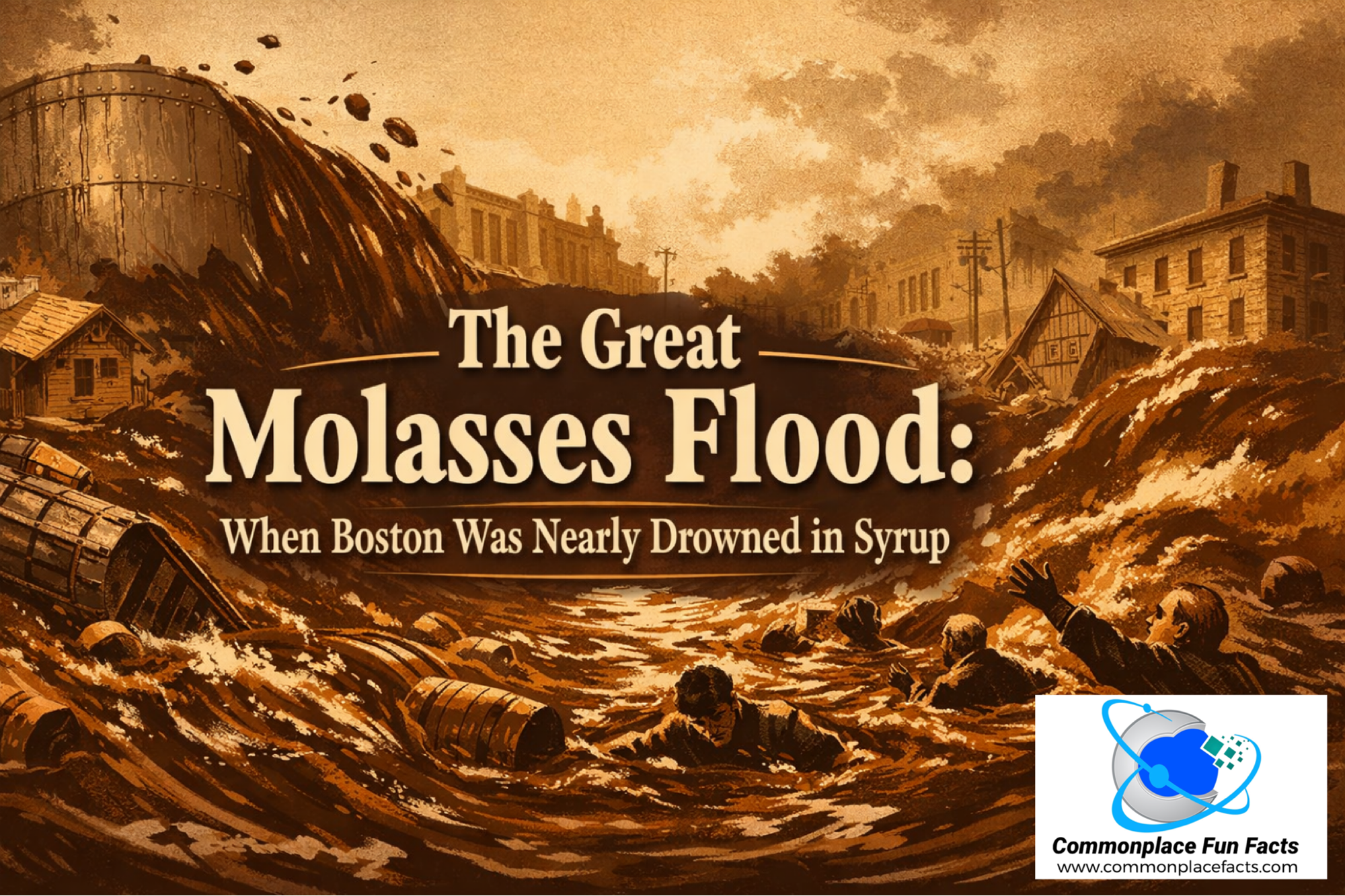

On January 15, 1919, Boston learned—suddenly and fatally—that molasses is not merely a baking ingredient. Under the right circumstances, it is an urban hazard.
Shortly after 12:30 p.m., a massive industrial storage tank near Keany Square in the city’s North End burst open, releasing more than two million gallons of molasses into the surrounding streets. What followed was not a metaphor, not a journalistic flourish, and not an exaggerated tall tale that grew with each retelling. It was a literal wall of syrup that tore through a crowded neighborhood with enough force to flatten buildings, derail a railroad car, and kill 21 people.
History would eventually call it the Boston Molasses Disaster, the Great Molasses Flood, or the Great Boston Molasses Tragedy. The fact that no one quite settled on a single name reflects a deeper discomfort: it is difficult to sound appropriately grave when recounting a catastrophe involving industrial quantities of pancake topping. The consequences, however, were deadly serious. More than 150 people were injured, entire blocks were damaged, and Boston acquired a disaster story so strange it still feels faintly unreal.
Contents
An Industrial Shortcut Waiting to Fail
The tank belonged to the Purity Distilling Company, a subsidiary of United States Industrial Alcohol. It stood roughly 50 feet tall, measured about 90 feet in diameter, and held approximately 2.3 million gallons of molasses imported from the Caribbean. The molasses was not destined for kitchens or bakeries. It was raw material for industrial alcohol, used in munitions, solvents, and other wartime necessities.

This was the final year of World War I and the dawn of Prohibition. Demand for industrial alcohol was high, and there was a strong incentive to scale up production quickly. Safety, unfortunately, was treated as a secondary concern. The tank had been built rapidly, using steel that was thinner than contemporary engineering standards would have recommended even at the time.
From the beginning, the tank leaked. Residents in the neighborhood reportedly collected molasses dripping from its seams and brought it home. This detail often gets repeated as a bit of darkly charming trivia, but it was also an unmistakable warning sign. A structure designed to hold millions of gallons of liquid should not behave like a communal syrup dispenser.
Instead of addressing the leaks through proper repairs or testing, the company painted the tank brown to make them less noticeable. This did not improve the structural integrity of the tank. It merely improved its ability to hide problems.
Fermentation, Pressure, and a Very Bad Day

Molasses naturally ferments, producing carbon dioxide gas. Inside a sealed tank, that gas increases internal pressure. On January 15, 1919, Boston experienced a sudden temperature swing. The day began bitterly cold, with temperatures around 2 degrees Fahrenheit, then warmed rapidly to more than 40 degrees.
The rising temperature accelerated fermentation inside the tank, increasing pressure at precisely the wrong moment. The steel walls, already thin and brittle, were no match for the stress. Rivets failed. Seams split. The tank gave way.
Witnesses later described hearing a noise like a machine gun as rivets shot outward. Others thought there had been an explosion. Some assumed a train was passing nearby, because the ground shook and the neighborhood filled with a deep, rolling roar. Then the molasses surged outward.
When “Slow as Molasses” Briefly Stopped Applying
Molasses is famous for being slow. It has become the universal benchmark for sluggishness. This reputation, however, depends on temperature and containment. When warm, pressurized molasses is suddenly released, it behaves very differently.
Estimates suggest the initial wave reached heights of up to 40 feet in places and moved through the streets at roughly 35 miles per hour. This detail alone tends to short-circuit the imagination. Molasses is not supposed to move at highway speeds. And yet, for a brief and catastrophic window, it did.
The force of the flood was enough to knock a fully loaded railroad car off its tracks. Brick buildings were pushed off their foundations. Wooden structures were crushed outright. Several city blocks were inundated to a depth of two to three feet.
It bears repeating that this was not water. Molasses is dense and heavy. A gallon of it weighs roughly 12 pounds. Multiply that by more than two million, and the destructive potential becomes easier to understand.
Trapped in the Syrup
The true horror of the disaster lay not just in the initial wave, but in what followed. Molasses clings. It resists movement. People and animals caught in it did not simply fall; they became stuck. Struggling made things worse, pulling bodies deeper into the thickening mass.

Rescue efforts were immediately complicated by the environment. Firefighters, police officers, soldiers, sailors, and volunteers rushed to help, only to find themselves wading through knee-deep syrup. Boots were pulled off feet. Tools became useless. Rescuers themselves sometimes had to be pulled free.
The Boston Post attempted to describe the scene and produced an account that remains unsettling more than a century later. Molasses covered the streets waist-deep. Forms struggled in the sticky mass, sometimes indistinguishable as human or animal. Horses died like flies on flypaper. The more they struggled, the deeper they were ensnared.
This was not poetic exaggeration. It was an attempt to convey the physical reality of a substance that behaves like liquid cement when it decides to stop cooperating.
Cleanup, Lingering Smells, and Sticky Memories
Cleaning up the aftermath took weeks. Saltwater was pumped in from Boston Harbor in an attempt to wash the molasses away. Sand was spread to provide traction. Streets, buildings, and subway tunnels were scrubbed repeatedly.
Even so, the molasses proved stubborn. Residue remained in cracks, crevices, and wooden structures long after the visible mess was gone. For decades afterward, residents claimed they could still smell molasses in the North End on hot days. Whether this was a genuine sensory experience or a powerful collective memory is difficult to say. Either way, Boston acquired a disaster that refused to be entirely forgotten.
The Lawsuit That Followed
The legal aftermath of the flood was nearly as significant as the physical damage. More than 100 plaintiffs filed claims against United States Industrial Alcohol, leading to one of the first major class-action lawsuits in American history.
The case dragged on for years, involving extensive testimony and investigation. Ultimately, the company was found liable. It paid damages totaling hundreds of thousands of dollars, a substantial sum for the era.
The lawsuit helped establish important precedents for corporate responsibility and engineering oversight. It also encouraged stricter building codes and safety standards. The lesson was straightforward, if belated: when you store millions of gallons of anything above a populated neighborhood, you are responsible for what happens when it escapes.
Engineering Lessons Learned the Hard Way
Modern analysis has not been kind to the tank’s design. A 2014 engineering study concluded that the steel was about half as thick as it should have been and lacked sufficient manganese, making it brittle and prone to cracking. Rivets were improperly installed. Stress calculations were either flawed or nonexistent.
Basic safety tests, such as filling the tank with water to check for leaks, were never performed. Had they been, the flaws would have been obvious. Instead, the tank stood as a silent liability, its problems hidden beneath a coat of brown paint.
Why the Great Molasses Flood Still Matters
There would be other food-related disasters that would follow, such as the Great Wisconsin Butter Fire of 1991, but nothing quite like the Great Molasses Flood. It has drifted into that peculiar category of historical events that are both horrifying and faintly unbelievable. It often appears as a trivia question or a footnote, remembered more for its oddity than its lessons.
Yet the disaster remains a clear example of what happens when industrial ambition outruns engineering discipline. It is a story about ignored warnings, cost-cutting, and the assumption that nothing will go wrong because nothing has gone wrong yet.
Boston rebuilt. The neighborhood recovered. The tank is long gone. But the story endures—sticky, strange, and quietly instructive. It serves as a reminder that disasters do not always arrive with flames or explosions. Sometimes they arrive at 35 miles per hour, carrying the faintly sweet smell of molasses.
For more information, read Dark tide : the great Boston molasses flood of 1919 by Puleo, Stephen
You may also enjoy…

The Wisconsin Butter Fire of 1991: Melted Madness and Dairy Disaster
Discover the shocking story of The Great Wisconsin Butter Fire of 1991, where millions of pounds of butter fueled an epic inferno. Learn how this unusual disaster unfolded, its environmental impact, and the heroic efforts to control a molten butter flood.

Cleveland Balloon Disaster: Spectacle or Ecological Debacle?
In 1986, the Cleveland Balloon Disaster saw an attempt to break the world record for releasing the most helium balloons. Despite initial excitement, the release led to disastrous consequences. The balloons obstructed rescue operations, caused traffic accidents, and polluted waterways, resulting in lawsuits and significant environmental impact.

Waffle House Index: How Coffee and Comfort Food Signal Disaster Recovery
Discover how the Waffle House Index—a disaster recovery barometer used by FEMA—provides hope and normalcy in times of chaos. Learn how businesses, communities, and even a plate of waffles contribute to resilience.






Leave a Reply