

When Faced With Writer’s Block, Write the Shortest Academic Article
Every writer has faced writer’s block. It is that magical condition in which the brain looks at a blank page, considers its options, and says, “No, thank you. We shall be staring into the middle distance today.”
Some writers respond by taking a walk. Others make coffee. Some reorganize their bookshelves, alphabetize the spice rack, or conduct urgent research into whether giraffes can swim. Not that we would know anything about that. We are professionals here.
Dennis Upper took a different approach. He turned writer’s block into peer-reviewed literature.
Contents
The Academic Paper That Said Everything by Saying Nothing
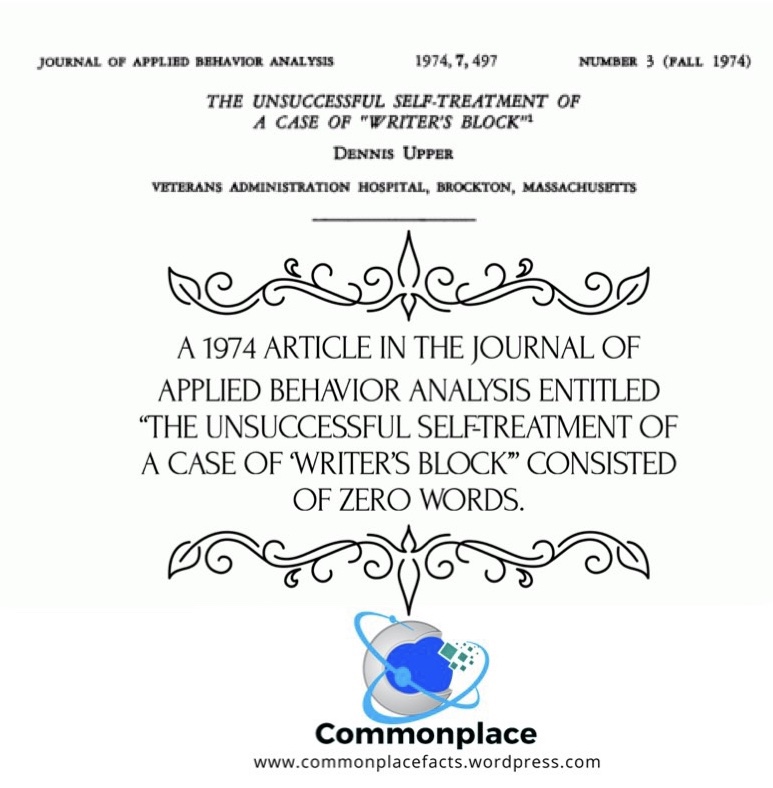
In 1974, the Journal of Applied Behavior Analysis published a paper entitled, “The Unsuccessful Self-Treatment of a Case of ‘Writer’s Block’.”
The title is doing a great deal of heavy lifting here. In fact, aside from the title and a footnote, the article by Dennis Upper consists of no other content.
That is not a typo. There is no abstract. No introduction. No literature review. No methods section. No conclusion in which the author heroically announces that further research is needed, as authors are legally required to do whenever they reach the end of anything academic.
The article is blank.
Which, when one pauses to appreciate it, may be the most honest thing ever published about writer’s block.
Yes, This Was a Real Published Academic Article
The best part is that this was not merely a joke passed around faculty lounges or a gag stapled to a bulletin board by someone who had enjoyed one too many cups of conference coffee. It appeared in the Journal of Applied Behavior Analysis, a real academic publication.

This makes the whole thing even better. A blank paper about writer’s block is funny. A blank paper about writer’s block published in an academic journal is art.
The paper’s lone footnote states that portions of the paper were “not presented” at the 81st Annual American Psychological Association Convention, and that reprints were available from the author. This is the kind of footnote that deserves a small parade. It manages to be technically informative while also quietly poking the entire machinery of academic publishing in the ribs.
There is something glorious about a paper that admits its own failure with perfect scholarly composure. Dr. Upper did not cure his writer’s block. He documented it. And in doing so, he may have created one of the shortest published academic articles in history.
The Peer Review Was Also a Masterpiece
As wonderful as the article itself is, the reviewer’s comments may be even better. The review reportedly stated:
“I have studied this manuscript very carefully with lemon juice and X-rays and have not detected a single flaw in either design or writing style. I suggest it be published without revision. Clearly it is the most concise manuscript I have ever seen — yet it contains sufficient detail to allow other investigators to replicate Dr. Upper’s failure. In comparison with the other manuscripts I get from you containing all that complicated detail, this one was a pleasure to examine. Surely we can find a place for this paper in the Journal — perhaps on the edge of a blank page.”
That is not merely a peer review. That is a tiny monument to editorial delight.
The reviewer managed to praise the paper for being flawless, concise, and replicable, which is technically true in the same way that an empty grocery cart is low in calories. It contains no errors because it contains almost nothing. Its method can be replicated by anyone with a writing deadline, a chair, and a growing sense of doom.
There are academic papers that require years of study to understand. This one requires a passing familiarity with the human condition and perhaps a calendar reminder you have been ignoring since Tuesday.
The Shortest Academic Article Ever?
Upper’s article is widely recognized as one of the shortest published academic articles, and often described as the shortest. This is the sort of claim that invites someone, somewhere, to emerge from a basement archive holding an even shorter paper consisting only of a semicolon and a grant acknowledgment. Academic record-keeping is a strange wilderness, and we enter it wearing sensible shoes.
Still, whether it is absolutely the shortest or merely among the shortest, “The Unsuccessful Self-Treatment of a Case of ‘Writer’s Block’” has earned its place in the pantheon of scholarly oddities.
It is brief. It is memorable. It is funny. It is also, in its own ridiculous way, deeply relatable.
Anyone who has ever tried to write knows the peculiar misery of the blank page. The blank page is not hostile, exactly. It just sits there, clean and smug, radiating judgment. It has no ideas, but somehow still acts superior.
Upper’s paper took that experience and made it literal. The result is a piece of academic comedy so pure that adding more words would almost ruin it. Naturally, we are adding several hundred words about it now, because that is how blogging works.
When Failure Becomes the Whole Point
The genius of the article lies in its completeness. A failed attempt to treat writer’s block resulted in a paper with no body text. The outcome perfectly matched the subject. It is like writing a dissertation on procrastination and submitting it twelve years late, or publishing a study on forgetfulness but leaving the title page at home.
Upper’s failure became the evidence. The missing content became the content. The blank space became the joke.
And somehow, it worked.
There is a lesson here, though we should be careful not to make it too inspirational. This is still an article about a blank article, not a motivational poster with a mountain on it. But there is something oddly comforting about the fact that even writer’s block can be transformed into something useful, memorable, and funny.
Sometimes the thing stopping the work becomes the work.
Sometimes the blank page is not the enemy. Sometimes it is the punchline.
Read the Entire Article, If You Have Several Seconds
You can read Dennis Upper’s full article, “The Unsuccessful Self-Treatment of a Case of ‘Writer’s Block’.” Please set aside enough time. Perhaps a lunch break. Possibly less.
In the end, Dennis Upper may not have cured writer’s block, but he accomplished something arguably more impressive: he turned it into publication history. For every writer who has ever stared at an empty page and felt defeated, take heart. Sometimes the blank page is not evidence that you have failed.
Sometimes it is your entire article.
You may also enjoy…

Meet F.D.C. Willard, the Cat Who Co-Authored a Scientific Paper
F.D.C. Willard: Cuddly, Cute, and Co-Author F.D.C. Willard was 7 years old when he became a published researcher. As you might expect with someone so gifted at such a young age, there were some difficulties in coping with fame. His personality was sometimes described in less-than-flattering terms. Some called him aloof, frustratingly-independent, and almost-obsessive about…

Writing By the Seat of Your Pants
“The art of writing is the art of applying the seat of the pants to the seat of the chair.” — Mary Heaton Vorse

When The World’s Great Authors Formed a Cricket Team
What do literary giants do when they aren’t writing history’s greatest books? There’s no better way to stave off a case of writer’s block than to play a rousing game of cricket. That seemed to be the motivation of a cadre of famous writers who formed the most literary-talented cricket team in history. J.M. Barrie…





Leave a Reply