

America is turning 250, which is exactly the kind of milestone that invites solemn reflection, patriotic pageantry, and, if we are honest, a suspicious number of commemorative coffee mugs.
As part of our ongoing celebration of the nation’s semiquincentennial — a word that sounds as if it escaped from a spelling bee and is now living under an assumed identity — we are continuing our series of 250 fun facts about the United States. This is Part 3 in our series celebrating 250 fun facts for America’s 250th anniversary. In Part 1, we looked at presidents and politicians. In Part 2, we explored wars, disasters, and decisions that probably needed another committee meeting, preferably one with adult supervision. This installment takes us on a state-by-state tour of the country, with 50 fun facts about the 50 states.
Some of these facts involve food. Some involve presidents. Some involve caves, flags, dinosaurs, diamonds, radioactive lizards — okay, not radioactive lizards, but give America enough time and we will probably get there. The point is this: every state has contributed something strange, wonderful, important, or delightfully unnecessary to the national story.
So buckle up. We are about to take a road trip across all 50 states without stopping for gas, arguing about the thermostat, or asking whether a 200-mile detour to see the world’s largest kidney stone is “worth it.”
Contents
Alabama: Mobile Had Mardi Gras Before New Orleans Made It Famous
When most people think of Mardi Gras, they think of New Orleans: beads, parades, jazz, questionable decisions, and the general civic philosophy of “what if Lent had a pregame show?”
But Mobile, Alabama, has a strong claim to America’s oldest organized Mardi Gras celebration, dating back to the early 1700s, when Mobile was still part of French Louisiana. New Orleans may have the bigger reputation, but Mobile got there first. It is the historical equivalent of arriving early to the party, setting up the chairs, and then watching someone else become famous for dancing on the table.
Alaska: It Is America’s Northernmost, Westernmost, and Easternmost State
Alaska is so geographically excessive that it somehow manages to be the northernmost, westernmost, and — thanks to the Aleutian Islands crossing the 180th meridian — easternmost state in the Union.
This is the kind of cartographic flex that sounds like a trick question, because it is. Alaska looked at geography and said, “Why pick one direction when I can hoard all of them?”
This achievement is surpassed only by the Pacific nation of Kiribati, which is the only country in all four hemispheres.
Arizona: London Bridge Really Did Move There
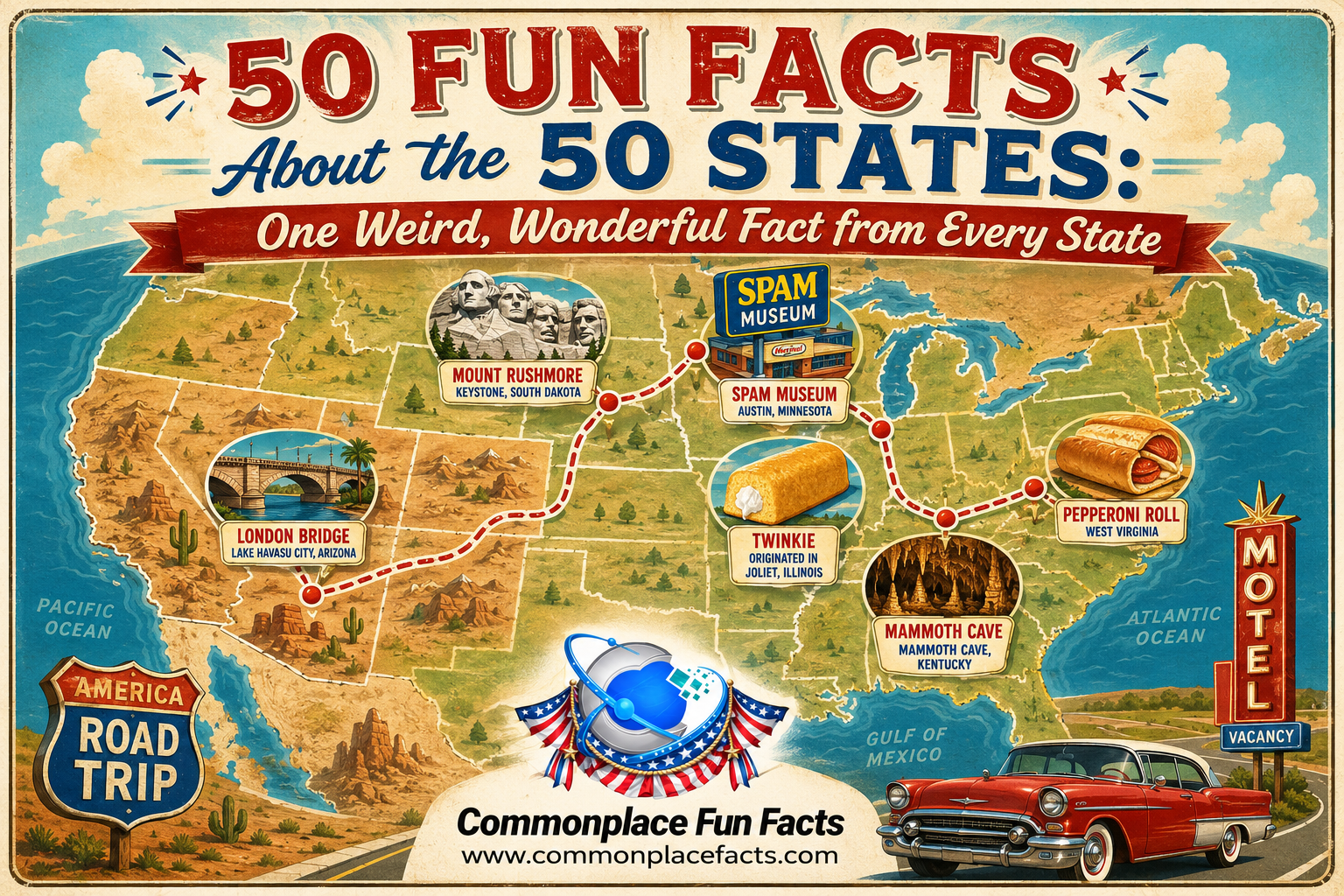
Lake Havasu City, Arizona, is home to London Bridge. Not “a bridge named London Bridge.” The actual London Bridge that once crossed the River Thames in England was purchased, dismantled, shipped to Arizona, and reassembled in the desert.

This is not usually how urban planning works. Most cities build bridges because they have water. Lake Havasu City acquired a bridge and then made sure the water situation cooperated. Somewhere, a civil engineer probably whispered, “That is not the order we normally do this in.”
Arkansas: You Can Dig for Diamonds and Keep What You Find
At Crater of Diamonds State Park in Murfreesboro, Arkansas, visitors can search for diamonds in a plowed field atop an ancient volcanic crater. Even better, the rule is simple: finders keepers. It boasts that it is the only place in the world where the public can search for natural diamonds in their original volcanic source.
This makes Arkansas one of the few places where “I’m going to spend the afternoon crawling around in the dirt” can be either a recreational activity or a sound investment strategy. It is prospecting, but with sunscreen and a gift shop.
California: The Fortune Cookie Is More American Than Most People Think
The fortune cookie is commonly associated with Chinese restaurants, but its modern American form is widely linked to California, especially San Francisco and Los Angeles. Its exact origin is debated, because apparently even dessert comes with jurisdictional disputes.
What seems clear is that the fortune cookie became a California-made American restaurant tradition, which is fitting. California has always had a talent for taking something, reinventing it, branding it, and then making the rest of us feel underdressed for not knowing about it earlier.
Colorado: The State Fossil Is Stegosaurus
Colorado’s state fossil is the Stegosaurus, which was first identified from fossils found in the Morrison Formation. This gives Colorado the right to claim one of the most recognizable dinosaurs in the world.
Stegosaurus was not the smartest dinosaur, judging by brain-to-body-size estimates, but it did have back plates, tail spikes, and the general look of an animal that chose its wardrobe with the primary goals of being memorable and intimidating. Mission accomplished.
Connecticut: The Hamburger Has a New Haven Birth Certificate
Louis’ Lunch in New Haven, Connecticut, is recognized by the Library of Congress as the birthplace of the hamburger sandwich. The restaurant still serves burgers on toast, not buns, because tradition is tradition and ketchup is apparently where Connecticut draws the line.
This means one of America’s most iconic foods may have begun in a small Connecticut lunch spot, proving once again that history’s greatest inventions often start with someone saying, “I need lunch, and I need it now.”
Delaware: It Really Is the First State
Delaware became the first state to ratify the U.S. Constitution on December 7, 1787. That is why it proudly calls itself “The First State,” which is one of the rare state nicknames that functions as both branding and a footnote.
Delaware may be small, but it got to the constitutional party first, signed the guest book, and has been casually mentioning it ever since.
Florida: Alligators and Crocodiles Live Together in the Everglades
The Florida Everglades are the only place in the United States where alligators and crocodiles naturally coexist.
This seems like the premise of a terrible neighborhood association meeting. “Agenda Item One: wetland drainage. Agenda Item Two: why are both kinds of prehistoric bite machines in the same zip code?” Yet there they are, sharing the ecosystem like scaly retirees with boundary issues.
Georgia: Coca-Cola Was First Served in Atlanta
On May 8, 1886, pharmacist John Pemberton served the first glass of Coca-Cola at Jacobs’ Pharmacy in downtown Atlanta.
At the time, it was sold as a soda fountain drink. Today, Coca-Cola is one of the most recognizable brands on Earth, proving that America’s global influence can sometimes be measured in treaties, aircraft carriers, and carbonated beverages.
Hawaii: It Has America’s Only Royal Palace

ʻIolani Palace in Honolulu is the only royal palace in the United States. Built in 1882 by King Kalākaua, it served as the official residence of Hawaii’s last reigning monarchs.
This is a reminder that Hawaii’s history did not begin when tourists discovered floral shirts. It was an independent kingdom with monarchs, diplomacy, music, political complexity, and a palace that still stands as one of the most powerful symbols of Hawaiian sovereignty and identity.
Idaho: It Has Rare Star Garnets
Idaho is famous for potatoes, but it also has something much sparklier: star garnets. These rare gemstones display a star-like pattern when cut properly, and significant deposits are famously associated with Idaho.
So yes, Idaho has potatoes and gemstones. It is basically saying, “We can make dinner and accessorize.”
Illinois: The Twinkie Was Invented There
The Twinkie was invented in Illinois in 1930 by James Dewar (not the same James Dewar who invented the Thermos), who was looking for a way to use shortcake equipment when strawberries were out of season.
From that practical problem came one of America’s most famous snack cakes: golden, cream-filled, shelf-stable, and somehow always giving the impression that it will outlast several minor civilizations.
Indiana: America’s Skyscrapers Have a Little Hoosier in Them
Indiana is famous for basketball, the Indy 500, and the word “Hoosier,” which everyone uses confidently while quietly hoping no one asks too many follow-up questions.
But Indiana also gave America one of its favorite building materials: limestone. Indiana limestone has been used in landmarks such as the Empire State Building, the Pentagon, the National Cathedral, and numerous state capitols. That means Indiana has been quietly holding up some of America’s most important buildings while letting everyone else take the dramatic skyline photos. Very Midwestern of it.
Iowa: The Field of Dreams Is a Real Place

The baseball field from Field of Dreams still exists in Dyersville, Iowa, where fans can visit the movie site and stand in the same corn-surrounded ballpark where cinema taught America that ghost baseball is apparently emotionally devastating.
It is one of the rare tourist attractions built around a fictional premise that somehow feels more sincere than many real ones. Build it, and they will come. Maintain the parking lot, and they will keep coming.
Kansas: It Marks the Geographic Center of the Lower 48
Near Lebanon, Kansas, a monument marks the geographic center of the 48 contiguous United States. The exact calculation has some wiggle room, because geography enjoys making simple questions irritating, but the site remains a beloved roadside attraction.
It is also very Kansas: modest, central, windswept, and quietly holding the country together while everyone else argues about coastlines.
Being the geographic center also had the unfortunate effect of making a certain Kansas farm the accidental address for countless international criminals — at least according to some wildly overconfident IP address mapping. Read “The IP Address Mapping Error that Made a Kansas Farmhouse a Major Criminal Hangout” for the details.
Kentucky: Mammoth Cave Is the World’s Longest Known Cave System
Mammoth Cave National Park in Kentucky contains the world’s longest known cave system, with hundreds of miles of explored passageways.
That is impressive, unless you are the person who gets lost in the visitor center parking lot, in which case “hundreds of miles underground” feels less like a natural wonder and more like a personal threat.
Louisiana: Tabasco Sauce Comes from Avery Island
Tabasco sauce has been made by the McIlhenny Company on Avery Island, Louisiana, since the 19th century. The peppers, salt, barrels, and family tradition have made this little bottle of heat one of Louisiana’s most famous exports.
It is proof that a state already known for bold food can still look at dinner and say, “This needs more consequences.”
Maine: It Is the Closest State to Africa
Here is one that makes people pause: within the 50 states, Maine is closer to Africa than Florida is. Because of the curve of the Earth and the position of the continents, the eastern tip of Maine is nearer to parts of Africa than Florida’s coastline.
This is exactly the kind of fact that sounds wrong until geography walks in, unfolds a globe, and ruins everyone’s confidence.

Maryland: The National Anthem Was Inspired There
Francis Scott Key wrote the poem that became “The Star-Spangled Banner” after witnessing the British bombardment of Fort McHenry in Baltimore during the War of 1812.
The flag was still there, Key was inspired, and generations of Americans were eventually given a national anthem that begins reasonably enough and then turns into a vocal obstacle course. Patriotic? Yes. Easy to sing? Absolutely not.
Massachusetts: Boston Built America’s First Subway
Boston’s Tremont Street subway opened in 1897, making it the first subway tunnel in the United States.
This means Boston pioneered American underground transit, presumably after concluding that street traffic was already annoying enough to drive civilization beneath the pavement. A bold vision, and also an eerily accurate prediction of rush hour.
Michigan: It Touches Four of the Five Great Lakes
Michigan borders four of the five Great Lakes: Superior, Michigan, Huron, and Erie. Only Lake Ontario misses the Michigan party.
The state is essentially surrounded by freshwater, which explains why Michiganders can identify lakes the way some people identify cousins: confidently, affectionately, and with mild judgment toward outsiders who get the names wrong.
Living beside the Great Lakes also gives Michiganders a somewhat calibrated sense of scale. When residents of other states point proudly to their local “lake,” Michigan tends to respond with a condescending smile and the words, “That’s cute.”
Minnesota: There Is a SPAM Museum
Austin, Minnesota, is home to the SPAM Museum, dedicated to the canned meat product made famous by Hormel.
It is free to visit, which feels appropriate. If you are going to build a museum devoted to SPAM, charging admission would somehow make it less majestic. This is America. Sometimes the shrine to processed meat should welcome all pilgrims.
Mississippi: The Teddy Bear Story Began There
The teddy bear was inspired by a 1902 hunting trip in Mississippi, where President Theodore Roosevelt refused to shoot a bear that had been tied up for him. A political cartoon followed, and toy makers soon turned “Teddy’s bear” into a national sensation.
Thus one of history’s most famously rugged presidents helped inspire one of childhood’s softest companions. That is range.
Missouri: The Gateway Arch Is Taller Than the Washington Monument

The Gateway Arch in St. Louis stands 630 feet tall, making it taller than the Washington Monument.
It is also 630 feet wide, because apparently Missouri looked at architecture and said, “Let’s make a monument that is also a geometry lesson.” The result is sleek, dramatic, and just slightly unsettling if you remember that people ride to the top in tiny tram pods.
Montana: One Mountain Sends Water Toward Three Oceans
Triple Divide Peak in Glacier National Park sits at a rare hydrological crossroads. Water flowing from the mountain can eventually drain toward the Pacific Ocean, the Atlantic Ocean through the Gulf of Mexico, or the Arctic Ocean through Hudson Bay.
That is a lot of responsibility for one mountain. Most of us struggle to sort laundry into three piles.
Nebraska: Kool-Aid Was Invented in Hastings
Kool-Aid was invented in Hastings, Nebraska, by Edwin Perkins, who figured out how to turn a liquid drink concentrate into a powder that was easier to ship.
This is the kind of practical innovation that changed childhood forever. Somewhere in America, a kitchen counter is still faintly red because of it.
Nevada: It Has an Absurd Number of Mountain Ranges
Nevada is one of the most mountainous states in the country, with hundreds of named mountain ranges. People often picture Las Vegas first, but the state is far more than casinos, neon, and bachelor parties making life choices under fluorescent lighting.
Nevada is rugged, high, dry, and mountainous — basically the Old West wearing sunglasses.
New Hampshire: It Guarded the First-in-the-Nation Primary
New Hampshire is famous for holding the first presidential primary in the United States, a tradition it protects with the intensity of a dragon guarding treasure.
Every four years, candidates descend upon the state to eat pancakes, shake hands, answer questions in diners, and pretend they are not terrified of retirees with very specific opinions about denture insurance.
New Jersey: The First Drive-In Movie Theater Opened There
The first patented drive-in movie theater opened in Camden, New Jersey, in 1933.
This allowed Americans to combine two of their deepest loves: movies and refusing to get out of the car. It was entertainment, convenience, and mild windshield glare all in one glorious package.
New Mexico: The Real Smokey Bear Came from There
The advertising character Smokey Bear existed first, but the real bear who became the living symbol of wildfire prevention was a cub rescued from a 1950 forest fire in New Mexico’s Lincoln National Forest.
He survived, recovered, and became one of the most recognizable conservation figures in American history. Not bad for a bear whose original career plan was presumably “be bear.”
New York: America’s First Pizzeria Opened There

Lombardi’s in New York City is widely recognized as America’s first pizzeria, receiving a license in 1905.
New York pizza has inspired arguments, loyalties, fold techniques, and regional rivalries that may never be settled. But as American food history goes, New York can credibly say it helped launch the pizza era. The rest of us have been gratefully over-ordering ever since.
North Carolina: The Wright Brothers Took Flight There
On December 17, 1903, Wilbur and Orville Wright achieved the first successful powered airplane flights near Kitty Hawk, North Carolina.
Ohio supplied the brothers. North Carolina supplied the wind, sand, and open space. This has led to a long-running friendly dispute over who gets the bragging rights, because even aviation history needs a custody arrangement.
North Dakota: Rugby Claims the Center of North America

Rugby, North Dakota, has long claimed to be the geographic center of North America, marked by a stone monument.
As with many “geographic center” claims, there are technical debates, because maps are where certainty goes to get nibbled to death by math. Still, Rugby has the monument, the claim, and the confidence, which in roadside America counts for quite a lot.
Ohio: Cleveland Is Home to the Rock & Roll Hall of Fame
Cleveland, Ohio, is home to the Rock & Roll Hall of Fame, honoring the artists, producers, performers, and cultural forces that shaped modern music.
Ohio’s place in rock history is helped by the legacy of Cleveland DJ Alan Freed, who helped popularize the phrase “rock and roll.” The museum’s location is not random. It is a loud, glassy, guitar-powered monument to the idea that sometimes music history needs lakefront property.
Oklahoma: It Has an Official State Meal
Oklahoma does not merely have an official state food. It has an official state meal. The menu includes such modest little items as chicken-fried steak, barbecue pork, fried okra, cornbread, black-eyed peas, biscuits and gravy, pecan pie, and more.
In other words, Oklahoma looked at the concept of a symbolic food and said, “What if we made it a legislative buffet?” This is democracy at its most digestively ambitious.
Oregon: Its State Flag Has Two Different Sides
Oregon has the only U.S. state flag with a different design on each side. One side displays the state seal; the other features a beaver.
This is delightful because most flags are content to communicate one thing at a time. Oregon’s flag has a front, a back, and a plot twist.
Pennsylvania: ENIAC Helped Launch the Computer Age
ENIAC, announced in 1946 at the University of Pennsylvania, was one of the first general-purpose electronic computers and helped usher in the modern computer age.
It was enormous, room-filling, and far less convenient than the device currently in your pocket, which has the power to access all human knowledge and still mostly gets used to check weather, argue with strangers, and look up whether that actor is still alive.
Rhode Island: It Is the Smallest State with the Longest Official Name
Rhode Island is the smallest state by area, but for most of its history it had the longest official state name: “State of Rhode Island and Providence Plantations.” In 2020, voters approved shortening the official name to simply “State of Rhode Island.”
That means Rhode Island spent centuries overcompensating in syllables for what it lacked in acreage.
South Carolina: Tea Grows There
South Carolina is home to the Charleston Tea Garden on Wadmalaw Island, often described as America’s oldest tea garden and a rare commercial tea-growing operation in the United States.
This gives South Carolina a curious distinction: it can host a beach trip, a history tour, and a conversation about domestic tea production before lunch. That is range, and impressive caffeine.
South Dakota: Mount Rushmore Was Originally Supposed to Look Different
Mount Rushmore features the carved faces of George Washington, Thomas Jefferson, Theodore Roosevelt, and Abraham Lincoln. But the original concept promoted by South Dakota historian Doane Robinson focused more on figures from the American West.
The final version became a national presidential monument instead, because nothing says “regional tourism idea” like escalating into four gigantic presidential heads carved into a mountain.
Tennessee: The Grand Ole Opry Is Still Going
The Grand Ole Opry began in 1925 and is recognized as one of the longest-running radio broadcasts in American history.
It has survived changing musical tastes, new technology, television, streaming, and several generations proclaiming, “Country music is over.” The Opry kept playing, which is a very Tennessee response.
Texas: Six Flags Is Not Just a Theme Park Name
The phrase “Six Flags over Texas” refers to the six nations whose flags have flown over all or part of Texas: Spain, France, Mexico, the Republic of Texas, the United States, and the Confederacy.
Eventually the phrase inspired the name of the Six Flags amusement park chain. Texas history is complicated, but at some point someone looked at centuries of sovereignty disputes and thought, “You know what this needs? Roller coasters.”
Utah: The Great Salt Lake Can Be Much Saltier Than the Ocean
Utah’s Great Salt Lake has no outlet, so minerals accumulate as water evaporates. As a result, its salinity can be far higher than ocean water.
This makes swimming there unusually buoyant, assuming lake conditions cooperate. It is one of the few places where you can float effortlessly while nature quietly reminds you that chemistry is in charge.
Vermont: Billboards Are Banned
Vermont banned billboards in 1968 as part of an effort to preserve scenic views along its roads.
This means you can drive through Vermont without being visually assaulted by a 40-foot advertisement for fireworks, personal injury lawyers, or a diner claiming to have “world-famous pie” despite being known mainly to the area PTA groups.
Virginia: Eight Presidents Were Born There
Virginia is known as the “Mother of Presidents” because eight U.S. presidents were born there: George Washington, Thomas Jefferson, James Madison, James Monroe, William Henry Harrison, John Tyler, Zachary Taylor, and Woodrow Wilson.
That is an astonishing presidential batting average. At some point, Virginia was less a state than a chief executive hatchery.
Washington: Starbucks Began at Pike Place Market
Starbucks opened its first store at Seattle’s Pike Place Market in 1971.
From there, it grew into a global coffee empire, proving that a small shop selling beans and coffee gear can become a worldwide institution if it has ambition, branding, and enough ways to ask whether someone wants whipped cream.
West Virginia: Pepperoni Rolls Were Miner Food Before They Were Iconic
The pepperoni roll became a West Virginia staple because it was practical food for coal miners: bread wrapped around pepperoni, portable, filling, and not requiring refrigeration.
It is simple, brilliant, and delicious — the culinary equivalent of saying, “What if lunch fit in your pocket and did not betray you underground?”
Wisconsin: The QWERTY Keyboard Has Wisconsin Roots

Christopher Latham Sholes, who worked in Wisconsin and helped develop the first practical typewriter, is closely associated with the creation of the QWERTY keyboard layout.
So if you have ever typed “teh” instead of “the,” accidentally activated caps lock, or rage-deleted half a paragraph, Wisconsin deserves at least a polite nod from your frustrated fingers.
Wyoming: Yellowstone Became the First National Park
Yellowstone National Park, much of which lies in Wyoming, was established in 1872 as the first national park in the United States — and widely regarded as the first national park in the world.
It gave America geysers, bison, boiling mud, dramatic scenery, and the useful lesson that signs reading “Do Not Approach Wildlife” are not philosophical suggestions.
One Nation and 50 Fun Facts About the 50 States
There you have it: 50 states, 50 facts, and one more reminder that America is not merely a country. It is a sprawling historical group project assembled from ambition, accident, invention, geography, food, weather, stubbornness, and the occasional decision to move a bridge from London to Arizona.
That may be the real beauty of the United States at 250. Every state has its own contribution to the national story. Some are grand. Some are weird. Some are delicious. Some are underground. Some are lightly salted. Taken together, they form a country that is impossible to summarize neatly — which is inconvenient for textbook writers but excellent news for those of us who enjoy fun facts.
And with 100 more facts still to go in this series, we can confidently say this much: America has never suffered from a shortage of interesting footnotes. If anything, the footnotes may be running the place.
Join us for Part 4, where we look at 50 fun facts about animals that shaped American history.
You may also enjoy…

50 Fun Facts About Presidents and Politicians That Sound Made Up (But Aren’t)
Discover 50 surprising fun facts about presidents and politicians that sound unbelievable—but are completely true. From duels to pet raccoons, history is stranger than fiction.

50 Fun Facts About American History: Wars, Disasters, and Decisions That Probably Needed a Second Meeting
Explore 50 weird, wonderful, and slightly embarrassing fun facts about American history, including strange wars, bizarre military plans, disasters, nuclear scares, and decisions that definitely needed a second meeting.

47 Fun Facts About the Presidents
How much do you know about the 47 presidents of the United States? Here are some fun facts about the presidents to test your knowledge.




Leave a Reply