
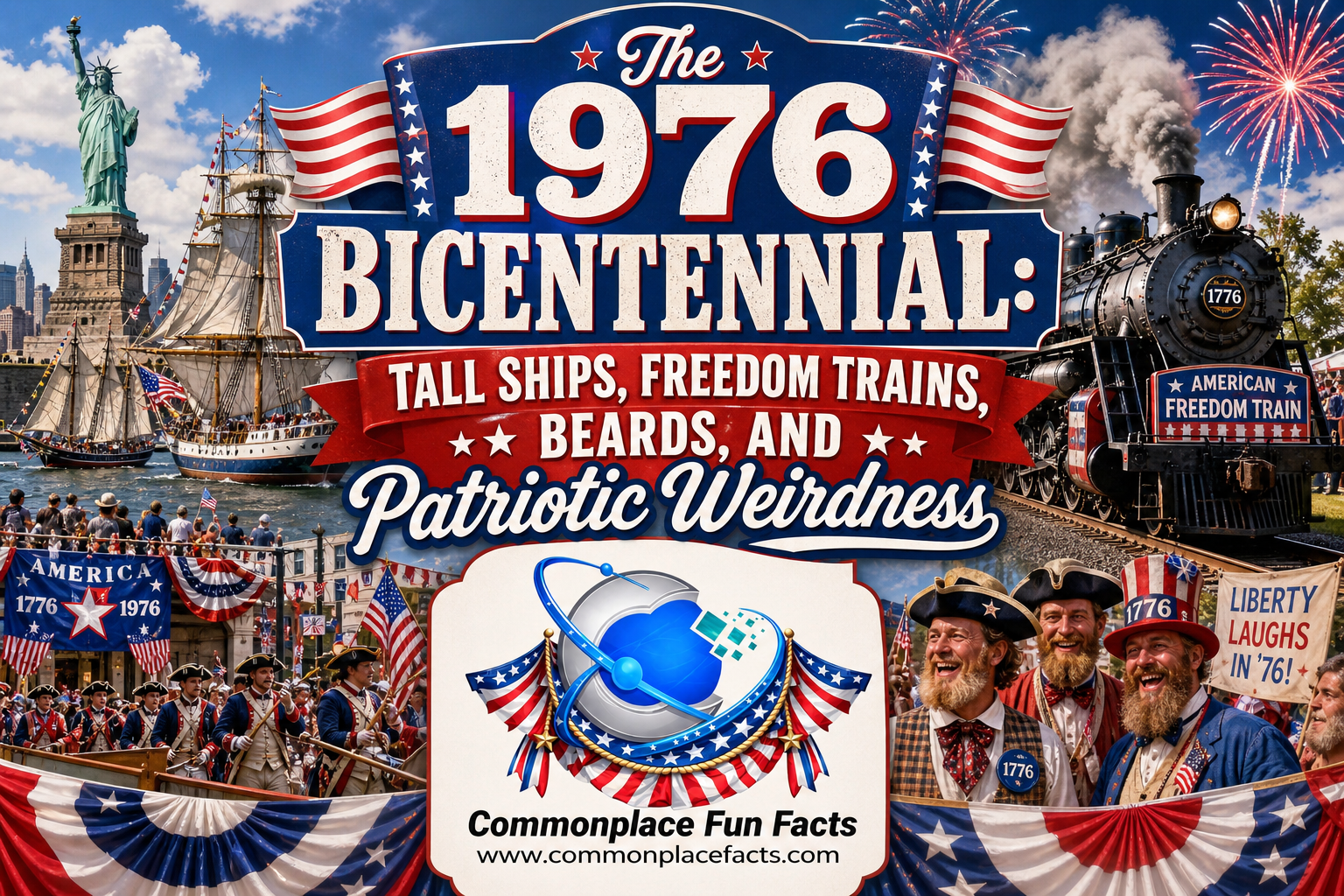

This year the United States celebrates its semiquincentennial — hopefully, we’ll learn how to spell that word without looking it up before the year is over. Throughout the nation, events are already underway to celebrate 250 years of independence.
The last big celebration was fifty years ago. In 1976, the United States celebrated its 200th birthday in a way that reflected the character of the times. The country had emerged from riots, demonstrations, war, Watergate, and disco, and it let everyone know it was stronger than ever by putting red, white, and blue on absolutely everything that would hold still long enough.
The 1976 Bicentennial was not merely a holiday. It was a mood. It was a national decorating scheme. It was an official government program, a commercial bonanza, a civic revival, a history lesson, a parade permit, and possibly the greatest excuse ever invented for grown men to wear colonial breeches in public without being asked to leave the premises.
There were tall ships in New York Harbor. There were fireworks over Washington. There were wagon trains crossing the country in reverse. There was a train filled with historic treasures. There were coins, stamps, beer cans, lunchboxes, costumes, posters, quilts, plaques, medallions, souvenir plates, and enough commemorative merchandise to make George Washington quietly ask whether this was really what Valley Forge had been about.
There were also beards.
Brace yourself. This was the ’70s, after all.
Contents
A Country in Need of a Birthday Party
To understand the Bicentennial, it helps to remember what America had just been through. The early 1970s had not exactly been a Norman Rockwell painting, unless Norman Rockwell had suddenly developed an interest in congressional hearings, helicopter evacuations, urban decay, gas lines, inflation, and the awkward discovery that presidents could tape themselves committing political self-harm.
The Vietnam War had ended in national exhaustion. Watergate had ended in presidential resignation. Trust in institutions had taken a beating. The economy was struggling. The country was divided over politics, race, war, culture, and whether leisure suits were a cry for help.
Into this came the 200th anniversary of the Declaration of Independence. The Bicentennial offered something Americans badly needed: a reason to remember that the national story was bigger than the last scandal, the last war, or the gallon of gasoline that cost you an hour of waiting in line.
The federal government had begun planning years earlier. The American Revolution Bicentennial Commission was created in 1966, later replaced by the American Revolution Bicentennial Administration, or ARBA, because nothing says “spontaneous patriotic joy” quite like a federal acronym. ARBA was tasked with coordinating, encouraging, and blessing Bicentennial projects around the country.
The planners organized the celebration around three broad themes. “Heritage ’76” looked backward, inviting Americans to remember the people, ideas, struggles, and occasionally alarming wigs that shaped the nation. “Festival USA” celebrated the country’s cultural diversity, which was a much more interesting way of saying, “Please remember that America is not just powdered wigs and portraits of men pointing at documents.” “Horizons ’76” looked ahead to the nation’s third century, because apparently even in 1976 someone understood that a birthday party should include at least one responsible adult asking what happens after the cake is gone.
The Country Had Done This Before
America had, of course, been through this sort of national birthday extravaganza before. In 1876, the country celebrated its 100th birthday with the Centennial Exposition in Philadelphia, a sprawling world’s fair where visitors could admire the wonders of industry, art, machinery, and the exciting new national pastime of pretending technology would solve everything.
A century later, the Bicentennial carried some of that same energy, only with more television cameras, more polyester, and substantially more commemorative mugs. The Centennial had shown off a young nation eager to prove it had grown up; the Bicentennial showed off a middle-aged nation trying to remember where it left its optimism. For more on America’s first great birthday bash, see our article on the 1876 Centennial Exposition.
The Official Party: Presidents, Bells, Ships, and Fireworks
The climax came on July 4, 1976, the 200th anniversary of the adoption of the Declaration of Independence. President Gerald Ford spent the day in motion, which was appropriate for a celebration that seemed determined to put the whole country on wheels, rails, waves, and horseback.
Ford began at Valley Forge, where he honored the conclusion of the Bicentennial Wagon Train Pilgrimage. From there he went to Philadelphia, where he signed the Bicentennial Day Declaration at Independence Hall. Then he traveled to New York Harbor for Operation Sail, the grand parade of tall ships and naval vessels. Finally, he returned to Washington, D.C., where he and Betty Ford watched fireworks from the White House balcony.
That itinerary alone sounds like the itinerary of a man trying to win a national scavenger hunt.

Operation Sail 1976 was one of the most spectacular events of the year. More than 200 ships gathered in New York Harbor, including tall ships from around the world and naval vessels representing foreign governments. Millions of spectators crowded the waterfront. For a city struggling through fiscal crisis, crime fears, and a general sense that New York might be held together by duct tape and attitude, the event was a rare shared triumph.
There was also a national bell-ringing. At 2:00 p.m. Eastern time on July 4, bells rang across the country in a coordinated salute to independence. It was simple, symbolic, and surprisingly moving. It was also much easier to organize than asking every American to agree on literally anything else.
Foreign dignitaries joined the celebration. French President Valéry Giscard d’Estaing visited in May and presented a sound-and-light show at Mount Vernon, honoring the long Franco-American friendship that began when France decided the best way to annoy Britain was to help a rebellious teenager move out of the house. Queen Elizabeth II and Prince Philip toured the United States in July, visiting Philadelphia, Washington, Virginia, New York, Connecticut, and Massachusetts. The Queen presented the Bicentennial Bell, a replica of the Liberty Bell, on behalf of the British people.

It was a gracious gesture. It also had to be one of history’s more elegant ways of saying, “No hard feelings about that unpleasantness with the tea.”
The royal visit also gave the Bicentennial one of its finest moments of accidental diplomatic comedy. At the White House state dinner on July 7, 1976, President Gerald Ford escorted Queen Elizabeth II onto the dance floor while the Marine Band played “The Lady Is a Tramp.” This was not, one hopes, a deliberate commentary on the House of Windsor. According to later accounts, the musicians were playing from numbered arrangements rather than song titles, and the unfortunate tune simply arrived at precisely the wrong moment, wearing tap shoes and carrying a subpoena. The Queen, to her credit, showed no visible offense and danced on with the serene composure of a woman who had endured wartime bombings, royal protocol, and decades of people asking whether her corgis were housebroken.
The American Freedom Train: History on Rails
One of the most beloved Bicentennial projects was the American Freedom Train, a traveling museum pulled by a restored steam locomotive. It began its journey in April 1975 and eventually visited 137 cities in 48 states. Inside its railroad cars were hundreds of documents, artifacts, and objects connected with American history.

The Freedom Train carried treasures ranging from foundational documents to cultural artifacts. It was designed to bring history directly to the people, which was a noble idea, especially for Americans who liked their patriotism with a whistle, a schedule, and a gift shop.
The train became a destination wherever it stopped. In Archbold, Ohio, a town of just over 3,000 people, local organizers sold more than 35,000 tickets in a 14-county area. According to the official Bicentennial report, more than 52,000 people turned out during the train’s visit, and at one point the line stretched four miles.
That is not a line. That is a migration with snacks.

The Wagon Train That Went East
If the Freedom Train was history on rails, the Bicentennial Wagon Train was history with horses, dust, and the occasional logistical question of what happens when your national commemoration needs hay.
The Bicentennial Wagon Train Pilgrimage to Pennsylvania recreated the pioneer journey in reverse. Instead of wagons heading west from the old settlements, wagon trains from around the country traveled east toward Valley Forge. It was sponsored by the Pennsylvania Bicentennial Commission and involved communities and riders across the nation.
The symbolism was obvious and effective. The nation that had expanded westward was now looking back toward one of the sacred places of the Revolution. By July 4, 1976, the wagons had converged at Valley Forge after a journey that wound through 48 states. The official report described it as a 17,000-mile journey, which means the Bicentennial had managed to turn nostalgia into a cardio event for horses.
Thousands of riders participated. Local communities welcomed the wagons with ceremonies, parades, meals, and probably more speeches than any horse strictly required. It was romantic, messy, deeply American, and only slightly confusing if one paused to remember that covered wagons had very little to do with the Declaration of Independence itself. But never mind. In 1976, if it had wheels, wood, and a flag, it was invited.
The Smithsonian, the Boston Pops, and Disney Join the Party
The Smithsonian Institution celebrated the Bicentennial with a 12-week Festival of American Folklife, showing that American culture was not just battles, presidents, and dead men in waistcoats. It was music, foodways, crafts, immigrant traditions, regional customs, Native cultures, occupational skills, and the glorious realization that a country this large cannot be summarized by one fife and two drummers, no matter how hard souvenir companies tried.
The National Air and Space Museum opened on the National Mall on July 1, 1976, just in time for the big birthday weekend. This was excellent timing, because nothing says “America’s first 200 years” like placing the Wright brothers, Charles Lindbergh, the Apollo program, and various flying machines under one roof and letting visitors contemplate the national habit of looking at gravity and saying, “We respectfully disagree.”
Boston supplied one of the most enduring July Fourth traditions. Arthur Fiedler and the Boston Pops performed for a massive crowd on the Charles River Esplanade. The concert, with fireworks and cannon fire, became one of the defining images of the Bicentennial. The event helped cement the Boston Pops Fireworks Spectacular as a national holiday institution.
Meanwhile, Disney did what Disney does: turned history into a parade with enormous heads.
“America on Parade” ran at Walt Disney World and Disneyland during the Bicentennial period. Mickey Mouse, Donald Duck, and Goofy led the procession as the “Spirit of ’76,” because apparently the American Revolution had been missing only one mouse, one duck, and one extremely tall dog. The parade told a sweeping, simplified, deeply theatrical version of American history, with floats, costumes, music, and enough cheerful spectacle to make actual eighteenth-century life look suspiciously clean.
The Coins in Your Pocket Also Got Patriotic
The Bicentennial even reached American pocket change. The U.S. Mint issued special circulating designs for the quarter, half-dollar, and dollar coins. The quarter received the familiar colonial drummer on the reverse. The half-dollar showed Independence Hall. The Eisenhower dollar featured the Liberty Bell superimposed over the moon, which is either a brilliant symbol of America’s revolutionary past and space-age present or the sort of design you get when a committee says, “Can we add just one more national symbol?”

The coins were produced in enormous numbers. For many Americans, the Bicentennial quarter became the most durable souvenir of the year. It remains one of those coins people still find in change and briefly wonder whether it is worth something before discovering, with the crushing efficiency of numismatics, that most of them are worth twenty-five cents.
Still, the coins did what they were supposed to do. They put the Bicentennial into daily life. Every purchase became, in its tiny way, a patriotic transaction. Buy a newspaper, get a drummer. Buy gum, get Independence Hall. Buy gasoline at what then felt like painful 1970s prices and receive a reminder that liberty is priceless but fuel was getting ambitious.
Speaking of gasoline, the average price in 1976 was about 61 cents per gallon, which sounds almost adorable until you remember that it had been about 36 cents in 1970, meaning it had climbed by roughly 70 percent since the start of the decade. Adjusted for inflation, that 61-cent gallon works out to about $3.56 in 2026 dollars. This was also an era when new passenger cars averaged about 17.5 miles per gallon under EPA lab figures, while new trucks averaged about 14.4 mpg, so the family car was not exactly sipping fuel like a hummingbird with a conservation ethic. The Bicentennial quarter might have been cheerful, but the gas pump was already practicing its villain speech.
The Commercial Avalanche
The Bicentennial was not only a civic celebration. It was also a marketing opportunity visible from low Earth orbit.

By 1976, the official Bicentennial logo appeared everywhere. The red, white, and blue star designed by Bruce Blackburn became one of the most recognizable symbols of the era. It appeared on posters, patches, stamps, mugs, government publications, souvenirs, and promotional materials. The logo was clean, modern, patriotic, and adaptable, which meant it could be placed on almost anything. Naturally, almost anything is exactly where it went.
Companies discovered that consumers would buy commemorative items with the intensity of people who believed the Founding Fathers had specifically written decorative plates into the Declaration of Independence. There were patriotic glasses, clocks, ties, costumes, T-shirts, music boxes, egg timers, yo-yos, and mugs. There were beer cans featuring Revolutionary scenes. There were collectible series and commemorative packaging. There were enough bald eagles, Liberty Bells, colonial drummers, and “1776–1976” inscriptions to make one wonder whether the entire economy had been temporarily converted to bunting.
Philadelphia’s Ortlieb’s Brewing Company produced a Bicentennial beer can series, releasing one can each month beginning in September 1975. Each can featured Revolutionary War imagery or eighteenth-century themes. This was both historically themed advertising and an extremely 1970s way to say, “Remember liberty responsibly.”
Not all of the merchandise was dignified. Some of it was wonderful. Some of it was tacky. Some of it was wonderfully tacky, the highest form of American commemorative art. The Bicentennial turned patriotism into a consumer category, and by the time the country finished celebrating independence from Britain, Americans had apparently achieved complete dependence on souvenir ashtrays.
Small-Town America Takes Over
The real heart of the Bicentennial was not only in Washington, Philadelphia, Boston, or New York. It was in thousands of towns, counties, schools, churches, civic clubs, historical societies, and local committees that decided America’s birthday was too important to leave to professional speechmakers.

The official Bicentennial Communities Program encouraged local participation. Communities could receive official recognition for planning events around the national themes. By 1976, official Bicentennial designations numbered in the thousands and reached communities across the country.
Some places restored historic buildings. Some produced pageants. Some held festivals, lectures, concerts, parades, reenactments, quilting projects, essay contests, and cemetery walks. Schoolchildren dressed as colonial citizens. Adults dressed as colonial citizens. Everyone discovered that tricorn hats have a way of making even normal conversation feel like it should be followed by a vote of the Continental Congress.
There were old-fashioned games. There were colonial fairs. There were fashion shows. There were potluck dinners. There were readings of the Declaration of Independence. There were candle-lighting ceremonies. There were flag tributes. There were parades featuring floats built by people whose enthusiasm sometimes exceeded their access to historically accurate materials.
This was the Bicentennial at its most charming. It was not always polished, but it was sincere. It was a country trying to tell itself a story about who it had been, who it was, and who it hoped to become. Sometimes that story involved carefully restored landmarks. Sometimes it involved papier-mâché.
Both have their place.
The Fire Hydrants of Liberty
Then there were the stranger celebrations, the ones that make history worth reading because they prove that local committees, given enough paint and encouragement, can do almost anything.

In South Bend, Indiana, Ruth von Karowsky organized hundreds of citizens, ranging in age from 9 to 79, to paint 4,800 fire hydrants so they resembled Revolutionary War soldiers. Let us pause to appreciate that number. Four thousand eight hundred fire hydrants. That is not a craft project. That is a municipal campaign.
The South Bend project was financed in part through the sale of “I Love South Bend” buttons. Other places followed with their own hydrant art, turning fire plugs into Betsy Ross, Revolutionary soldiers, and historical flags.
Was this necessary? Of course not.
Was it magnificent? Absolutely.
There is something deeply American about looking at a fire hydrant and thinking, “You know what that needs? A colonial uniform.” It captures the Bicentennial spirit perfectly: local pride, civic effort, historical enthusiasm, and a complete willingness to make ordinary infrastructure look like it was reporting for duty at Yorktown.
It was also helped by the fact that the Third Amendment only prohibits the forced quartering of troops in private homes. It does nothing to prevent fire hydrants from being drafted into uniformed service.
The Time Capsule Big Enough for a Car
Time capsules were another major Bicentennial obsession. This made sense. A 200th birthday naturally makes people think about what future generations should know about the present. Unfortunately, it also tempts people to assume future generations will urgently need commemorative keychains, newspapers, school essays, and possibly a polyester necktie.
Seward, Nebraska, went further than most. The town built a time capsule large enough to hold a 1976 Chevrolet Vega and murals painted by area students.
This raises several questions, beginning with: why a Chevy Vega? Also: what future archaeologist deserved that? And: how large does a time capsule have to be before it stops being a time capsule and becomes a garage with ambition?
Still, one must admire the scale. Many communities buried documents. Seward buried a car. That is commitment. That is vision. That is also a reminder that if you ask Americans to preserve something for the future, someone will eventually say, “Can we fit an automobile in there?”
It also means that this year there are a lot of people scratching their heads and asking, “Now, where exactly did we bury that thing that we were supposed to dig up this year?”
The Brothers of the Brush
And now, as promised, the beards.

Facial hair contests were a recurring feature of local anniversary celebrations in the twentieth century. Groups of men sometimes called themselves “Brothers of the Brush,” growing beards or mustaches as part of centennial, sesquicentennial, or Bicentennial events. The idea was to cultivate a rugged old-time appearance, because nothing evokes the founding generation quite like a banker, mechanic, or insurance salesman slowly transforming into a frontier blacksmith for civic purposes.
One example came from Bowdoinham, Maine, where the local celebration included a shaving contest for the Brothers of the Brush who had grown beards for the Bicentennial. The town’s festivities also included an antique car parade, old fire equipment, potluck suppers, and a crowd that reportedly reached 10,000 visitors.
The beard-growing custom was partly historical theater, partly community bonding, and partly an excuse for men to avoid shaving while calling it patriotism. This may be the most efficient civic program ever devised.
One imagines the conversations:
“Honey, are you ever going to shave?”
“I cannot. The Republic needs me.”
The Brothers of the Brush remind us that the Bicentennial was not just about monuments and speeches. It was about ordinary Americans entering into the spirit of the thing, sometimes through scholarship, sometimes through volunteer service, and sometimes through aggressive sideburns.
Colonial Costumes Everywhere
The Bicentennial also gave America a temporary national wardrobe. Colonial costumes appeared everywhere. Schoolchildren became miniature patriots. Teachers became reluctant Martha Washingtons. Local officials put on waistcoats. Women wore bonnets. Men wore buckled shoes, or at least something from the community theater costume closet that had once been near buckled shoes.
The costume craze was not always historically precise, but that was hardly unique to 1976. American historical memory has always had a complicated relationship with accuracy, especially when hats are involved. What mattered was participation. People wanted to feel connected to the founding era, even if that connection was mediated through polyester, rented wigs, and the occasional suspiciously modern zipper.
America as a Festival
One of the better impulses behind the Bicentennial was the recognition that America’s story was not one story. It was many. The Smithsonian Folklife Festival and related touring programs brought cultural performances to communities around the country. Japanese folk dancers performed in Milwaukee. Mexican mariachi groups performed in El Paso. Italian dancers performed in Los Angeles. German performers appeared in Lincoln, Nebraska. Students from Ghana helped plan participation in a Black Arts and Heritage Festival in Wichita.
This part of the Bicentennial deserves more attention. The celebration could easily have become nothing but powdered wigs, muskets, and repeated invocations of Philadelphia. There was plenty of that, of course, because America can never resist a man with a quill pen. But Festival USA widened the lens. It emphasized that the country’s identity had been shaped by Native peoples, immigrants, regional traditions, workers, artists, musicians, and communities that did not always appear in the old patriotic pageants.
That broader approach gave the Bicentennial more depth than its souvenir culture might suggest. Beneath the avalanche of commemorative mugs was a real attempt to ask what America contained, not just what it declared.
Patriotic Therapy
The Bicentennial did not solve America’s problems. Inflation did not disappear because someone rang a bell. Political mistrust did not evaporate because Mickey Mouse dressed as the Spirit of ’76. Painting fire hydrants as Revolutionary soldiers, while spiritually powerful, did not repair the post-Vietnam national psyche. Just a few days after the celebrations, America would be shocked by the largest kidnapping in its history, so clearly crime had not taken a holiday.
But the Bicentennial did give Americans a shared moment. That mattered.
For one weekend, and really for much of the year, the country had something to do together. It could watch ships. It could attend concerts. It could visit the Freedom Train. It could stand in a town square while bells rang. It could wave flags, bury time capsules, grow beards, paint hydrants, buy questionable souvenirs, and argue only mildly about whether the parade route should turn left at the courthouse.

There was nostalgia in it, certainly. There was commercialism. There was mythmaking. There was also genuine civic energy. Thousands of communities used the Bicentennial to restore buildings, collect local history, create museums, organize volunteers, and teach children that the American story had begun long before their parents bought a commemorative ashtray.
President Ford later described the Bicentennial as a moment when the nation recovered pride and hope after a period of wounds. That may sound sentimental, but sentiment was part of the point. Nations run on laws, institutions, money, and infrastructure, but they also run on shared stories. In 1976, America badly needed one.
Looking Back from the Edge of 250
The Bicentennial now feels both distant and strangely familiar. The clothes are different, though not always better. The music has changed. The commemorative merchandise has become vintage, which is the polite word for “your grandparents saved this in a box and now someone on the internet wants $38 for it.”
But the basic question remains. How does a country celebrate itself honestly?
In 1976, the answer was messy, enthusiastic, commercial, sincere, overdecorated, and occasionally bearded. The Bicentennial looked backward to 1776, but it also reflected the anxieties and hopes of the 1970s. It was a birthday party held by a country that had been through a rough decade and wanted, for at least one long weekend, to remember that it was still capable of common purpose.
As the United States approaches its 250th birthday, the Bicentennial offers both inspiration and warning. The inspiration is that people really will participate when given a chance to connect national history with local pride. The warning is that commemorative merchandise will reproduce faster than rabbits if left unsupervised.
Still, there is something admirable about the sheer energy of 1976. Tall ships sailed. Bells rang. Trains rolled. Wagons creaked. Coins jingled. Fireworks exploded. Disney characters marched. Beer cans saluted the Revolution. Fire hydrants became soldiers. Men grew beards in the name of liberty.
Was it all dignified?
Not remotely.
Was it memorable?
Absolutely.
And maybe that is the real lesson of the Bicentennial. A nation does not celebrate 200 years of independence by being tasteful at all times. Sometimes it celebrates by gathering millions of people around a harbor. Sometimes it celebrates by opening a museum. Sometimes it celebrates by reading the Declaration of Independence aloud.
And sometimes it celebrates by painting 4,800 fire hydrants like Revolutionary War soldiers and calling it civic engagement.
Honestly, the Founders might not have understood it.
But they probably would have applauded the enthusiasm.
You may also enjoy…

The 1876 Centennial Exposition: The Weird Ways America Celebrated Its 100th Birthday
Step back in time and discover the weird, fascinating, and surprisingly modern ways America celebrated its 100th birthday at the 1876 Centennial Exposition—from telephones to towering machines.

Caesar Rodney: The Midnight Ride That Secured American Independence
Caesar Rodney’s daring 80-mile ride through a storm changed history by breaking Delaware’s tie for independence. Discover the heroic story of America’s forgotten midnight rider.

Did George Washington’s Glasses Save American Democracy?
Learn how George Washington’s glasses played a key role in preventing the United States from becoming a monarchy.



Leave a Reply