

Patent Errors and the Need for Proofreading
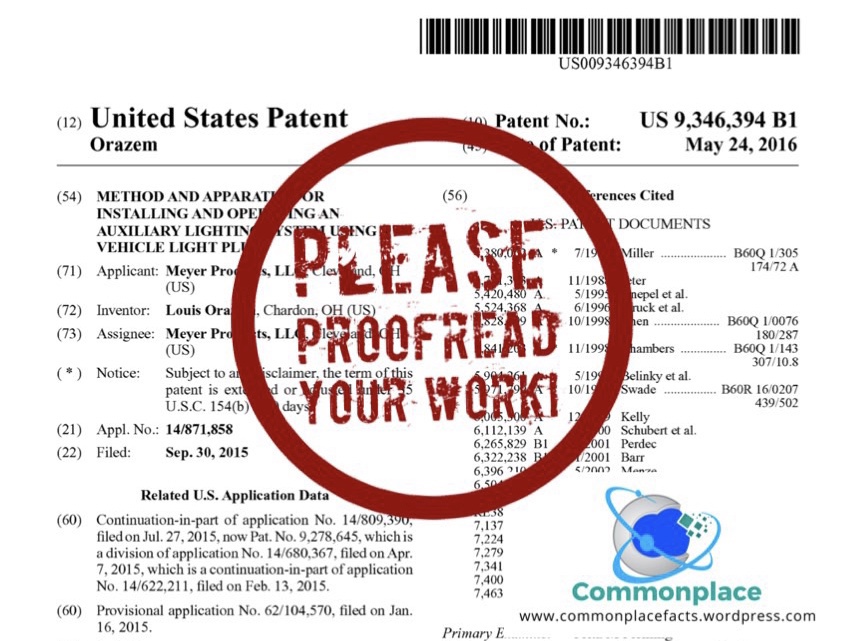
Proofreading your work is important at every stage of life (as Douglas MacArthur discovered during an embarrassing incident in Japan), but never more than when you submit something that will be subject to public scrutiny. This lesson was learned the hard way by the attorney who filed for and received Patent 9,346,394 for a “method and apparatus for installing and operating an auxiliary lighting system using a vehicle light plug.”
Anyone examining the 23-page technical description of the invention will be amused to find these words appearing out of the blue: “I’m sorry babe, but I may actually have to be here late. I’ve got to get this patent application filed today. Thankfully, Traci is willing to stay late to help me get it done.”
Presumably, the attorney was using multiple computer screens and neglected to move the cursor while sending a text message to his or her “babe.”

This, alas, was not the only example of a patent application that was submitted and approved without appropriate proofreading. Patent 7,305,199 is for a “display control apparatus for image forming apparatus.” In the midst of the technical jargon relating to the device, we find this curious paragraph:
“The method of providing user interface displays in an image forming apparatus which is really a bogus claim included amongst real claims, and which should be removed before filing; wherein the claim is included to determine if the inventor actually read the claims and the inventor should instruct the attorneys to remove the claim.”

You may also enjoy…

Who Was the Only President to Obtain a Patent?
Before Abraham Lincoln occupied the White House, he patented a device for lifting boats over obstructions. Patent No. 6,469 records a presidential talent seldom mentioned on the campaign trail.

Fire Destroys Fire Hydrant Patent
Learn about the ironic twist of fate that resulted in the fire hydrant patent going up in smoke.

Chindogu: The World of Weird, Funny, and (Un)Useless Inventions
Chindōgu is the Japanese art of inventing things that almost solve a problem. Getting one gloriously impractical device to qualify is harder than it sounds. Even the inventions that nobody needs have rules.




Leave a Reply