
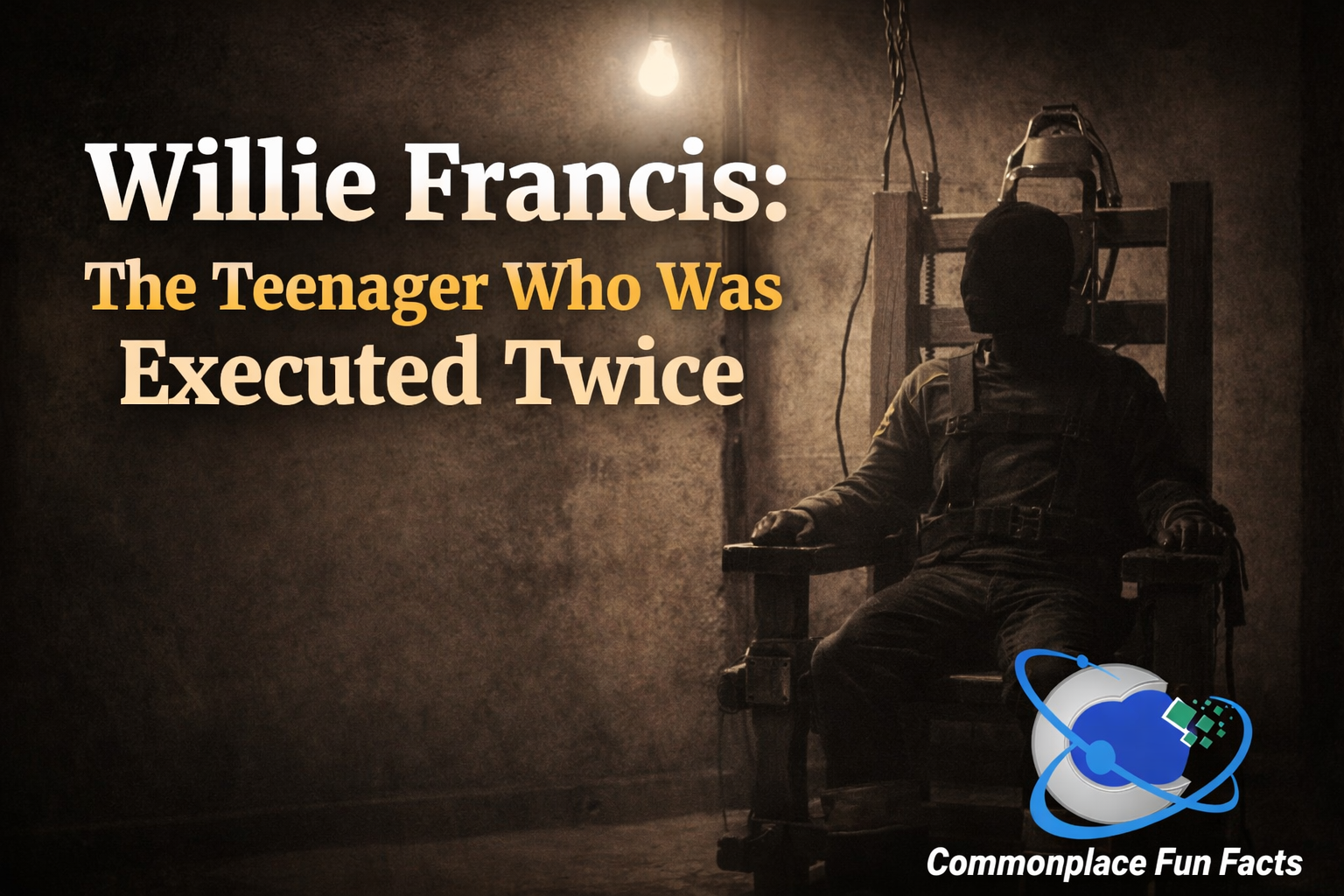

Willie Francis: The Boy the Electric Chair Couldn’t Quite Kill (At First)
History contains no shortage of grim milestones, but few are as unsettling—or as bizarre—as the case of Willie Francis. In the long and troubling history of capital punishment in the United States, Francis holds a distinction no one would ever volunteer for: he was the first person to be executed twice.
Contents
A Crime, A Confession, and a Shockingly Quick Trial

Willie Francis was just 15 years old in 1945 when pharmacist Andrew Thomas was murdered in St. Martinville, Louisiana. The case went cold for nine months, which in criminal investigation terms is roughly the point where everyone starts hoping for a lucky break rather than expecting one.
The break came in August 1945, when police detained Francis near an unrelated incident. During questioning, officers discovered Thomas’ wallet in his possession. That detail tends to complicate one’s day. Francis confessed and provided information that led authorities to the murder weapon, effectively sealing his fate.
What followed was less a trial and more a procedural formality. The entire proceeding lasted just two days. His court-appointed attorneys offered no meaningful defense, raised no objections, and generally behaved as though they had somewhere else to be. The jury deliberated briefly, found him guilty, and he was sentenced to death.
Enter “Gruesome Gertie”
Louisiana’s electric chair, affectionately—and by “affectionately,” we mean “deeply ominously”—known as “Gruesome Gertie,” was not a fixed installation. It was portable, which raises all sorts of logistical and philosophical questions about the phrase “bring the execution to you.”
On May 3, 1946, the now-16-year-old Francis was strapped into the chair. What happened next was not supposed to happen.
When the switch was thrown, the machine malfunctioned. Instead of delivering a lethal current, it produced a weaker surge. Francis convulsed but did not die. Witnesses reported hearing him cry out from beneath the hood, “Take it off! Take it off! Let me breathe!”—a sentence that tends to linger unpleasantly in the mind.
Accounts vary as to why the chair failed. Some reports suggest it had been improperly set up by an intoxicated guard and an untrained inmate. Which is, admittedly, not the dream team one hopes for when assembling high-voltage execution equipment.
Sheriff E. L. Resweber later offered the understated observation: “This boy really got a shock when they turned that machine on.” This is technically accurate, though perhaps not the moment for dry commentary.
The Legal Question: Do You Get a Second Try?
At this point, a reasonable person might assume that surviving an execution attempt would at least earn a reprieve. Francis’ attorney certainly thought so. And that argument actually worked in the case of Half Hangit Maggie Dickson.
The case made its way to the United States Supreme Court, where his lawyer argued that a second attempt would violate two constitutional protections: the prohibition against cruel and unusual punishment and the ban on double jeopardy. After all, being electrocuted once seems like it should count as “jeopardy,” even if the equipment didn’t quite follow through.
In a narrow 5–4 decision, the Court disagreed. In Louisiana ex rel. Francis v. Resweber (1947), the majority held that the failed execution was an accident, not an intentional act of cruelty, and therefore a second attempt was constitutionally permissible.
Justice Felix Frankfurter, concurring, essentially argued that the Constitution does not guarantee a flawless execution—only that the state does not deliberately inflict unnecessary suffering. One imagines this was not especially comforting to the person scheduled to test that theory.
The Second Attempt
On May 9, 1947, Willie Francis was returned to Gruesome Gertie. This time, the machine functioned as intended. At 12:05 p.m., the electrical current was delivered at full strength, and Francis died. He was 18 years old.
Fun (and Slightly Unsettling) Historical Context
The case of Willie Francis did not occur in isolation. It came during an era when the electric chair was still widely viewed as a modern and humane alternative to earlier methods like hanging. The theory was that electricity would provide a quick and relatively painless death.
Reality, unfortunately, did not always cooperate with theory. Early electric chair executions were notoriously inconsistent, leading to a series of high-profile mishaps that would not look out of place in a darkly ironic safety manual titled What Could Possibly Go Wrong?
Louisiana’s decision to use a portable electric chair added an extra layer of unpredictability. Unlike permanently installed equipment, “Gruesome Gertie” had to be transported, assembled, and operated in varying conditions. This was not exactly a recipe for precision engineering.
Why This Case Still Matters
Willie Francis’ case remains one of the most cited examples in debates over capital punishment, particularly when discussing what constitutes “cruel and unusual punishment.” It highlights a persistent tension in the legal system: the gap between theoretical safeguards and real-world outcomes.
It also raises an uncomfortable question that has never entirely gone away: how much error is acceptable in a system where the stakes are irreversible?
For all the legal arguments, court opinions, and historical analysis, the core of the story is remarkably simple—and deeply unsettling. A teenage boy survived his own execution, only to be brought back a year later to try again.
History is full of strange stories. Some are amusing. Some are inspiring. And some, like this one, serve as a reminder that “unusual” does not always mean “interesting in a fun way.”
You may also enjoy…

The Horrifying Hanging of Mary, the Circus Elephant Who Was Executed for Murder
Discover the tragic story of Mary, a circus elephant hanged in 1916 for murder after a public outcry. Explore the shocking details behind this execution and its lasting impact.

The Neck Verse: How to Escape Execution With a Little Latin
Explore the fascinating story of Ben Jonson, the ‘Benefit of Clergy,’ or ‘Neck Verse,’ and how his Latin skills saved him from execution in 1598 after a duel with Gabriel Spencer.

How Sweden’s King Experimented on Prisoners With Coffee
Coffee seems to have had a love/hate relationship with royalty. For centuries, many people viewed the caffeinated beverage with suspicion. Around the year 1600, many in Roman Catholic circles viewed coffee as evil, prompting Pope Clement VIII’s advisors to urge him to denounce the drink. Fortunately for coffee lovers, the pontiff refused to opine on…







Leave a Reply to Commonplace Fun FactsCancel reply