
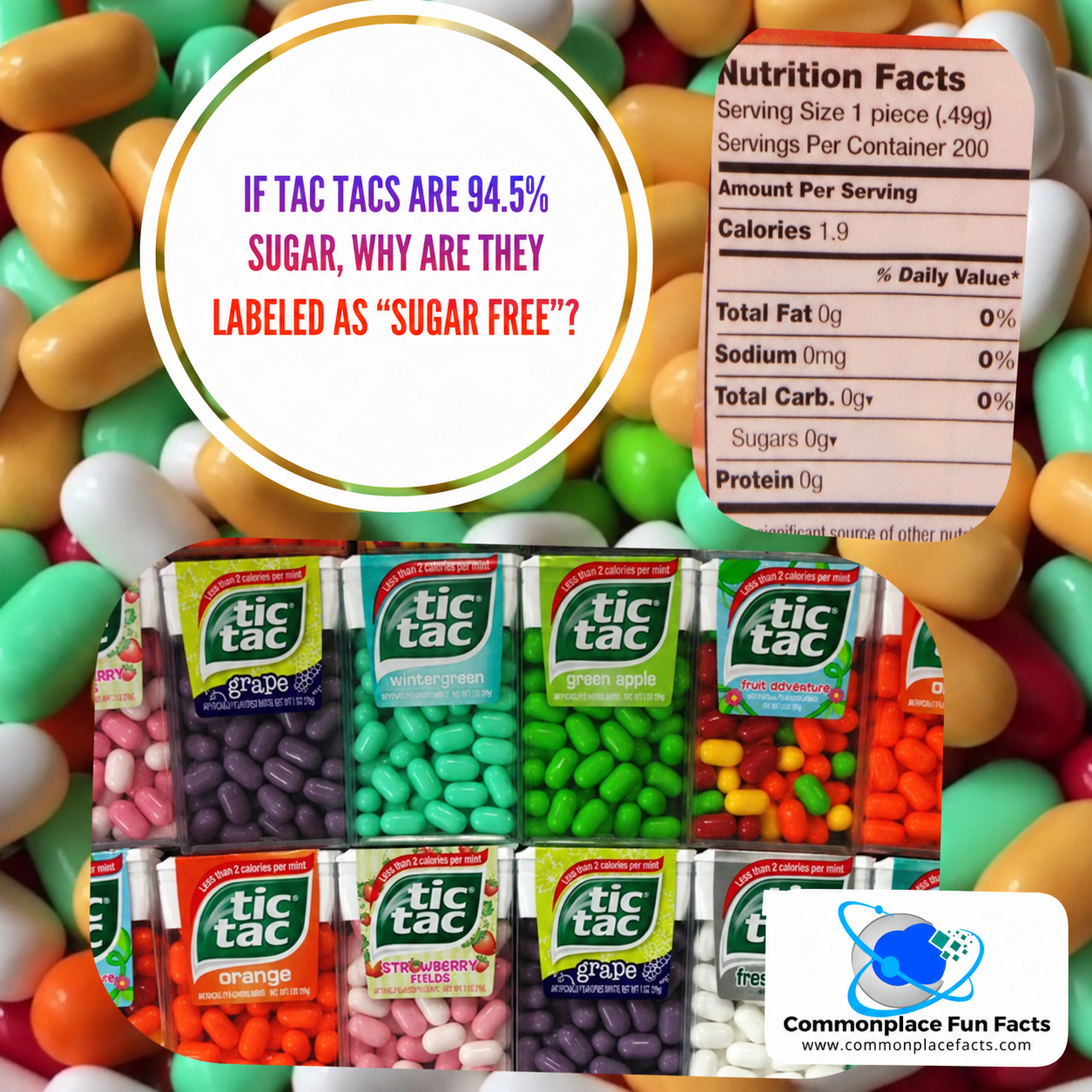

Are Tic Tacs sugar-free?
You wouldn’t think so. Sugar is the first ingredient and the primary ingredient. Only 5.5% of Tic Tacs aren’t sugar. Nevertheless, the Nutrition Facts label on a package of Tic Tacs reports zero grams of sugar per serving. This is not a contradiction, a printing error, or evidence that mathematics has finally given up. It is simply what happens when a very small mint encounters federal rounding rules.
Tic Tacs are among the simpler joys of human existence. They are small, refreshing, pleasantly rattly, and sold in a container that inevitably makes you dispense either one mint or seventeen. There appears to be no setting in between.
First introduced in 1969—the same year humans landed on the moon—Tic Tacs have since appeared in numerous flavors around the world. As anyone familiar with the occasionally fictional science of artificial flavors already knows, the name printed on a candy package should sometimes be regarded as more of a general suggestion than sworn testimony.
The explanation rests on two small facts: the serving size is one very tiny mint, and federal regulations permit very tiny quantities to be rounded down to zero.
Contents
Are Tic Tacs Sugar-Free?

Regular Tic Tacs are not sugar-free in the ordinary sense of the term. On the company’s current U.S. Freshmints product page, the ingredient list begins with sugar, followed by maltodextrin, rice starch, gum arabic, flavorings, magnesium stearate, and carnauba wax.
When sugar occupies first place on an ingredient list, it is generally safe to conclude that the product is not primarily composed of kale.
The precise formula can vary by flavor and country, but the company’s current British nutrition information for Fresh Mint Tic Tacs reports 94.5 grams of sugar for every 100 grams of product. That makes the mints 94.5% sugar by weight. The remaining 5.5% is apparently responsible for the mint flavor, the polished exterior, and maintaining the legal fiction that you are not eating sugar directly from a bowl.
Why Does the Tic Tac Label Say 0 Grams of Sugar?
The answer is hiding in the serving size.
The current U.S. Nutrition Facts panel defines one serving as one mint weighing 0.5 gram. Because the entire mint weighs only half a gram, the amount of sugar in that mint must be slightly less than half a gram.
Under FDA nutrition-labeling regulations, total sugar is generally reported to the nearest whole gram. When a serving contains less than 0.5 gram of sugar, the manufacturer may express that amount as zero.
Each Tic Tac therefore contains real sugar—quite a lot of it in proportion to the mint’s size—but not enough sugar in a single serving to survive the rounding process.
Imagine owing someone 49 cents and announcing that, when rounded to the nearest dollar, you owe nothing. This is mathematically defensible, although it may not preserve the friendship.
Does 0 Grams of Sugar Mean Sugar-Free?
Not necessarily. A statement of “0 grams of sugar” on the Nutrition Facts panel is a numerical declaration governed by rounding rules. A front-of-package claim such as “sugar-free,” “zero sugar,” or “no sugar” is a separate kind of claim governed by additional regulations.

Federal rules permit a product to use a sugar-free claim only when it meets several requirements. Among other things, it must contain less than 0.5 gram of sugar per customary serving and per labeled serving. If sugar appears in the ingredient list, the ingredient may also need an explanatory asterisk stating that it adds only a trivial or negligible amount.
The current Tic Tac ingredient list does precisely that. It identifies sugar with an asterisk and adds this statement:
“Adds a Trivial Amount of Calories, Total Sugars and Added Sugars.”
Even so, Tic Tac’s current U.S. product page does not prominently advertise ordinary Freshmints as “sugar-free.” It reports zero grams of sugar per one-mint serving. Those two statements may sound identical during a hurried trip through the checkout line, but federal regulations keep them in separate filing cabinets, presumably because regulations enjoy filing cabinets.
How Many Calories Are in One Tic Tac?
The same rounding principle applies to calories. Incidentally, the Calorie displayed on a food label is technically 1,000 scientific calories, because nutrition apparently decided that ordinary arithmetic was not already carrying enough of the burden.
Using the company’s British nutrition figure of 397 calories per 100 grams, a half-gram mint contains approximately two calories. That is not much, of course. You could probably burn it off by struggling to open the plastic wrapper around a new package.
It does mean, however, that “zero calories” on the label does not always mean the product contains no energy whatsoever. Sometimes it means the calories are present but too small to receive individual recognition.
How Much Sugar Is in a Whole Pack of Tic Tacs?
The current U.S. Freshmints line includes packages containing 50, 60, 100, or 200 mints. The American Nutrition Facts panel does not disclose the exact fraction of a gram of sugar in each mint, so it cannot tell us the precise amount of sugar in an entire package. Rounding has concealed the evidence one serving at a time.
Other countries require the figures to be presented differently. In the United Kingdom, for example, Tic Tac reports 94.5 grams of sugar per 100 grams of Fresh Mint candies. The company also sells an 18-gram package containing approximately 37 mints. Using those published figures, that package contains about 17 grams of sugar and approximately 71 calories.
| Amount | What the label says | What is actually happening |
|---|---|---|
| 1 Tic Tac | 0 grams of sugar | Contains less than 0.5 gram of sugar |
| Several Tic Tacs | Each individual serving rounds to zero | The fractional amounts begin adding together |
| An entire package | Zero multiplied by the number of servings still looks like zero | You have eaten a measurable quantity of sugar |
This produces the delightful mathematical argument that zero multiplied by 37 is still zero. It is impeccable arithmetic based on a deeply suspicious premise.
Frequently Asked Questions About Tic Tacs and Sugar
Are Tic Tacs actually made of sugar?
Yes. Sugar is the first ingredient in regular U.S. Freshmints, and published nutrition information for the British version reports that the product is 94.5% sugar by weight.
Why do Tic Tacs say 0 grams of sugar?
One mint weighs only 0.5 gram. Because it contains less than 0.5 gram of sugar, FDA rounding rules permit the Nutrition Facts label to report the amount as zero.
How many calories are in a Tic Tac?
A regular Tic Tac contains approximately two actual calories, depending on the flavor and formulation. Since the amount is below five calories per serving, federal rules permit it to be rounded down to zero on the label.
Can eating several Tic Tacs add up to real sugar and calories?
Yes. The rounding rule applies to each labeled serving, not to every mint you consume over the course of the day. Small fractions remain small only until they begin inviting their friends.
The Sweet Truth About Tic Tacs
There is nothing deceptive about listing sugar as the first ingredient and then following federal rules for the Nutrition Facts panel. The information is available to anyone willing to read the ingredients, examine the serving size, consult the Code of Federal Regulations, and conduct a small mathematical investigation before consuming a breath mint.
Still, Tic Tacs provide a useful reminder that nutrition labels do not always speak the same language as ordinary human beings. To most people, zero means none. On a food label, it can mean “some, but not enough to count after rounding.”
So go ahead and enjoy your Tic Tacs. Just remember that they are not miraculous sugarless health pellets. They are tiny pieces of sugar that have discovered the nutritional equivalent of offshore banking.
Originally published in 2019. Updated in July 2026 with current product information and federal labeling regulations.

Fugu: The Pufferfish That Can Kill You—and the People Who Eat It Anyway
Discover how Japan turned the poisonous pufferfish into fugu, a prized delicacy requiring skilled chefs, strict rules, and remarkable nerve.

Henrietta Nesbitt: The White House Housekeeper Who Made FDR Hate Dinner
Discover FDR’s hilarious White House food feud with Henrietta Nesbitt, the housekeeper who served meals the president hated—and refused to stop.

50 Fun Facts About American Inventions, Pop Culture, and Everyday Weirdness
Celebrate America’s 250 years with fun facts about inventions, pop culture, toys, snacks, gadgets, and everyday weirdness.







Leave a Reply