
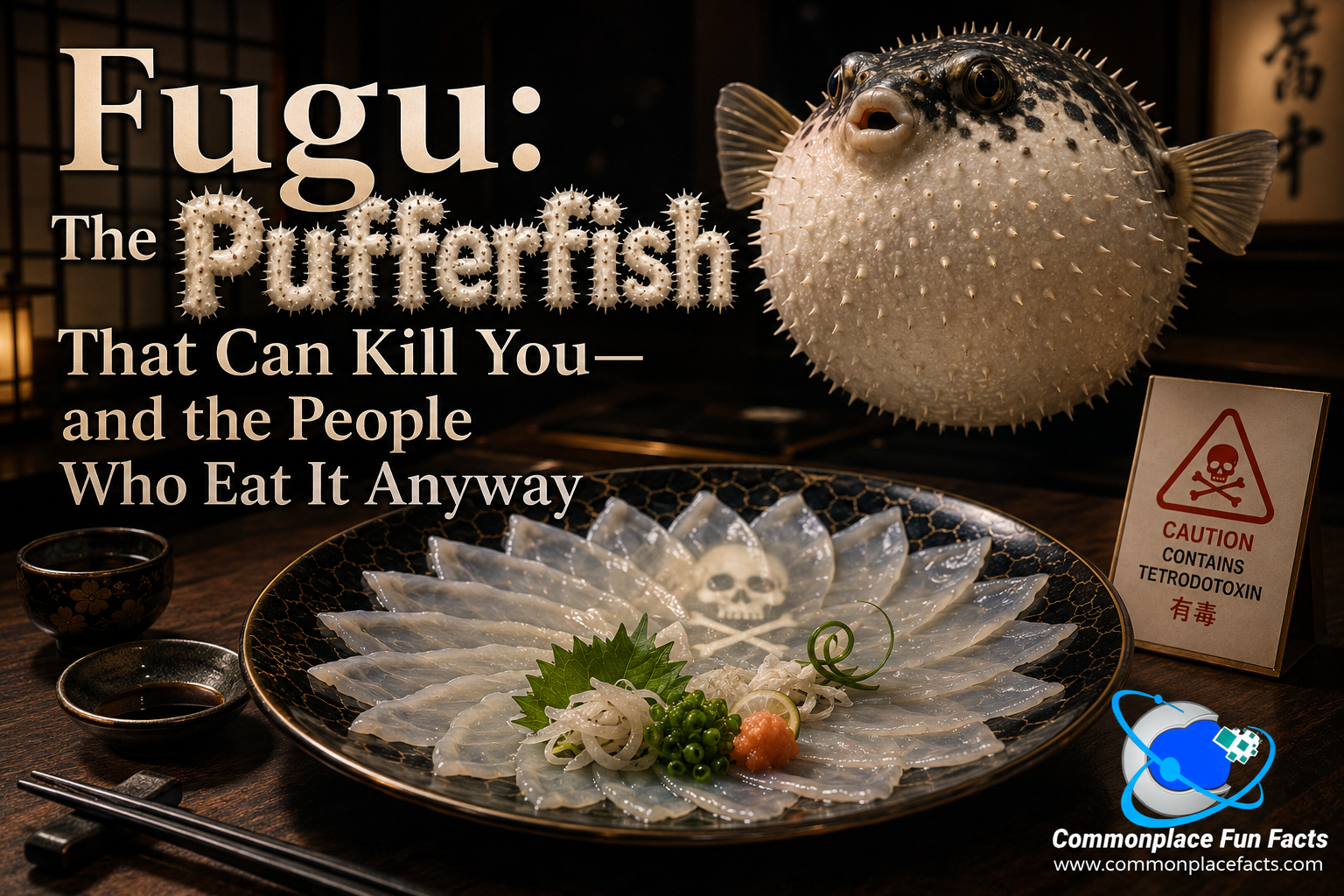

At some point in the distant past, a human being looked at a pufferfish and thought, “I wonder what that tastes like.”
This was already a questionable decision.
The fish had done everything reasonably possible to discourage further investigation. When threatened, it inflated itself into a spiny ball, transforming from an ordinary fish into something resembling a naval mine designed by a balloon artist. It would have been unpleasant to bite and difficult to swallow. If that weren’t enough, many species also carried enough poison to ensure the diner never ate anything again.
One would think we would have taken the hint.
Instead, at some point, someone apparently watched another diner die a horrible death and thought, “I’ll bet that fish would be absolutely delicious if we tried a different way to prepare it.”
Today, dishes made from pufferfish—known in Japan as fugu—rank among the country’s most famous delicacies. The fish can be served raw, fried, grilled, or simmered in hot pot, while its roasted fins can be steeped in hot sake. It is prepared by specially qualified professionals who must know precisely which species they are handling, which pieces can be eaten, and which pieces belong in a locked container before being destroyed.
If that last detail makes the meal sound even more appealing, your idea of fine dining falls somewhere between running with the bulls in Pamplona and ringing the local crime boss’s doorbell before hiding in the bushes.
So how did a fish that arrives equipped with spikes, poison, and the visual demeanor of a startled hand grenade become a symbol of culinary refinement? The answer involves ancient diners, dead soldiers, government bans, a prime minister with an adventurous palate, chefs trained to dismantle dinner like a bomb squad, and toxic leftovers that must be locked away before disposal. In other words, fugu is not merely a meal. It is what happens when humanity mistakes a warning label for a set of cooking instructions.
Contents
The Fish That Turns Into a Balloon
Pufferfish belong to the family Tetraodontidae, a large group of marine and freshwater fish found in warm waters around the world. They are also known as blowfish, balloonfish, globefish, swellfish, and several other names apparently invented by people who watched one inflate and decided that was the primary feature for nomenclature.

A pufferfish is not built for speed. Its body is relatively stiff, and it moves by using its fins rather than bending gracefully from side to side like more conventional fish. This makes it maneuverable but not particularly good at escaping a determined predator.
Instead, it relies on theater.
When danger approaches, the fish rapidly draws water into its stomach and expands to several times its ordinary size. In species with small dermal spines, inflation makes those spines stand out more prominently, leaving a predator with the marine equivalent of a mouthful of thumbtacks.
For added emphasis, many pufferfish contain tetrodotoxin, a powerful neurotoxin. The amount and location vary considerably depending on the species, sex, season, geographic area, and diet. In some species, the toxin is heavily concentrated in the liver and ovaries. Even the flesh is not safe in every variety.
This is why identifying a pufferfish merely as “one of the round ones” is not considered sufficient culinary training.
What Tetrodotoxin Does to the Human Body
Tetrodotoxin does not behave like an ordinary case of bad seafood. It does not merely cause an uncomfortable evening in which the bathroom becomes the most important room in the house.

It interferes with the body’s ability to transmit electrical signals through the nerves. More specifically, the toxin blocks voltage-gated sodium channels, which are essential to the process by which nerves communicate and muscles contract.
The first symptoms may include tingling or numbness around the mouth. That can progress to nausea, dizziness, weakness, difficulty speaking, loss of coordination, and paralysis. In severe cases, the muscles needed for breathing stop working.
The victim may remain conscious while this happens, which is just piling on at this point.
There is no specific antidote. Treatment consists mainly of keeping the person breathing and supporting the body until the toxin is eliminated. Prompt medical care can save a victim, but tetrodotoxin does not leave much room for someone to finish dessert and see whether the tingling clears up on its own.
Cooking does not solve the problem. Tetrodotoxin is heat-stable and can survive boiling, frying, grilling, and other traditional efforts to persuade food to become less dangerous. Freezing does not reliably destroy it either. The safety of fugu depends on removing the toxic portions without contaminating the edible meat.
In other words, this is not one of those recipes where mistakes can be covered with ketchup.
Where Does the Poison Come From?
For many years, people assumed that pufferfish simply produced tetrodotoxin themselves. The actual process appears to be more complicated.
Evidence strongly suggests that pufferfish acquire tetrodotoxin through the food chain rather than producing it themselves. Marine bacteria may be among the toxin’s original sources, although its precise biological origin remains unsettled.
Researchers have raised pufferfish on carefully controlled, toxin-free diets and produced fish containing little or no detectable tetrodotoxin. Feed them toxin-containing food, and they can become toxic again.
This raises an obvious question: could restaurants someday serve reliably nonpoisonous fugu?
Perhaps. Farmed, carefully fed pufferfish already exist. Japanese authorities, however, have continued to prohibit serving notoriously dangerous organs such as the liver, even from cultivated fish. Regulators have apparently decided that “Our chef believes this liver is probably harmless” carries roughly the same scientific weight as dropping a pork chop on the floor and invoking the five-second rule.
People Have Been Eating Pufferfish for Thousands of Years
Pufferfish consumption in Japan is not a modern stunt created for adventurous tourists. Archaeologists have found pufferfish bones at ancient sites, showing that people in the region were eating the fish thousands of years ago.
Those early diners had no understanding of sodium channels, bacterial toxin accumulation, or respiratory support. They had observation, experience, and presumably a lengthy oral tradition consisting of warnings such as, “Do not eat the part that killed Uncle Kenji.”
Over generations, communities learned which fish were safer, which organs had to be removed, and which preparation techniques reduced the risk. The knowledge became part of the food culture of western Japan, especially around Shimonoseki in Yamaguchi Prefecture.
The government was less enthusiastic.
The Military Campaign Defeated by Dinner
During the late 16th century, the Japanese ruler Toyotomi Hideyoshi assembled forces for his invasions of Korea. Soldiers traveling through the Shimonoseki area encountered the local pufferfish and began eating it.
Some of them died.
Hideyoshi had gone to considerable trouble to recruit, equip, organize, and transport an army. Watching pieces of it disappear because the troops had experimented with lunch was understandably irritating. He prohibited the consumption of pufferfish.
The ban was sensible and straightforward. It was also about as effective as a warning label on a pack of cigarettes. Once people decide something is worth the risk, government warnings tend to become background decoration.
Fugu continued to be eaten, particularly in western regions where local knowledge was strongest and central enforcement was weakest. The fish moved from being merely dangerous to being dangerous and forbidden, a combination that has rarely reduced public interest in anything.
The Prime Minister Who Put Fugu Back on the Menu
The decisive turn came in late 1887, when Itō Hirobumi, Japan’s first prime minister, visited Shimonoseki.
As the story is traditionally told, bad weather prevented the Shunpanrō inn from obtaining its usual supply of fish. The proprietress was therefore confronted with the timeless hospitality problem of having an important guest and nothing suitable to serve him.

She did, however, have pufferfish.
Serving an illegal and potentially lethal meal to the prime minister was not the most obvious solution. It was, however, the solution currently available.
The fish was carefully prepared and presented to Itō, who enjoyed it. Rather than arresting everyone in the building, he arranged for the prohibition in Yamaguchi Prefecture to be lifted the following year. In 1888, Shunpanrō became Japan’s first publicly licensed restaurant to serve fugu.
Itō was not the only national leader to let his opinion about something on the menu influence public policy. A century earlier, Sweden’s Gustav III became convinced that coffee was deadly and reportedly ordered one condemned twin to drink three pots of coffee each day while another drank the same amount of tea. The king expected the coffee drinker to die first. Instead, the tea drinker died first at the age of 83, while Gustav himself was assassinated long before the experiment reached anything resembling a useful conclusion. You can read the full story of Gustav III’s remarkably patient coffee experiment here.
Compared with that production, Itō’s method was refreshingly efficient: eat one dinner, survive it, enjoy it, and change the law.
More than a century later, Shunpanrō is still in operation, and it has not forgotten the meal that secured its place in culinary history. Its menu includes complete fugu dinners featuring sliced raw pufferfish, fried pufferfish, pufferfish hot pot, pufferfish skin, soft roe, and rice porridge made with pufferfish broth. The inn that once risked serving an illegal fish to the prime minister now offers several carefully priced opportunities for customers to follow his example.
How to Prepare a Fish That Must Not Be Prepared Incorrectly
Fugu preparation in Japan is tightly controlled, although the familiar claim that every fugu chef must complete exactly three years of training and then eat his own examination fish is an oversimplification.
Japan’s national government establishes food-safety guidelines, approved edible species, and permissible body parts. Without the word “fugu” nearby, this could just as easily be the regulatory framework for a deeply disturbing horror film.
The qualifications required of the person doing the processing have traditionally been administered by prefectures and local governments. Requirements have varied by location, although national standards have been developed to bring greater consistency to the system.
A qualified handler must be able to identify different pufferfish species, including hybrids. This is not a minor concern. Different species may have completely different edible and toxic portions, and naturally occurring hybrids can be difficult to classify.
The processor removes the skin where required, opens the fish, and carefully separates the internal organs from the edible flesh. The liver, ovaries, intestines, and other prohibited portions must be handled without puncturing them or spreading toxin to nearby meat, utensils, work surfaces, or the chef, who has likely grown attached to breathing.
Specialized knives are used, including a thin-bladed knife designed to produce the nearly transparent slices associated with fugu sashimi. The preparation area and tools must be thoroughly cleaned, and the edible portions are repeatedly washed.
Then there is the waste.
Official rules in places such as Fukuoka require toxic organs and other remains to be stored in a dedicated container with a lockable lid until they can be destroyed, often by incineration.
Most restaurant scraps are taken to the trash.
Fugu scraps are treated like toxic waste.
A Meal Arranged Like a Work of Art
The best-known form of fugu is tessa, or fugu sashimi. The meat is sliced so thinly that the pattern of the plate can be seen through it. Chefs arrange the slices in elaborate circular designs, frequently resembling a chrysanthemum.

The finished dish is delicate, symmetrical, and beautiful. It looks less like food than something created by an artist who wanted to remind diners that mortality can have excellent presentation.
The sashimi is commonly eaten with ponzu sauce, grated daikon, scallions, and other seasonings. Fugu has a subtle flavor and a firm, slightly chewy texture. Diners who expect the fish itself to deliver an explosive culinary experience may discover that the danger has a stronger personality than the meat.
Fugu can also appear in tecchiri, a hot pot in which pieces of fish are cooked with vegetables. After the fish and vegetables are eaten, rice and egg may be added to the remaining broth to create a porridge called zosui.
Other preparations include grilled fugu, fried fugu, fugu skin, and hirezake, in which a roasted pufferfish fin is placed in hot sake.
Hirezake is sometimes lit briefly before drinking, because apparently the fish, the poison, and the alcohol were not already giving the evening enough moving parts.
Fugu, Fuku, and the Marketing of Good Luck
In Shimonoseki and parts of Yamaguchi Prefecture, people often call the fish fuku rather than fugu. The word fuku can also suggest good fortune or happiness.
This is excellent branding.
A less confident community might have selected a name meaning “Please verify the chef’s credentials.” Shimonoseki chose “good luck” and built an industry around it.
The city became Japan’s best-known center for fugu processing and trade. Restaurants developed elaborate multicourse meals, and the fish became associated with winter celebrations, luxury dining, and regional pride.
Fugu was no longer simply something people had figured out how to eat without dying. It had become refined cuisine.
The Man Who Thought He Was Immune
The danger did not disappear merely because the table settings improved.
One of the most famous modern fugu fatalities was Bandō Mitsugorō VIII, a celebrated kabuki actor who had been designated a Living National Treasure.
In January 1975, Bandō dined with friends at a Kyoto restaurant. He reportedly ordered four servings of fugu liver, one of the fish’s most poisonous organs. Serving it was prohibited, but fame and confidence have occasionally persuaded restaurants to interpret rules as opening suggestions.
Bandō claimed that he could withstand the poison.
He could not.
He suffered progressive paralysis and died later that night.
The story contains several possible lessons about toxicology, restaurant regulation, celebrity privilege, and the danger of treating personal confidence as a medical intervention. The simplest is that poison does not care whether the person eating it has received critical acclaim.
How Dangerous Is Restaurant Fugu Today?
Properly prepared fugu from a regulated restaurant is considerably safer than its reputation might suggest.
The fact that we are writing that sentence about something people want to eat is still mildly astonishing.
Modern controls have greatly reduced the number of deaths, and the most dangerous incidents usually do not involve qualified restaurant chefs. They involve amateurs.
A study of Japanese cases from 2004 through 2023 identified 450 pufferfish poisoning incidents involving 622 patients and 17 deaths. Most of the poisonings were connected to fish prepared outside regulated commercial settings, often by people who had caught the fish themselves.
This makes sense. A trained fugu professional approaches the fish with years of knowledge, specialized equipment, legal responsibilities, and an intense desire not to become nationally famous for the wrong reason.
An amateur approaches it with a fishing knife and the memory of having watched Grandpa clean a trout with his pocketknife.
Japanese health authorities continue to warn the public not to prepare pufferfish at home. Species can be misidentified, poisonous tissues may be overlooked, and one slip can contaminate otherwise edible meat.
The fact that most recent poisonings come from home preparation is oddly reassuring for restaurant diners. It means the greatest danger is not the quiet professional standing behind the kitchen door.
It is the overconfident uncle announcing that he knows what he is doing—a phrase also commonly heard immediately before food poisoning at a family cookout, an unscheduled fireworks display, or a household electrical repair.
Fugu in the United States
The United States does not leave fugu importation to the optimism of individual restaurant owners.
The Food and Drug Administration tightly restricts imported pufferfish. Under an arrangement between the FDA and the Japanese government, only specified products from the tiger pufferfish Takifugu rubripes, processed and certified under Japanese safety requirements, may enter through the approved import program. Other pufferfish shipments are subject to detention, and travelers cannot simply place a suspiciously round fish in their luggage and explain that it is for personal use.
The FDA notes that cooking and freezing do not destroy tetrodotoxin and that toxic tissue can contaminate edible portions during improper processing, freezing, or thawing.
This is one of the few foods for which “Was it processed under a bilateral international agreement?” is a reasonable question to ask before ordering.
Why Would Anyone Eat It?
The obvious explanation is that people eat fugu for the thrill of danger.
Fugu is hardly the only dish that makes diners wonder whether appetite has finally overruled judgment. Around the world, people have turned fermented sharks, live octopus, insect larvae, blood-based dishes, and assorted animal parts into regional delicacies. You can explore more examples in this collection of some of the world’s weirdest foods.
Still, fugu occupies a special category. Most unusual foods merely challenge the diner’s courage. This one also requires the chef to identify which parts belong on the plate and which parts belong in secure containment.
The thrill is undoubtedly part of fugu’s international reputation, but it does not fully explain the Japanese tradition. For experienced diners, fugu is not supposed to be culinary Russian roulette. It is a seasonal delicacy associated with skilled preparation, subtle texture, artistic presentation, regional identity, and an elaborate shared meal.
The point is not that the chef might kill you.

The point is that the chef is sufficiently skilled not to.
That distinction turns danger into craftsmanship. Anyone can serve a harmless fish. Fugu transforms the absence of catastrophe into part of the dining experience.
There is also the prestige. Fugu can be expensive, especially when served as a full multicourse dinner featuring prized tiger pufferfish. At a comparatively accessible specialty restaurant, a complete meal might cost the equivalent of $50 to $90 per person. At the historic Shunpanrō in Shimonoseki, full fugu courses currently range from about $150 to more than $200 per diner.
Those who insist that their potentially lethal fish must also have enjoyed a free-range childhood can order the seasonal course made with wild pufferfish for roughly $370 per person. Add the required second diner and a 10% service charge, and dinner for two begins at more than $800 before anyone orders a drink.
The cost reflects the fish, the labor, the training, the regulation, and presumably a modest surcharge for the chef accepting responsibility for everyone’s continued respiratory function. The poison may have been removed from the meal, but the restaurant has thoughtfully transferred some of the danger to the bill.
Would Harmless Fugu Still Be Fugu?
The development of farm-raised pufferfish with little or no toxin presents an interesting cultural problem.
If the danger can be removed, the fish becomes easier to serve. More of it might be eaten, regulations could eventually be relaxed, and customers would no longer need to wonder whether the chef’s hand was steady that evening.
But something might also be lost.
Fugu owes much of its reputation to the careful boundary between food and poison. Remove the toxin, and the diner is left with a mildly flavored white fish that is attractive when sliced thinly.
That may be delicious, but it is a much less compelling story.
Human beings routinely claim to want safety, convenience, and predictable results. We also climb mountains, jump from airplanes, eat peppers bred to cause immediate regret, and pay restaurant prices for a fish whose liver must be locked up.
Apparently, total safety is admirable right up until it becomes boring.
The Triumph of Appetite Over Common Sense
Fugu is more than a dangerous food. It is a monument to human persistence.
Nature created a slow-moving fish capable of inflating like a balloon, sometimes equipped with spines, and carrying a toxin capable of paralyzing anyone who ignored the first two warnings.
Humanity responded by developing licensing examinations, specialized knives, secure waste containers, international import agreements, and decorative serving arrangements.
The reasonable response would have been to eat something else. Instead, we turned the fish into a luxury delicacy.
There may be no better example of the human ability to look at an obstacle and see an opportunity—or to look at a poisonous organ and ask whether it would pair well with sake.
Fortunately, modern fugu diners do not need to rely on luck. They rely on regulation, expertise, and a chef who knows exactly what to remove.
Still, when the waiter places that translucent chrysanthemum of fish on the table, it is difficult not to admire the entire chain of events that brought it there.
Someone ate the wrong part. Someone else wrote down which part it was. A government banned the fish. A prime minister brought it back. Generations of chefs perfected the process. Regulators developed rules for disposing of the remains.
And now, centuries later, dinner is served.
History may be written by the victors, but every so often, it is rewritten by whoever survives dinner.
You may also enjoy…

The Weird Foods of the World: You Ate What?
Discover the world’s weird foods—from dancing squid to fermented shark and maggot-infested cheese. Explore bizarre global delicacies that are equal parts fascinating and stomach-churning.

The Favorite Foods of Every President: Treats To Tickle the Tastebuds of the Commander-in-Chief
Explore the favorite foods of every president, from George Washington’s hoecakes to Donald Trump’s Diet Coke. Test your knowledge with our interactive quiz!

Enjoy Kiviak: The Tasty Christmas Dish of Putrefying Birds
Kiviak is a unique Greenland Christmas tradition that involves fermenting auk birds inside a seal carcass for three months. The preparation is labor-intensive and requires specific ingredients, creating a potent dish reminiscent of mature cheeses. Although costly and unconventional, kiviak offers an unforgettable holiday experience for adventurous eaters.







Leave a Reply