
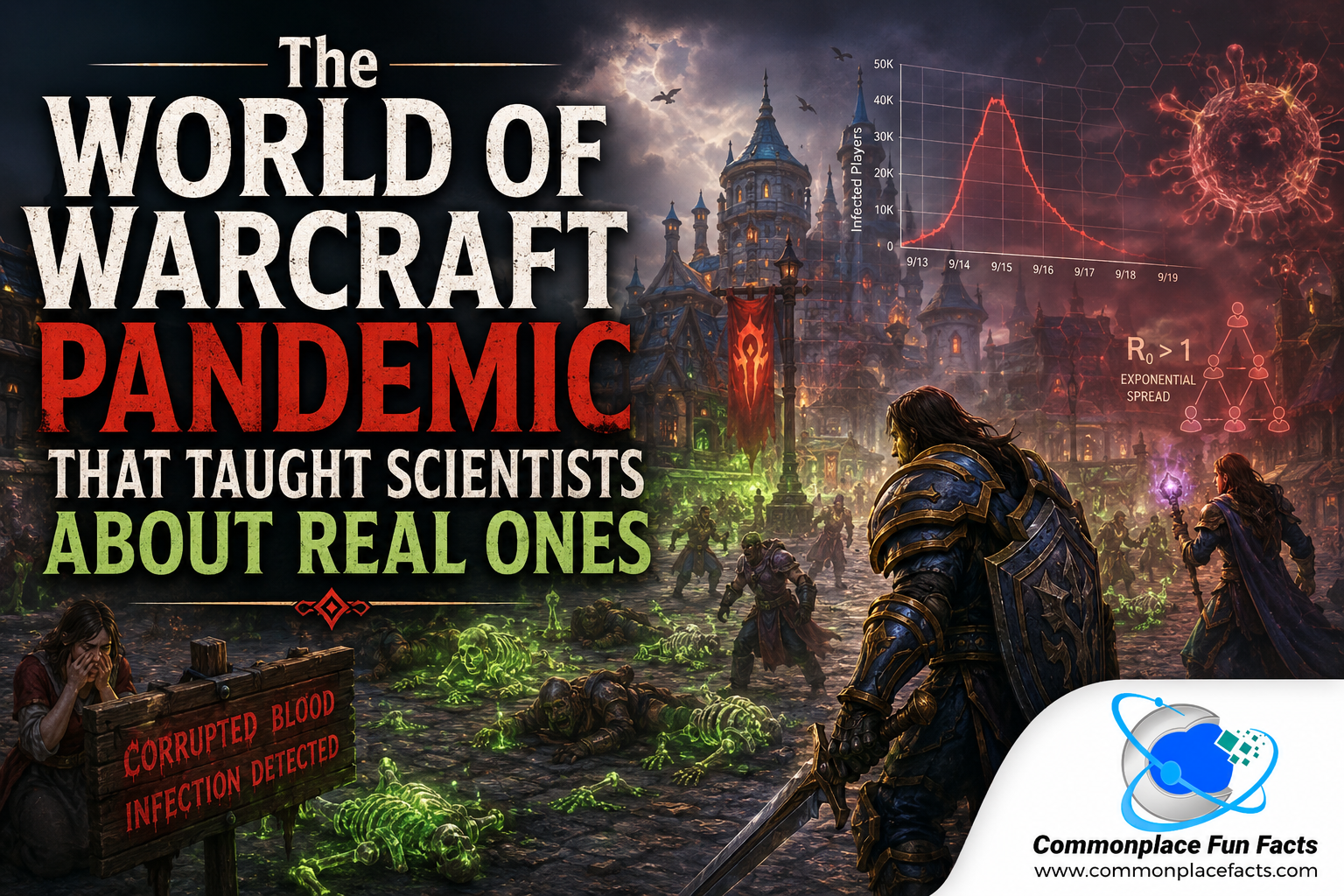

A strange new disease emerged from a remote corner of the world. It spread through close contact. Some of the infected seemed healthy enough to continue traveling, working, shopping, and generally acting as if nothing was wrong. Others collapsed almost immediately. Officials issued warnings. People ignored them. Quarantines were announced. People ignored those, too. Rumors spread faster than the disease, which is saying something, because the disease was doing quite well for itself.
This may sound like a description of COVID-19, influenza, Ebola, or any number of real-world outbreaks that have given public health officials the thousand-yard stare normally reserved for air-traffic controllers and substitute teachers.
But this pandemic did not begin in a wet market, a jungle village, a laboratory, a livestock farm, or that one coworker who insists, “It’s probably just allergies,” while sounding like a haunted accordion.
It began in World of Warcraft.
In 2005, an accidental outbreak known as the Corrupted Blood pandemic swept across Blizzard Entertainment’s online fantasy world of Azeroth. What should have been a temporary boss-fight mechanic became an uncontrolled virtual plague. Within hours, cities were littered with digital corpses. Players fled, panicked, investigated, mocked official warnings, spread misinformation, tried to help, made everything worse, and occasionally infected others on purpose because apparently humanity does not stop being humanity just because it has equipped enchanted shoulder pads.
What looked at first like a hilarious software bug soon attracted the attention of epidemiologists. Years before the world learned to say “social distancing” without sounding like it was reading stage directions from a dystopian dinner party, scientists were already studying how people behave during a pandemic by watching gamers react to a fake disease in a fantasy world.
Contents
What Was the Corrupted Blood Pandemic?
World of Warcraft, commonly known as WoW, launched in 2004 and became one of the most successful online role-playing games ever created. It is a massively multiplayer online role-playing game, or MMORPG, which is a convenient abbreviation because “a place where millions of people pretend to be wizards while arguing about loot distribution” takes too long to say.
Players create characters, join guilds, explore the world, fight monsters, collect treasure, and occasionally spend six hours trying to coordinate a raid with people whose microphones sound like they are broadcasting from inside a cereal box.
By the time the Corrupted Blood incident occurred, WoW had become a sprawling social world. It had cities, economies, transportation networks, crowded gathering places, healers, guild leaders, rumors, opportunists, brave fools, ordinary fools, and that special category of fool who sees disaster and immediately says, “I should go look at that.”
In other words, it had everything necessary for a pandemic except actual germs.
Enter Hakkar, the Dragon Who Accidentally Became Patient Zero
On September 13, 2005, Blizzard introduced a new raid area called Zul’Gurub. At the center of it was Hakkar the Soulflayer, a powerful winged serpent-god who, like many video game bosses, had apparently concluded that simply being enormous and terrifying was not enough. He needed a disease.

During the battle, Hakkar infected players with a spell called Corrupted Blood. The effect was supposed to last only a short time. It damaged infected players and could spread to nearby characters, making the fight more difficult and forcing players to manage their positioning carefully. This was normal raid design: mildly sadistic, mathematically precise, and guaranteed to produce at least one guild argument that would be remembered for years.
The problem was not the spell itself. The problem was what happened when players left Zul’Gurub.
Corrupted Blood was supposed to stay inside the raid. It did not. Thanks to a programming oversight involving hunter pets and other mechanics, the infection escaped. Players could dismiss infected pets during the encounter, leave the dungeon, and later summon those pets in crowded areas. When the pets reappeared, Corrupted Blood came with them, because apparently even digital plagues understand the value of public transportation.
Suddenly, what had been a contained boss-fight mechanic became an uncontrolled outbreak.
How a Video Game Disease Spread Like a Real One
The disease spread through proximity. If an infected character stood near an uninfected character, the uninfected character could catch it. This was bad news in a world where players regularly gathered in busy cities to trade, train, chat, show off gear, and stand around doing the digital equivalent of leaning on a counter at a gas station.
High-level players could survive long enough to travel while infected. Low-level players often died almost instantly. That created a grim dynamic familiar to anyone who has studied infectious disease: some hosts were mobile carriers, while the most vulnerable suffered the worst consequences.
Non-player characters, or NPCs, made things worse. These are the shopkeepers, guards, quest-givers, and other computer-controlled residents of the game world. In many cases, they could become infected and pass the disease along without dying. This turned them into perfect reservoirs for infection: immortal cashiers of doom, standing there patiently while the plague circulated through the city.
Then there was fast travel. Players could move quickly between distant locations, spreading Corrupted Blood from one region to another before anyone understood the scale of the problem. Epidemiologists call this “mobility.” Everyone else calls it “Oh good, now the plague has a frequent-flyer program.”
Within hours, major cities were overwhelmed. Players logged in and found piles of skeletons in the streets. Some tried to flee to less-populated areas. Some shouted warnings. Some treated the entire thing as a disaster movie in which they had been cast as both victim and popcorn vendor.
Blizzard Tried Public Health Measures. Players Responded Like People.
Blizzard Entertainment tried to contain the outbreak. The company warned players not to bring infected pets into crowded areas. It asked infected players to avoid cities. Eventually, quarantine-style measures were attempted.
This went about as well as you might expect if you have ever watched human beings encounter a clearly marked “Wet Paint” sign.
Some players cooperated. Others did not. Some did not believe the warnings. Some believed the warnings but decided the rules did not apply to them, which is a proud human tradition dating back at least to the first person who looked at a cliff and thought, “I can probably jump that.”
Some players fled infected areas, carrying the disease with them. Others intentionally traveled to outbreak zones to see what was happening. A few deliberately spread the infection. Because if civilization teaches us anything, it is that there will always be someone who looks at a public emergency and asks, “How can I make this stupider?”
That behavior turned out to be the most scientifically interesting part of the whole episode.
Why Epidemiologists Started Paying Attention
At first glance, the Corrupted Blood incident was just a bizarre gaming story. A software bug turned a fantasy raid into a mass casualty event. Players died. Cities shut down. Blizzard eventually had to intervene decisively to stop the outbreak. End of story.
But to epidemiologists Eric T. Lofgren and Nina H. Fefferman, the incident looked like something more useful. In 2007, they published a paper in The Lancet Infectious Diseases arguing that virtual worlds could offer valuable insight into disease modeling.
Traditional epidemiological models can simulate disease transmission, but they often struggle with the messy, unreasonable, gloriously inconvenient part of every pandemic: people.
People do not always follow instructions. They misunderstand risks. They panic. They get curious. They share bad information. They assume official warnings are exaggerated. They help in ways that accidentally make things worse. They behave nobly, selfishly, irrationally, heroically, and with the general consistency of a shopping cart with one bad wheel.
The Corrupted Blood pandemic captured that behavior in real time. The disease was fake, but the reactions were real. Nobody’s actual health was at risk, but players still made choices under uncertainty, fear, curiosity, boredom, and social pressure. In that sense, Azeroth became an accidental laboratory for human behavior during an epidemic.
This is the philosophy that results in college courses such as “Competitive Pokémon and Game Theory” that study human behavior through video games. Read 18 Weird College Degrees and Courses That Somehow Actually Exist for more about that.
The Healers Who Helped—and Accidentally Helped the Disease More
One of the most striking behaviors involved healers. In WoW, some characters can heal injured players. When Corrupted Blood began spreading, many healers rushed into infected areas to save others. This was brave, generous, and exactly the sort of thing that makes one briefly hopeful about human nature.
Unfortunately, it also helped the outbreak continue.
By keeping infected players alive longer, healers sometimes allowed them to remain contagious longer. Some healers became infected themselves, then carried the disease elsewhere. What looked like rescue work could unintentionally extend the outbreak.
This does not mean helping is bad. Please do not run from this article shouting, “Commonplace Fun Facts says nurses are the problem.” That would be a bold misreading, and frankly we have enough of those already.
The lesson is more subtle: during an outbreak, even well-intentioned intervention can have unintended consequences if helpers lack protection, coordination, or accurate information. Real-world public health workers understand this painfully well. During infectious disease outbreaks, doctors, nurses, emergency responders, and caregivers often face elevated risks precisely because they move toward danger instead of away from it.
Azeroth’s healers were not wrong to help. They simply demonstrated that compassion without containment can become a very busy delivery service for pathogens.
The Curious Crowd: “I Heard There’s a Plague. Let’s Go Look.”
Another behavior fascinated researchers: curiosity.
Some players deliberately traveled to infected areas simply to see what was going on. They had heard rumors of skeleton-filled streets, mass death, and cities rendered uninhabitable. So naturally, they went there. This is the same instinct that causes traffic jams on the opposite side of the highway from an accident. It is not our species’ finest quality, but it is very much on-brand.
In a real-world pandemic, curiosity can serve a useful purpose. Journalists, researchers, aid workers, and officials may need to enter dangerous areas to gather information, provide assistance, or alert the public. But movement into and out of outbreak zones also increases risk. The observer can become a carrier. The person documenting the crisis can become part of the crisis.
The Corrupted Blood incident showed this dynamic in exaggerated form. People wanted information. They wanted to witness history. They wanted to say they had been there. Some probably just wanted screenshots. Whatever the motive, curiosity became a transmission route.

The Digital Typhoid Mary Problem
Not every player spread Corrupted Blood by accident. Some reportedly spread it intentionally.
This is where the story stops being merely funny and starts becoming depressingly educational. In nearly every public crisis, a small number of people discover that chaos gives them attention, power, or entertainment. In WoW, they could infect crowded areas. In the real world, the tools differ, but the impulse is recognizable: hoaxes, misinformation, reckless exposure, fake cures, forged documents, and the ancient human urge to be the loudest raccoon in the trash fire.
Intentional spread was not the main driver of Corrupted Blood, but it mattered because it revealed something disease models often struggle to include: malice, mischief, and performative stupidity.
Numbers can model contact rates. They can estimate transmission probabilities. They can project hospital capacity. They have a harder time accounting for the guy who thinks rules are tyranny, risk is fake, and “watch this” is a philosophy of life.
What Corrupted Blood Got Right About Real Pandemics
The Corrupted Blood pandemic was not a perfect model of real disease. Nobody catches Ebola from a summoned tiger. No one boards a griffin flight from the ICU. Public health departments cannot stop a pandemic by rebooting North America, although one suspects the idea has appeared on at least one whiteboard during a difficult week.
Still, the virtual outbreak captured several real-world pandemic dynamics with unsettling clarity.
- Mobility matters. Infected players traveled quickly between regions, just as real people carry disease along roads, flights, trains, and daily routines.
- Asymptomatic or mildly affected carriers matter. Stronger characters could survive while spreading the disease to more vulnerable players.
- Animal or secondary carriers complicate containment. In-game pets helped spread Corrupted Blood beyond its intended boundaries.
- Public warnings are not self-executing. People have to believe instructions, understand them, and choose to follow them.
- Helpers need protection. Healers rushing into outbreak zones sometimes prolonged transmission.
- Curiosity can be contagious-adjacent. People who travel to see a crisis can become part of the crisis.
- Behavior can defeat neat models. The disease spread not only because of code, but because of choices.
That last point is the big one. Disease is biological. Pandemics are social. A pathogen may begin the story, but human behavior writes most of the chapters, usually in ink, sometimes in crayon, and occasionally on fire.
What Corrupted Blood Got Wrong
Of course, Azeroth is not Earth. This is an important distinction, especially for anyone currently preparing grant proposals involving elves.
The Corrupted Blood pandemic had major limitations as a scientific model. Players were not physically endangered. Death in WoW is temporary. Economic consequences were limited to a game environment. Characters could resurrect. Administrators could reset servers. Nobody had to worry about ventilators, funeral homes, school closures, eviction moratoriums, vaccine distribution, or whether Uncle Gary had done his own research on a website last redesigned during the Clinton administration.
Also, players in a game may take risks precisely because the stakes are low. A person who would never walk into an actual quarantine zone might happily send a level 60 warrior into a plague-ridden city just to watch the chaos unfold. That does not make the data useless, but it does mean researchers have to be careful about drawing direct comparisons.
Still, the outbreak revealed something valuable: even in a fake world, people responded in ways that looked familiar. Fear looked like fear. Curiosity looked like curiosity. Defiance looked like defiance. Altruism looked like altruism. Bad decision-making wore exactly the same hat it wears everywhere else.
The Pandemic That Could Be Ended by Rebooting the World
Eventually, Blizzard brought the outbreak under control. The company intervened with fixes and server resets, using powers not generally available to the Centers for Disease Control unless its budget has improved more than anyone realized.
This is the great advantage of a virtual pandemic: the world can be patched.
Real pandemics are less cooperative. You cannot restart a country. You cannot roll back a week of infections. You cannot issue a software update that makes everyone understand exponential growth. If such an update exists, it is currently stuck in beta testing, presumably because someone keeps commenting, “But what about my personal freedom to lick doorknobs?”
But that difference is also what made Corrupted Blood useful. It offered a glimpse of outbreak behavior in a controlled environment where researchers could observe choices, reactions, movement, and communication without anyone actually dying. That is rare. Usually, by the time scientists can study a pandemic at scale, people are already suffering.
Why the World of Warcraft Pandemic Still Matters
The Corrupted Blood incident remains one of the strangest footnotes in both gaming history and public health research. It was not designed as an experiment. It was not approved by an ethics board. No one at Blizzard woke up that morning and said, “Let’s create a behavioral epidemiology simulation with dragons.”
And yet, that is roughly what happened.
The outbreak showed that virtual worlds can reveal real patterns of human behavior. It demonstrated that public health is not merely a matter of medicine, math, or official announcements. It is also a matter of trust, incentives, fear, boredom, culture, social pressure, and whether people think the rules apply to them.
That lesson became painfully relevant during COVID-19. Public health officials could calculate transmission rates and recommend precautions, but they still had to deal with the unpredictable variable known as “the public,” which is less a variable than a sack of caffeinated squirrels wearing opinions.
The Corrupted Blood pandemic did not predict COVID-19 in the mystical sense. Azeroth was not a crystal ball. Hakkar was not a prophet. No one should be building national pandemic policy around the behavior of a warlock named Shadowmuffin.
But it did foreshadow one of the central truths of modern outbreaks: the pathogen is only part of the problem. The rest is us.
The Real Lesson of Corrupted Blood
The most important thing about the World of Warcraft Corrupted Blood pandemic is not that a video game accidentally created a plague. That is interesting, certainly, but software bugs happen. Sometimes they delete your progress. Sometimes they duplicate your inventory. Sometimes they create a simulated public health emergency that ends up in medical journals. Technology likes to keep its options open.
The important thing is what happened next.
Players behaved like people. They helped. They panicked. They ignored instructions. They gathered in crowds. They fled. They investigated. They spread rumors. They tried to save others. They made selfish choices. They made brave choices. They made choices so baffling that somewhere, a future epidemiologist probably stared at the data and whispered, “Well, that tracks.”
The Corrupted Blood pandemic was fake. The behavior was not.
That is why scientists paid attention. That is why the story still matters. And that is why, decades later, a plague unleashed by a fictional blood god in a digital jungle remains one of the oddest and most useful reminders that when disaster strikes, the first thing to understand is not just the disease.
It is the people standing next to it saying, “I just want to see what happens.”
You may also enjoy…

The Pink Poop Pandemic and the Breakfast Cereal That Caused It
In 1971, children eating Franken Berry cereal experienced alarming side effects, notably passing pink poop due to the indigestible dye FD&C Red No. 2. Despite no health risks, the phenomenon, dubbed “Franken Berry Stool,” led to the cereal’s market withdrawal. Similar effects were noted with other cereals using artificial coloring.

The Search to Uncover the Legendary Secret Graveyard of Video Games
It was April 2014, and the excavators approached the rumored burial site with high hopes. Many expressed doubt that the place even existed. Those who were in the best position to know had publicly stated that the site was an urban legend. Despite the naysayers, there was a loyal group of true believers who were…

Magic: the Gathering: The World’s Most Complex Game is Too Complicated for a Computer
Discover why Magic: The Gathering* is officially the most complex game ever created—so intricate that even computers can’t calculate a winner. From Captain Kirk’s fake Fizzbin to CIA training decks, explore how games outsmart logic and intelligence alike.



Leave a Reply