

Commonplace Fun Facts loves Canada. We have written about its enlightened policies that have created the only rat-free territory in the world, the establishment of the Global Strategic Maple Syrup Reserve, and a “H0H0H0” postal code for Santa Claus. In short, we couldn’t be happier that our neighbor to the north is a BFF of the USA.
It’s a good thing the relationship between Canada and the United States is friendly. The 5,525-mile (8,892-km) border is not only the longest international border but is also unguarded. It isn’t much of an exaggeration to say that nothing could come between the two allies.
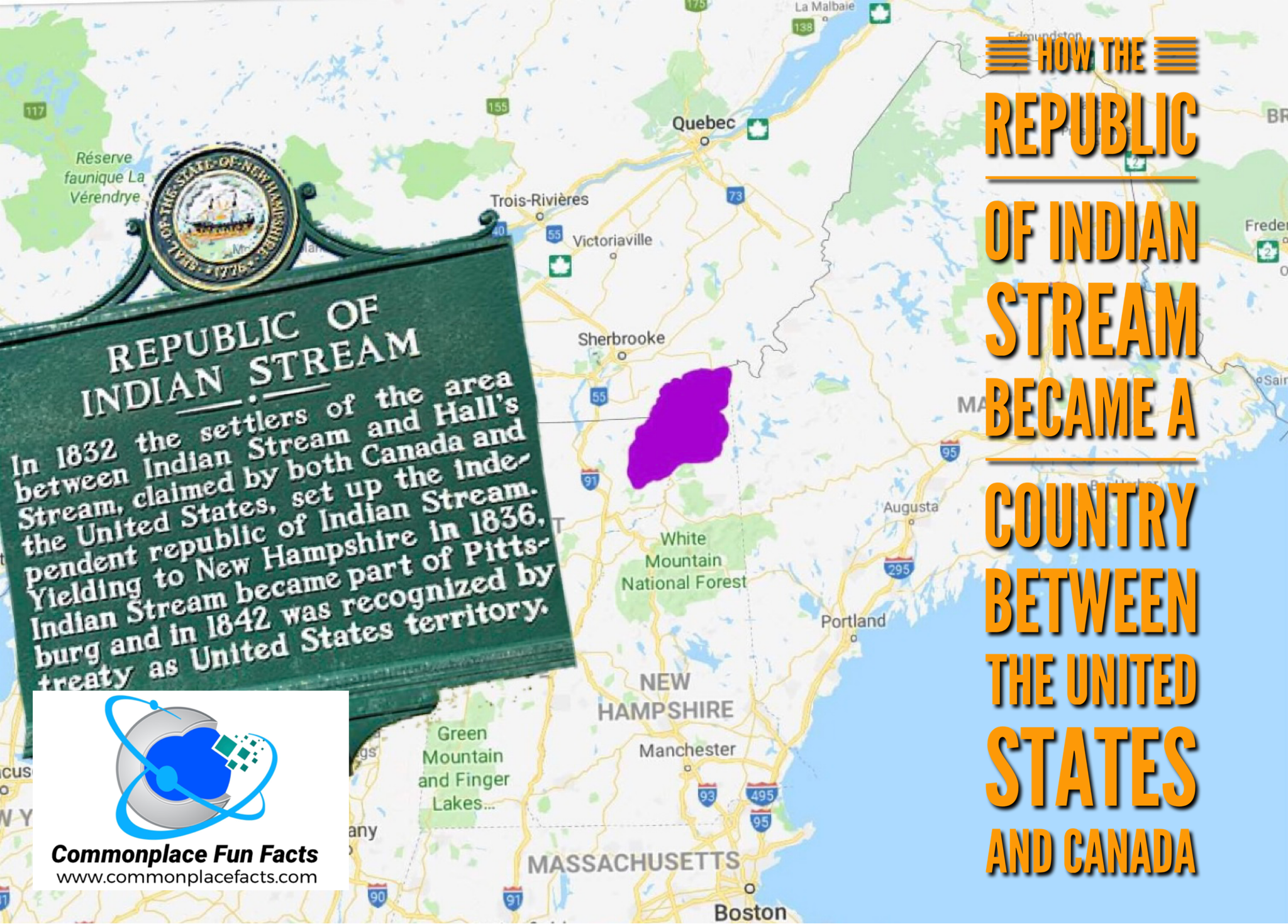
Nothing, that is, except the country that used to exist in between the two great nations. What’s that? You didn’t know about the country separating Canada from the USA? You must have been sleeping the day your geography teacher spoke about the Republic of Indian Stream.

An adage tells us that good fences make good neighbors. The international application of this principle can be found in national borders. Borders are essential to the security and identity of a country. That’s why it is so important to define them clearly.
Some national borders are easy to describe. Australia’s primary national border can be defined as the spot where your feet start to get wet. Others, such as the border between Argentina and Chile, use mountain ranges to separate countries.
Whatever the basis for a border, ultimately it falls back on mutual understanding. That’s where things went wrong between Canada and the United States, thus giving birth to the Republic of Indian Stream.
Long before the two nations cemented their BFF status, the relationship fell into the “it’s complicated” category. There was a minor little kerfuffle in the latter half of the 18th century when thirteen British colonies decided to do their own thing. The primary sticking point that led to the American Revolution was taxation without representation. Of course, once the colonists got their independence, they learned that taxation with representation is no great blessing, either, but that’s a whole different topic.
The fighting formally ended with the signing of the 1783 Treaty of Paris. One of the provisions of the treaty defined the boundary line between the newly-formed United States of America and Lower Canada (then under the control of Great Britain). Regarding the New England territory, the treaty declared that the border would proceed
… [westward] along the said highlands which divide those rivers that empty themselves into the river St. Lawrence, from those which fall into the Atlantic Ocean, to the northwesternmost head of the Connecticut River; thence down along the middle of that river to the forty-fifth degree of north latitude; from thence by a line due west on said latitude …
That sounds clear enough, doesn’t it? As you may have guessed from the fact that this article still has a few paragraphs to go, it wasn’t as clear as the framers of the treaty imagined. It turns out the Connecticut River has three tributaries, each of which could qualify as the northwesternmost head of the river.
Unsurprisingly, the United States took the position that Halls Stream, the westernmost tributary, was the head of the Connecticut River. The Canadian representatives maintained that the chain of Connecticut Lakes was the place pointed to by the treaty. The result was an area of disputed territory claimed by both nations.
There were no great military battles fought over the disputed territory. Instead, both governments sought to exercise sovereignty over the real estate by imposing taxes on the people and the property. Those who supported the Revolution thought they were throwing off the oppression of unfair taxation. They traded that for the unexpected consequence of having tax collectors from two governments showing up and demanding their fair share.
King William I of the Netherlands was asked to arbitrate. In 1831, he declared that the disputed territory belonged to Canada. Canada was thrilled with this decision and promptly informed the male residents that there was this little thing called mandatory military service and they should suit up and report for duty.
Having just come through a very hands-on lesson in political science, the people remembered that there is such a thing as declaring independence from another country. The citizens of the disputed area got together and decided the best way to get rid of the blight excessive government meddling would be to form their own country.
On July 9, 1832, the Republic of Indian Stream declared its independence. It is clear they did not intend this to be a permanent arrangement. The new country’s constitution declared, in part:
The people inhabiting the Territory formerly called Indian Stream Territory do hereby solemnly and mutually agree with each other to form themselves into a body politic by the name of Indian Stream and in that capacity to exercise all the powers of a free, sovereign and independent state, so far as it relates to our own internal Government till such time as we can ascertain to what government we properly belong.
The new country immediately got to work doing all the things that countries are supposed to do. It enacted laws, printed its own postage stamps, and formed an armed militia of 41 men. Forty-one soldiers may not seem like much. Consider, however, that Indian Stream’s total population was 300 residents. That meant that 13.6% of its people were actively involved in national defense. To achieve that same level of commitment, the United States today would need to have over 45,200,000 people in its armed forces.
Although the process for declaring its independence was not a lot different than the one followed by the United States in 1776, it turns out that independence typically is not recognized without a lot of troublesome fighting. Canadian authorities were not overly threatened by Indian Stream’s fighting force and essentially ignored the proclamation of sovereignty. Canadian tax collectors continued to show up, demanding prompt payment of all tax obligations.
The United States seems to have recognized Indian Stream’s claims. It stopped sending tax collectors. Instead, the USA started charging import duties on goods coming from Indian Stream.
While all of this was going on, the governmental authorities of Indian Stream realized there is something else every nation gets to do: tax its citizens. Money was needed to fund the operations of the government, and people rarely hand over the necessary funds without some sort of legal obligation to do so. Consequently, the people of Indian Stream went from two nations demanding their money to three nations bleeding them dry. A heavy price to pay for independence, indeed.
In 1835, the Indian Stream Congress voted to request annexation by the United States, on the condition that they not be considered a part of New Hampshire. The Attorney General of the United States replied that this was not possible; annexation meant they would be once part of New Hampshire, whether they liked it or not.

While this was going on, Canadian officials arrested a citizen of Indian Stream for failure to pay his bills to a hardware store. New Hampshire, eager to defend its newest citizens, sent its militia into Indian Stream to free the incarcerated debtor. In the process, they shot up the house of the judge who had sentenced the man. This sparked a serious international crisis between the United States and Canada/Great Britain.
Fortunately, before things could get too much out of hand, cooler heads prevailed. The British ambassador to the United States was said to be appalled at the prospect of a third war between the US and Great Britain over something as trivial as an unpaid hardware bill. He agreed to begin negotiations to clarify the border definition from the 1783 Treaty of Paris. In 1842, this new border was formalized by treaty.
Ironically, by being forced to become citizens of New Hampshire, the people of Indian Stream became part of a state whose motto is, “Live Free or Die.”

Emperor Norton: The Man Who Was Emperor of the United States
Learn about the fascinating and entertaining life of Emperor Norton, the man who proclaimed himself to be the Emperor of the United States.

The Boy Who Rejected His Right to be King
What do you make of someone who renounces his birthright — especially when that means renouncing the right to be King? The story has played out before, triggering the expected media firestorm. There is the example of King Edward VIII, who gave up his throne to become the Duke of Windsor. Today’s tabloids and talk…

Welcome to the Land Wanted By No Nation
There’s nothing unique about disputed territory. It is one of the most common causes of war. When two nations cannot agree on who holds the right to possess a piece of real estate, conflict is inevitable. Unless, of course, we’re talking about Bir Tawil. The conflict over the possession of Bir Tawil is similar to…





Leave a Reply to Monkey’s TaleCancel reply