

Meet George Berkeley and the Theory of Immaterialism
Anglican bishop and philosopher George Berkeley (1685-1753) was famous for his theory of immaterialism. He linked existence to perception. He suggested that material things do not exist in and of themselves but are little more than illusions that spring into being as a result of being perceived.

Admittedly, that’s a gross oversimplification of a complex philosophy, especially for those of us whose philosophical sophistication is limited to the Spider-Man mantra, “With great power comes great responsibility.” We mention it to make it sound as if we are far more clever than we really are. Also, it helps provide background for one of our favorite amusing tidbits of philosophy.
In Berkeley’s A Treatise Concerning the Principles of Human Knowledge, published in 1710, he wrote:
But, say you, surely there is nothing easier than for me to imagine trees, for instance, in a park, or books existing in a closet, and nobody by to perceive them.
The objects of sense exist only when they are perceived; the trees therefore are in the garden… no longer than while there is somebody by to perceive them.
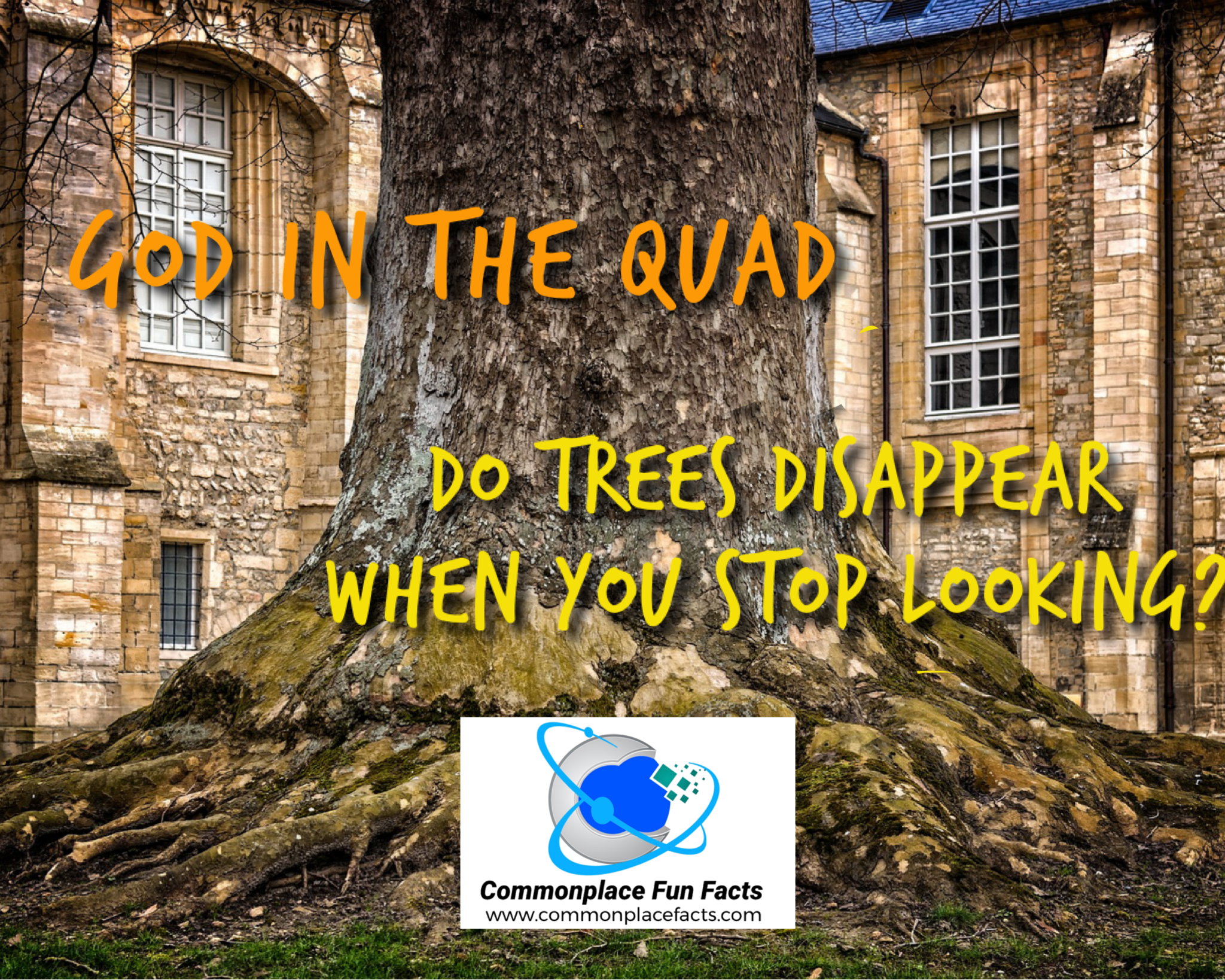
Berkeley’s proposition raised the startling prospect that something as solid as a tree could abruptly cease to exist simply because no one happened to be looking at it.
This seemed to be too ridiculous to accept and prompted Ronald Knox (1888-1957), to express his doubts by tacking the following limerick on a tree in the Quad of Trinity College, Oxford:
There once was a man who said, “God
Must think it exceedingly odd
If he finds that this tree
Continues to be
When there’s no one about in the Quad.”
The solution to this dilemma was offered by an unknown poet who attached the following response:
Dear Sir,
Your astonishment’s odd.
I am always about in the Quad.
And that’s why the tree
Will continue to be
Since observed by
Yours faithfully,
God
A similar approach was taken by Roderick T. Long, Professor of Philosophy at Auburn University. He offered this lyrical analysis:
If objects depend on our seeing
So that trees, unobserved, would cease tree-ing,
Then my question is: Who
Is the one who sees you
And assures your persistence in being?
Dear Sir,
You reason most oddly.
To be’s to be seen for the bod’ly.
But for spirits like me,
To be is to see.
Sincerely,
The one who is godly.
You may also enjoy…

A Limerick for Mathematicians
For those of us who have yet to memorize our multiplication tables, the concept of someone doing math for fun is as paradoxical as putting pineapple on pizza. Even so, Leigh Mercer (1893–1977) was known for being a recreational mathematician. In other words, he simply delighted in math. We know… Weird, isn’t it? Then again,…

The Omnificent English Dictionary In Limerick Form
Here at Commonplace Fun Facts, we love words. We also love limericks. When we stumbled across The OEDILF, we thought someone had been taking a peek at our Christmas gift wish list. The OEDILF is The Omnificent English Dictionary in Limerick Form. According to the website, the goal of The OEDILF is to produce a…

Pleasing Pendulum Poetic Limerick
Thanks to Lesser Mutterings for pointing us to this wonderful science-based limerick. The primary equation that describes how a pendulum works is: T is the period of time it takes for a pendulum, displaced sideways from its resting, equilibrium position, to return to the equilibrium position. L is the length of the pendulum, and g…





Leave a Reply