
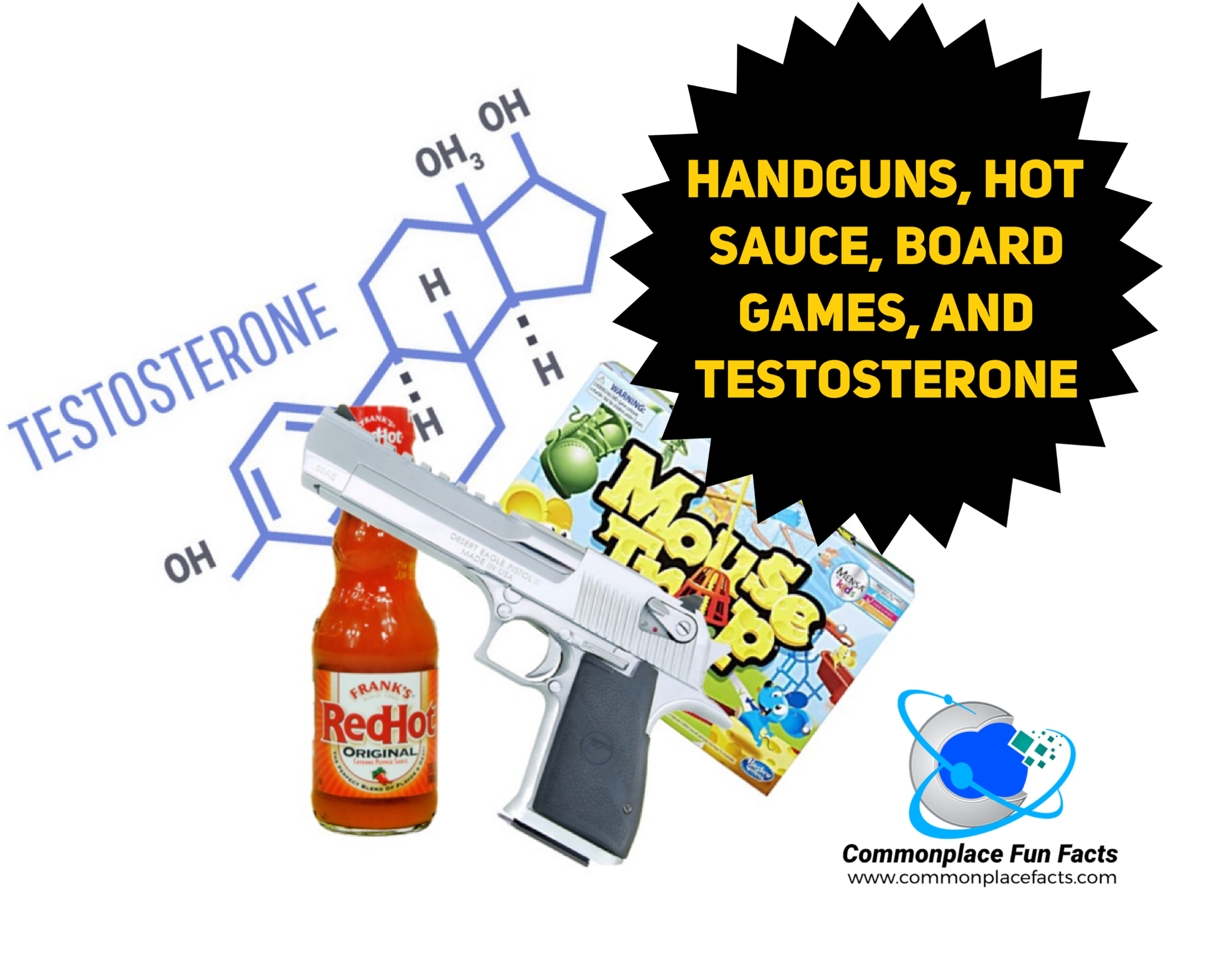

Testosterone and Aggression: Is there a Link?
Many important scientific studies have expanded the realm of human knowledge. Commonplace Fun Facts has faithfully informed its readers about innovative research that has answered questions such as “How long does it take mammals to empty their bowels and bladders?”, “Is there a link between liking strong coffee and developing psychopathic tendencies?”, and “Why does walking with a cup of coffee cause it to spill?”
Although some might question the relevance of the information gleaned from those studies, we recently found one that has indisputable value. It goes a long way toward answering the ageless questions “Why do guys act the way they do?” and “Why do men have shorter lifespans than women?”
Contents
For insight into these mysteries, we refer you to the groundbreaking study from Knox College, Illinois, entitled “Guns, Testosterone, and Aggression: An Experimental Test of a Mediational Hypothesis.“
Of all the studies we have reported, we have to admit that this is one we would most like to have participated in. At the very least, we would have enjoyed watching it play out. The fact that it is designed to study distinctly male behavior probably has something to do with this, since the Commonplace Fun Facts writers are exclusively male and have all been accused of exhibiting “Male Pattern Brain Dysfunction.”
The Experiment
Researchers sought to determine whether certain activities were more likely to increase testosterone levels and if it would carry through to increased aggressive behavior. To test their hypotheses, researchers enlisted the assistance of 30 male college students, aged 18-22. They were told that they would be participating in a study to see if there is a link between taste sensitivity and attention to detail.

The subjects were first brought to a relatively-calm state by showing them nature videos and exposing them to calming music. Each of them then provided a saliva sample, from which the baseline testosterone level was measured.
Half of the men were brought, one by one, into a room and given a replica of a Desert Eagle™ automatic handgun. The other half, serving as a control group, were provided with Hasbro’s Mouse Trap® board game. They were told to spend fifteen minutes fiddling with the items while writing detailed instructions about how to disassemble and reassemble the parts. After 15 minutes, each of them provided a second saliva sample.
For the next stage in the experiment, each of the guys was led into a room and given a cup of water mixed with a single drop of Frank’s® RedHot® sauce. They were told that the water/hot sauce mixture had been prepared by the prior participant. The subject took a sip of water and recorded his assessment of the taste.
Next, the subject was told to prepare the water/hot sauce mixture for the next person, putting as much hot sauce into the water as he wished. The theory was that the higher the testosterone level, the greater the amount of hot sauce that would be inflicted upon fellow participants.
The Results
When the experiment was concluded and the results were tabulated, the researchers confirmed their initial hypothesis. The guys who got to play with a gun saw an average increase in testosterone levels of 62.05 pg/ml. Those who got to play with the board game only experienced an average increase of 0.68 pg/ml.
Did this increased testosterone have any connection to aggressive behavior? That hypothesis was also confirmed. Among the guys who got to play with a gun, they added, on average, 13.61 g of hot sauce to the water that they thought would be tasted by the next participant. The Mouse Trap control group, in contrast, added, on average, 4.23 g.
The Conclusion
If you don’t want to have your next drink of water spiked with hot sauce, you should probably keep guns out of the hands of the guys in your household.
There are probably other conclusions one could draw, but frankly, we’re too distracted with our grand design to introduce hot sauce into the city’s water supply. In retrospect, it may not have been a good idea to start this project with all of our research into the Desert Eagle handgun.
You may also enjoy…

Sleep Science 101: Why Are Yawns Contagious? The Answer is More Invigorating Than You Might Expect
Why are yawns contagious? Discover the fascinating science as we explore theories on brain chemistry, social mirroring, and how yawning strengthens social bonds across humans and animals alike.

Nightmare on Left-Side Street: Is Your Sleep Position to Blame?
Does your sleep position affect whether you will have dreams or nightmares? Discover the surprising science behind sleep positions and dreams, plus tips to improve your night’s rest.

Honeybee Sting Pain Index: Exploring the Most Painful Places on the Body to Get Stung
Discover Michael L. Smith’s research on the Honeybee Sting Pain Index, ranking pain from stings on different body parts. Find out which sting hurts the most.







Leave a Reply