
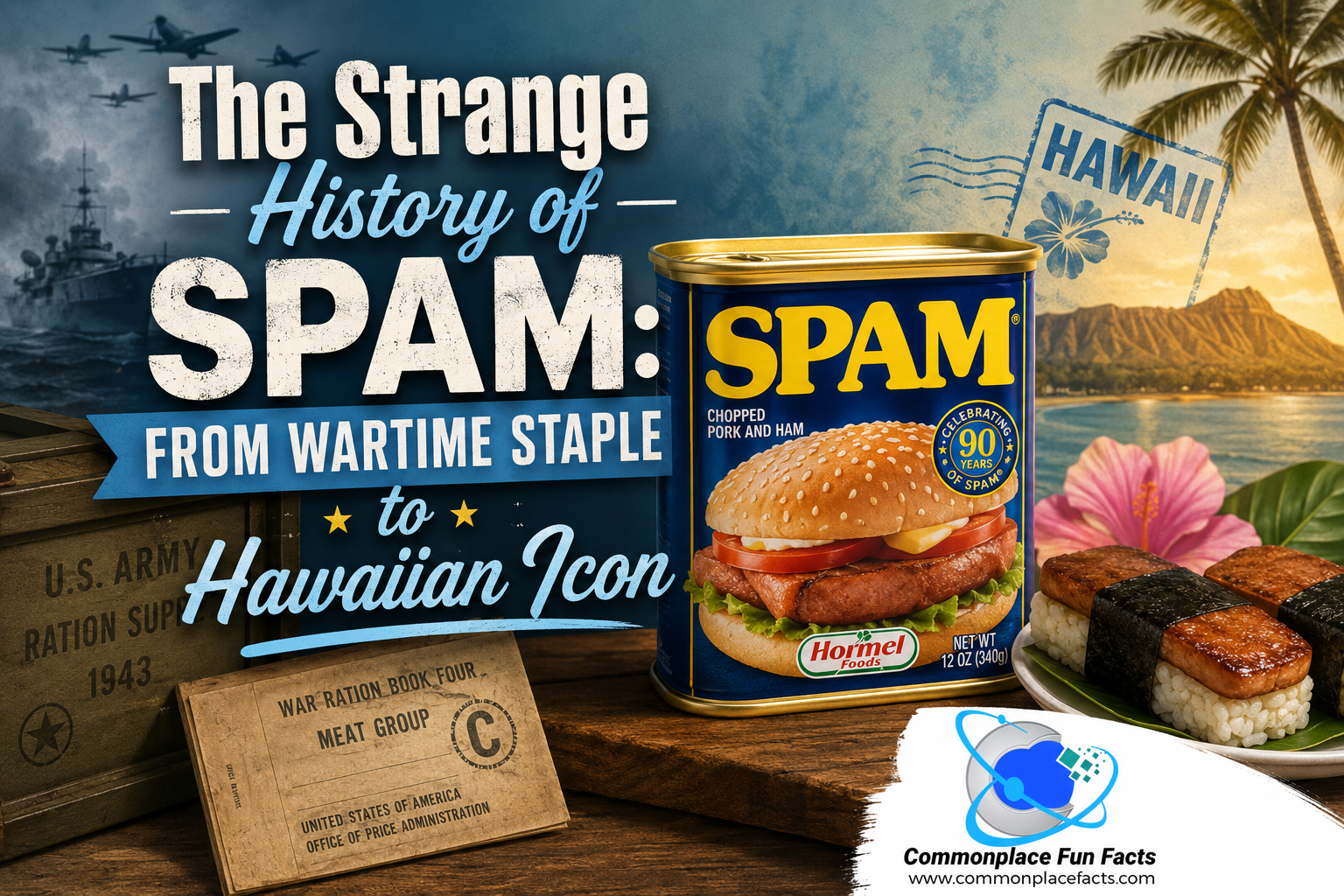

There are foods that announce themselves with elegance. Caviar whispers of old money. Truffles murmur of refined taste. A perfectly prepared soufflé suggests that somebody in the kitchen has both skill and emotional stability.
Then there is SPAM.
SPAM does not whisper. SPAM arrives in a blue-and-yellow can like a small rectangular brick of confidence. It has survived the Great Depression, World War II, Cold War rationing, Monty Python, internet mockery, Hawaiian devotion, Korean gift baskets, and the indignity of being locked behind glass like a nitrite-laden Rolex.
It is one of the most recognizable food products in the world, despite the fact that many people still regard it with the same wary expression one reserves for unidentified leftovers in the back of the refrigerator. Is it ham? Is it pork? Is it lunch meat? Is it a geological formation? The answer is yes, also yes, sort of, and please hold the rest of your questions until the end, please.
The history of SPAM is a triumph of convenience, marketing, wartime necessity, cultural adaptation, and the American ability to take pork shoulder, pressure, salt, and branding and turn them into an international phenomenon. It is also proof that history has a sense of humor, though sometimes that humor comes packed in sodium nitrite.
Contents
A Can Is Born: The History of SPAM
SPAM entered the world on July 5, 1937, courtesy of Hormel Foods of Austin, Minnesota. It was not born from a chef’s poetic vision, unless the chef’s poetic vision involved moving a lot of pork shoulder.

That was the practical problem. Pork shoulder was not the glamorous cut of the pig. It was not the belle of the butcher counter. It was useful, certainly, but it did not have the public-relations sparkle of ham, bacon, or chops. Hormel needed a way to make the less fashionable parts of the pig more marketable.
The solution was to grind pork shoulder together with ham, add seasoning and preservatives, seal it in a can, and sell it as an affordable, shelf-stable meat product during the Great Depression. This was not merely convenient; it was brilliant timing. In 1937, many American households were still recovering from economic disaster. Meat was expensive. Refrigeration was not yet universal. A can of ready-to-eat pork that could sit patiently in the pantry without needing attention was a very big deal.
SPAM was not marketed as survival food, although it was certainly prepared to survive. It was sold as modern, efficient, practical, and easy. It was the sort of product that promised dinner without drama. That alone would have qualified it for sainthood in many households.
Of course, the real transformation came a few years later, when humanity decided that what the world needed most was another global war. Nothing says “culinary destiny” like geopolitics discovering your canned meat.
What Is SPAM Made Of?
The mystery surrounding SPAM’s ingredients is far larger than the actual ingredient list. SPAM Classic is made from pork with ham, salt, water, modified potato starch, sugar, and sodium nitrite.
That’s it.

No mysterious hoof paste. No secret laboratory foam. No meat-adjacent industrial slurry harvested from the dreams of livestock. Just pork, ham, salt, water, starch, sugar, and a curing agent used in many preserved meats.
This is slightly disappointing if you were hoping for a conspiracy, but reassuring if you were hoping lunch was not assembled by a committee of villains.
The potato starch was added later to help bind the mixture and reduce the famous gelatin layer that once appeared in the can. Yes, older cans of SPAM could contain a certain amount of gelatinous material, which was harmless but did have the visual charm of a nervous science project. Potato starch helped solve that problem, because even shelf-stable meat deserves public relations.
SPAM’s flavor is exactly what you would expect from its ingredients: salty, savory, slightly sweet, and unmistakably porky. It can be sliced, fried, baked, diced, grilled, cubed, stirred into rice, tucked into sandwiches, or eaten straight from the can by anyone either very hungry, very brave, or on a camping trip that has gone on too long.
Yes, It Is Cooked Inside the Can
One of the most interesting things about SPAM is that it is cooked after it is sealed in the can.
The process is fairly straightforward. The pork and ham are ground. Salt, sugar, water, potato starch, and sodium nitrite are mixed in. The mixture is placed into the familiar rectangular cans. The cans are vacuum-sealed. Then the sealed cans are cooked and cooled for about three hours.
This means the can is not merely packaging. It is part of the cooking process. SPAM is born, sealed, cooked, cooled, labeled, packed, and shipped like a tiny meat astronaut prepared for a long mission.
That process is what gives SPAM its shelf stability. It is fully cooked. It does not need refrigeration until opened. It can be stored for long periods, transported easily, and distributed in places where fresh meat would be difficult, expensive, or impossible to maintain.
This is why SPAM became so valuable during wartime. It was compact. It was calorie-dense. It was protein-rich. It did not spoil quickly. It did not require delicate handling. It could cross oceans, jungles, deserts, military depots, and the occasional barracks prank.
In short, SPAM did not merely sit on a shelf. It reported for duty.
What Does SPAM Mean?
The name “SPAM” is almost as famous as the product, and nearly as mysterious.
The most common explanation is that it is a shortened form of “spiced ham.” That explanation has been repeated for decades, and Hormel itself has acknowledged that Ken Daigneau, the brother of a Hormel executive, came up with the name during a naming contest. For his contribution to world culture, Daigneau reportedly received $100.
Imagine receiving $100 for naming one of the most recognizable food products on Earth. Somewhere, a modern branding consultant just dropped a $12 latte in grief.
Other theories have circulated over the years. Some people have suggested that SPAM stands for “Shoulder of Pork and Ham.” Others have offered “Specially Processed American Meat,” which sounds like something the federal government would print on a crate during an emergency while insisting everything was fine.
Hormel has generally leaned into the mystery. The official position has often been that the real answer is known by only a small circle of former Hormel Foods executives. And probably Nostradamus.
The safest answer is this: SPAM was created as a memorable brand name, “spiced ham” is the most widely accepted explanation, and the ambiguity has helped keep people talking about it for nearly a century.
As marketing strategies go, “make everyone argue about the name of canned meat while the competition fades into obscurity” has worked out surprisingly well.
Does SPAM Last Forever?
SPAM has one of those reputations that makes it sound less like food and more like a building material with a pull tab. There is a persistent belief that an unopened can of SPAM will last forever, surviving war, famine, economic collapse, cockroaches, and possibly the sun’s red giant phase.

The truth is less dramatic, which is always disappointing but usually better for digestion.
Hormel’s official answer is that SPAM products have a “best-by” date printed on the bottom of the can. That is the date Hormel recommends using the product by for best quality. The company’s FAQ even jokes that emergency-bunker enthusiasts may believe SPAM offers “eternal freshness,” but says there is, in fact, “a limit to their goodness.”
That does not mean the can suddenly becomes a biological weapon at midnight on the printed date. “Best-by” dates generally refer to quality, not an instant food-safety cliff. The USDA says most shelf-stable foods are safe indefinitely, and canned goods can last for years as long as the can remains in good condition — no rust, dents, swelling, or leakage.
So the practical answer is this: SPAM is not officially immortal, but an undamaged, properly stored can may remain safe well beyond its best-by date. The flavor, texture, and general “yes, this is still technically lunch” experience may decline over time. In other words, SPAM may outlast your New Year’s resolutions, but Hormel is not promising it will be there for the heat death of the universe.
Check the date. Inspect the can. If it is bulging, leaking, badly dented, heavily rusted, or hissing ominously like it knows something you don’t, do not eat it. History is fun. Botulism is not.
SPAM Goes to War
World War II transformed SPAM from a convenient pantry item into an international wartime staple.

The reasons were obvious. Armies need food that can travel. Soldiers need calories. Supply officers need products that do not immediately become tragic in warm weather. SPAM fit the job beautifully. It could be shipped in enormous quantities, stored without refrigeration, and prepared with minimal fuss.
Millions of cans were sent to American troops and Allied nations. It appeared in military rations, aid shipments, field kitchens, and civilian relief packages. It fed soldiers in the Pacific, Britain, the Soviet Union, and other places where the phrase “fresh local pork shoulder” was not exactly appearing on the daily menu.
American troops developed complicated feelings about it. Some appreciated it. Some tolerated it. Some wrote jokes about it. Some probably stared at it in the mess line with the exhausted suspicion of men who had seen too much and now had to see lunch.
But SPAM endured. That is the secret of the product. It does not ask to be loved immediately. It waits. It shows up. It fills the plate. It gets fried, diced, mocked, praised, sung about, and eaten anyway.
That is not just a food product. That is a personality type.
Khrushchev and the Red Army’s Salty Little Helper
One of the more remarkable SPAM admirers was Nikita Khrushchev. Yes, that Nikita Khrushchev: Soviet leader, shoe-pounding United Nations legend, Cold War headline machine, and apparently a man who understood the strategic importance of canned pork.
During World War II, the Soviet Union received enormous quantities of food through the American Lend-Lease program. The USSR had lost vast agricultural regions to the German invasion, and feeding the Red Army became a matter of survival. American shipments included grains, fats, canned goods, and meat products, including SPAM.
Khrushchev later acknowledged how important that food had been. He is credited with observing that without SPAM, the Soviet Union would have had great difficulty feeding its army.
This is one of those historical details that sounds invented by a satirist with a deadline, but it is real. One of the 20th century’s great ideological struggles included, somewhere in its enormous machinery, the humble blue can from Minnesota.
Capitalism and communism disagreed about many things. Apparently, both sides could agree that when millions of soldiers need food, shelf-stable pork becomes less of a joke and more of a logistical miracle.
Hawaii: The SPAM Capital of America
No discussion of SPAM is complete without Hawaii, where the product is not merely tolerated. It is embraced, celebrated, fried, sliced, wrapped in rice, and invited to the party.
Hawaii consumes more SPAM per person than any other U.S. state. Nearly seven million cans are eaten there every year. That is not a food preference. That is a constitutional framework.
The roots of Hawaii’s SPAM affection go back to World War II and the military presence in the islands. Fresh meat was limited, rationing was real, and shelf-stable canned meat became part of everyday life. SPAM fit beautifully into local foodways. It was salty, savory, affordable, adaptable, and easy to pair with rice.

The most famous Hawaiian SPAM dish is SPAM musubi: a slice of seared or fried SPAM placed on a block of rice, often glazed with teriyaki sauce, and wrapped with nori. It is portable, filling, reportedly delicious, and increasingly available far beyond Hawaii, including at island-style restaurants such as Hawaiian Bros. Cultural fusion works best when nobody in a boardroom overthinks it and somebody remembers to bring the seaweed.
SPAM appears in breakfasts, plate lunches, fried rice, noodles, sandwiches, and fast-food menus. McDonald’s locations in Hawaii have served SPAM. Burger King has served SPAM. Local restaurants elevate it. Home cooks defend it. Visitors discover it. Nutritionists stare into the middle distance and choose their battles.
Hawaii even hosts the annual Waikiki SPAM JAM, a street festival devoted to the product. Restaurants serve creative SPAM dishes. Crowds gather. Music plays. People celebrate. Recipes get exchanged. Pigs everywhere sense a strange disturbance in the Force.
How Much SPAM Do Americans Eat?
SPAM consumption statistics are a little slippery, because the company often talks about worldwide sales, while the internet likes to repeat national figures with the carefree confidence of a man selling meat from a trench coat.
The official SPAM site says 12.8 cans of SPAM products are eaten every second worldwide, that SPAM is sold in 50 countries, and that Hawaii alone eats about seven million cans per year.
For the United States specifically, the commonly cited figure is about 113 million cans per year. Using the Census Bureau’s 2025 U.S. population estimate of about 341.8 million people, that works out to roughly 0.33 cans per American per year, or about one can for every three people.
But Hawaii distorts the picture, because Hawaii does not merely eat SPAM. Hawaii has entered into a long-term cultural alliance with it. With about 1.43 million residents and seven million cans eaten annually, Hawaii comes in around 4.9 cans per person per year.
If we subtract Hawaii from the national estimate, the rest of the United States consumes about 106 million cans among roughly 340.4 million people. That comes to about 0.31 cans per person per year. So Hawaii raises the national average from about 0.31 to 0.33 cans per person — a modest numerical bump, but an enormous spiritual one.
Put another way: the average American eats about one-third of a can of SPAM per year. The average Hawaii resident eats nearly five cans. The rest of us are apparently just letting Hawaii carry the group project.
SPAM Around the World
SPAM’s global success did not end with Hawaii. The product became deeply embedded in several places touched by World War II, American military presence, food scarcity, or all three.
In Guam and the Northern Mariana Islands, SPAM is enormously popular. It is part of local cooking and identity, with per-capita consumption that rivals or exceeds Hawaii’s. If canned meats had electoral votes, the Pacific islands would be heavily courted.

In the Philippines, SPAM is a breakfast staple, often served with garlic rice and eggs. It has become part of the broader Filipino love affair with salty, savory, convenient foods that know exactly what they are doing.
In South Korea, SPAM occupies a particularly fascinating place. It is not merely emergency food or military nostalgia. It became popular after the Korean War, entered dishes such as budae jjigae — “army base stew” — and eventually became a common holiday gift item. Gift sets featuring SPAM are sold for major holidays such as Chuseok and Lunar New Year.
This is one of the great cultural plot twists in food history. In some places, SPAM is the punchline. In South Korea, it can be wrapped nicely and given to someone you respect.
SPAM has also maintained popularity in the United Kingdom, where wartime rationing made canned meat a familiar presence. British affection for it is complicated, of course, because Britain has a unique national ability to both complain about and cherish the same food item for generations.
Today, SPAM is sold in many countries and comes in numerous varieties, including less sodium, hot and spicy, jalapeño, teriyaki, hickory smoke, turkey, bacon, and regional flavors. The original remains the icon, but the product line now has more variations than some superhero universes.
Famous Fans and Cultural Oddities
SPAM has attracted famous attention from politicians, entertainers, military figures, comedians, and chefs.
Khrushchev’s wartime praise may be the most historically significant, but he was not alone. Dwight Eisenhower is often associated with SPAM because of its importance in feeding Allied troops. Margaret Thatcher reportedly referred to it as a wartime delicacy. Gracie Allen praised it. Monty Python made it immortal for entirely different reasons.

Chefs have also found ways to rehabilitate SPAM’s reputation. Fried properly, SPAM develops crisp edges and a savory richness that explains why it keeps finding new audiences. It is not subtle, but neither is a marching band, and nobody asks the trombone section to whisper.
SPAM also has its own museum in Austin, Minnesota. It celebrates the history, production, marketing, and global culture of the product. Visitors can learn about the brand, inspect memorabilia, and confront the reality that canned meat has achieved a level of institutional preservation many presidents would envy.
The product has inspired cookbooks, festivals, songs, contests, merchandise, and military nostalgia. It has been praised, mocked, rationed, fried, gifted, hoarded, stolen, and turned into sushi-adjacent convenience food.
At this point, SPAM is less a product than a civilization in a can.
From Canned Meat to Junk Email
Of course, the word “spam” now means something far beyond canned pork. It is also the term for unwanted junk email, the digital confetti of modern annoyance.
That meaning did not come directly from Hormel. It came from Monty Python.
In the famous 1970 Monty Python sketch, nearly everything on a café menu contains SPAM. A group of Vikings repeatedly sings the word “SPAM,” drowning out normal conversation. The joke is not subtle. Then again, neither is receiving 600 emails about miracle supplements, fake invoices, extended car warranties, and a prince who has apparently been trying to transfer money since dial-up.
Early internet users adopted “spam” to describe repetitive, unwanted messages that drowned out actual communication. The term stuck, spread, and became part of the language.
We have already explored the digital side of this story in our article “Meet the Creator of Spam Email”, which tells the story of Gary Thuerk, the man credited with sending the first unsolicited mass marketing email in 1978. Thuerk considered himself a pioneer. That opinion is not universally shared.
Hormel has had a complicated relationship with the digital use of the word. Understandably, the company would prefer that its famous canned meat not be confused with online scams, malware, and messages promising pharmaceutical miracles from suspicious domains. The brand generally uses all caps — SPAM — for the food product and encourages lowercase “spam” for unwanted email.
This is a reasonable distinction. One is a salty canned meat product. The other is an unsolicited intrusion into your inbox. Both are surprisingly persistent.
SPAM Under Lock and Key
SPAM’s popularity has produced one of the stranger modern retail developments: in some places, it has been locked behind glass or placed in anti-theft cases.
Yes, SPAM theft is a real thing.

In Hawaii, stores on Oahu have reported SPAM and canned corned beef being stolen frequently enough that some retailers moved the products behind counters or into locked cases. The reason is not merely that people are hungry, though food insecurity is certainly part of many retail-theft stories. SPAM is also easy to resell. It is compact, popular, nonperishable, recognizable, and useful. That makes it attractive to thieves looking for quick cash.
Retailers described organized groups stealing canned meats by the case. Some stolen goods were reportedly resold at swap meets or informally out of cars. It is difficult to imagine a black-market sentence more oddly specific than “the hot SPAM is in the trunk,” but history asks us to be mature about these things, and history will be disappointed.
The phenomenon is not limited to Hawaii. In 2022, reports emerged of a New York City store locking up SPAM in a plastic anti-theft case. In the United Kingdom, some stores reportedly placed SPAM in security boxes as shoplifting rose. The modern grocery aisle has become a strange place, where toothpaste, laundry detergent, baby formula, meat, and canned pork may all require employee intervention.
This creates a marvelous absurdity. SPAM began as an inexpensive, practical meat for ordinary households. It became wartime food, military food, island comfort food, Korean holiday food, internet slang, comedy fuel, and finally a product that some customers must request from behind glass like a forbidden artifact.
Conclusion: The Little Can That Could
SPAM should not be as culturally important as it is.
It began as a way to sell pork shoulder. It became a Depression-era convenience food, a World War II staple, a Lend-Lease protein source, a Hawaiian icon, a Korean gift item, a Monty Python punchline, the inspiration for the name of junk email, and a retail-theft target. That is a lot of work for a 12-ounce can.
Its success lies in its adaptability. SPAM can be mocked and loved at the same time. It can sit quietly in a pantry for months and then become breakfast. It can feed soldiers, families, students, island communities, festival crowds, and people who have decided that frying something usually improves it.
It is not fancy. It is not delicate. It is not pretending to be artisanal. SPAM knows exactly what it is: pork, ham, salt, convenience, and history pressed into a rectangle.
And perhaps that is why it endures. Civilizations rise and fall. Technologies change. Empires collapse. Email filters struggle. But somewhere, in a pantry, a blue can waits patiently.
It has survived worse than us.
You may also enjoy…

Meet the Creator of Spam Email
Ever wonder who is responsible for all the junk in your email inbox? Meet Gary Thuerk, the creator of spam email.

The Cargo Cults: Faith, Spam, and the Strangest Religion of the 20th Century
Discover the true story of the WWII-era cargo cults — Pacific islanders who built bamboo airstrips and worshipped cargo planes, awaiting “John Frum” and divine Spam. A hilarious, haunting look at faith, imitation, and the strangest religion of the 20th century.

The Tasty and Timeless Twinkie
What started as a simple science class experiment in 1976 ended up exposing the timelessness of a time-honored treat. Chemistry teacher Roger Bennatti placed an unwrapped, fresh Twinkie atop a classroom chalkboard in 1976. He did this so his class at George Stevens Academy in Maine could see how long it took for it to…







Leave a Reply