
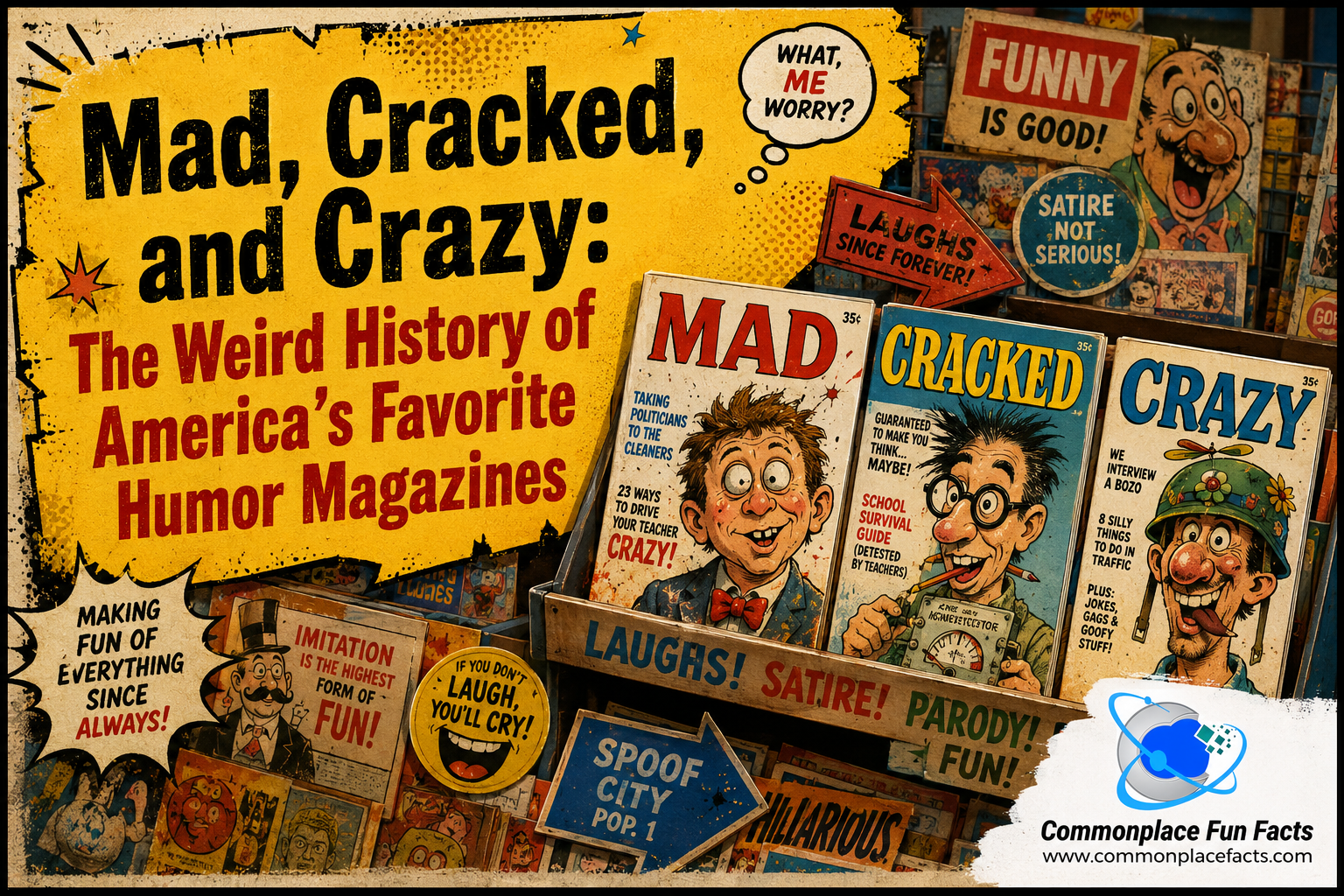

There was a time, not that long ago, when a kid could walk into a drugstore, wander past the aspirin, cough drops, marked-down holiday decorations, and greeting cards for people you only remembered at the last possible second, and find an entire education in sarcasm waiting on the magazine rack.
Not a formal education, of course. No one was handing out diplomas in Advanced Movie Parody or Comparative Fake Advertising. Although, to be honest, if they had, America’s public school system might have benefited from the elective credit.
But there they were: Mad, Cracked, and Crazy. Three humor magazines with names suggesting either a comedy empire or a very concerning psychiatric intake form. They were loud, cheap, weird, and usually located just low enough on the rack for children to reach them, which was either excellent marketing or a collapse of adult supervision.
For several generations of young readers, these magazines were more than disposable jokes printed on paper. They were training manuals in skepticism. They taught kids that advertising was ridiculous, movies were ridiculous, politicians were ridiculous, television was ridiculous, and adults were often ridiculous but with more serious expressions. Before the internet made everyone a professional mocker of everything, mockery had to be purchased, rolled up, and smuggled into study hall.
And at the center of this great newsstand disorder stood three publications: Mad magazine, the original anarchic genius; Cracked, the durable knockoff that refused to die; and Crazy, Marvel’s strange attempt to prove that even parody magazines could use a little comic-book DNA, because every cultural movement needs a version wearing tights under its clothes.
Contents
Before the Madness: Comics, Panic, and the Birth of Mad
The story begins with EC Comics, publisher William M. Gaines, and editor Harvey Kurtzman, which already sounds like the opening credits to a documentary that will eventually mention congressional hearings.
In the early 1950s, EC Comics was best known for horror, crime, war, and suspense titles. These were not polite little stories about cheerful woodland animals learning the value of punctuality. EC’s comics were sharp, dark, grotesque, and frequently moralistic in the way only a severed head in a story-ending twist can be moralistic.

Then came the comic-book panic. Adults became convinced that comic books were corrupting children. This was before video games, heavy metal, Dungeons & Dragons, the internet, and whatever children are currently doing on apps that frighten school boards, so comic books had to carry the full burden of destroying civilization.
The public concern culminated in the 1954 Senate hearings on juvenile delinquency and the comic-book industry’s creation of the Comics Code Authority. The Code clamped down on horror, crime, gore, and anything else that might make a parent clutch pearls hard enough to produce emergency jewelry.
But before that storm fully broke, EC launched something very different. In 1952, Gaines and Kurtzman introduced Tales Calculated to Drive You MAD. It began as a comic book, but it was already something stranger: a parody machine aimed at comics, movies, radio, television, advertising, and the entire solemn parade of American popular culture.
Kurtzman’s great insight was that the culture was already absurd. He did not need to invent the ridiculous. He merely had to point at it with enough precision that readers could no longer unsee it. Westerns, superheroes, detectives, advertisements, movie stars, patriotic speeches, and consumer products all went into the grinder. Out came satire, which is what happens when comedy puts on glasses and starts taking notes.
Mad Becomes a Magazine and Escapes Like a Smirking Houdini
In 1955, Mad changed from a comic book into a magazine. This turned out to be one of those decisions that looked practical at the time and historically important later, which is the best kind of business accident.

The magazine format helped place Mad outside the reach of the Comics Code Authority. This was no small thing. Comic books were suddenly subject to strict content rules, but magazines operated in a different category. Mad had effectively climbed out a window while the adults were busy locking the front door.
The new format also gave Mad more room to become itself. The larger pages allowed for elaborate movie parodies, fake advertisements, illustrated essays, recurring departments, and the kind of densely packed visual jokes that rewarded a reader who stared at the page long enough to start worrying about the artist.
This was important because Mad was not just telling jokes. It was teaching readers how parody worked. It took a recognizable piece of culture and twisted it just enough to reveal the machinery underneath. A movie poster became a joke about Hollywood formulas. An advertisement became a joke about manipulation. A politician’s speech became a joke about language being used as upholstery.
It looked like a magazine. It behaved like a prank. Naturally, children loved it.
Harvey Kurtzman: The Mad Scientist Who Built the Machine
Harvey Kurtzman did not stay with Mad for very long, but his fingerprints were all over its original identity. He was the founding editor, the guiding intelligence, and the person most responsible for making the magazine smarter than it had any financial obligation to be.
Kurtzman approached parody with discipline. He was not merely swapping names and adding pie fights. He studied the thing being mocked. If Mad parodied a movie, comic strip, or genre, Kurtzman wanted the structure right. The joke worked because the target was recognizable. The satire landed because it knew where to poke.
That may sound obvious, but it is the difference between real parody and simply yelling “Ha ha, this exists!” while wearing a funny hat. Many lesser humor projects have built entire careers on the funny hat method, and we should all take a moment to look disappointed.
Kurtzman eventually left Mad and went on to create other humor publications, including Trump, Humbug, and Help! None matched Mad in staying power, but Kurtzman’s influence spread far beyond a single title. He helped establish a style of American satire that treated popular culture as something not merely to consume, but to interrogate with a rubber chicken and a suspicious squint.
Al Feldstein and the Usual Gang of Idiots
After Kurtzman left, Al Feldstein took over as editor and helped turn Mad from brilliant insurgency into full-blown institution. This is harder than it sounds. Lots of people can start a fire. Far fewer can keep it burning for decades without accidentally becoming respectable.

Under Feldstein, Mad developed the familiar rhythm that readers came to love. The magazine assembled its legendary “usual gang of idiots,” a phrase that somehow sounds insulting and affectionate at the same time, much like most family reunions.
The roster included artists and writers whose work became inseparable from the magazine’s identity: Don Martin, Mort Drucker, Sergio Aragonés, Al Jaffee, Antonio Prohías, Dave Berg, Frank Jacobs, and many others. Each brought a distinct flavor of mischief.
Mort Drucker’s celebrity caricatures made movie stars look more like themselves than they did in real life, which must have been a deeply uncomfortable experience for the movie stars. Don Martin drew humans as if their bodies had been assembled by committee during a minor earthquake. Sergio Aragonés filled the margins with tiny acts of chaos. Al Jaffee turned the back cover into an interactive booby trap with the Fold-In. Antonio Prohías gave the Cold War its perfect cartoon expression in “Spy vs. Spy,” where two agents repeatedly destroyed each other in black-and-white futility. It was geopolitics, but with more dynamite and fewer think tanks.
Mad also made a point of mocking advertising while refusing, for most of its classic run, to carry traditional ads. This gave the magazine a peculiar moral authority. It could make fun of Madison Avenue without a cereal company nervously clearing its throat on the next page.
Alfred E. Neuman: America’s Least Qualified Presidential Candidate, Which Is Saying Something
No discussion of Mad can avoid Alfred E. Neuman.
Alfred’s face became the magazine’s mascot: gap-toothed, freckled, cheerful, and profoundly unworried. His motto, “What, me worry?”, was not just a catchphrase. It was a philosophy. It was stoicism with bigger ears.

Alfred was the perfect ambassador for Mad because he looked like the kid who had just broken a window, denied everything, and somehow got elected treasurer. His face could be inserted into anything: movie posters, presidential campaigns, historical paintings, celebrity portraits, political scandals. He was not merely a mascot. He was a vandalism device.
Starting in the 1950s, Alfred even became a recurring fake presidential candidate. This was supposed to be ridiculous, of course. A gap-toothed grinning mascot running for elected office? Imagine such a thing. History, as usual, has a wicked sense of timing.
Mad at Its Peak: When Snark Had Staple Binding
By the 1960s and 1970s, Mad had become a cultural force. It was not merely a magazine kids read. It was a shared language. If you were a certain kind of adolescent, especially one with glasses, comic books, and a dangerous surplus of trivia, Mad felt less like a publication and more like proof that someone, somewhere, understood.
It taught young readers that television commercials were lying to them, politicians were performing, celebrities were manufactured, movies followed formulas, and authority figures often survived by sounding confident while saying almost nothing. This was an extremely useful education, even if it did not help with algebra.
The magazine’s great trick was that it appealed to children and adults at the same time, though not always in the same way. A kid might laugh at the goofy drawings and silly names. An adult might catch the political satire, advertising parody, or cultural commentary. A very particular kind of young person might catch all of it and then continue to wonder why he didn’t have a date to the prom.
Mad influenced generations of comedians, cartoonists, writers, and satirists. Its fingerprints can be found on sketch comedy, late-night television, animated satire, parody websites, fake news formats, and the general American habit of treating seriousness as suspicious until proven otherwise.
In other words, if you have ever watched a political speech and mentally supplied a fake product slogan, you may owe Mad a small royalty.
Enter Cracked: The Other Magazine You Bought When Mad Was Sold Out
Success breeds imitation. This is true in business, entertainment, fashion, and every church potluck where someone brings the same casserole as last year but calls it “updated.”

In 1958, Cracked appeared. It was not subtle about what it wanted to be. It was a humor magazine in the Mad mold, with movie parodies, television spoofs, silly features, fake departments, and a cover mascot of its own. If Mad was the original recipe, Cracked was the store-brand version placed directly next to it with suspiciously similar packaging.
That sounds cruel, but it is also incomplete. Cracked was derivative, absolutely. It copied Mad’s general layout, tone, and approach so clearly that even a legally blind reader could probably sense the lawsuit-shaped outline. But Cracked also survived. For decades. That matters.
Most imitators vanish quickly. Cracked hung around like a cousin who came for Thanksgiving and somehow still had mail arriving at your house in March. It became the most durable of the Mad imitators and developed its own loyal audience.
Its mascot was Sylvester P. Smythe, a janitor who functioned as Cracked’s answer to Alfred E. Neuman. This was a revealing choice. Alfred looked like chaos in child form. Smythe looked like the guy left to clean up after chaos had already filed its paperwork. There is a certain dignity in that, though not much.
Why Cracked Worked Anyway
It is easy to treat Cracked as merely Mad’s less glamorous younger sibling, forever standing in the doorway wearing hand-me-down satire. And yes, there is some truth there. But Cracked deserves more credit than that.
For one thing, it delivered what readers wanted. If you liked goofy movie parodies, ridiculous caricatures, fake features, and broad pop-culture jokes, Cracked was happy to serve them. It was often less sharp than Mad, but sometimes sharpness was not the point. Sometimes you just wanted a magazine that would make fun of the latest blockbuster with a title that sounded like it had been written during lunch detention.
Cracked was also widely available. If Mad was sold out, too expensive, missing, or already confiscated by someone’s mother, Cracked was right there. It occupied the valuable cultural position of “close enough,” which has supported entire industries.
And over time, some readers genuinely preferred it. Cracked could be goofier, looser, and less intimidating. It did not always seem like it was trying to dismantle the entire machinery of American consumer culture. Sometimes it seemed like it just wanted to throw a cream pie at a movie poster and call it a day. There is room in the world for both approaches.
If Mad was the Beatles of parody magazines, Cracked was not exactly the Rolling Stones. It was more like the band playing a very enthusiastic county fair tribute set. But people still bought tickets, and some of them had a wonderful time.
Crazy Magazine: Marvel Decides Satire Needs More Capes
Then there was Crazy.
Marvel Comics entered the humor-magazine arena with Crazy Magazine in 1973. This was the same company that had built a superhero empire out of radioactive spiders, angry green scientists, blind acrobatic lawyers, and emotionally troubled billionaires in metal pajamas. Naturally, the next step was parody journalism.

Crazy followed the black-and-white magazine format that let comic publishers reach older readers and avoid some of the limitations associated with standard comic-book distribution. It joined a crowded field of satirical publications influenced by Mad, but it brought with it a definite Marvel flavor.
That flavor included pop-culture parodies, comic-book in-jokes, fake features, fumetti experiments, recurring departments, and enough Marvel-adjacent energy to make the whole enterprise feel as if someone in the bullpen had said, “What if Mad, but with more cape residue?”
The magazine’s mascot eventually became Irving Nebbish, another strange little figure in the grand tradition of humor-magazine mascots who look like they were assembled from leftover anxieties. If Alfred E. Neuman was cheerful idiocy and Sylvester P. Smythe was janitorial resignation, Irving Nebbish was the nervous cousin who knew too much about the printing schedule.
Crazy never became the cultural force that Mad was. It did not last as long as Cracked. But it remains a fascinating artifact of the 1970s and 1980s comics world, when publishers were willing to try almost anything if there was a chance the newsstand spinner rack had room for it.
The Three Personalities: Original, Imitator, and Weird Cousin
The easiest way to understand Mad, Cracked, and Crazy is not merely by chronology, but by personality.
Mad: The Original Troublemaker
Mad was the sharpest and most influential of the three. It had the confidence of a magazine that knew it had gotten there first and intended to leave fingerprints on everything. Its satire could be silly, but it was rarely empty. Beneath the grotesque caricatures and fake ads was a sustained critique of American culture’s polished nonsense.
Mad did not merely make fun of movies. It made fun of the way movies sold themselves. It did not merely mock politicians. It mocked the performance of politics. It did not merely parody advertisements. It taught readers to recognize the machinery of persuasion. This is dangerous knowledge to give children, which is probably why it worked.
Cracked: The Persistent Second Banana

Cracked was broader, scrappier, and more derivative. It lived in Mad’s shadow, but it brought a lunch and stayed there for nearly half a century. That kind of persistence deserves respect, or at least a commemorative folding chair.
Its great achievement was not originality. Its great achievement was availability, familiarity, and survival. Cracked understood the market: readers liked parody magazines, and one parody magazine per rack was not always enough. Sometimes the public demands a backup smart aleck.
Crazy: The Marvel-Flavored Experiment
Crazy was the odd cousin. It belonged to the same family, but it arrived wearing a cape and asking whether anyone wanted to see a fake comic-book parody of a parody. It had the structure of a humor magazine, the instincts of a comic-book publisher, and the slightly chaotic energy of Marvel in the 1970s.
It was never the leader of the pack, but it added something distinctive. It showed how deeply the Mad model had penetrated American publishing. Even superhero companies wanted a piece of the satire rack.
| Magazine | Launch | Publisher | Mascot | Personality | Legacy |
|---|---|---|---|---|---|
| Mad | 1952 | EC Comics, later DC | Alfred E. Neuman | Sharp, anti-authority, culturally defining | The gold standard of American parody magazines |
| Cracked | 1958 | Major Magazines and later owners | Sylvester P. Smythe | Broad, persistent, shamelessly familiar | The longest-running major Mad rival |
| Crazy | 1973 | Marvel Comics | Irving Nebbish | Comic-book flavored, experimental, niche | A cult artifact of Marvel’s satirical ambitions |
Why Were There So Many Humor Magazines?
To understand why Mad, Cracked, and Crazy mattered, you have to remember the power of the magazine rack.
Today, everyone carries a glowing rectangle capable of delivering jokes, news, outrage, weather alerts, conspiracy theories, recipes, and videos of raccoons stealing cat food. This is called progress, apparently.
But for much of the twentieth century, the newsstand and drugstore magazine rack were cultural gateways. They were where readers encountered movie magazines, comic books, hobby publications, scandal sheets, science fiction digests, sports titles, teen magazines, and humor magazines. The rack was chaotic, democratic, and only loosely supervised.
Humor magazines thrived there because they were perfectly suited to browsing. A cover parody could grab your attention in seconds. A fake movie title could make you laugh before you even opened the issue. The magazines could be read in order, out of order, upside down, or while pretending to look at something more educational.
They also served a social function. Kids passed them around. Friends quoted them. Pages were folded, torn, clipped, taped to lockers, and left in bedrooms where parents would pick them up, flip through three pages, sigh heavily, and wonder whether they should have pushed harder for piano lessons.
These magazines were analog memes. They circulated jokes before the internet gave everyone the ability to ruin a joke globally in under seven minutes.
The Art of the Parody Title
One of the great pleasures of these magazines was the parody title. A popular movie, television show, or celebrity could not pass within striking distance of the newsstand without being renamed something groan-worthy.
The parody title was one of the magazines’ favorite weapons. A popular movie or television show could not simply appear in Mad, Cracked, or Crazy under its own name. That would be far too respectful, and respect was not why anyone bought these things. Mad gave readers titles such as “Superduperman” for Superman, “Bats-Man” for Batman, “In Cold Blecch!” for In Cold Blood, “Inbanana Jones and the Temple of Goons” for Indiana Jones and the Temple of Doom, “It’s Depends Day” for Independence Day, and “A Decent Disposal” for Indecent Proposal. The goal was not subtlety. The goal was recognition followed immediately by a groan, which, in parody-magazine terms, counts as applause.
This was not a minor skill. A good parody title had to be obvious enough for readers to recognize the target and dumb enough to feel satisfying. It occupied that narrow artistic space between “clever” and “a middle-schooler just discovered puns.”
Mad was particularly good at this. The titles were often terrible in exactly the right way. They announced that dignity had left the building and would not be returning until the next issue.
Cracked and Crazy followed the same formula, because once someone discovers that a pun can fill half a cover, the temptation is difficult to resist. This is why civilization has warning labels.
Fake Ads, Real Lessons
The fake advertisements may have been the most educational part of the whole operation.

A good fake ad did more than make up a silly product. It exposed the logic of real advertising: the fear, the flattery, the promises, the emotional manipulation, the cheerful assumption that your life would improve dramatically if only you bought the correct deodorant, cereal, car, aftershave, or suspiciously futuristic kitchen appliance.
For kids, this was a revelation. Real ads suddenly looked different. Once you saw the trick, you could not unsee it. The announcer’s voice, the smiling family, the gleaming product shot, the before-and-after transformation, the tiny print designed by someone who had clearly given up on morality — it all became material.
This may be one of Mad’s most lasting contributions. It taught readers to ask, “What is this trying to sell me, and why does it think I’m an idiot?” That question remains useful in advertising, politics, entertainment, and certain extended warranty conversations.
The Decline: When the World Became Its Own Parody
So what happened?
The short answer is that the world changed. The longer answer is that the world changed, print magazines declined, pop culture sped up, television comedy expanded, cable multiplied, the internet arrived, and eventually everyone with a login became a parody writer, cultural critic, unpaid fact-checker, and part-time public menace.
Monthly humor magazines had a timing problem. In the old days, a movie parody appearing weeks or months after the film still felt timely. Later, by the time a print magazine reached readers, the internet had already produced jokes, counter-jokes, backlash to the jokes, think pieces about the backlash, and a meme in which the movie was represented by a raccoon wearing sunglasses.
Crazy ended in 1983, before the internet could do anything to it, which was considerate. Cracked eventually left its print identity behind and became better known as a web brand. Mad continued in various forms, but its old centrality faded as satire escaped into every corner of media.
The problem was not that Mad, Cracked, and Crazy stopped being funny. The problem was that the culture became faster, louder, more fragmented, and frequently ridiculous enough to parody itself without professional assistance.
The Legacy: The Magazine Rack Is Gone, but the Snark Escaped
The old magazine rack is mostly gone now. So are many of the drugstores, spinner racks, newsstands, and checkout-line rituals that once made browsing a form of accidental education. But the influence of these magazines is everywhere.
Mad trained readers to distrust the polished surface. It taught them that movies, commercials, politicians, celebrities, and authority figures could be mocked, deflated, and reassembled with silly names. It helped create the modern American comedy reflex: the instinct to look at something self-important and immediately wonder how it would look with Alfred E. Neuman’s face on it.
Cracked proved that the appetite for parody was bigger than one magazine. It may have been the imitator, but it was a remarkably durable one. Being second through the door is still being through the door, especially when the first guy is carrying dynamite.
Crazy showed that the format had spread so widely that even Marvel wanted in. It remains a strange, funny, collectible reminder of an era when publishers tried things because the newsstand was vast, weird, and hungry.
Together, these magazines helped shape the way Americans joke about pop culture. They were not the only source of satire, but they were one of the most accessible. They were comedy for kids who were starting to suspect that the adult world was mostly theater, paperwork, and people pretending not to panic.
And honestly, they were not wrong.
What, Me Nostalgic?
Looking back, it is tempting to treat Mad, Cracked, and Crazy as relics of a simpler time. But that is not quite right. The time was not simpler. The paper was just cheaper.

These magazines emerged from anxieties about youth culture, mass media, advertising, politics, and entertainment. They thrived because the world was already absurd. They declined because the tools of mockery changed hands. Satire moved from the magazine rack to television, then to websites, then to social media, where it now lives in a state of permanent caffeine overdose.
Still, there was something special about those old humor magazines. They required patience. You had to turn pages. You had to study the art. You had to find the margin jokes. You had to physically fold the back cover and hope you were doing it right, because destroying reading material used to be a participatory art form.
Mad gave American kids permission to question the sales pitch. Cracked proved there was room for a second smart aleck. Crazy proved Marvel would try almost anything if it could be printed in black and white and placed near the comics.
The next time someone complains that modern culture is too sarcastic, too cynical, or too quick to mock authority, spare a thought for the newsstand magazines that helped make it happen. They did not invent American smart-aleckery, but they mass-produced it, stapled it, priced it for children, and placed it right beside TV Guide.
Which, frankly, seems like poor adult supervision.
You may also enjoy…

The Comics Code Authority: When Good Must Triumph Because It’s In the Rules
Discover the strange history of the Comics Code Authority, the censorship rules that shaped Spider-Man, Batman, and beyond. From banned werewolves to Marvel’s rebellion, here’s how comic book censorship rose and fell.

Hollywood Before the Hays Code: The Party Before the Chaperone
Discover Pre-Hays Code Hollywood (1929–1934), when movies flaunted sex, crime, and scandal before censorship took hold. Explore the films, stars, and controversies that made this era unforgettable.

Movie Ratings Explained: Who Decides What’s Too Sexy, Too Violent, or Just Right?
From the Hays Code to PG-13, discover how the U.S. movie ratings system decides what’s too violent, too sexy, or just right—and why studios love PG-13 while G is nearly extinct.



Leave a Reply