
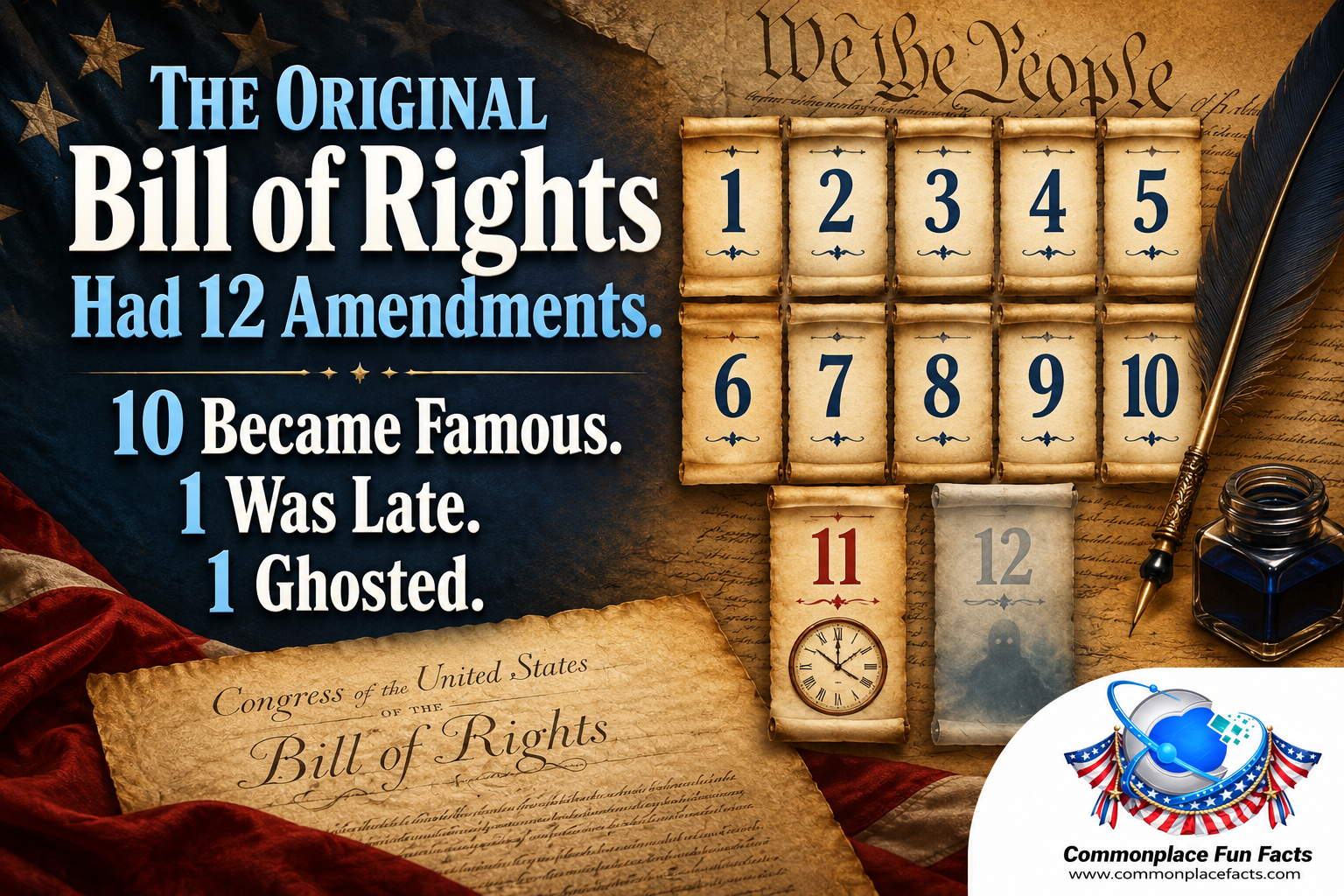

The Bill of Rights consists of the first ten amendments to the United States Constitution. This is a simple fact that we’re supposed to learn before we are old enough to drive. It’s also accurate in the same way it is true to say that a hot dog is a sandwich, if you enjoy ruining picnics.
The slightly messier truth is that the original Bill of Rights consisted of twelve amendments proposed in 1789. Ten of them were ratified in 1791 and became the Bill of Rights we know today. One of the other two took 203 years to get around to being ratified, which is either a triumph of constitutional persistence or the most aggressive procrastination project in American history.
The last one is still waiting.
That means the First Amendment — the one with speech, religion, press, assembly, and petition — was not originally the first proposed amendment. It was originally the third. The real first proposed amendment dealt with the size of the House of Representatives, which is considerably less stirring unless you are the kind of person who reads congressional apportionment charts recreationally. And if you are, welcome. There are at least dozens of you.
From there, the story only gets stranger. Over the years, Americans have proposed constitutional amendments to abolish millionaires, ban divorce, punish liars with hard labor, replace the President with a three-person Roman-style executive committee, and rename the country the “United States of the Earth.”
So let us take a stroll through the constitutional junk drawer, beginning with the two amendments that were originally sent to the states alongside the amendments that became the Bill of Rights but somehow ended up in the “miscellaneous cables” box of American history.
Contents
The Bill of Rights Was Originally a Twelve-Pack
On September 25, 1789, the First Congress sent twelve proposed amendments to the states. The states ratified ten of them by December 15, 1791. Those ten became what we now call the Bill of Rights.

But the numbering was not what we use today. The amendments we now call the First through Tenth Amendments were originally proposed as Articles Three through Twelve.
The first two proposed amendments were left behind. Not rejected exactly. Not repealed. Just not ratified by enough states.
And because the amendment process described in Article V of the Constitution can be both majestic and deeply weird, one of those leftovers was still eligible to be ratified more than two centuries later.
Imagine ordering twelve amendments, receiving ten, and then having one of the missing items arrive in 1992 with no apology and a tracking number signed by James Madison.
The Original First Amendment: Make the House Bigger
The original first proposed amendment dealt with congressional apportionment. In normal human language, it tried to answer a basic question: as the country grew, how many people should each member of the House of Representatives represent?

At the time, this was not some dusty procedural concern. Representation was one of the central arguments surrounding the new Constitution. People wanted to know whether the federal government would stay close enough to ordinary citizens or become a distant club of powdered-wig professionals using the phrase “the public good” while quietly looking for better parking.
The amendment attempted to set a formula for enlarging the House as the population increased. The goal was to keep representatives from becoming too remote from the people they served. A representative in the First Congress spoke for tens of thousands of people. Today, each House member represents hundreds of thousands. That is less “town meeting” and more “customer service line during a cable outage.”
This is why the amendment still attracts attention. It is sometimes described as capping congressional districts at 50,000 people. If that idea were applied to the modern United States, the House of Representatives would grow from 435 voting members to roughly 6,800. That is not a typo. That is a legislature large enough to require stadium seating, shuttle buses, and possibly a halftime show.
Technically, the wording of the amendment is more complicated than a simple rule that no district could exceed 50,000 people. Constitutional language, like plumbing under an old house, becomes less straightforward the longer you stare at it. But the larger point is clear enough: the proposed amendment reflected a founding-era concern that representation should remain personal, local, and close to the people.
The amendment did not receive enough state ratifications. Eventually, the size of the House was fixed by federal statute rather than by constitutional formula. That is how we ended up with 435 voting representatives instead of a congressional body so large that C-SPAN would need a wider camera lens and roll calls would qualify as endurance sports.
This amendment remains unratified. Technically, it is still out there, sitting in constitutional limbo, wearing a powdered wig and waiting for someone to ask if it is next.
The Original Second Amendment: Congress Cannot Instantly Give Itself a Raise
The original second proposed amendment was much easier to understand and much easier to sell to the average voter:
Congress can change its pay, but the change cannot take effect until after the next election.
That is not the exact wording, but it is the basic idea. If Congress wants to increase congressional salaries, fine. But first the voters get a chance to express their views, possibly through thoughtful civic reflection, or possibly by throwing the bums out. Democracy is a rich tapestry.
This amendment also failed to receive enough ratifications in the 1790s. But unlike many later amendments, Congress had not placed a ratification deadline on it. So it did not expire.
It just waited.
And waited.
And waited some more.
Then, in 1992, after enough additional states ratified it, the congressional pay amendment became the Twenty-Seventh Amendment to the Constitution.
That was 203 years after Congress first proposed it.
The Twenty-Seventh Amendment is the constitutional equivalent of a library book returned during the Clinton administration after being checked out by James Madison. It is also proof that the amendment process can work slowly, which is a gentle way of saying that glaciers have been known to shout, “Pick up the pace.”
So Were All Twelve Original Amendments Finally Ratified?
Not quite.
Of the twelve amendments proposed by Congress in 1789:
- Articles Three through Twelve were ratified in 1791 and became the first ten amendments, which we know as the Bill of Rights.
- Article Two, dealing with congressional pay, was ratified in 1992 and became the Twenty-Seventh Amendment.
- Article One, dealing with House apportionment, has never been ratified, but is still floating around out there, waiting for someone to take up the cause.
So the original Bill of Rights story gives us ten immediate amendments, one extremely delayed amendment, and one amendment still pacing outside the constitutional theater asking whether its name was called.
The Six Amendments Congress Sent to the States but the States Did Not Ratify
Congress has sent thirty-three proposed amendments to the states. Twenty-seven have been ratified. That leaves six proposed amendments that cleared Congress but never became part of the Constitution.
These are the serious “almost amendments.” They are not random letters from citizens suggesting that Congress be replaced by a council of especially patriotic raccoons. These actually made it through Congress and went to the states for ratification.
1. The Congressional Apportionment Amendment
This was the original first amendment from 1789. It would have created a formula for increasing the size of the House of Representatives as the population grew.
It failed to get enough ratifications, which is why the House eventually became fixed at 435 voting members by statute. Whether that is good, bad, or merely proof that Congress discovered the limits of available chair space is a separate debate.
2. The Titles of Nobility Amendment
Proposed in 1810, the Titles of Nobility Amendment would have gone beyond the Constitution’s existing ban on American titles of nobility. Article I already prohibits the United States and the states from handing out noble titles, because the Founders had a perfectly reasonable fear that someone would eventually try to become the Earl of Pittsburgh and make everyone address him accordingly.
The proposed amendment took things further. It said that any American citizen who accepted, claimed, received, or retained a title of nobility or honor from a foreign power — or accepted certain foreign presents, pensions, offices, or emoluments without congressional consent — would cease to be a citizen and could no longer hold public office.
There were serious concerns behind it. In the early 1800s, the United States was still a young republic trying not to be manipulated by European powers, which had the annoying habit of using titles, pensions, marriages, and diplomatic glitter to influence people. Napoleon was rearranging Europe like furniture, foreign intrigue was not imaginary, and Americans were understandably wary of aristocratic hooks being slipped into republican fish.

The amendment came surprisingly close to ratification. Twelve states approved it, but that was not enough. As new states entered the Union, the number needed for ratification increased, and the amendment stalled. It was never adopted.
That should have been the end of it.
Naturally, it was not.
The Titles of Nobility Amendment later became the star of one of the stranger constitutional conspiracy theories: the claim that it actually was ratified, secretly became the “real” Thirteenth Amendment, and somehow stripped lawyers of their citizenship because attorneys sometimes use “Esquire.” We previously wandered into that swamp in “Did a Missing Constitutional Amendment Take Away the Citizenship of All Lawyers?”, and yes, the answer remains no, but it takes a surprisingly entertaining amount of time to get there.
The short version is that old printed copies of the Constitution sometimes mistakenly included the Titles of Nobility Amendment as though it had been ratified. That created confusion, and confusion is the natural habitat of conspiracy theories. Eventually, “this was mistakenly printed as part of the Constitution” turned into “lawyers hid the real Constitution so they could keep controlling the courts,” because even constitutional typography errors need a villain.
Still, the Titles of Nobility Amendment is fascinating because it began as a serious attempt to guard the young republic against foreign influence and eventually became a magnet for people who believe the entire legal system can be defeated by discovering a printer’s error from the Madison administration.
That is quite a career arc.
3. The Corwin Amendment
The Corwin Amendment is one of the darkest “what ifs” in American constitutional history. Proposed in 1861, just before the Civil War, it would have protected slavery from federal interference by declaring that no future constitutional amendment could authorize Congress to abolish or interfere with the “domestic institutions” of any state, including “persons held to labor or service.” In plain English, it was an attempt to make slavery constitutionally untouchable where it already existed.
This was not some fringe proposal scribbled in the margins by a panicked crank with an ink-stained sleeve. It passed Congress. Outgoing President James Buchanan even signed it, although presidential approval is not required for constitutional amendments. Abraham Lincoln, still trying to avoid civil war, did not object to it being sent to the states. The whole thing was a last-minute constitutional peace offering to slaveholding states, which is a polite way of saying the country briefly considered saving the Union by permanently protecting human bondage. History occasionally does things like this, just to see if we’re paying attention.

The amendment failed to do its job. The secession crisis continued, the Civil War came, and four years later the actual Thirteenth Amendment abolished slavery rather than protecting it. That is the part of the story that usually gets told, and understandably so.
But here is the unsettling procedural wrinkle: the Corwin Amendment did not include a sunset provision. Congress did not say, “Ratify this within seven years or forget it.” That means the proposal is generally treated as still technically pending before the states, at least in the same odd constitutional sense that allowed the Twenty-Seventh Amendment to spend 203 years wandering around before finally becoming part of the Constitution. In theory, enough states could still try to ratify it today. In practice, any such effort would run face-first into the actual Thirteenth, Fourteenth, and Fifteenth Amendments, modern constitutional law, political reality, basic morality, and probably several people shouting, “Absolutely not,” before the clerk finished reading the title.
A handful of states did ratify it. Kentucky approved it in 1861. Ohio also ratified it in 1861, then rescinded that ratification in 1864. Rhode Island ratified it in 1861. Maryland ratified it in 1862, then rescinded that approval in 2014. Illinois ratified it in 1863, though an earlier Illinois convention vote is sometimes treated as questionable because the delegates were not acting as the state legislature. Illinois later rescinded its ratification in 2022. Rhode Island has also considered removing its name from the list. Apparently some states eventually looked at their constitutional attic, found a pro-slavery amendment sitting under a sheet, and decided it was time for housekeeping.
There was even an attempt in Congress to pull the amendment back. In 1864, as Union victory became more likely, Senator Henry B. Anthony of Rhode Island introduced a joint resolution to withdraw the Corwin Amendment from further consideration by the states and stop the ratification process. It went to committee and then, like many congressional attempts to clean up earlier congressional mistakes, disappeared into the legislative sofa cushions.
Because no constitutional oddity is complete without a conspiracy theory, the Corwin Amendment has also inspired “Ghost Amendment” claims. The basic idea is that the Corwin Amendment somehow became the real Thirteenth Amendment, or should be treated as a hidden constitutional provision that was suppressed, ignored, or displaced. This should not be confused with the separate Titles of Nobility Amendment theory, which claims that a different missing amendment secretly invalidated lawyers because of the word “Esquire.” Constitutional conspiracy theories, like potato chips, apparently come in multiple flavors.
The Corwin theory does not work. The amendment was never ratified by enough states, and the Thirteenth Amendment we actually have — the one abolishing slavery — was duly ratified and certified in 1865. Still, the Corwin Amendment remains fascinating because it shows how close the Constitution came to being amended in exactly the wrong direction. It is a reminder that the amendment process is a tool. Whether it produces justice or disaster depends entirely on the hands holding it.
4. The Child Labor Amendment
Proposed in 1924, the Child Labor Amendment would have given Congress power to regulate or prohibit labor by people under eighteen.
Today, federal child labor regulation is mostly treated as part of the ordinary landscape of modern law. But in the early twentieth century, it was wrapped up in a fierce debate over federal power, state sovereignty, industrial reform, and whether children should be sent into factories when they were still young enough to believe that “nap time” was a constitutional right.
The amendment was ratified by a majority of the states but not the required three-fourths needed to make it official. Later developments in Supreme Court doctrine and federal legislation changed the practical legal landscape, reducing the perceived need for a child labor amendment.
In other words, the amendment lost the constitutional battle but many of its policy goals marched in through another door. Law does that sometimes. It is very fond of side entrances.
5. The Equal Rights Amendment
The Equal Rights Amendment, commonly known as the ERA, was proposed by Congress in 1972. Its central purpose was to prohibit denial or abridgment of equal rights under the law on account of sex.
The ERA was ratified by many states but did not receive enough ratifications before the deadline recognized by Congress. The legal status of later ratifications and attempted rescissions remains a subject of argument among supporters, scholars, and public officials.
That makes the ERA different from most failed amendments. It is not merely an artifact. It is still a live political and legal argument, occasionally rising from the civic floorboards to remind everyone that constitutional procedure can be both technical and combustible.
If the Constitution had a group chat, the ERA would be the thread nobody can mute.
6. The District of Columbia Voting Rights Amendment
Proposed in 1978, the District of Columbia Voting Rights Amendment would have treated D.C. more like a state for purposes of congressional representation, presidential elections, and the constitutional amendment process. It also would have repealed the Twenty-Third Amendment, which gives D.C. electoral votes in presidential elections.
It failed to receive enough state ratifications before its deadline.
The issue, of course, did not disappear. D.C. representation remains one of those constitutional topics where the arguments involve democracy, federalism, partisan consequences, historical design, and the awkward fact that hundreds of thousands of American citizens live in the capital city without voting representation in Congress.
Supporters see that as a glaring democratic defect. Critics respond that D.C. is not just any city: it is the seat of the federal government, and federal employment is unusually concentrated there. USAFacts reported that federal employees made up 41.2% of D.C.’s workforce as of September 2024, which means any proposal to give the District full congressional representation inevitably raises questions about how independent a federal district can be from the federal government it surrounds.
That does not resolve the argument, of course. Nothing involving D.C. representation has ever been resolved that easily. It just explains why the issue has remained stuck between two powerful instincts: the democratic impulse to give citizens voting representation, and the constitutional uneasiness of giving the capital city the same political status as a state. It is less a tidy civics problem than a constitutional junk drawer with a flag pin stuck in it.
Only 18 states had ratified the proposed amendment by its expiration date in 1985. If this one is going to make it into the Constitution, someone is going to have to start the process all over again.
The Constitutional Junk Drawer: Amendments That Never Made It Out of Congress
Now we arrive at the truly entertaining section, because Americans have proposed more than 11,000 constitutional amendments over the years. Only 27 have been ratified.
That means the Constitution has inspired thousands upon thousands of ideas that went nowhere. Some were serious. Some were ahead of their time. Some were terrible. Some were so peculiar that they sound like they were introduced after a long train ride, a bad sandwich, and a personal grievance.
Let us examine a few of the more curious specimens.
The Amendment to Rename America the “United States of the Earth”
In 1893, Representative Lucas Miller of Wisconsin proposed renaming the country the “United States of the Earth.”

The theory, apparently, was that the American republic might someday expand until all nations joined it. This was an ambitious branding exercise, especially for a country that had not yet figured out how to make every state pave roads consistently.
There is something wonderfully nineteenth-century about this proposal. It has the confidence of a railroad brochure and the modesty of a man naming his backyard “The Western Hemisphere.”
The amendment did not pass. The United States remained merely the United States of America, which was probably for the best. “U.S.E.” would have made every federal form look like an instruction manual.
The Amendment to Abolish Millionaires
During the Great Depression, Representative Wesley Lloyd proposed an amendment that would have taken income above $1 million and applied it to the national debt.
This was not just ordinary taxation. This was more like the Constitution putting on a green accountant’s visor and saying, “Congratulations on your success. We’ll take the rest.”
The proposal reflected the economic desperation and anger of the 1930s. The country was in crisis, unemployment was catastrophic, and vast personal fortunes looked very different when millions of Americans were trying to figure out whether dinner could be stretched into soup by adding more water and optimism.
Still, the amendment did not go anywhere. The Constitution has been used for many things, but “national wealth ceiling with confiscatory vibes” never quite made the cut.
The Amendment to Regulate Marriage and Divorce
Marriage and divorce amendments appeared repeatedly in Congress over the years. Some proposals would have given Congress power to establish uniform marriage and divorce laws across the country.
This came from a real concern. States had different marriage and divorce rules, and people could sometimes travel to another state to obtain a divorce that would have been unavailable at home. Naturally, some people looked at this patchwork and concluded that what American domestic life needed was more federal oversight.
Because nothing says romance quite like congressional jurisdiction.
The amendment never passed. Marriage and divorce remained primarily matters of state law, though federal constitutional law has repeatedly shaped the boundaries of what states may do.
Still, one can imagine the campaign slogans: “Vote Yes for Uniform Matrimonial Procedure.” Try fitting that on a bumper sticker without losing custody of the font size.
The Amendment to Replace the President With Three People
After the disputed presidential election of 1876, some Americans were understandably frustrated with the presidency. The election between Rutherford B. Hayes and Samuel Tilden was a constitutional migraine with side effects including disputed electoral votes, sectional tension, and the kind of political bargaining that makes everyone involved look like they should wash their hands afterward.

One proposed solution was to abolish the single-person presidency and replace it with a three-person executive, modeled loosely on a Roman triumvirate.
This is the sort of idea that sounds creative until one remembers that Roman triumvirates were not famous for producing calm, stable, low-drama governance. Ancient Rome tried “three ambitious men sharing power,” and the result was less “balanced leadership team” and more “prequel to stabbing.”
The proposal did not become law, which is why today we still have one President instead of three people arguing over who gets the nuclear football, the ceremonial pens, and the good chair.
The Amendment to Abolish the Senate and the Presidency
Also in the turbulent aftermath of the 1876 election, some citizens proposed going even further: abolish the Senate and the presidency altogether.
The complaint was that these institutions favored moneyed interests, railroads, manufacturers, and political elites. The solution, apparently, was to take a constitutional chainsaw to two of the three branches and hope the remaining machinery worked better without all those extra parts.
It did not happen.
The Senate survived. The presidency survived. The railroads did pretty well too, which may not have improved anyone’s mood.
The Amendment to Keep Duelers Out of Public Office
In the nineteenth century, dueling was not merely something dramatic people did in historical miniseries while wearing excellent coats. It was a real social and political problem. Prominent men sometimes tried to resolve insults by shooting at one another, which was barbaric, illegal, and still somehow more dignified than debating on social media.
After Representative William Graves of Kentucky killed Representative Jonathan Cilley of Maine in an 1838 duel, Congress considered a constitutional amendment that would have barred duelers from holding public office. On one hand, that sounds oddly specific. On the other hand, when members of Congress are literally shooting each other, “oddly specific” starts to look like prudent drafting.
The amendment never made it into the Constitution, but the anti-dueling instinct did survive in other places. Kentucky, for example, still requires attorneys, state officers, and members of the legislature to swear that they have not fought a duel with deadly weapons, sent or accepted a challenge, served as a second, or assisted anyone else in the whole pistol-based nonsense parade. We previously looked at that peculiar requirement in “Kentucky Lawyers and Politicians Are Required to Disavow Dueling.”
The Kentucky provision has been part of the state constitution since 1849, when dueling was still recent enough that lawmakers apparently felt the need to clarify that public service and recreational homicide were not ideal résumé companions. The requirement has survived repeated efforts to remove it, including a 2010 attempt that died in committee — from inaction, not from a duel.
So while the federal anti-dueling amendment failed, the basic idea lived on: perhaps the people who make and interpret the laws should not be the same people settling personal grievances at dawn with pistols. It is a low bar, but government has often shown an astonishing ability to limbo beneath those.
The Amendment Requiring Everyone to Tell the Truth
In 1963, a citizen proposed an amendment requiring everyone to tell “the truth, the whole truth, and nothing but the truth,” with severe punishment for violators.
This may be the most optimistic constitutional proposal ever made.
It would have ended politics, advertising, fishing stories, dating profiles, middle school, most committee reports, and every sentence that begins, “I’m not saying this because I’m mad.”
It likely would have resulted in the imprisonment of quite a few people who self-report their weight on their driver’s licenses.
The amendment did not become part of the Constitution, presumably because Congress recognized that enforcing universal truthfulness would require either divine omniscience or a federal bureaucracy so large it would need its own moon.
Why So Many Amendments Fail
The amendment process is difficult by design.
Under Article V, an amendment generally must be proposed by two-thirds of both houses of Congress and then ratified by three-fourths of the states. There is also a convention method, but no national constitutional convention has ever been called under Article V.
That high bar means the Constitution can change, but only when a proposed amendment survives a national obstacle course involving Congress, the states, public opinion, timing, politics, and the ancient constitutional principle known as “good luck getting thirty-eight states to agree on anything.”
This is why thousands of amendments have been proposed, but only twenty-seven have been ratified.
Some failed because they were bad ideas. Some failed because they were divisive. Some failed because Congress or the states ran out of enthusiasm. Some failed because ordinary law eventually handled the issue. And some failed because, upon reflection, renaming the country the United States of the Earth sounded less like constitutional wisdom and more like something written on the back of a menu during a very confident lunch.
The Constitution Is Hard to Change, and That Is Mostly the Point
The story of the original Bill of Rights reminds us that constitutional history is not as tidy as the classroom poster version.

The Bill of Rights did not arrive as a neat set of ten. Congress proposed twelve. The states ratified ten. One of the leftovers became the Twenty-Seventh Amendment after 203 years. The other is still unratified.
That alone is wonderfully strange. But the larger story is even better. Americans have spent more than two centuries trying to amend the Constitution to solve problems, settle arguments, correct injustices, preserve injustices, reorganize government, restrain government, empower government, punish Congress, expand rights, restrict rights, regulate family life, eliminate vast fortunes, and make everyone stop lying.
Some of those efforts produced landmark constitutional change. Others produced footnotes. Others produced the civic equivalent of “maybe sleep on it and read this again tomorrow.”
And that is the point. Article V is not a suggestion box with automatic installation. It is a constitutional gauntlet. It allows change, but it makes change difficult enough that a proposed amendment must command broad, sustained, national support.
That can be frustrating. It can also be protective. The same amendment process that made it difficult to advance good ideas also made it difficult to advance terrible ones. Constitutional stability is not glamorous, but neither is discovering that someone successfully amended the Constitution during a national bad mood.
You may also enjoy…

TONA: Did a Missing Constitutional Amendment Take Away the Citizenship of All Lawyers?
“The first thing we do, let’s kill all the lawyers!” (Henry VI, Part 2, Act IV, Scene 2). When William Shakespeare wrote those infamous words about lawyers in 1591, he parodied the anti-attorney sentiment that has been part of popular culture for centuries. The Bard, of course, wrote those words in jest. No one has…

How the Constitutional Convention Barely Survived the Summer of 1787
The Constitution nearly collapsed before it was written. Explore the tense 1787 Constitutional Convention, Franklin’s prayer speech, and the compromise that saved America’s government.

Mary Katharine Goddard: The Woman Whose Name is on the Declaration of Independence
Who was Mary Katharine Goddard, and how did her name appear on the Declaration of Independence?




Leave a Reply