
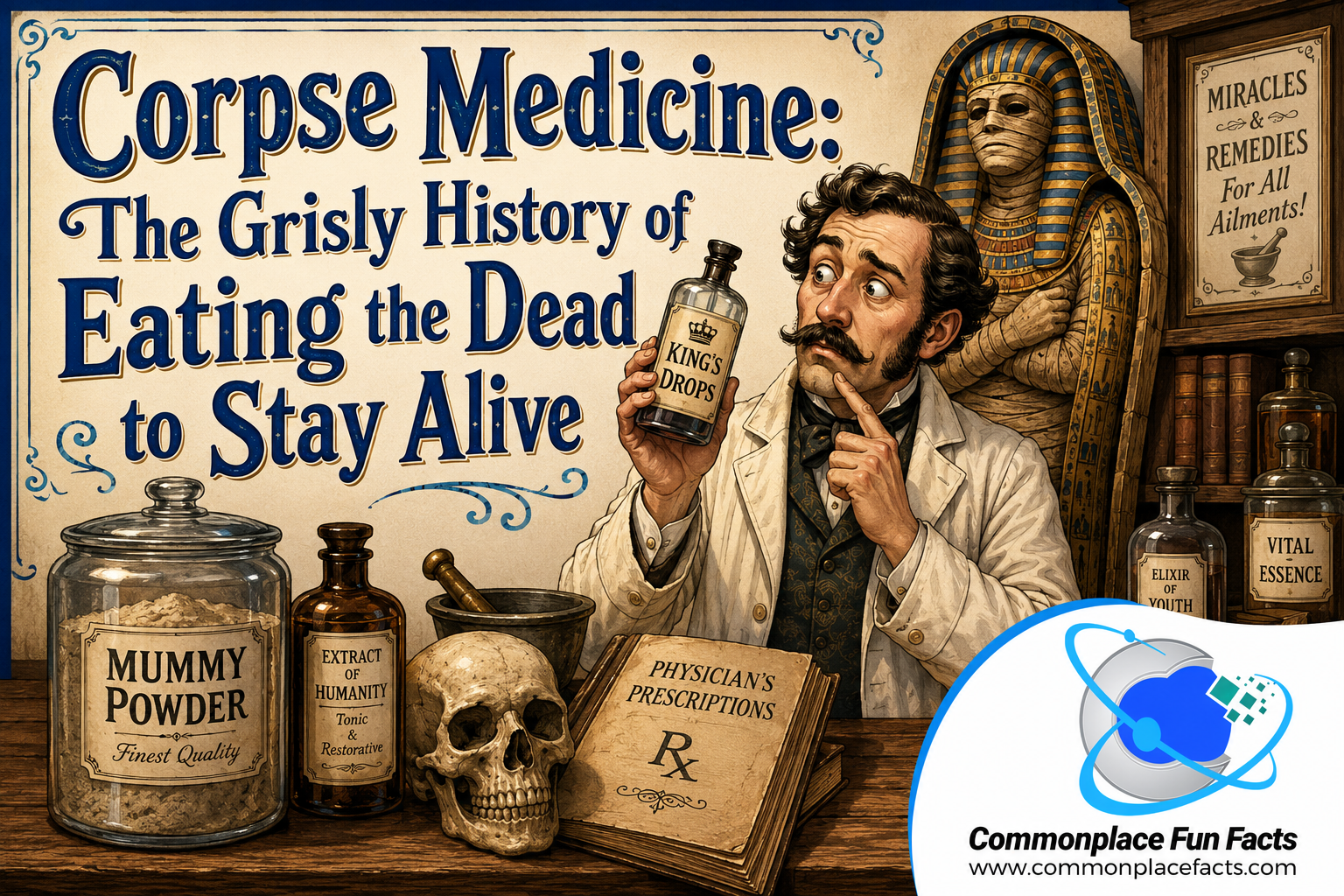

Sometimes we look at the quaint practices of our ancestors and say, “Well, they did the best they could with the information they had.”
Then there are moments when we look back and say, “They did what?”
Today’s subject falls squarely in the latter category. Welcome to the strange, unsettling, and deeply unpleasant world of corpse medicine, the once-respectable medical practice of using human remains as treatments for illness. We are not talking about organ transplants, blood transfusions, skin grafts, or any of the modern, carefully regulated ways one human body may help another survive. We are talking about smoked cadaver flesh, powdered skulls, human fat ointments, blood fresh from the executioner’s block, and imported Egyptian mummies ground into medicine.
Yes, really.
For centuries, especially in early modern Europe, learned physicians, apothecaries, nobles, commoners, and even royalty believed that the dead could help heal the living. They did not think of this as horror. They thought of it as medicine. Which is one of those facts that makes you want to reach back in time, take our ancestors gently by the shoulders, and ask whether they had considered therapy.
Contents
Corpse Medicine: Because History Wasn’t Already Weird Enough
Before we go any further, it is worth emphasizing that this was not usually treated as some shadowy back-alley horror show. Corpse medicine often came with the approval of physicians, apothecaries, scholars, and the sort of people who owned Latin books and therefore expected everyone else to stop asking difficult questions.
The practice went by other names, such as medical cannibalism, and took many forms, but the basic idea was simple: the dead still had something useful to offer the living. Blood might strengthen blood. Skull might help ailments of the head. Fat might soothe wounds and aches. A body cut down suddenly in the prime of life might still contain vitality that sickness, age, or time had not yet managed to steal.
Was this science? Not in any sense that would survive contact with a modern laboratory, a medical ethics board, or a reasonably alert pharmacist. But to many early modern Europeans, it sounded logical enough. And once that door opened, history did what history does best: walked through it carrying a bag of powdered mummy and acting like this was all perfectly normal.
The Pharmacy of the Dead
Corpse medicine sounds like something invented by a novelist who was told to make the villain more subtle and responded, “What if the doctor eats people?” But it was real, and for a surprisingly long time, it was not especially fringe.
The basic idea was simple: human remains contained human vitality. If someone was sick, weak, bleeding, epileptic, bruised, wounded, or otherwise experiencing the delightful misery of being alive before antibiotics, anesthesia, germ theory, and dentists who did not use tools from the local blacksmith, then perhaps the body of a dead person could supply what the sick person lacked.
This belief was not entirely random. It grew out of a broader medical worldview in which bodies, substances, spirits, fluids, planets, temperatures, and hidden virtues were all connected. Ancient and medieval medicine often depended on correspondences. Things were hot, cold, wet, dry, male, female, solar, lunar, earthy, airy, fiery, watery, and generally in need of a better filing system.
Medicine was not just chemistry. It was symbolism with a mortar and pestle.

The result was a pharmacological universe in which the skull might help the head, blood might help the blood, fat might soothe bodily pains, and the remains of a violently dead man might possess special power because his life had been cut short before nature had used up all the good stuff. This is the kind of reasoning that sounds ridiculous until you remember that many modern people still buy “detox” products from someone on the internet who thinks punctuation is a conspiracy.
To be fair, early physicians were working with limited tools. They did not know about bacteria. They did not understand epilepsy. They had no controlled clinical trials, no modern pathology, no MRI machines, and no urgent care clinics where a person can spend three hours proving to an insurance company that breathing is medically necessary. They observed, guessed, repeated old authorities, and sometimes mistook coincidence for cure.
Still, even allowing for all that, corpse medicine was a lot.
Mumia: When “Mummy” Meant Medicine
The story begins, or at least becomes commercially enthusiastic, with mumia.
Originally, the word did not necessarily mean a dead Egyptian wrapped like a linen burrito. It referred to bitumen, a dark tar-like substance that was used medicinally. Bitumen was thought to have healing properties, especially for wounds, bruises, and internal bleeding. Since ancient mummies were often darkened by resins, oils, and other embalming materials, medieval and early modern Europeans began associating those preserved bodies with the valuable medicinal substance.
From there, the logic took a turn. Not a good turn. Not the sort of turn where one says, “Ah, here we are at modern science.” More like the sort of turn where the GPS says, “Proceed to the nearest tomb.”
By the Middle Ages, Europeans were importing and consuming material sold as mummy. Physicians prescribed it. Apothecaries stocked it. Patients swallowed it. People believed it could treat bruises, bleeding, poison, epilepsy, headaches, stomach trouble, and a wide assortment of complaints that apparently all responded to the same basic instruction: “Add corpse.”
Egyptian mummies became medicine cabinets with hieroglyphics.
The demand was enormous, and like all booming markets, it attracted entrepreneurs, fraudsters, middlemen, counterfeiters, and probably at least one enthusiastic salesman who offered wild, cash-only inventory closeout sales.
There was one small problem: authentic ancient mummies were not exactly an easily renewable resource. Despite the best efforts of merchants, grave robbers, and assorted people who looked at archaeological remains and saw a business model, there were only so many ancient Egyptian bodies available for grinding into European remedies.
So the market adapted.
And by “adapted,” we mean “started selling other dead things and hoping no one noticed.”
The Mummy Business
Once mummy powder became valuable, the supply chain became as trustworthy as a diet pill commercial at 2:00 a.m.
Some “mummy” was genuine ancient material. Some was probably made from more recent Egyptian corpses. Some came from the bodies of executed criminals, the poor, the unidentified, the foreign, or anyone unfortunate enough to end up where merchants could turn mortality into inventory. Some may not have been human at all. Camel flesh, animal remains, and other substitutes were allegedly used when actual human remains were inconvenient, expensive, or unavailable.

This means that a sick European patient might have swallowed something believed to be powdered pharaoh but actually made from a relatively recent corpse, a conveniently dead stranger, or possibly a toasted camel. It was like pharmaceutical roulette, except every chamber was loaded with regrettable decisions.
By the 16th century, some physicians recognized that the mummy trade had problems. Guy de la Fontaine, physician to the king of Navarre, reportedly investigated the trade in Alexandria and found that merchants were manufacturing “mummy” from bodies that were not ancient at all. This should have been the moment when everyone said, “Perhaps we should stop eating corpse powder.”
Instead, many concluded that the problem was not corpse powder itself, but low-quality corpse powder.
This is an important distinction in the history of bad ideas. When confronted with fraud, people do not always abandon the foolish premise. Sometimes they merely demand better labeling.
“This mummy powder is counterfeit,” they said, while apparently missing the larger point that the authentic version was also a dead person.
“Take the Fresh, Unspotted Cadaver…”
Eventually, some medical writers moved beyond imported mummy and proposed making fresh mummy from more recent human bodies. Why rely on ancient Egypt when Europe had perfectly good executions at home?
Here we arrive at one of the most infamous passages in the history of medicine: the recipe associated with Johann Schröder’s Pharmacopoeia Medico-Chymica. Schröder recommended using the “fresh, unspotted cadaver of a redheaded man” who had died a violent death.

Let us pause there.
Fresh. Unspotted. Redheaded. Violently dead.
Remember that this is a prescription, not a casting call for a low-budget horror movie.
Schröder’s medical instructions were to “Take the fresh, unspotted cadaver of a redheaded man (because in them the blood is thinner and the flesh hence more excellent) aged about twenty-four, who has been executed and died a violent death. Let the corpse lie one day and night in the sun and moon—but the weather must be good. Cut the flesh in pieces and sprinkle it with myrrh and just a little aloe. Then soak it in spirits of wine for several days, hang it up for 6 or 10 hours, soak it again in spirits of wine, then let the pieces dry in dry air in a shady spot. Thus they will be similar to smoked meat, and will not stink.”
Smoked meat.
After writing more than 3,000 articles for Commonplace Fun Facts, there are few phrases that make us pause and want to apologize to humanity for presenting it, but “human corpse prepared like smoked meat” is one of them.
The red hair detail was not random. Some medical writers believed redheaded men had thinner blood or more desirable flesh. As a redhead-adjacent historical claim, this is both bizarre and oddly specific. Somewhere in early modern Europe, a red-haired man must have heard doctors discussing “superior flesh” and immediately decided that baldness was not a curse after all.
The recipe also reveals how early modern medicine blended chemistry, alchemy, folklore, and kitchen technique into one deeply alarming casserole of theory. Myrrh and aloe had known medicinal associations. Alcohol preserved and extracted. Sun and moon exposure carried symbolic and supposed natural significance. Violent death supplied vitality. The human body became raw material.
In other words, corpse medicine was not merely cannibalism. It was cannibalism with footnotes.
Blood at the Scaffold
Not all corpse medicine came powdered, dried, or wrapped in a misleading apothecary label. Sometimes the most prized medicine was fresh blood.
For centuries, people believed that blood carried life force. That idea was hardly unique to Europe. Blood is visually dramatic, immediately associated with life and death, and difficult to ignore when it is leaving the body in a hurry. In a world without modern physiology, it made grim intuitive sense that blood contained vitality.
This belief helps explain one of the most disturbing features of corpse medicine: the scramble for blood at executions.
People suffering from epilepsy or other conditions sometimes sought the blood of executed criminals. The logic was that sudden violent death left the blood charged with life. The condemned man had been healthy moments before, and his vitality had not been slowly drained by disease or age. It had been interrupted. Therefore, the blood was potent.
This gave executioners an unusual side business. Executioners were often feared, shunned, and socially marginalized. They were necessary officials but not always welcome dinner guests, which is understandable when your occupation involves making everyone at the table aware of their neck. Yet because they handled death, they were also believed to possess special powers. They might sell blood, fat, or other materials to desperate patients.
Picture the scene: a public execution, a crowd, a condemned man, an executioner, and sick people waiting nearby with cups.
History has produced many upsetting images, but “concession stand at the scaffold” deserves its own wing in the Museum of Please Stop.
There is something especially revealing about this practice. The people buying fresh blood were often not rich. Wealthy patients could afford refined preparations from apothecaries. Poorer patients might go directly to the source. Corpse medicine was not only an elite eccentricity. It crossed class lines because sickness crosses class lines, and desperation is one of history’s most successful salesmen.
Skulls, Drops, and Royal Branding
Human skulls had a particularly busy career in early modern medicine.
Powdered skull was prescribed for epilepsy, headaches, bleeding, and other conditions. The reasoning was partly symbolic: skull for head trouble. It was also tied to ideas about spirits, salts, and the hidden virtues contained in bone. A skull was not merely a skull. It was a container of medicinal possibility, provided one did not think too long about whose head had previously been using it.

One famous preparation was associated with King Charles II of England. Charles was interested in chemistry and experimental medicine, and he reportedly used or helped popularize a remedy known as the King’s Drops. These were made from human skull treated and dissolved in alcohol.
Royal branding has always been powerful. Today, a celebrity can sell perfume, tequila, or lifestyle advice of uncertain necessity. In the 17th century, a king could lend prestige to skull liquor. Progress is not always a straight line.
The King’s Drops were supposed to treat various ailments, including convulsions and weakness. They were not a quirky one-off. Preparations involving human skull were sold and discussed for generations. Some medical manuals specified that the skull should come from a person who had died violently. Others preferred skulls not buried too long. Some valued skull moss, known as usnea, which grew on exposed crania and was used against bleeding.
Yes, moss from skulls.
And some of us complain because cold medicine doesn’t come in bubblegum flavor.
This particular remedy shows how corpse medicine slid easily between medicine and magic. Was skull moss effective because it came from the head? Because it grew between life and death? Because it had absorbed some essence from the corpse? Because it looked strange enough to be important? The answer was probably “yes,” depending on whom you asked and whether they had already paid for it.
Human Fat and Other Household Horrors
Blood and skull were only part of the medical use of bodies. Human fat also enjoyed a deeply uncomfortable popularity.
Rendered human fat was used externally for wounds, aches, gout, arthritis, and other bodily complaints. It could be rubbed on the skin or used in bandages. Some believed it eased pain or promoted healing. German medical writers discussed its use, and executioners could supply it from the bodies of criminals.

If mummy powder was the supplement aisle, human fat was the topical ointment section.
One can imagine the apothecary’s shelf: lavender, rosemary, beeswax, human fat, and perhaps a small sign reading, “Ask about our seasonal skull tinctures.”
Human fat also appeared in magical traditions. Candles made from human fat—sometimes called thieves’ candles—were believed to stupefy victims or help criminals commit theft without being noticed. The famous “Hand of Glory,” a preserved hand of a hanged man, was likewise associated with criminal magic and folklore. These ideas were not the same as mainstream medicine, but the boundary between medical, magical, and religious thinking was not always clean.
The early modern world did not have our tidy categories. A treatment could be natural, occult, chemical, religious, and commercial all at once. A physician might reject witchcraft but prescribe skull. A patient might distrust folk magic but swallow mummy. A preacher might condemn heathen cannibals while accepting a medicine made from a dead criminal’s body.
Humans contain multitudes. Unfortunately, in this period, they also contained marketable ingredients.
The Logic Behind the Madness
It is tempting to treat corpse medicine as proof that everyone before us was absurdly gullible. That is emotionally satisfying, but not entirely fair. They were wrong, but they were not always irrational by the standards of their own medical universe.
The governing logic was often “like cures like.” Skull helped the head. Blood helped the blood. Human vitality helped human weakness. A violently dead body retained power. A young body had more life force than an old one. A healthy body was more useful than a diseased one. A preserved body could preserve the living.
Was this science? No, not in the modern sense. Was it a structured system of thought? Yes. A bad system can still be internally consistent. So can a conspiracy theory, a fad diet, or the plot of a soap opera if everyone agrees that amnesia is a reasonable Tuesday.
Early modern medicine also relied heavily on authorities. If a respected ancient writer, medieval physician, Renaissance scholar, or royal doctor endorsed something, that endorsement carried weight. Medical knowledge was cumulative, but not always corrective. Old claims could persist for centuries because they were copied, repeated, translated, expanded, and sold.
There was also the problem of evidence. Without controlled studies, a remedy could seem effective for all sorts of reasons. Some conditions improved naturally. Some came and went. Some patients recovered because the body healed itself. Some felt better because they believed they would. Some were soothed by alcohol, herbs, or rest. The corpse ingredient got the credit because it had the best publicist and the worst smell.
Desperation mattered too. If your child had seizures, your wound would not heal, your pain was unbearable, or your physician had run out of non-horrifying options, you might try what respected people recommended. We should not underestimate how fear changes judgment. A person facing death may become very open-minded about the medicine cabinet.
That does not make corpse medicine good. It makes it human.
Civilized Cannibals
One of the strangest aspects of European corpse medicine is the hypocrisy surrounding it.
Early modern Europeans often condemned cannibalism as a mark of savagery. Reports from the Americas and elsewhere were filled with exaggerated or invented stories of “man-eating” peoples, used to justify conquest, colonization, enslavement, and moral superiority. Cannibalism became a rhetorical weapon. It proved that the other people were barbarous and that Europeans, by contrast, were civilized.

Meanwhile, back in Europe, respectable patients were swallowing powdered mummy, drinking human blood, and rubbing human fat on their joints.
This is the sort of moral double-entry bookkeeping at which civilization has always excelled.
The distinction Europeans drew was partly cultural. They imagined foreign cannibalism as savage, ritualistic, uncontrolled, and morally corrupt. Their own use of human remains was framed as medical, rational, regulated, and therapeutic. Eating people was barbaric. Taking corpse medicine was science. The difference, apparently, was whether the body had been processed by an apothecary and given a Latin name.
Religious controversy added another layer. Protestants sometimes accused Catholics of cannibalism because of the doctrine of transubstantiation—the belief that the bread and wine of the Eucharist become the body and blood of Christ. Yet some of those same critics lived in societies where corpse-based remedies were available and accepted.
So, to summarize the early modern European position: symbolic or sacramental cannibalism? Horrifying. Indigenous ritual cannibalism, real or imagined? Proof of savagery. Medicinal cannibalism involving skull dust and mummy powder? Please take twice daily with wine.
Michel de Montaigne saw the problem. In his famous essay “Of Cannibals,” he criticized European hypocrisy and suggested that Europeans were far too eager to label others barbarous while ignoring their own cruelties. Montaigne was not writing a modern medical ethics paper, but his point lands squarely on this topic: the people most confident of their civilization are often standing ankle-deep in contradiction.
And sometimes contradiction has a faint aroma of aloe and myrrh.
Did Any of This Work?
The short answer is no.
The slightly longer answer is: not in the way people thought, and not because of the corpse.
Some preparations may have had incidental effects. Alcohol could numb, sedate, or disinfect in limited ways. Herbs such as myrrh or aloe might have had mild medicinal properties. Powders could sometimes help clot bleeding mechanically. Fat-based ointments could protect skin or soften tissue. And the placebo effect is real. If a patient believed strongly enough that a treatment would help, he might feel better, especially for subjective symptoms like pain or anxiety.
But mummy powder did not cure epilepsy. Fresh blood did not transfer vitality. Powdered skull did not repair the nervous system. Human fat was not a magical gout eraser. If anything, many corpse preparations carried obvious risks: contamination, decay, toxins, fraud, infection, and the general medical disadvantage of consuming poorly regulated dead people.
Some critics noticed. The great French surgeon Ambroise Paré objected to mummy medicine and reported that it caused stomach pain, vomiting, and foul breath. To be fair, those side effects are not nearly as bad as those commonly listed for modern FDA-approved medications.
The broader problem was that corpse medicine was not based on tested efficacy. It rested on tradition, symbolism, anecdote, authority, and demand. That made it durable. A failed remedy could always be explained away. Perhaps the dose was wrong. Perhaps the mummy was counterfeit. Perhaps the corpse had been too old, too sick, too buried, insufficiently redheaded, or tragically low in moon exposure.
Bad medicine survives when every failure has an excuse and every coincidence has a testimonial.
Why It Faded Away
Corpse medicine did not vanish overnight. It faded gradually as medicine changed, anatomical knowledge improved, chemistry advanced, and physicians became less willing to rely on ancient authorities and more interested in observation, experiment, and eventually clinical evidence.
Cultural attitudes changed too. The human body came to be treated differently in law, religion, medicine, and ethics. Dissection remained controversial, but medical science increasingly separated anatomical study from medicinal consumption. Bodies could be studied to understand disease without being powdered into treatment. A low bar, perhaps, but an important one.
Better remedies also emerged. As medicine became more effective, patients had less need to turn to spectacularly desperate cures. Once physicians had treatments that actually worked, “try this skull wine” lost some of its market appeal.
Still, corpse medicine lingered. Mummy appeared in medical listings long after one might expect. Skull remedies and blood-drinking stories persisted into the 18th and 19th centuries. The habit of treating the human body as medicinal material proved stubborn.
This should not surprise us. Medical fads rarely die because everyone becomes rational at once. They die because institutions change, evidence accumulates, alternatives improve, and eventually the old practice becomes embarrassing enough that people pretend no one respectable ever believed in it.
History is full of ideas that go from “obvious truth” to “minority position” to “we definitely never did that” in just a few generations.
Corpse medicine followed that path, though with more skulls.
Conclusion: The Dead Were Not Resting; They Were Being Prescribed
Corpse medicine is one of those historical topics that feels almost too grotesque to be real. It belongs in the mental category with plague masks, exploding whales, radioactive health tonics, and medical instruments that look as if they were designed by a blacksmith going through a difficult divorce.
But it was real, and that matters.
It reminds us that bad medicine does not always arrive wearing a fool’s cap. Sometimes it arrives with professional credentials, royal endorsement, impressive terminology, and a long bibliography. Sometimes it is sold by respected practitioners to frightened patients. Sometimes it looks, to its own age, not like superstition but like cutting-edge knowledge.
The people who used corpse medicine were not all monsters. Many were sick, desperate, grieving, or afraid. Many trusted the best authorities available to them. Many lived in a world where death was closer, medicine was weaker, and hope had fewer places to shop.
That is what makes the subject so unsettling. Not merely that people ate or applied human remains, but that they did so within systems that made sense to them. The apothecary shelf, the executioner’s side business, the powdered mummy, the skull tincture, the redheaded corpse recipe—all of it emerged from a culture trying to control suffering with the tools it believed it had.
Those tools were often wrong. Occasionally horrifying. Frequently unsanitary. And, in at least one case, weirdly specific about hair color.
Today, we have better science, better ethics, better medicine, and—one hopes—a firmer general consensus that “fresh, unspotted cadaver” should not appear anywhere near a prescription pad. But the history of corpse medicine still has something to teach us. It warns us about the power of authority, the danger of wishful thinking, the seduction of ancient remedies, and the impressive human ability to make terrible ideas sound reasonable if they are packaged correctly.
It also reminds us to read labels carefully.
Because once upon a time, somewhere in Europe, a patient reached for medicine and swallowed mummy powder, skull tincture, or something allegedly improved by the unfortunate career trajectory of a redheaded man.
The dead, it turns out, were not always allowed to rest in peace.
Sometimes they were expected to make house calls.
You may also enjoy…

Take Some Mummy Powder, A Few Drops of Gladiator Blood, and Call Me in the Morning
Quack medicine is nothing new. Over the centuries, people have ingested some pretty disgusting things in hopes of curing whatever ails them. Consider some of the following examples from history: Mellified Man: Take one male volunteer aged 70 or 80, bathe him, and feed him with nothing but honey. Upon his death (usually within a…

The Six Million Dollar Mummy: The True Story Behind Hollywood’s Gruesome Prop
Discover the shocking true story behind The Six Million Dollar Mummy — a Hollywood prop that turned out to be a real mummified body with a bizarre criminal past.

Paruria Erratica: The Weird Medical Case of the Woman Who Urinated from Eyes, Ears, Nose & Navel
Discover the bizarre 18th-century case of Maria Burton, a woman who urinated from her eyes, ears, nose, and navel — a rare condition known as Paruria Erratica.



Leave a Reply