
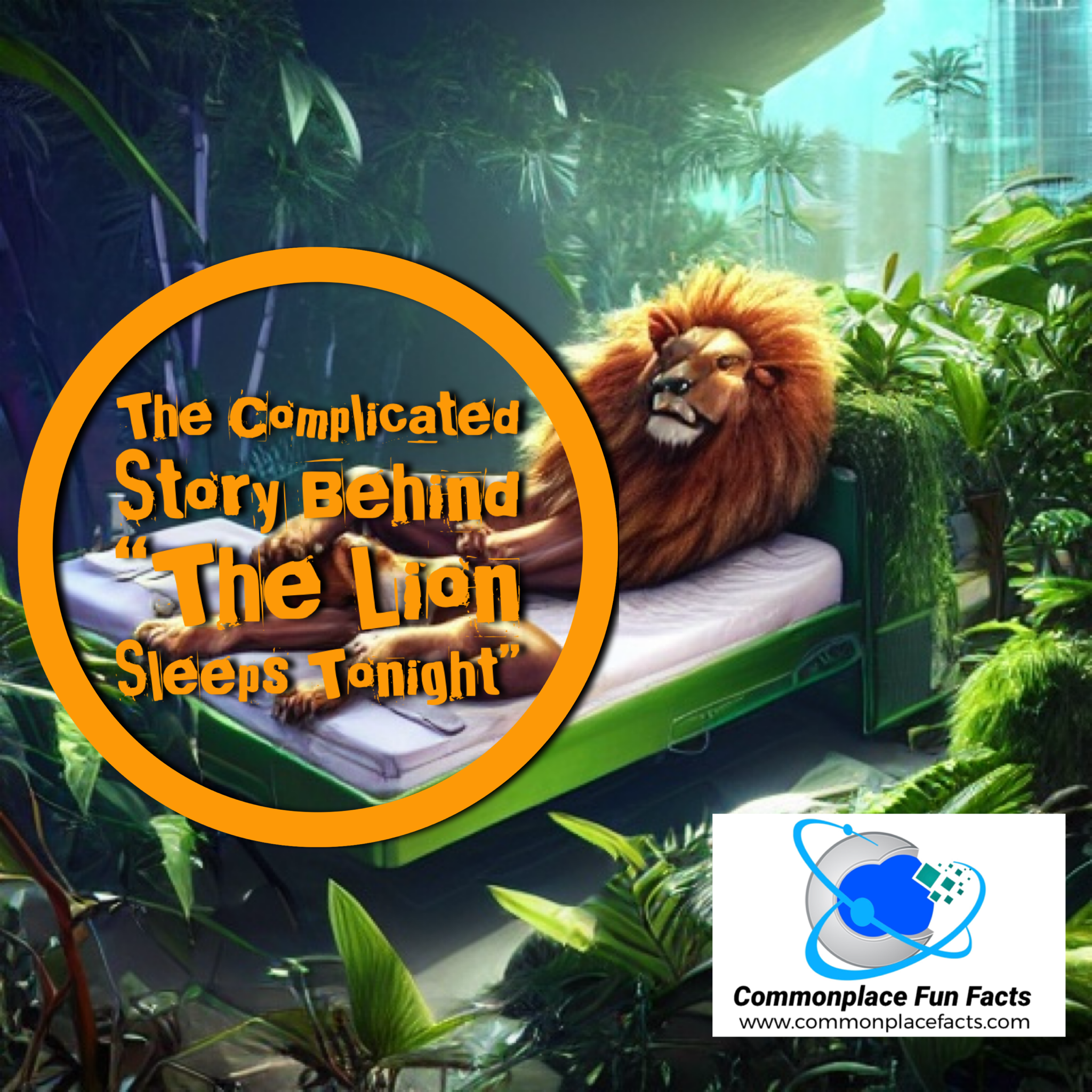

The Jungle Journey of “The Lion Sleeps Tonight”
Weeheeheehee dee heeheeheehee weeoh aweem away
Weeheeheehee dee heeheeheehee weeoh aweem away
(Wimoweh, wimoweh, wimoweh, wimoweh)
(Wimoweh, wimoweh, wimoweh, wimoweh)
(Wimoweh, wimoweh, wimoweh, wimoweh)
(Wimoweh, wimoweh, wimoweh, wimoweh)
By now, you are likely singing or humming along with us as we jump into the memorable and catchy tune, “The Lion Sleeps Tonight.” If this were any other blog, we’d probably just join in with you and be thankful for a few minutes of bliss. This, however, is Commonplace Fun Facts, where we feel compelled to pour cold water on every happy memory endeavor to enlighten our readers to the less-well-known facts that tell the full story.
With that in mind, let’s take a look at “The Lion Sleeps Tonight.” Where shall we begin? The beginning would make sense. The beginning for “The Lion Sleeps Tonight” is in 1939 when Solomon Linda and the Evening Birds recorded “Mbube.”

Mbube is Zulu for “lion.” As originally recorded, the Evening Birds sang, “Mbube, uyimbube,” (“Lion, you’re a lion”) as Solomon Linda sang the improvised lead. The song was a hit, selling 100,000 copies in South Africa.
What Do the Lyrics Mean?
Which brings us to the first balloon we must pop in your understanding of “The Lion Sleeps Tonight.” The lyrics most of us know weren’t part of the official song. “Wimoweh” can be found nowhere in the original lyrics. Here is the original version:
Lyrics in Zulu
Uyimbube
Uyimbube
Uyimbube
(Uyimbube
Uyimbube
Uyimbube)
Njalo Ekuseni Uya Waletha Amathamsanqa
Yebo!
Amathamsanqa
Mbube
Uyimbube
Uyimbube
Uyimbube
Uyimbube
Uyimbube Mama We
He! He! He! He!
Uyimbube Mama
We We We We We We
Uyimbube
Uyimbube
Kusukela Kudala Kuloku Kuthiwa
Uyimbube
Uyimbube Mama
English Translation
You’re A Lion
You’re A Lion
You’re A Lion
(You’re A Lion
You’re A Lion
You’re A Lion)
Every Morning You Bring Us Good Luck
Yes!
Good Luck
Lion
You’re A Lion
You’re A Lion
You’re A Lion
You’re A Lion
You’re A Lion, Mama!
Hey! Hey! Hey! Hey!
You’re A Lion, Mama
Oh Oh Oh Oh Oh Oh
You’re A Lion
You’re A Lion
Long, Long Ago People Used To Say
You’re A Lion
You’re A Lion, Mama
One would assume that Solomon Linda was able to retire and live off of the royalties from such a big success. Unfortunately, he was paid a grand total of £1 (the equivalent of £54.43 in 2024) for the recording. When he died in 1962, his family could not afford to purchase a gravestone. We’ll revisit this sad fact shortly.
Meanwhile, the song lived on, increasing in popularity as it went international. It has been translated into multiple languages, including Congolese, Navaho, Danish, and Japanese.
Over the years, the song changed in significant ways. Perhaps the biggest change happened by accident. In 1949, Peter Seeger adapted “Mbube” for his band, the Weavers. Unfortunately, not knowing Zulu, he misunderstood “uyimbube” as “wimoweh.” The former means “you’re a lion.” The latter means… well… nothing, as nearly as we can tell. Google Translate seems to think it is Polish, but translates it into English as “wimoweh,” which is less than helpful.
The second big change can be attributed to a bad understanding of nature. In 1961, George Weiss added the lyrics, “In the jungle, the mighty jungle, the lion sleeps tonight.” Lovely, words, but an unlikely scenario for a few reasons.
First of all, lions tend to sleep during the day and hunt at night. Secondly, wild lions live in the African Savannah, not in the jungle. Thirdly, that verse that goes, “Near the village, the peaceful village, the lion sleeps tonight” is just downright creepy. Presumably, the lion is camped out by the village because he plans on snacking on the inhabitants. A further assumption is that the village is peaceful because they are blissfully ignorant about the horrifying fate that awaits them when the lion wakes up.
So to recap, the most famous song to come out of South Africa (at least the way it is sung today) was written by a fellow who was paid pennies. It was written in Zulu but now consists primarily of nonsensical words. It is nominally about the sleeping habits of lions but gets the time and location of their sleep completely wrong. Lastly, it seems to celebrate the impending doom of some poor villagers.
On a positive note, it is a really catchy song.
It is so catchy, in fact, that 55 years after it was first recorded, “The Lion Sleeps Tonight” made an appearance in Disney’s The Lion King, continuing on through the Broadway adaptation of the movie. That only increased the song’s popularity. It also brought attention to the plight of Solomon Linda’s family. Someone calculated that if he had been paid a fairly for the rights to his song, he would have earned $5 million in five years’ time from the Broadway production alone. Remember that he received a whopping £1 and died in poverty.
The Lion King tells the gripping story of a young lion prince who was denied the throne after his father was murdered. The villain was Uncle Scar. As long as we are setting the facts right, we should point out that in nature, Scar would likely have been the king to start with. He had a dark mane — a status symbol for male lions. It is the result of having high levels of testosterone and a healthy diet.
Nevertheless, the underdog (underlion?) in the story overcomes adversity. Ultimately, he receives the recognition he should have had from the beginning and takes the throne of his kingdom.
In that respect, The Lion King’s plot parallels the story of Solomon Linda. More than half a century after Mbube was released, Solomon’s family decided it was time he got the recognition he deserved. In 2004, the family took on the giant by suing Disney. Like his little lion counterpart, Solomon ultimately received his birthright. The parties settled the case, with Disney agreeing to pay the family royalties, dating back to 1987.
Hopefully, with all the facts straightened out, you will be able to sleep tonight. Just know that the lion won’t.
You may also enjoy…

The Sinister Origin of a Beach Boys Song
Few cultural symbols better represent the innocence of the 1960s than the Beach Boys. They ushered in the “California sound” with songs that evoke pleasant thoughts of surfing, cars, romance, and youth. That is why the sinister origin of one of their songs is particularly shocking and creepy. Charlie wanted to strike it big in…

Yankee Doodle Once Promised Death to a Founding Father
One of the earliest and best-known patriotic songs of the United States is “Yankee Doodle.” Learned by every school child and sung every Independence Day, the song is a rich reminder of the heroic actions of America’s Founding Fathers. Speaking of Founding Fathers, few names loom larger than that of John Hancock. Strictly speaking, his…

From Karaoke King to Cockroach Killer: The Unlikely Journey of a Musical Innovator
Do you have a secret passion to be a pop star? Have you ever dreamt about taking the microphone and performing before an enraptured audience, wowing the spectators as you belt out your favorite song? What is holding you back? Is it a concern about lack of musical talent? OK, so you don’t have the…

Leave a Reply