

There are Olympic Games that inspire awe. There are Olympic Games that reshape nations, transform cities, and produce moments of athletic greatness so stirring that broadcasters immediately begin searching for orchestral music and slow-motion footage.
Then there are the 1904 Olympics in St. Louis.
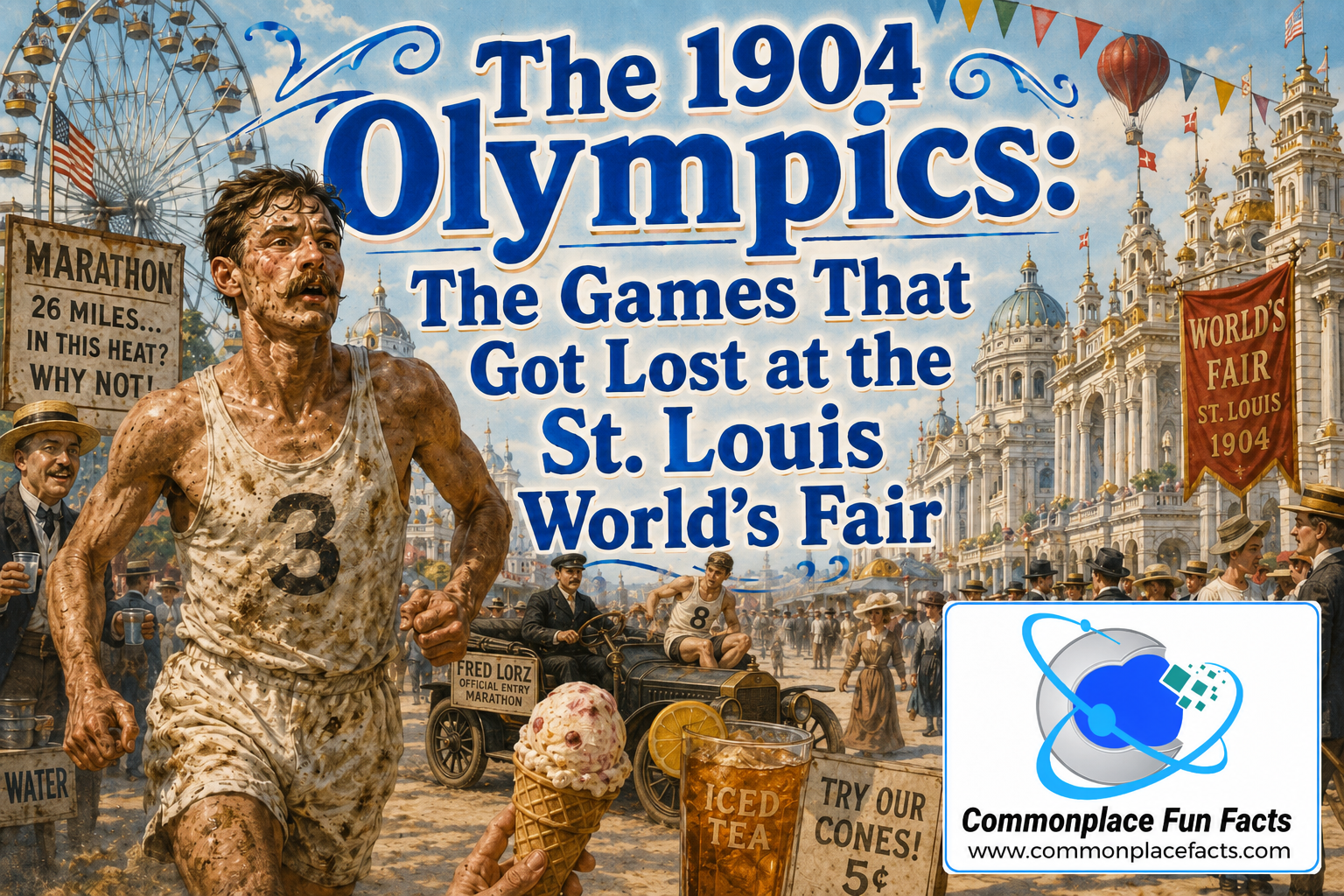
The 1904 Games were the first Olympics held in the United States, which sounds impressive until you learn that they were basically swallowed whole by the St. Louis World’s Fair, digested slowly over several months, and occasionally reappeared in the form of confused athletes, questionable judging, “scientific” racism, and one marathon that appears to have been organized by the Three Stooges.
Contents
The World’s Fair That Ate the Olympics
To understand the 1904 Olympics, you first have to understand the enormous spectacle that surrounded them: the Louisiana Purchase Exposition, better known as the St. Louis World’s Fair. Officially, the Fair was a celebration of the 100th anniversary of the Louisiana Purchase. Unofficially, it was St. Louis standing on a chair and shouting, “Please notice us!” at the rest of the world.

And the world did notice. Millions came. Buildings rose. Foods were popularized. Technology was displayed. Nations competed for attention. Human beings were shamefully treated as zoo exhibits. And somewhere in the middle of all this, the Olympic Games tried to happen.
They did, technically.
But so did a lot of other things, and some of them involved strychnine.
The Louisiana Purchase Exposition opened in St. Louis on April 30, 1904, and ran until December 1. It occupied a vast section of Forest Park and the surrounding area, including part of the campus of Washington University. This was not a modest county fair with a pie contest and rides that seemed to be held together with duct tape and optimism. This was a temporary city of palaces, lagoons, gardens, exhibition halls, statuary, restaurants, railways, electric lights, and enough civic self-confidence to power a small battleship.
The Fair covered roughly 1,200 acres and included around 1,500 buildings, most of them built from temporary materials. They were grand, gleaming, classical-looking structures intended to create the impression that St. Louis had located a misplaced marble empire in eastern Missouri.
It was, in many ways, an architectural illusion. Many of the buildings were made of “staff,” a plaster-and-fiber material commonly used in exposition construction. It looked magnificent. It photographed beautifully. It also was not designed to last, because apparently the idea was to build Rome, charge admission, and then let weather and time handle demolition.
The Fair celebrated the Louisiana Purchase, but it also celebrated American ambition, industrial progress, consumer culture, empire, science, art, education, electricity, agriculture, transportation, and the thrilling belief that if something existed, it should probably be put in a pavilion with a label.
In that setting, the Olympics were not the main event. They were a feature. A sideshow. A sporting garnish on a seven-month buffet of human achievement and questionable judgment.
Wait, Weren’t the 1904 Olympics Supposed to Be in Chicago?
Yes. The 1904 Olympics were originally awarded to Chicago.

This is important, because it means the St. Louis Olympics began with the sort of regional rivalry that more or less defines Midwestern cities. Chicago had been selected to host the Games, but St. Louis had the World’s Fair, money, momentum, and a strong desire not to have another major attraction stealing attention.
The 1904 St. Louis Games were only the third Olympic Games of the modern era, which helps explain why they did not yet carry the international prestige, wall-to-wall attention, and corporate-sponsored gravitas now associated with the Olympics. The first modern Olympics were held in Athens in 1896, with some estimates of approximately 280 athletes from 12 countries, while Olympic reporting based on official records often lists 176 participants; either way, it was still a small, experimental revival rather than the global colossus we know today. The second Games were held in Paris in 1900, tangled up with that city’s World’s Fair, and had about 1,224 participants, including one mystery boy who won first place for a rowing event and disappeared. By the time St. Louis hosted in 1904, the Olympics were still finding their identity — less “planetwide sacred festival of sport” and more “promising international athletic project that could still be misplaced inside a World’s Fair like a set of car keys.”
St. Louis organizers wanted the Olympics. More specifically, they wanted athletic competitions at the Fair that could be marketed as Olympic-level attractions. They worked with American athletic organizations and created enough pressure that the International Olympic Committee eventually moved the Games from Chicago to St. Louis.
Pierre de Coubertin, founder of the modern Olympic movement, was not thrilled. He had already watched the 1900 Paris Olympics get absorbed into that year’s world exposition, where the Games became so disorganized that some competitors reportedly did not even realize they had participated in the Olympics. Naturally, humanity learned from this mistake and immediately repeated it four years later, because progress is mostly a decorative word we put on posters.
Coubertin did not attend the St. Louis Games. That may have been wise. There is only so much sorrow one man can endure while watching his noble vision become a scheduling appendix to a World’s Fair.
The Olympics as a Months-Long Identity Crisis
Modern Olympic Games are tightly scheduled, heavily branded, internationally televised events. The 1904 Olympics were more like a recurring rumor.
The Games stretched across months, with events scattered through the Fair season. Depending on how one counts the competitions, the Olympic program ran from July into November, though many of the most recognizable track-and-field events occurred in late August and early September. There were also “world championship” contests, athletic demonstrations, and events attached to the Fair’s Department of Physical Culture.
This created a problem: What counted as Olympic? What counted as a fair attraction? What counted as a championship? What counted as someone in a blazer making things up because the printer needed a program by Tuesday?
International participation was weak. Travel to St. Louis was expensive and difficult, especially for European athletes. The Russo-Japanese War was underway. The Olympic movement was still young. And to many potential competitors, crossing an ocean to compete in Missouri under the shadow of a World’s Fair probably sounded less like a global sporting festival and more like an elaborate prank.
And getting to America was only half the battle. This was fifty years before the Interstate Highway System, and making one’s way to the heartland of the country was a hazardous adventure in and of itself.
As a result, the 1904 Games were dominated by Americans. The United States won most of the medals because the United States supplied most of the competitors. As far as strategies go, this is hard to beat.
The 1904 Games did introduce some important Olympic traditions. They were the first Olympics where gold, silver, and bronze medals were awarded for first, second, and third place. Boxing made its Olympic debut. Freestyle wrestling also appeared. The Games mattered.
They just mattered in the way a chaotic family reunion matters: historically significant, emotionally complicated, and best understood after someone explains why Uncle Fred arrived in a car during the marathon.
The Marathon That Became a Public Safety Exhibit
No single event captures the spirit of the 1904 Olympics quite like the marathon. This is unfortunate for the marathon, but excellent for history.

The race was held on August 30, 1904, in brutal conditions. The course was about 24.85 miles long, shorter than today’s official marathon distance of 26.2 miles, which would not be standardized until later. The runners faced heat, dust, hills, rough roads, traffic, and very limited access to water.
Nothing says “international athletic excellence” like asking exhausted men to run through choking dust while wagons, cars, and horses share the road.
The course was so dusty that vehicles accompanying the runners kicked up clouds that made breathing miserable. Several athletes suffered badly. One runner reportedly had to withdraw after inhaling so much dust that it caused internal distress. This may be the only marathon in which “eating my dust” became less a taunt and more a medical diagnosis.
Then came Fred Lorz.
Lorz was an American runner who started the race, became exhausted, and dropped out. He then rode in a car for roughly 11 miles, waving to fellow competitors as he passed them. When the car broke down, he got out and resumed running. He entered the stadium first and was initially greeted as the winner and awarded a laurel crown by President Theodore Roosevelt’s daughter, Alice.

As far as approved methods for improving one’s marathon time, this was not one of them.
Lorz later claimed it was a joke. Olympic officials were not amused, which is usually what happens when your punchline includes fraud, a finish line, and Alice Roosevelt being present to congratulate you.
After Lorz was disqualified, the winner was Thomas Hicks.
And that is where the story becomes less “sports achievement” and more “medical malpractice with spectators.”
Hicks struggled badly during the race. His handlers gave him a mixture that included strychnine and brandy. Strychnine, for readers who do not keep a Victorian medicine cabinet next to the baking soda, is a poison. In small doses, it was sometimes used at the time as a stimulant. This is one of those historical facts that makes you grateful for modern sports drinks, even the ones that are really nothing more than sugar mixed with a bit of water.
Hicks staggered toward the finish, hallucinating and barely functional. His attendants helped him along, and he crossed the line in a time of 3 hours, 28 minutes, and 53 seconds — the slowest winning time in Olympic marathon history.
After the race, Hicks had to be treated by doctors. This is generally not the victory lap one hopes for.
Félix Carvajal, the Cuban Mailman Who Nearly Stole the Show
Then there was Félix “Andarín” Carvajal of Cuba, one of the great characters in Olympic history.
Carvajal was a Cuban mailman who raised money to travel to St. Louis. The popular version of the story says he lost much of his money before arriving and had to make his way to the Games under less-than-ideal circumstances. He appeared at the marathon in street clothes, including long trousers, which were cut down before the race.

He reportedly chatted with spectators during the event, accepted food along the route, and generally approached Olympic competition with the relaxed energy of a man who had mistaken the marathon for a social call.
At one point, he ate fruit from an orchard, possibly including apples that did not agree with him. Some accounts say he stopped for a nap. And yet, despite all of this, Carvajal finished fourth.
Fourth.
In an Olympic marathon.
After showing up underprepared, dressed like he had wandered out of a lunch break, eating roadside produce, and possibly taking a snooze.
There are athletes with training plans, nutritionists, equipment sponsors, and coaches who would be spiritually flattened by this information.
The First African Olympians and the Dog Incident
The 1904 marathon also included two South African runners, Jan Mashiani and Len Tau. They are often identified as among the first Black African athletes to compete in the modern Olympics, though older accounts sometimes described them inaccurately as “Zulu.” Later scholarship has questioned and corrected some of those labels.

Their presence at the Games was connected to the Fair’s Boer War exhibition, another reminder that the Olympics and the World’s Fair were deeply entangled.
Tau reportedly might have placed higher in the marathon if he had not been chased off course by dogs.
Let us pause there.
One of the early Olympic marathoners lost ground because dogs chased him.
This is not how NBC packages the Olympics today. There is no tasteful slow-motion montage for “athlete pursuing glory while pursued by local dogs.” But in St. Louis, even the neighborhood animals wanted to contribute to the event’s reputation.
George Eyser: Six Medals and a Wooden Leg
The 1904 Olympics were not only absurd. They also produced genuinely remarkable achievements.
One of the most extraordinary was George Eyser, a German-born American gymnast who competed with a wooden prosthetic leg. Eyser had lost part of his left leg in a train accident, yet he became an elite gymnast.
At the 1904 Games, Eyser won six medals in one day: three gold, two silver, and one bronze.
That would be impressive for any athlete. For a gymnast competing with a wooden leg in 1904, it is almost beyond comprehension. Gymnastics requires balance, power, landing control, coordination, and a strong preference for not crashing into equipment. Eyser did all of this with prosthetic technology that was somewhat less advanced than “bionic” and somewhat more advanced than “please do not think about splinters.”
His achievement deserves far more attention than it usually gets. The 1904 Olympics were strange, yes, but they were not merely strange. They also contained moments of real human brilliance hiding in the chaos like diamonds in a very dusty Missouri haystack.
The Fair as America’s Temporary Dream City
Meanwhile, outside the athletic venues, the St. Louis World’s Fair was performing its own kind of marathon: a seven-month sprint of spectacle, invention, commerce, art, and imperial storytelling.

Visitors came to see palaces devoted to industry, education, transportation, electricity, machinery, agriculture, fine arts, and foreign nations. They saw new products, new technologies, new entertainments, and visions of the future wrapped in classical architecture.
The Fair was meant to show what America had become since the Louisiana Purchase. In 1803, the United States had doubled its territory through a transaction with France. In 1904, the country presented itself as a rising global power: industrial, modern, confident, wealthy, and increasingly imperial.
The Fair was an enormous act of national self-presentation. It said, “Look how far we have come.” It also said, “Please ignore the temporary plaster.”
Only a few structures survived. The most famous is the Palace of Fine Arts, now home to the Saint Louis Art Museum. Most of the rest disappeared, leaving behind photographs, postcards, souvenirs, maps, memories, and the faint suspicion that Americans in 1904 had never met an exhibition hall they did not want to supersize.
The Food Legends of the 1904 Fair
The World’s Fair is frequently associated with the introduction of iconic foods, as we saw in “Sweet Beginnings: How the 1893 World’s Fair Revolutionized Your Snack Drawer.” The St. Louis World’s Fair is no exception. Depending on which version of the story you hear, the Fair gave us the ice cream cone, the hot dog, the hamburger, peanut butter, cotton candy, Dr Pepper, puffed rice, iced tea, and possibly modern civilization’s entire snack drawer.

As usual, history is messier than the souvenir version.
Many of these foods existed before 1904. The Fair did not necessarily invent them. What it did was popularize them, commercialize them, and place them in front of millions of hungry visitors who were walking across a massive fairground and needed portable food.
The ice cream cone is the classic example. The popular story says an ice cream vendor ran out of dishes and teamed up with a nearby waffle vendor, who rolled waffles into cones. It is a charming story. It may even contain some truth. But cone-like edible ice cream holders existed before the Fair, and multiple vendors later claimed credit.
This is what historians call “complicated” and what food marketers call “ours.”
Still, the Fair helped make the ice cream cone famous. The same goes for other portable fair foods. A World’s Fair was the perfect setting for culinary experimentation. Visitors wanted novelty. Vendors wanted sales. Nobody wanted to sit down for a twelve-course meal in the middle of a 1,200-acre festival of progress.
So yes, we should be cautious about saying the 1904 Fair invented all these foods. But it absolutely helped launch several of them into American popular culture.
Which means the same event that gave us the Olympic strychnine marathon also helped normalize ice cream cones.
History contains multitudes. Some of them are delicious. Some of them require a poison-control center.
The Pike: Entertainment, Spectacle, and Profitable Weirdness
The Fair’s entertainment district was called the Pike. It was a long stretch of amusements, shows, concessions, rides, performances, and attractions. If the main exhibition palaces represented education and progress, the Pike represented the timeless human desire to pay money to look at something odd while eating sugar.
The Pike included foreign villages, theatrical spectacles, mechanical attractions, animal shows, music, food, and all manner of staged exoticism. Some attractions were harmless fun. Others were entangled with the Fair’s troubling habit of turning cultures into spectacles for American consumption.
Visitors could spend the day moving from industrial exhibits to art halls to scientific displays to staged villages to athletic contests. The Fair compressed the world into a walkable amusement landscape, then charged admission at the gate.
That was part of the appeal. It was also part of the problem.
The Darker Side: Human Exhibits and “Anthropology Days”
No honest account of the 1904 World’s Fair can ignore its racial and imperial displays.
The Fair included human exhibitions that presented Indigenous peoples, Filipinos, Africans, and others as objects of study, curiosity, or entertainment. These displays reflected the racial thinking and imperial politics of the period. They were not merely unfortunate background details. They were central to the way the Fair told its story about civilization, progress, and hierarchy.

The Philippine Exposition was especially large and politically charged. The United States had acquired the Philippines after the Spanish-American War and fought a brutal war against Filipino independence forces. At the Fair, Filipino people from different groups were displayed in ways that encouraged Americans to see colonization as benevolent, educational, and necessary.
It was empire with landscaping.
The Olympics became connected to this through the infamous “Anthropology Days.” These events involved Indigenous and colonized people competing in athletic contests arranged by organizers who wanted to use sport as a tool for racial comparison. The entire premise was drenched in pseudo-science and white supremacy.
The contests were not fair athletic competitions. Participants were often unfamiliar with the events. The setup was designed less to measure ability than to reinforce assumptions already held by the organizers.
Modern readers should not treat this as a quirky footnote. It was dehumanizing. It was racist. It shows how easily the language of science, education, and entertainment can be twisted into something ugly when the people in charge have already decided who counts as fully human.
That is part of the 1904 story, too.
The Fair was dazzling and disturbing. It celebrated human creativity while putting human beings on display. It popularized ice cream cones while staging disturbing propaganda. It gave America a spectacle of progress while reminding us that “progress” is a dangerous word when used by people who think they are the measuring stick for civilization.
Why the 1904 Olympics Were Both a Failure and a Turning Point
It is tempting to call the 1904 Olympics a failure. In many ways, they were.
They were poorly separated from the World’s Fair. International participation was limited. The schedule was confusing. Some events were barely recognizable by modern Olympic standards. The marathon was a health hazard. The Anthropology Days were disgraceful. The Games lacked the global identity that later Olympics would develop.
And yet, the 1904 Olympics were also important.
They marked the first time the Olympics came to the United States. They introduced the gold-silver-bronze medal format. They helped establish several sports in Olympic competition. They produced unforgettable athletes and stories. They also provided a cautionary tale for the Olympic movement: do not let the Games become a side attraction inside someone else’s mega-event.
The Olympics had to become their own spectacle. St. Louis showed what happened when they were not.
In that sense, the 1904 Games helped define the future by demonstrating exactly what not to do. This is an underrated form of leadership, generally practiced by people shortly before the creation of new rules.
What Made the St. Louis Fair So Memorable?
The St. Louis World’s Fair was memorable because it was enormous, ambitious, and contradictory.
It was a celebration of national growth. It was a commercial wonderland. It was a technological showcase. It was a temporary city of beauty and excess. It helped popularize foods that still shape American eating habits. It brought millions of visitors to St. Louis and left behind cultural memories that lasted far longer than most of its buildings.
It also reflected the prejudices and power structures of its age. It presented empire as education. It used human beings as exhibits. It treated racial hierarchy as science. It showed how easily entertainment and exploitation can share the same ticket booth.
That combination makes the Fair historically fascinating. It was not simply good or bad, enlightened or benighted, impressive or appalling. It was all of those things at once, because history has a terrible habit of refusing to organize itself into convenient moral filing cabinets.
The Best Story Is the Connection
The real story is not just “the 1904 Olympics were weird” or “the St. Louis World’s Fair was huge.” The real story is how the two events collided.
The Fair wanted attention. The Olympics needed a host. St. Louis wanted to outshine Chicago. Athletic organizers wanted prestige. Civic boosters wanted crowds. The result was an Olympic Games that became embedded in a World’s Fair so large and loud that the Olympics could barely hear themselves think.
That is why the 1904 Olympics feel so strange today. They were not yet the Olympics as we know them. They were part athletic competition, part fair programming, part national boasting, part scientific exhibition, part sporting experiment, and part administrative fog bank.
They belonged to a moment when the modern Olympics were still figuring out what they were. Unfortunately, in St. Louis, they figured it out while surrounded by plaster palaces, colonial exhibits, snack vendors, confused scheduling, and marathon officials who apparently believed hydration was a character flaw.
Legacy: Palaces, Medals, Ice Cream, and Regret
Today, the 1904 St. Louis World’s Fair is remembered in fragments.
There is the Saint Louis Art Museum, housed in the former Palace of Fine Arts. There are photographs of bright white buildings reflected in lagoons. There are stories of new foods and giant crowds. There are souvenirs tucked away in collections. There is the song “Meet Me in St. Louis, Louis,” which helped cement the Fair in popular memory.
There are also the troubling memories: the human exhibits, the racial pseudo-science, the imperial messaging, and the Anthropology Days.
The Olympics, meanwhile, are remembered for their oddities: the car-assisted marathoner, the strychnine-assisted winner, the Cuban mailman in cut-off trousers, the dogs, the dust, the low international turnout, and George Eyser’s astonishing medal haul.
All of this makes 1904 one of the strangest years in Olympic history. It was not polished. It was not graceful. It was not always admirable. But it was revealing.
The Fair showed America how it wanted to see itself: modern, powerful, inventive, cultured, and destined for greatness. The Olympics showed the young international sporting movement trying to find its footing in a world of fairs, nationalism, amateur athletic politics, and logistical improvisation.
Together, they produced an event that was magnificent, embarrassing, innovative, exploitative, delicious, dangerous, and occasionally powered by poison.
So the next time someone complains that the Olympics have become too commercial, too political, too chaotic, or too full of questionable decisions, remember St. Louis in 1904.
The modern Games may have their problems.
But at least the marathon winner usually does not arrive hallucinating after being dosed with rat poison while the disqualified winner explains that the automobile portion of his race was just a little joke.
Progress, like the ice cream cone, must begin somewhere.
You may also enjoy…

The 1988 Seoul Olympics Dove Fire: The Reason Doves Are No Longer Used in the Opening Ceremony
The Olympics dove fire at the 1988 Seoul games put an end to the tradition of releasing live doves during the opening ceremonies. Learn the details of this BBQ disaster!

Relive the Wonder of the 1893 Chicago World’s Fair
In 1893, Chicago threw a big party in honor of the 400th anniversary of Christopher Columbus’ voyage to the New World. It was a spectacular affair. For five months, people from all over the world flocked to Chicago to take in the sights, which included such things as the first Ferris Wheel, cultural exhibitions, lectures,…

Arrhichion of Phigalia: The Olympic Champion Who Won After Death
Ancient Greek athlete Arrhichion won his final Olympic pankration match even after dying. Discover the incredible true story and historical sources behind it.


Leave a Reply