
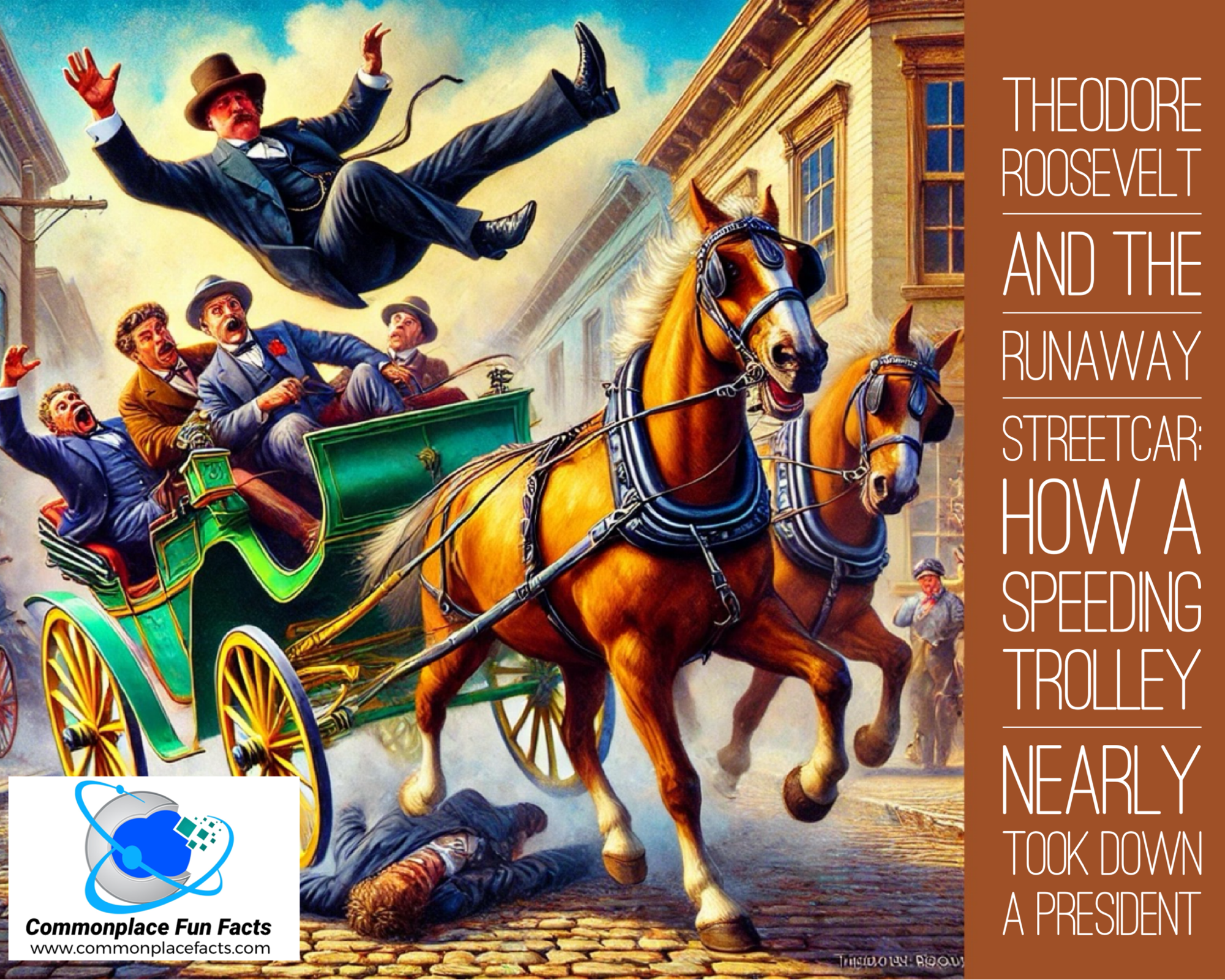

It is 1902, and the United States is still reeling from the shock of losing President William McKinley to an anarchist’s bullet just one year earlier. Its new president, Theodore Roosevelt, is the youngest man to ever hold the office. He is a model of good health and vitality. On top of that, after three presidential assassinations in fewer than 40 years, the Secret Service has been charged with protecting the nation’s chief executive. It would seem that hands holding the reins of government are safe and secure. Then, in the blink of an eye, the nation comes shockingly close to losing its second president in less than a year. Thanks to a rather overzealous streetcar driver, Roosevelt came within a whisker of joining his predecessor in the hereafter. What started as a routine political barnstorming trip quickly turned into a scene straight out of a disaster film, with a Secret Service agent dead, a president airborne, and a streetcar driver finding himself at the center of a legal firestorm and the focus of a Rough Rider’s wrath.
The Meteoric Rise of Theodore Roosevelt
Before we dive into that fateful day, let’s back up a bit. Theodore Roosevelt was not your average politician. Rising to fame during the Spanish-American War with his rough-and-tumble charge up San Juan Hill, Roosevelt’s path to the White House was more action-packed than a summer blockbuster. By 1900, he was the Republican Party’s golden boy, picked as William McKinley’s running mate despite the fact that McKinley had to be practically forced to take him on. But when McKinley was shot and killed just six months into his second term, the presidency fell into Roosevelt’s lap, making him the youngest person ever to hold the office at a mere 42 years old.
It must be remembered that these are the days before the 25th Amendment. Consequently, when Roosevelt took over as president, he would serve the remaining three and a half years without a vice president — a troubling fact but one that occurred with distressing frequency for the first 191 years of the nation’s history.
A Close Call in the Berkshires
Fast forward to September 3, 1902. Roosevelt, always one to keep busy, was on a whirlwind tour to rally support for his fellow Republicans in the upcoming elections. His travels brought him to Pittsfield, Massachusetts, a picturesque little city in the Berkshires. After delivering what was undoubtedly a rousing speech in the city park, he climbed into an open carriage with Massachusetts Governor Winthrop Crane, his secretary George Courtelyou, and his ever-loyal Secret Service agent, William Craig.
“If you’re set on risking your life, go to Pittsfield, Mass., and take a trolley ride.”
— Theodore Roosevelt
Today’s presidential motorcades are highly organized affairs involving multiple vehicles loaded with dignitaries, security, media, and staff. Roosevelt’s entourage was a bit more scaled down. He rode in a carriage, drawn by four horses and surrounded by a mix of VIPs and a mounted escort. The presidential party set off through Pittsfield’s streets, but just as the president was getting comfortable, a streetcar operated by the Pittsfield Electric Street Railway came hurtling toward them.
Euclid Madden, the streetcar driver, had been urged to make up for lost time by his bosses, who apparently had never heard the phrase “better late than never.” Madden did what any streetcar driver with a penchant for speed would do: he gunned it. Unfortunately, as he rounded a curve near the local country club, he found himself on a collision course with the president of the United States.

Secret Service agent William Craig saw what was coming and shouted his last words: “Look out! Hold fast!” By then, it was too late, and there was no stopping what came next. The streetcar smashed into Roosevelt’s carriage, sending the president flying and fatally injuring one of the horses, whose agonized screams filled the air. As for Craig, the streetcar knocked him to the ground, where he was tragically crushed beneath its wheels.
Roosevelt landed face-first in the mud. With blood streaming from his lip, his face swelling by the second, and his favorite silk hat now a soggy mess, the president struggled to find his glasses and get back on his feet. He wasn’t the only one worse for wear. Courtelyou was lying unconscious nearby, bleeding from the neck. Governor Crane, by some miracle, emerged unscathed.
Roosevelt’s Righteous Rage
Theodore Roosevelt was not a man to just roll over in the face of adversity. Ten years later, he famously insisted upon giving a campaign speech despite having just been shot in the chest by a would-be assassin. He certainly wasn’t going to take this brush with death lying down. As soon as he was upright, the president’s first order of business was to find the man responsible for this “most damnable outrage,” as he later called it. When Euclid Madden stepped forward, Roosevelt gave him a piece of his mind, with a few choice words that might not be appropriate for this family-friendly blog. Onlookers had to physically restrain the president from doing what we can only assume would’ve been a vigorous bit of rough-riding on the hapless streetcar driver.

Roosevelt wasn’t just angry; he was also injured. His swollen face and torn coat were one thing, but the wound to his shin turned out to be more serious than anyone initially thought. After cleaning himself up, the president continued his tour, but not without consequence. A painful abscess developed, leading to emergency surgery and even a stint in a wheelchair, thereby modeling presidential leadership from a wheelchair three decades before his cousin Franklin D. Roosevelt gave it a go.
The Aftermath of a Near-Disaster
Despite the harrowing ordeal, Roosevelt kept his focus on the job at hand. He publicly mourned the loss of William Craig, a man he deeply respected and whose loyalty he cherished. As for Euclid Madden, he ended up pleading guilty to manslaughter, receiving a fine, and serving six months in jail—a sentence that, one could argue, was more lenient than the one Roosevelt almost delivered on the spot. In an odd twist, the Pittsfield Electric Co. not only paid Madden’s fine but also gave him his old job back, because apparently, almost taking out a president was just a minor hiccup in the streetcar business.
Years later, Roosevelt would joke about his near-death experience in Pittsfield, telling an audience, “If you’re set on risking your life, go to Pittsfield, Mass., and take a trolley ride.” Beneath the humor, there was no denying how close the nation came to losing another president—this time not to an assassin’s bullet, but to a runaway streetcar and the reckless decision to make up for lost time.

The Perils of Pilfering From a President
The young man tried to be quiet as he rifled through the contents of the dresser drawer. He was desperate for funds to pay his way back to college. That desperation drove him to break into a room of the Willard Hotel in hopes of finding something of value. and searched for something of value…

Lincoln’s Funeral Procession and the Boys Who Saw It
The journey of Abraham Lincoln’s body from Washington, DC to Springfield, Illinois took 13 days and was witnessed by hundreds of thousands of mourners. Solemn observers lined the tracks as the funeral train passed by. In several cities, the President’s coffin was removed from the train so residents could pass by and show their respects.…

What Good Can Possibly Come From an Uneducable Boy?
Thomas would never amount to anything and was uneducable. That was the conclusion of his teachers, and increasingly, it was the opinion of his parents. The young man, despite being born to privilege and growing up in a home that valued education, appeared to have no ability to learn. The problem was dyslexia, although it…


Leave a Reply