
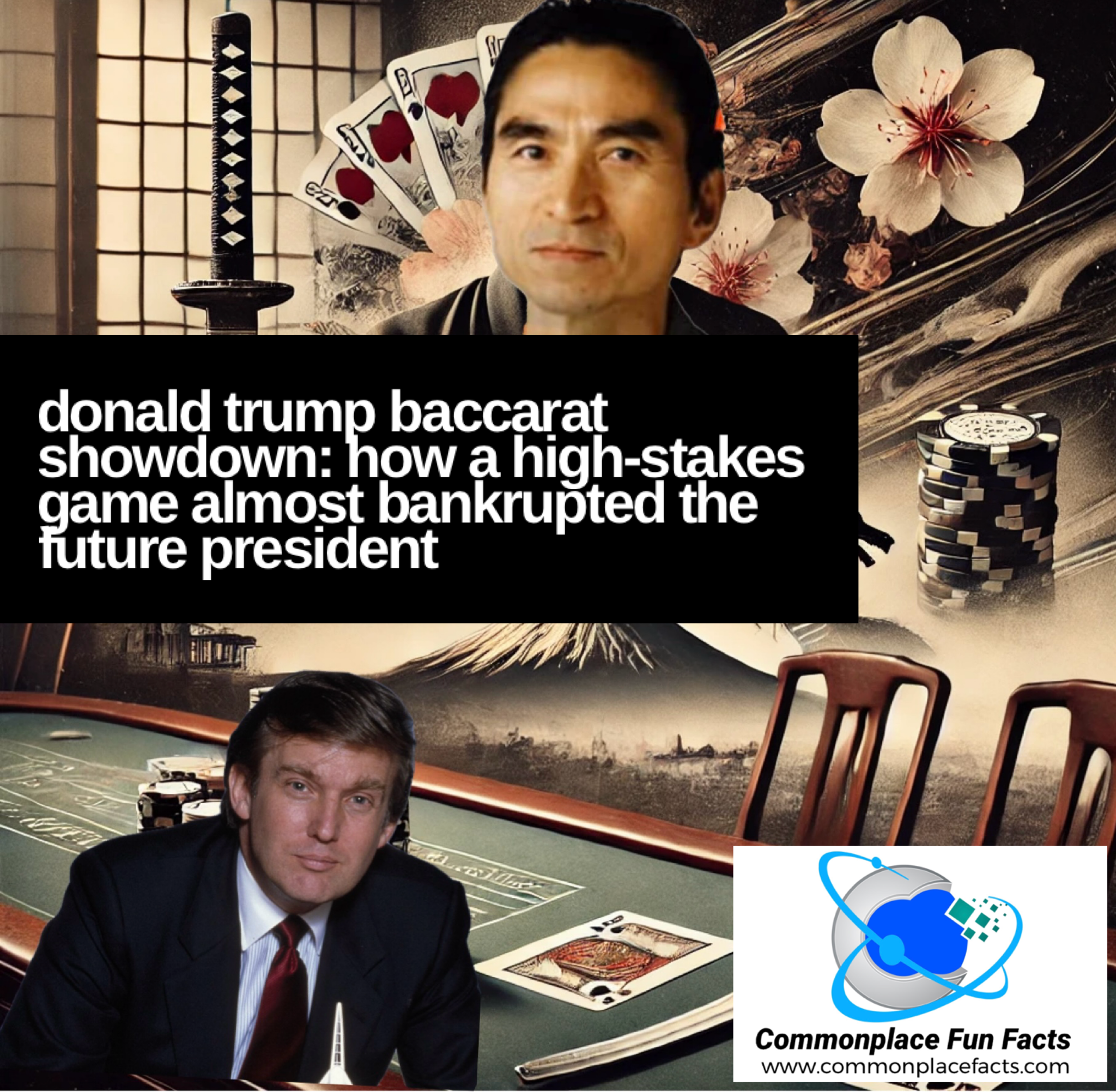

Akio Kashiwagi vs Donald Trump Baccarat Showdown
If someone pitched this as a movie script, you’d probably roll your eyes and say, “Too much, Hollywood.” It sounds like a tale that could only happen if The Godfather married The Sting and left us this story as their legacy.
At the center of it all is none other than Donald J. Trump—yes, that Donald Trump, the 45th and soon-to-be 47th President of the United States. Our story begins long before he resided at the White House, but even then, he was known for his flair, bravado, and sheer refusal to lose. Trump faced one of the most formidable gamblers the world has ever seen. The stakes? Enough to make anyone’s head spin and could have bankrupted and disrupted the political plans of The Donald.

Our other key player is Akio Kashiwagi, the Japanese multi-millionaire and baccarat prodigy. Known as “The Warrior” (or simply “Mr. K”), Kashiwagi was the kind of high-stakes gambling aficionado that casino owners dream of—or, in this case, have nightmares about. This was no ordinary card shark; Kashiwagi was a whale. Not just any whale, mind you—a blue whale, the rarest and most lucrative of them all. When Trump saw this whale, he was after him with more determination than Captain Ahab going after Moby Dick.
Like all good stories involving big egos, big money, and bigger consequences, things didn’t go quite as planned.
Contents
Courting a Whale
In the late ’80s and early ’90s, Akio Kashiwagi was making waves across the gambling world. At baccarat tables from Darwin to Las Vegas, he was either breaking the bank or walking away with fortunes. Casinos loved him and feared him in equal measure.

When Donald Trump heard about Kashiwagi, he saw not just dollar signs but headlines. Hosting someone like Kashiwagi at his Atlantic City casinos would cement his brand as a global gambling destination. Akio Kashiwagi wasn’t just another gambler; he was a spectacle, and Trump knew that better than anyone.
Thus, the wooing began. Trump offered the finest penthouse, complete with a grand piano, a personal butler, and enough jade Buddhas to start a shrine. If all of that wasn’t enough, he sweetened the pot by offering a $6 million line of credit to match Kashiwagi’s own bankroll.
Kashiwagi, a man who valued his privacy as much as his baccarat chips, landed in Atlantic City aboard Trump’s private jet. As one extra bonus, Trump greeted him with a signed copy of The Art of the Deal.
The Donald Trump Baccarat Blues
When Kashiwagi finally sat down to play, it didn’t take long for the chips—and Trump’s money—to start flowing. Within minutes, Kashiwagi had won $1 million. By the end of the first day, Trump’s casino was down $4 million.
As Trump himself later wrote in The Art of the Comeback, “What the hell am I doing? Cash flow is way down, and I’m playing with a guy who could win $40 or $50 million in a matter of days.”

By nightfall, Trump was down $4 million. He had spent the day watching Kashiwagi play $250,000 hands, at a rate of more than one a minute.
Trump wrote: “But this had nothing to do with logic or reason. I was merely sitting on the sidelines watching as one of the best gamblers in the world played against me for $250,000 per hand, seventy times an hour.”
After just two days, Kashiwagi walked away, reportedly $6 to $12 million richer. He had lived up to his reputation; the whale had swallowed the would-be whaler.
As Kashiwagi — and countless political pundits — would learn, Trump wasn’t one to take a loss lightly. He wanted a rematch, but this time, Trump came prepared with a secret weapon.
The Mathematician’s Gambit
To level the playing field, Trump enlisted Jess Marcum, a card-counting savant who claimed that if Kashiwagi stayed at the tables long enough, the odds would inevitably turn in Trump’s favor. Armed with this strategy, Trump lured Kashiwagi back to Atlantic City for another round.

Marcum is credited as the inventor of card counting. He told Trump that the secret was to keep Kashiwagi at the table. He figured that after 75 hours of playing, Kashiwagi’s odds of winning would be down to just 15%.
In May 1990, three months after his win, Kashiwagi returned to the Trump Plaza for a rematch. The agreement? Kashiwagi would play until he either doubled his $12 million bankroll or lost it all.
Over the course 7 days that included 70 hours and 5,056 hands of baccarat, Kashiwagi’s luck finally faltered. He had lost it all and then some. With Kashiwagi down $10 million, Trump abruptly ended the game, sending Kashiwagi into a rage.
Kashiwagi claimed Trump had broken their deal. The signed copy of The Art of the Deal? He vowed to burn it. If only that had been the end of the story.
A Fatal Hand in the World of High-Stakes Gambling
Kashiwagi nearly had the last laugh in his high-stakes tango with Donald Trump. Playing on credit, he left behind a check that either bounced or was canceled—no one’s entirely sure. What we do know is that Trump’s lawyers were soon threatening to sue.
Meanwhile, Trump himself was struggling to keep his Atlantic City empire afloat. By 1992, all three Trump casinos were bankrupt.
Unfortunately, Akio Kashiwagi never lived to see Trump’s Atlantic City adventure hit the rocks. His run-in with Trump marked the beginning of the end for “The Warrior.”
Find out which major business owes its existence to some high-stakes gambling.
While Kashiwagi managed to pay $6 million of the $10 million he owed Trump, he left the future president $4 million in the hole. Trump, ever the spin master, framed the debacle as a win:
“I loved our matches with him. He was a great player who loved big numbers. He made me a lot of money when money was very tight and the economy was crashing.”
Kashiwagi, however, fell victim to the gambler’s ultimate mistake: chasing a loss. After walking away from Trump’s tables, he hit Las Vegas for more high-stakes gambling, losing another $10 million, and then Europe, where he dropped an additional $5 million. His winning streak was over, and so was his business empire.
When the Japanese real estate bubble burst, Kashiwagi’s fortune crumbled with it. Suddenly, the man who once commanded baccarat tables now owned a mountain of debt, owing $131 million—more than the value of his devastated assets. The once-mighty whale went into hiding, never to be seen alive again.
Not long after their high-stakes showdown, Kashiwagi’s life took a darker turn. His gambling debts mounted, and the Japanese real estate bubble burst, leaving him with more liabilities than assets. By 1992, Kashiwagi owed a staggering $131 million and was reportedly in hiding.
On January 3, 1992, Kashiwagi’s body was discovered in his home near Mount Fuji. He had been stabbed at least 150 times in a scene straight out of a Yakuza thriller. No suspects were ever convicted, and the case of the Kashiwagi murder remains unsolved to this day.
The Moral of the Story
Akio Kashiwagi’s downfall is a cautionary tale about chasing losses. In retrospect, perhaps Kashiwagi’s relentless gambling and Trump’s refusal to back down were two sides of the same coin. For Trump, the lessons learned from this showdown would shape his approach to comebacks—whether at the baccarat table or in the political arena.
Fast forward to 2024, and Trump’s ability to turn a losing hand into a winning legacy is the stuff of legend. Akio Kashiwagi’s story may have ended tragically, but for Donald J. Trump, the game continues—always with higher stakes, bigger risks, and, of course, further refinement of the art of the deal.
You may also enjoy…

Pedestrianism: How a Lost Presidential Election Bet Created One of America’s First Sports Celebrities
A lost bet on the 1860 presidential election sent Edward Payson Weston walking from Boston to Washington—and unexpectedly made him famous. His peculiar journey helped launch a career in pedestrianism, the once-massive spectator sport in which thousands paid to watch professional walkers circle tracks for days.

Nintendo Is Older Than the Airplane—and Mario Wasn’t Even Its Strangest Idea
Nintendo is older than airplanes, sliced bread, and video games. Learn how the company began in 1889 and evolved from playing cards to Mario and the Switch.

The Bramah Challenge Lock: Britain’s Unpickable Lock Met One Stubborn American
In 1851, Alfred Charles Hobbs tackled the Bramah Challenge Lock and picked Britain’s supposedly unpickable Bramah lock.



Leave a Reply