
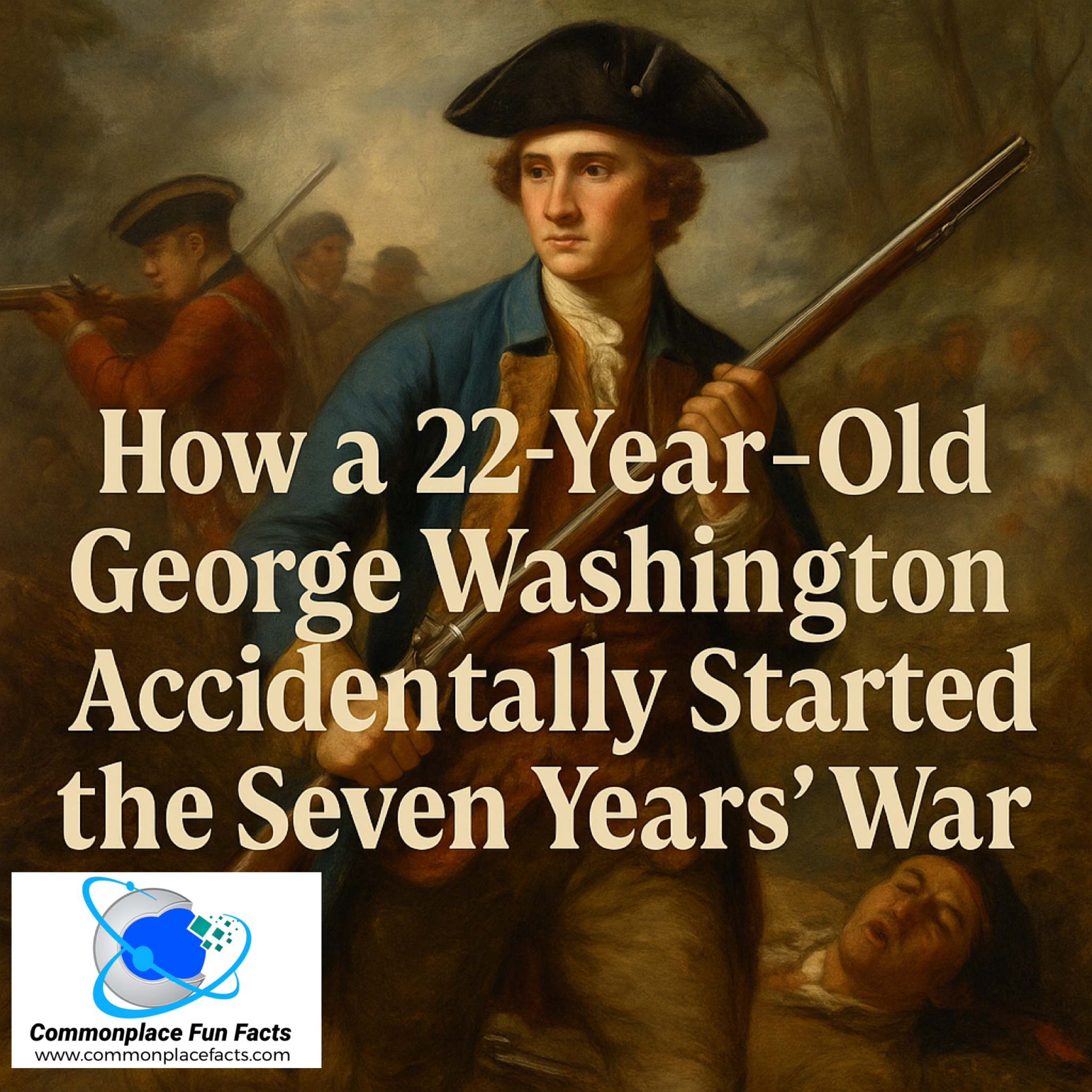

Editor’s Note: Thanks to our friends at The Hometown Herald for the article that inspired this piece. As they put it, “Before George Washington became the symbol of national unity and dignified restraint, he was an overly confident 22-year-old who kicked off a world war with a botched field assignment and some very bad French translation.” Be sure to visit The Hometown Herald for consistently outstanding information and insight about this and other notable chapters of history.
George Washington. His name alone evokes near reverence. He was the Father of His Country—a titan whose shadow spans the centuries. His wisdom and foresight created the U.S. presidency and established an unprecedented model for democracy and the peaceful transfer of power. He was the 18th century’s version of Superman — a fellow who was said to not be able to tell a lie and could throw a silver dollar across the Potomac. He had poor eyesight in later years, but in true Washingtonian style, he managed to use his glasses to save American democracy. His sole Kryptonite seems to have been poor dental hygiene—something for which he gloriously compensated with false teeth made of everything from wood to adamantium, depending on who is telling the tale.
Contents
No One Is Perfect — Not Even the Father of His Country
Despite his mythical reputation, George Washington was all too human. Before he became the marble-chiseled face of dignity, leadership, and powdered-hair gravitas, he was a 22-year-old surveyor with a musket, a map, and a knack for turning awkward encounters into international incidents.

Long before he crossed the Delaware or became the first President of the United States, he was the guy who accidentally started a global war, and he did it with a few ill-timed bullets and a spectacular misunderstanding. In so doing, he accidentally lit the fuse on what would become a global war.
It all started in 1754, when a 22-year-old Lieutenant Colonel Washington was dispatched by Virginia’s governor to deliver a sternly-worded “please vacate the premises” letter to the French, who were squatting in the Ohio River Valley. They declined, as one does when one’s empire is on the line. Washington did what any young man with a musket and a little too much enthusiasm might do: he went back with troops.
The Jumonville Incident: Diplomacy by Bayonet
On May 28, Washington and his men, along with Mingo leader Tanacharison (also known as the Half King), ambushed a French scouting party. The result: several French soldiers dead, including one Joseph Coulon de Jumonville. The French insisted Jumonville was on a diplomatic mission. Washington insisted it was a military encounter. Reality landed somewhere between awkward and incendiary. Especially when the French response involved sending troops to attack Washington’s newly constructed (and poorly located) Fort Necessity.
Washington surrendered after a day-long fight in the rain. Before leaving, he signed a surrender document. Since it was written by the French, the document was written in French. Washington, unfortunately, spoke only the King’s English and was unable to understand everything that appeared on the page above his signature. Had he been able to understand those words, he would have realized that his signature meant that he admitted to the “assassination” of Jumonville. It was the diplomatic equivalent of clicking “I agree” without reading the terms and conditions. The ramifications? It sparked the beginning of a war that would ultimately span five continents.
Incidentally, this certainly was not the only military engagement triggered by a failure to understand the language. For another example, read this article and learn how a mistranslation may have been responsible the atomic bombing of Hiroshima.
The War That Wouldn’t Stay Local
That skirmish was the first real bloodshed of what we call the French and Indian War here in North America, but what the rest of the world knows as the Seven Years’ War (1756–1763). It involved Britain, France, Spain, Austria, Prussia, and basically anyone else with a flag and a navy. It was fought in Europe, the Caribbean, West Africa, India, and across the Atlantic colonies. If you thought World War I was the first global military conflict, you were off by more than 150 years.
Britain emerged victorious, but its victory came with a cost. Yes, it gained an expanded empire, but it also picked up a breathtaking mountain of debt. And how did they decide to pay for it? By taxing the very American colonists who had helped fight the war. The names of those taxes remain some of the most-recognized tunes in the Your Hit Parade of History: the Stamp Act, the Sugar Act, the Townshend Acts, and the one that brought tea and Boston water into an unforgettable partnership—the Tea Act.
The Road from Ohio to Independence
Washington’s not-so-little incident set off a domino effect:

- France and Britain go to war around the globe.
- Britain wins but racks up debt like a college freshman with his first credit card.
- British Parliament taxes the colonies to recover costs.
- The colonies respond with protests, pamphlets, and eventually muskets of their own.
- Washington, who started the whole mess, ends up leading the rebellion.
It was the historical equivalent of a Rube Goldberg machine designed by the Three Stooges: one bonk on the head leads to a pie in the face, which somehow ends with tea in Boston Harbor.
So yes, you could say George Washington started the war that created the debt that caused the taxes that triggered the revolution he would eventually lead. That’s what we call narrative symmetry. Or possibly historical irony wearing a tricorne.
From Fort Necessity to Valley Forge

Washington’s humiliating defeat at Fort Necessity could have ended his military career before it ever began. Instead, he treated it like a master class in leadership. Over the next few years, he observed British military tactics, learned the importance of logistics (like not putting a fort in a swamp and not standing his troops in a stationary line while being shot at), and figured out how to rally men even in the most miserable conditions.
All of that came in handy when he was called upon to command the Continental Army two decades later. And he must’ve done something right, considering he went from “guy who started a war by accident” to “unanimously elected first president.” That’s a come-back story arc that would have made Rocky proud (the boxer, of course, not the flying squirrel—although, he probably would have approved, as well).
He Came. He Saw. He Accidentally Caused a Global Conflict.
George Washington’s life is often told in marble-statue terms, full of dignity, restraint, and posed horseback moments. But it’s worth remembering that he was once a young man with limited experience, big ambition, and a knack for causing massive unintended consequences. That doesn’t diminish his greatness—it makes it even more remarkable.
If anything, it’s a reminder that greatness isn’t about avoiding failure—it’s about growing from it. Washington’s early missteps didn’t disqualify him; they prepared him. He didn’t let embarrassment at Fort Necessity define his story. He learned, adapted, and came back stronger—eventually leading a fledgling nation through its own uncertain beginnings. So the next time you find yourself face-down in a metaphorical swamp of your own making, take heart. Even the most revered figures in history once had to climb out of a mess they helped create.
You may also enjoy…

The Kettle War of 1784: How One Shot Spilled More Soup Than Blood
In 1784, a conflict between the Netherlands and the Holy Roman Empire ended when a kettle of soup was spilled. Learn the fascinating history of The Kettle War.

Operation Candid: The Queen, the Cold War, and the Yacht That Could Outrun Armageddon
Learn about Operation Candid: the Cold War plan to use the royal yacht to help the Queen escape Doomsday.

Did George Washington’s Glasses Save American Democracy?
Learn how George Washington’s glasses played a key role in preventing the United States from becoming a monarchy.



Leave a Reply to The Wilderness Trap: Braddock, Washington, and the Frontier – The Hometown HeraldCancel reply