
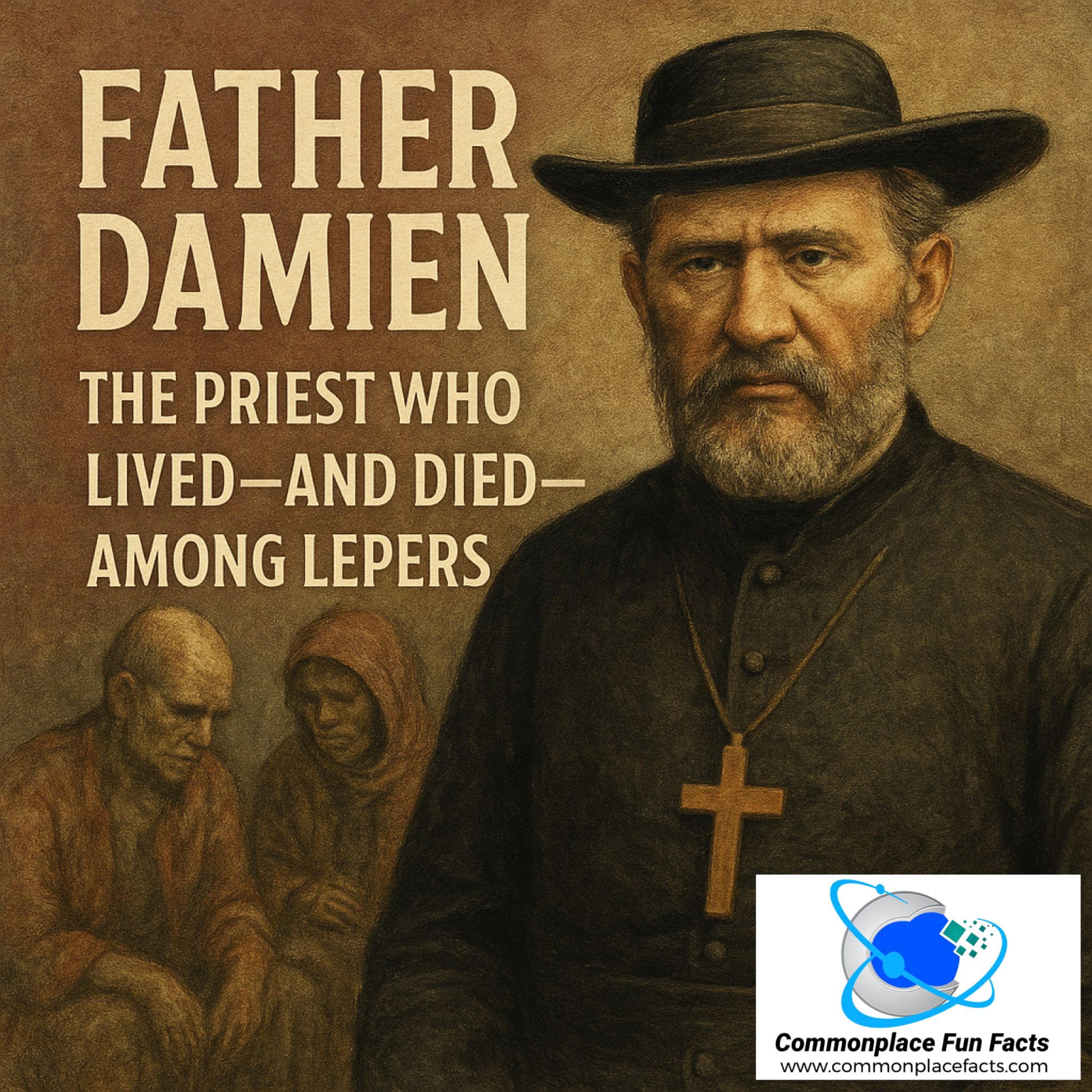

Some people take “love your neighbor” to mean a polite wave across the hedge and maybe loaning them a rake. Father Damien? He packed his bags, sailed halfway around the world, and moved in with his neighbors—who also happened to be quarantined on a volcanic peninsula with a contagious disease.
If you’re looking for someone who redefined the phrase “servant leadership,” meet Jozef De Veuster, better known as Father Damien. Born in Belgium in 1840, Damien didn’t just talk the talk—he walked the walk, built the buildings, bandaged the wounds, buried the dead, and then caught the disease everyone else was terrified of. All before turning 50. Feeling like an underachiever yet? Great. Let’s dive in.
Contents
From Belgian Farm Boy to Hawaiian Hero
Father Damien was born the youngest of seven in rural Tremelo, Belgium. He joined the Congregation of the Sacred Hearts of Jesus and Mary (which sounds like a Victorian-era band name) and took the name Damien after a 3rd-century saint known for healing. His older brother, also a priest, was supposed to head off on a mission to Hawaii, but got sick—so Damien did what all good little brothers do: he volunteered as tribute.
He arrived in the Hawaiian Kingdom in 1864 and quickly got to work ministering to the islands’ people. Just a few years later, he made a decision that would define his life—and, incidentally, earn him sainthood.
Molokai: Paradise Lost
Leprosy (or Hansen’s disease, for those keeping score at home) was wreaking havoc in Hawaii in the 19th century. The kingdom’s solution? Isolate the infected on the Kalaupapa peninsula of Molokai, a place so remote it made Gilligan’s Island look like a commuter suburb. Once sent there, patients were essentially left to fend for themselves. Supplies were spotty, homes were makeshift, and the general mood was somewhere between “hopeless” and “abandoned.”

Enter Father Damien. In 1873, he volunteered to go to Molokai. Not for a weekend mission trip. Not to drop off supplies. To live there. Permanently. With people who were contagious, disfigured, and dying. And he didn’t bring a hazmat suit. He brought a Bible, some building supplies, and a nearly supernatural level of determination.
Upon arriving, he didn’t sugarcoat things. He wrote to the Hawaiian Board of Health to report what he found—about 700 individuals, isolated not just from society but from each other, living in chaotic, unregulated conditions. “These wretches,” he wrote, “banished from society, live together, without any distinction being made regarding age or gender… They pass all their time playing cards, drinking some kind of rice beer, and giving themselves over to various excesses.”
“These wretches, banished from society, live together, without any distinction being made regarding age or gender…”
His superiors gave him strict rules: don’t touch the lepers, don’t let them touch you, and definitely don’t share a meal with them. Father Damien, however, had a different playbook—one that involved being more concerned about the approval of Jesus more than that of the health board. In a letter to his brother, he explained his approach simply: “As for me, I make myself a leper with the lepers to gain all for Christ.” He didn’t live among them as an outsider. He made himself one of them.
One Man, One Island, All the Jobs
Damien wasn’t content to just say Mass and call it a day. He built homes, dug irrigation ditches, organized schools, tended gardens, constructed coffins, dressed wounds, and probably fixed a few leaky roofs while he was at it. He also offered the sacraments—sometimes administering confession from across a ditch to avoid infecting others (social distancing, 19th-century edition).
He lived with the people, not over them. He shared meals, shook hands, and never treated anyone like outcasts. Unless you count the time he dressed down government officials for neglecting the colony. Then he treated them like outcasts.
Saintly Stubbornness: When Bullheaded Becomes Holy
If you’re looking for a poster child of holy defiance, look no further than Father Damien. The man had what we might politely call “an aggressive sense of purpose.” Others just called it bullheaded—and they weren’t exactly wrong. He clashed with superiors, squabbled with fellow priests, pushed boundaries, and occasionally treated rules as “light suggestions.” But that same unshakable resolve is what made him a legend on Molokai.

Damien wasn’t difficult for the sake of being difficult. His stubbornness was anchored in deep, unwavering fidelity to his calling: to serve the sick, the abandoned, and the outcast with everything he had—body, soul, and yes, opinionated letters to the Board of Health. He wasn’t interested in becoming a “lone hero,” and repeatedly begged for a fellow priest to serve alongside him. He wanted community, camaraderie, and, ideally, a functioning confessional. What he often got instead was conflict, suspicion, and the occasional threat involving a pistol.
Some of his fellow priests and superiors found him exasperating. He moved too fast, built too much, baptized too freely, and had the gall to think the Gospel actually required him to touch the lepers. He didn’t always ask permission, and when he did, he sometimes ignored the answer. This didn’t win him any ecclesiastical popularity contests, and it probably explains why his canonization process took so long. After all, it’s hard to rubber-stamp a saint when your old correspondence includes words like “reckless,” “insubordinate,” and “no brains.” (That last one was an actual quote from a superior. We’re guessing he didn’t get invited to the beatification ceremony.)
But behind every complaint was a man who was fiercely loyal—to his vows, to his people, and to a Gospel that didn’t always wait for bureaucratic approval. Even when slandered, blocked, and chronically under-supported, Damien stayed. When fellow priests left, he remained.
Yes, he was bullheaded. But maybe that’s exactly what holiness required on an island where everyone else had been told to give up hope. Father Damien didn’t just endure resistance—he outloved it, outworked it, and, in the end, outlasted it.
Recognition Came—But the Medal Stayed in the Drawer
Father Damien didn’t set out to become famous. He set out to help people, build some churches, and maybe avoid dying of heatstroke in a wool cassock. But as word of his work spread beyond Molokai, the world started paying attention. Even the Hawaiian royal family took notice. King David Kalākaua himself awarded Damien the title of “Knight Commander of the Royal Order of Kalākaua.” Which, let’s be honest, sounds like something from a Dungeons & Dragons campaign but is actually one of the kingdom’s highest honors.
When Crown Princess Lydia Liliʻuokalani visited the colony to present the medal in person, she was so moved—and so visibly wrecked by the suffering she saw—that she couldn’t even read her prepared remarks. Instead, she shared her heartbreak and praised Damien’s work. And just like that, this rugged Belgian priest with a hammer in one hand and a Bible in the other became a global symbol of compassion.
Protestants in the United States (yes, Protestants!) raised large sums of money to support his mission. The Church of England sent supplies—food, medicine, clothes—having reaching the shocking conclusion that the Body of Christ could extend a helping hand even across denominational lines. Damien’s work transcended the usual ecclesiastical turf wars. He was too busy saving lives to care which team got the credit.
Despite all the recognition, Damien was never seen wearing his shiny new medal. That just wasn’t his style. But when he died, they placed it beside him—because if anyone had earned a little bling, it was the man who turned an island of despair into a community of dignity.
“We Lepers…”
In December 1884, Father Damien discovered something… off. While preparing to take a bath, he stepped into scalding water and watched as his foot blistered like a baked potato—without feeling a thing. For most people, this would be a moment of concern. For Damien, it was confirmation of what he had long suspected: after eleven years of ministering to leprosy patients, he had become one himself.
Shortly thereafter, Damien began his sermon with the words: “We lepers…” After years of living among the lepers as a peer, he was literally one of them. Rather than leave, he kept working. He treated patients with even more urgency—now understanding firsthand the pain, the isolation, and the gradual decay that came with the illness.
Enter the Leprologist with a Plan (and Ointments)
In 1885, help arrived in the form of Dr. Masanao Goto, a Japanese leprologist who looked at Damien and said, in essence, “We’re not giving up yet.” Dr. Goto believed that leprosy came from a thinning of the blood, and his treatment plan was a blend of spa-day luxury and Spartan regimen: nutritious food, light exercise, vigorous friction to numb areas, medicated ointments, and therapeutic baths. It wasn’t a cure, but it gave relief—and, perhaps more importantly, hope. Damien trusted Goto so much he refused treatment from anyone else. The two became close friends, proving that sometimes the best medicine is equal parts balm and belief.
The Final Years: All Gas, No Brakes
Damien may have been falling apart physically, but spiritually and vocationally, he hit overdrive. In his final years, he poured what remained of his strength into building orphanages, completing chapels, strengthening the infrastructure of the colony, and offering comfort where others had long since given up. He wasn’t just counting his remaining days—he was wringing every ounce of good out of them.
Thankfully, reinforcements began to arrive, almost like a spiritual Avengers assemble:
- Father Louis Lambert Conrardy – A fellow Belgian priest who took over Damien’s pastoral duties.
- Joseph Dutton – A Civil War veteran and recovering alcoholic who gave up everything to serve the lepers and supervise construction projects. (Fun fact: possibly the only man in history who left behind a broken marriage for a mission to a leper colony.)
- James Sinnett – A nurse from Chicago who nursed Damien through his final illness.
- Mother Marianne Cope – A future saint and the former head of a hospital in Syracuse, NY, who organized a real working hospital on the island.

By 1889, Damien was physically wrecked. He wore a sling on one arm, bandages on his foot, and dragged his leg behind him like a ghost in a B-grade horror film. He knew the end was coming. On March 23, he was finally bedridden. On March 30, he made his general confession. On April 15 at 8:00 a.m., at the age of 49, Father Damien died of the very disease he had spent his life battling. He passed away in the arms of a community that had become his family—his “we lepers.”
The next day, the entire settlement turned out to honor him. After Mass at St. Philomena’s, the people followed his body to its resting place—beneath the same pandanus tree where Damien had first slept when he arrived on the island. Full circle. Fitting. Poetic.
Death Is Not the End—Just a Long Trip to Belgium
For 47 years, Damien rested in that soil. But in 1936, King Leopold III of Belgium asked for his body back. The Hawaiian government agreed, and Father Damien’s remains took a stately European vacation aboard the Belgian ship Mercator. He was reinterred in Leuven, near his birthplace. But Hawaii wasn’t forgotten. After Damien’s beatification in 1995, his right hand—the hand that had built homes, offered blessings, and dressed wounds—was returned to Molokai and buried in his original grave.
If anyone deserves to rest in two places at once, it’s the priest who lived—and died—so no one else had to suffer alone.
The Saint of the Forgotten

Damien’s life inspired waves of compassion worldwide. Mahatma Gandhi called him “an inspiration,” and Mother Teresa considered him a role model. The Catholic Church canonized him in 2009, naming him St. Damien of Molokai.
If you’re having a bad day and feeling as if everyone is treating you unfairly, remember Damien: the man who gave his life, his health, and ultimately his very body to make sure the forgotten weren’t forgotten. And he didn’t even post about it on social media. Legend.
Today, he’s the patron saint of leprosy patients, HIV/AIDS sufferers, and anyone who’s ever felt like an outsider. Hawaii honored him with a statue in the U.S. Capitol. Belgium declared a national day of celebration. And you? You just learned that sainthood sometimes looks like muddy boots, burned feet, and a very non-metaphorical cross to bear.
You may also enjoy…

If I’m Lying May I Be Afflicted By Beasts, Leprosy, Wretchedness, and Sea Monsters
If you have attended court proceedings or watched a televised legal drama, you are familiar with the process of swearing in a witness. Before testimony can be accepted, the individual must “solemnly swear to tell the truth, the whole truth, and nothing but the truth.” It wasn’t always quite that simple. Those who testified in…

Kalaupapa: The Last Leper Colony in the USA
Learn about Kalaupapa, the last leper colony in Hawaii.

The Real Sword in the Stone: How St. Galgano Went From Raucous Rogue to Saintly Sword Planter
Discover the true story of St. Galgano Guidotti, the knight who planted his sword in the stone as a symbol of peace and devotion. Explore his remarkable transformation, the Tuscan hermitage, and the history behind this real-life legend.





Leave a Reply to Commonplace Fun FactsCancel reply