
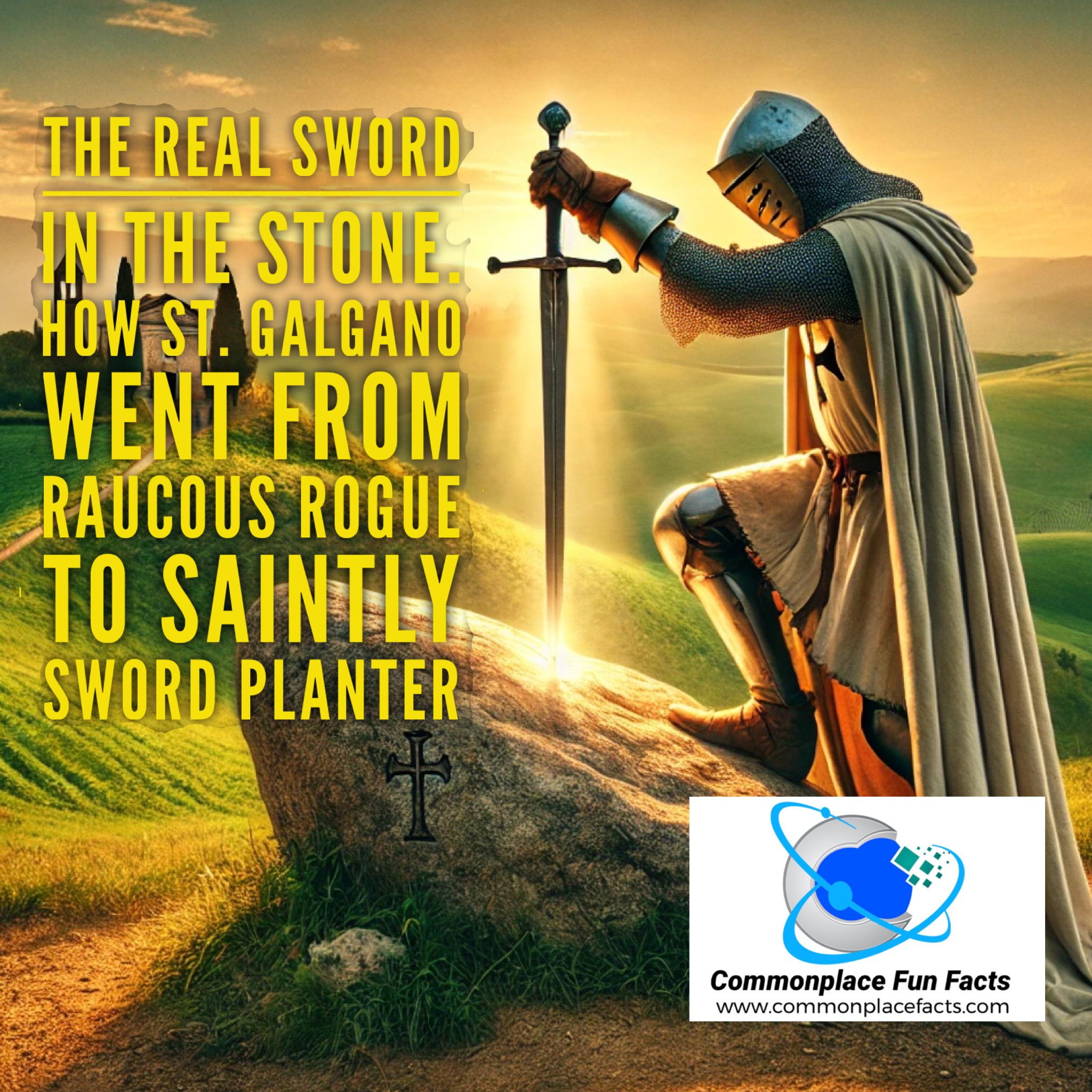

Meet Galgano Guidotti: The Real Sword in the Stone Guy
The sword in the stone. The phrase brings to mind images of King Arthur, his legendary sword Excalibur, and all kinds of mythical imagery that is the stuff of fairy tales.
While the tale of the legendary monarch pulling a sword from a stone has captivated imaginations for centuries, there’s another, lesser-known story involving a sword and a stone. This one is based not on myth, but historical fact, and it’s every bit as intriguing—minus the dragons and musical Monty Python moments. Meet St. Galgano Guidotti, a knight-turned-hermit whose life could easily inspire a cloak-and-dagger novel.
Let’s dive into the tale of Tuscany’s own “sword in the stone,” where chivalry meets mysticism and historical reality trumps Arthurian fantasy.
Table of Contents
The Wild Days of Galgano Guidotti
Born around 1148 in Chiusdino, Tuscany, Galgano Guidotti’s early years were a master class in how not to live a saintly life. Think of him as a medieval bad boy—a little wild, a little dissolute, and not exactly a paragon of virtue.
Things started to shift around his 30th birthday, after the death of his father. According to the records from his canonization and the oldest biographies, Galgano had a dream in which St. Michael the Archangel made a guest appearance. Now, as anyone who has experienced an angelic pep talk knows, these encounters tend to be life-changing. Galgano awoke with a burning desire to leave his wild ways behind.
In another dream, St. Michael went full travel agent, leading Galgano to Montesiepi, a nearby hill, where he was introduced to none other than the Twelve Apostles. They didn’t mince words: build a hermitage here, dedicate it to God, and embrace a life of solitude.
You couldn’t come up with a more radical career change if you tried.
A Horse with a Holy Sense of Direction
Like any good knight, Galgano set out to follow his calling. But first, he had a little detour—his mother, Dionysia, was busy arranging a marriage for him. On his way to meet his future bride, Galgano’s horse decided to play the part of a medieval Waze app and abruptly changed course, taking him straight to Montesiepi. Despite Galgano’s attempts to regain control of the horse and the route, his animal stopped at a precise spot and refused to budge.
Dionysia later testified to Church authorities during her son’s canonization process that this moment wasn’t just equine rebellion; it was a mystical nudge from above. Taking the hint, Galgano dismounted and did something no knight would typically consider: he took his sword, a symbol of warfare and worldly power, and plunged it into the ground. The sword sank deep, standing upright and forming the shape of the cross—a declaration of his renunciation of war and his commitment to a life of peace and spiritual devotion.

Word of this dramatic gesture spread like wildfire. Soon, pilgrims began flocking to Montesiepi, drawn by tales of the knight-turned-hermit and his extraordinary transformation. Many came seeking prayers and miracles, inspired by the profound symbolism of the sword-turned-cross.
Learn how the legend of Daniel Boone arose out of the kidnapping of his daughter
Of course, not everyone was impressed. The hermit’s fame also attracted its fair share of envy. One day, while Galgano was away, some envious people broke the sword. Galgano wasn’t one to be deterred. He planted what remained of the blade into a solid boulder, ensuring it would stay put this time. That same sword, firmly embedded in the stone, can still be seen at Montesiepi today, standing as a testament to his incredible story.
Sword Symbolism: Power vs. Peace
Now, before you start drawing too many parallels to King Arthur’s Excalibur, let’s set the record straight. Sure, both stories feature swords in stones, but the symbolism is strikingly different.
When Arthur pulled the sword from the stone, it was a sign of power and kingship. Galgano, on the other hand, planted his sword into the earth as a gesture of surrender—a knight turning from war to embrace a life of spiritual peace. One sword makes you a king; the other makes you a hermit. Choose your sword wisely.
Historical Facts vs. Pop Culture Myths
Despite the similarities, historians are quick to dismiss the idea that St. Galgano’s story inspired—or was inspired by—the Arthurian legend. The first stories of King Arthur date back to the 6th century, long before Galgano’s time. Any connection between the two is likely a product of modern pop culture (Yeah, we’re looking at you, Walt Disney).
What sets Galgano’s story apart is its historical verifiability. While Arthurian legend lives firmly in the realm of myth, St. Galgano’s life is backed by documented evidence, including testimonies from his canonization process.
A Legacy of Holiness and a Hermitage
Galgano’s life as a hermit was short but impactful. He died on December 3, 1181, less than a year after receiving approval from Pope Alexander III to establish his hermitage. His tomb quickly became a pilgrimage site, and the miracles attributed to him led to his elevation to sainthood just four years later, in 1185.
Today, the sword he planted still stands in Montesiepi, drawing thousands of visitors annually. The hermitage has expanded into a stunning religious complex, complete with a Gothic-Cistercian abbey and a church near Galgano’s birthplace. His feast day is celebrated on November 30, but locally, the big party happens on December 3—the anniversary of his death.
The Sword in the Stone You Can Actually Visit
Unlike Arthur’s Excalibur, which remains the stuff of legend, Galgano’s sword is a tangible piece of history. You can see it in Montesiepi, where it serves as a testament to one man’s radical transformation and unwavering faith. Whether you’re drawn to the legend, the history, or the stunning Tuscan scenery, it’s a story worth exploring.
So next time someone brings up King Arthur, you can wow them with a lesser-known tale that swaps knights and castles for hermits and holy hills. Because sometimes, the truth really is stranger—and more inspiring—than fiction.
You may also enjoy…

Royal Regalia and Highlander Honours
The Honours of Scotland is the name given to the crown, sceptre, and sword of the Scottish monarchy. They are the oldest set of crown jewels in the British Isles, dating back to the coronation of Mary I in 1543. The Crown of Scotland The crown is the ancient symbol of supreme authority. Scotland’s crown…

The Last Sword Duel in France Took Place in 1967
Imagine what it was like in days of yore, when a gentleman’s honor was defended with the razor-sharp steel of a sword. In those long ago days, an insulting word might very well be met with a challenge to duel to the death. Those were the days of chivalry. Those were the days of honor.…

Melting and Circulating the Saints
One of the challenges faced by Oliver Cromwell (1599-1658) during his tenure as Lord Protector of England, Scotland, and Ireland was a severe shortage of silver. Without the precious metal, the nation ran into the prospect of being unable to make coins. Cromwell ordered his advisors to scour the country, looking for any source of…




Leave a Reply