
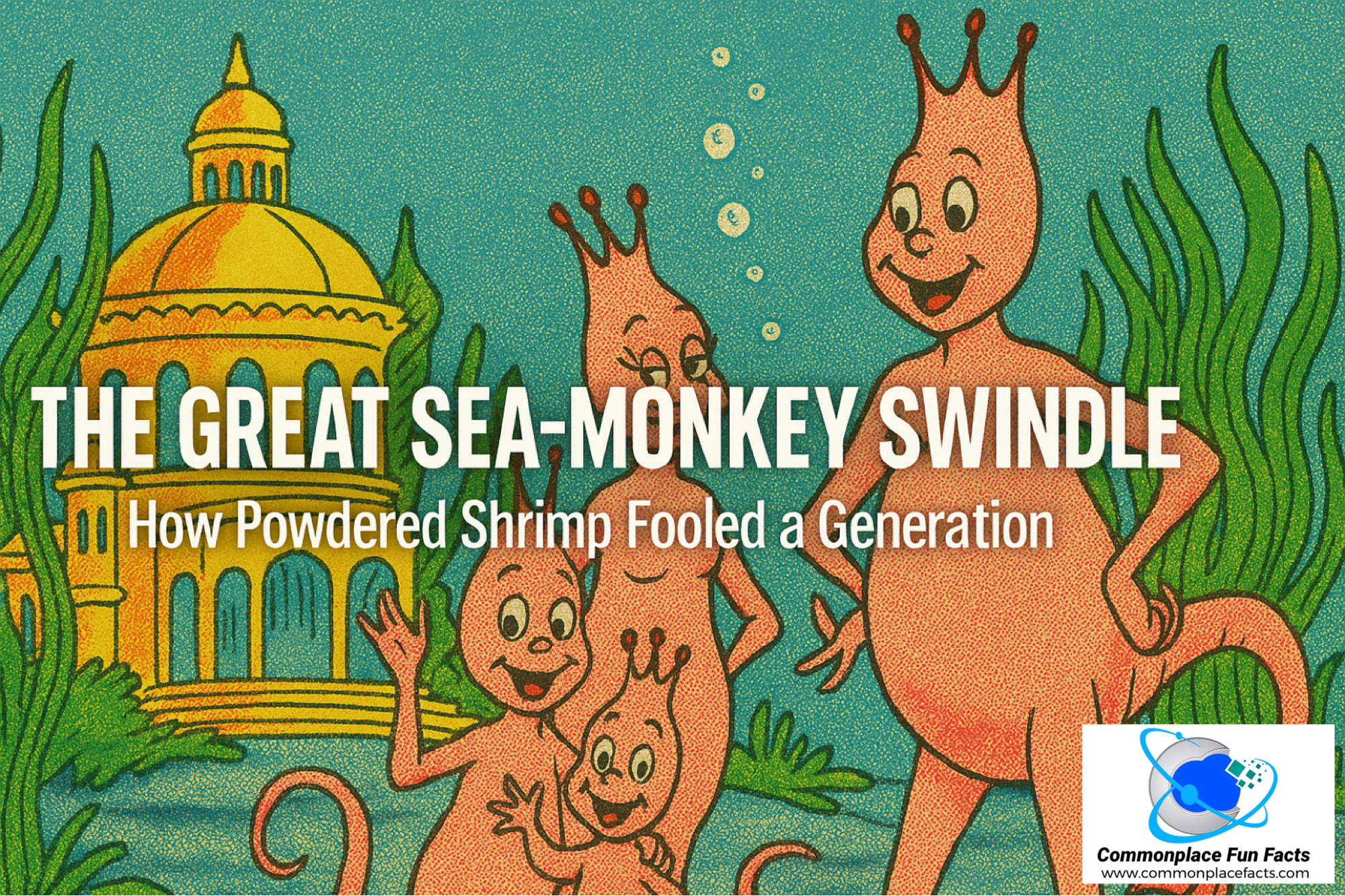

There was a time when “science” meant big things: rockets to the moon, miracle drugs, and color TV. And then there were the Sea-Monkeys — a scientific marvel you could pour out of a packet, and it could be yours for $1.25 plus postage. If you were a kid in the 1960s or 70s, their ads were impossible to resist: smiling pink creatures with crowns, living in underwater castles, practically begging to become your new best friends. Never mind that in reality, they looked more like animated dandruff than royalty. What mattered was the promise — instant life, right in your cereal bowl.
It was the golden age of mail-order dreams, when every comic book swore you could trade your allowance for X-ray vision, super strength, or a loyal crustacean colony. And presiding over this underwater empire was Harold von Braunhut, the kind of eccentric genius who could sell you both wonder and nonsense in the same breath. His story, like his shrimp, is a peculiar mix of biology, marketing, and moral murk — proof that sometimes the strangest thing about “instant life” isn’t what’s in the tank, but who’s selling it.
Contents
Sea-Monkeys and the Golden Age of Comic Book Hype
If you grew up flipping through comic books in the 1960s or 70s, you probably saw them — those irresistible, full-color ads promising an instant underwater kingdom. The kingdom’s citizens were a grinning family of pink, bubble-headed humanoids who waved waved from inside a crystal palace beneath the sea. “Own a bowlful of happiness!” they proclaimed, with the same confidence as a politician before the first scandal.

The artwork, designed by comic illustrator Joe Orlando (who later became an editor at Mad Magazine and DC Comics), was pure marketing genius. It turned shrimp into celebrities. The ads showed the Sea-Monkeys living in coral castles, playing ball, reading newspapers, and generally behaving more like suburban neighbors than aquatic invertebrates. They even had crowns. Because what’s the point of creating an underwater world without imposing monarchial absolutism?
These weren’t quiet little ads either. They were bright, loud, and strategically placed between superhero showdowns — exactly where young imaginations were already firing on all cylinders. For $1.25 (plus postage and handling, of course), you could become the proud owner of “a colony of friendly sea creatures that will come to life before your eyes!” Forget chores, homework, or the inevitable disappointments of puberty. You were about to become a god with an aquarium.
The trick worked brilliantly. Kids mailed off their allowance money, certain that a miniaturized Atlantis was en route. The ads never technically lied — the creatures did “come to life” — but the ads failed to mention that your new “pets” were barely visible without a magnifying glass. The fine print noted they were caricatures, but no child ever made it that far down the page. The Sea-Monkeys were born — not in the ocean, but in the fertile imagination of America’s postwar consumer boom. Kids squinted at cloudy tanks, as parents sighed, rolled up their sleeves, and prepared to deliver their patented “Don’t Believe Everything in Advertisements” lecture. Meanwhile, the distributor of Sea-Monkeys laughed all the way to the bank. It was the perfect storm of marketing psychology, childhood wonder, and a mild disregard for reality — which, come to think of it, describes nearly every political campaign commercial.
What They Really Are (Spoiler: Not Monkeys, Not From the Sea)
The mastermind was Harold von Braunhut, a virtuoso of the comic-book back page who also pushed marvels that mostly worked in the imagination. He launched “Instant Life” in the late 1950s, then rebranded as Sea-Monkeys. The ads promised pets that “play, train, and obey.” The illustrations showed a beaming nuclear family of bubble-headed aquanauts. The creatures themselves, when they hatched, looked like what you get if a lobster and a mosquito had a very small, very odd baby.
Sea-Monkeys are brine shrimp, usually sold as Artemia in a trademarked blend. The magic trick is cryptobiosis, a biological pause button that lets eggs survive extreme drying, heat, cold, and general disrespect from seven-year-olds. Add water and oxygen, and the eggs wake up, hatch into tiny nauplii, then molt through stages to adulthood. They breathe with feathery limbs, have a light-sensing “third eye,” and can shift color with oxygen levels. Not exactly the smiling humanoids from the ads, but undeniably odd in a “nature is a better sci-fi writer than we are” way.
How did life appear so quickly? The kit often included a “water purifier” packet and a second “egg” packet. A small portion of viable eggs in the first packet created the illusion that life bloomed the moment packet two hit the water. That little bit of stagecraft turned biology into spectacle. It was clever, theatrical, ethically gray, and wildly effective. Children believed; parents rolled their eyes; the cash register sang.
The science made the trick possible; the ads made it irresistible.
Pop Culture Cameos and the 1990s Fever Dream
Sea-Monkeys swam through late-night monologues, cartoons, and endless childhood recollections. The apex was a 1992 live-action TV show, The Amazing Live Sea-Monkeys, in which human-sized Sea-Monkeys navigated suburban life. It lasted a season, which feels merciful for everyone involved, including the props department. Still, for a product that looks like animated lint, the cultural footprint is absurdly large: a TV series, endless sitcom jokes, and more nostalgia than a cereal box prize deserves.
Why Sea-Monkeys Endure
Sea-Monkeys are still available for purchase through The Original Sea-Monkeys website. They thrive at the intersection of biology and salesmanship. They scratch the same itch as snow globes and ant farms: a small, contained world we can nudge with a spoon. Parents buy them for nostalgia. Kids buy them for the promise of creation on a school-night budget. The reality is humbler than the ads, yet the fascination lingers, because watching life rev up from a dusty pause remains astonishing, even when the life is only a few millimeters long.
That mix of hype and honest wonder is the secret sauce. A little theater, a little science, a little patience, and suddenly your desk is home to a tiny, translucent crowd doing their best impression of a traffic jam.
Fun Facts You Can Drop Into Conversation Like Fish Food
- Sea-Monkeys time-travel, sort of. Cysts can remain viable for years and wake on cue with water and oxygen.
- They change color. Higher oxygen levels can bring a pinkish hue; low oxygen trends paler.
- They sense light with an extra eye. The median eye spot helps set daily rhythms.
- There is a (semi-serious) Sea-Monkey Day. May 16 pops up in calendars and local news segments.
- They bulk up science fairs. Artemia are classic test organisms for toxicity and development studies.
- They have been to space. Eggs exposed to radiation experiments have hatched upon return.
- They are not picky about romance. Observers report, shall we say, enthusiastic social lives in healthy tanks.
Before the Shrimp Came the X-Ray Specs
Long before Harold von Braunhut sold the world on powdered shrimp, he was selling something even more audacious: X-Ray Specs. Yes, those iconic mail-order glasses that promised to let you “see through clothing, skin, and walls!” — the dream of every ten-year-old boy and the nightmare of every parent with a shred of dignity. The truth, of course, was less “mutant superpower” and more “optical illusion involving cardboard and feathers.”

Von Braunhut patented the concept in the 1950s, marketing it with the same unflinching confidence he’d later apply to Sea-Monkeys. Unlike the video camera Sony accidentally designed to see through clothing, the X-Ray Specs relied on a decidedly less sophisticated technology. The glasses contained two thin feathers pressed between layers of plastic lenses. The feathers diffracted light in just the right way to create a faint double image, tricking the wearer’s brain into thinking they could see the bones in their hand—or, if they were feeling particularly mischievous, beneath someone’s sweater. It was harmless fun, but the ads sold it with all the gravity of government technology smuggled out of Area 51.
Like the Sea-Monkeys to come, the genius wasn’t in the product — it was in the promise. The comic-book copy dripped with sensationalism: “Amaze your friends! Peer through skin and see the bones beneath!” No one expected subtlety, least of all the children mailing off $1.00 and waiting six long weeks for their first taste of “scientific wonder.” It was a masterclass in selling dreams — thin, cheap, vaguely creepy dreams, but dreams nonetheless.
The X-Ray Specs became a pop-culture staple, referenced in songs, sitcoms, and sketch comedy for decades. And while the specs didn’t actually let anyone see through anything, they revealed plenty about von Braunhut himself: a man who understood that curiosity, imagination, and gullibility were the most renewable resources on Earth. All he had to do was bottle them — or, in this case, laminate them to a pair of cardboard frames.
The Mad Genius, the Shrimp King, and His Shadow
Harold von Braunhut was the sort of man who could sell wonder in a box — or, failing that, at least convince you he could. In interviews late in life, he came across as the charming, eccentric grandfatherly type: the kind who’d corner you with a long story about “how nobody believed me!” while a cockatoo gnawed on his hearing aid wire. Born Harold Nathan Braunhut in Manhattan in 1926, he reinvented himself with a “von,” a dash of flair, and a flair for reinvention that blurred the line between invention and illusion. Like most great showmen, his life story was an ongoing sales pitch, and he was the product.

Von Braunhut’s empire of oddities began with a string of mail-order marvels that made America’s kids both thrilled and mildly disappointed. In addition to Sea-Monkeys and X-Ray Specs, his products included:
- Invisible Goldfish: imaginary fish sold with a handbook, fish food and a glass bowl, that were guaranteed to remain permanently invisible.
- The Amazing Hair-Raising Monster: a card with a printed monster that would grow “hair” (actually grass) when water was added. Basically, it was a 2-dimensional Chia Pet.
- Crazy Crabs: simply, hermit crabs in a box.
Von Braunhut’s personal history reads like a fever dream of mid-century Americana. He raced motorcycles under the name “The Green Hornet,” managed sideshow acts, dabbled in stage magic, and tinkered endlessly with “inventions,” racking up some 195 patents. Some, like his dolls’ eyes that closed when tilted, had genuine engineering merit. Others, like the Kiyoga Agent M5 — a telescoping whip he marketed as “the answer if you need a gun but can’t get a license” — veered into the absurd and occasionally illegal. When he was arrested at LaGuardia in 1979 for carrying six of the things, a courtroom demo proved that the “excruciating agony” they promised was… wildly oversold.
The Dark Side of the Shrimp King
For all the candy-colored whimsy, the story takes a darker turn. Von Braunhut’s most baffling invention wasn’t a toy at all — it was his own identity. Though born Jewish, he cultivated ties to white supremacist and neo-Nazi groups, most notoriously the Aryan Nations. Their founder, Richard Butler, called him a friend. Von Braunhut reportedly donated money to their cause and even appeared at rallies, sometimes performing symbolic acts like lighting the cross at their “whites-only” compound in Idaho. He was quoted as saying Hitler “just got bad press.” And yet, when reporters later revealed his Jewish origins — complete with documentation of his parents’ burial in a Jewish cemetery — the Aryan Nations turned a blind eye. Apparently, even extremists will make exceptions for a man with deep pockets and great shrimp sales.

It’s tempting to think that von Braunhut’s life was one long con — but that’s too simple. He was part huckster, part true believer, and entirely full-blooded in his contradictions. He sold fantasy to children and ideology to zealots, and he seemed equally at home doing both. For a man who made a living blurring the line between illusion and reality, it’s almost poetic that his final trick was convincing the world, and perhaps himself, that he could be both the creator of “a bowlful of happiness” and a willing guest at a hate rally. Salesmanship was his art form, and facts were just another prop.
Conclusion: Selling Wonder, One Packet at a Time
It’s easy to laugh at the gullibility of a generation that bought “instant life” through the mail. Yet there’s something enduringly human about the impulse that made Sea-Monkeys a hit. They were never really about shrimp — they were about the need to believe that a little packet of powder could unlock something marvelous. In that sense, Harold von Braunhut didn’t just sell toys; he sold hope, curiosity, and the illusion that the world could still surprise us for the price of $1.25 plus shipping.
That the same man could feed both childish wonder and adult hatred says something unsettling about how easily we compartmentalize our contradictions. Von Braunhut’s inventions gave the world a harmless kind of magic — and his beliefs, a far more poisonous one. Both depended on the same principle: tell people what they want to hear, and they’ll buy it. His story, equal parts carnival and cautionary tale, reminds us that wonder and delusion are often mixed from the same briny water.
So the next time you see an ad promising something incredible, remember the Sea-Monkeys — the tiny creatures that made us laugh, dream, and squint into murky water, searching for proof that magic still exists. Maybe it does, in small doses. Just be sure to read the fine print.
You may also enjoy…

Some Slick Stories Surrounding the Slinky
They say some people are like Slinky’s — they’re not really good for anything, but they bring a smile to your face when you push them down a flight of stairs. If that’s what you think, be prepared for an argument from some of the more than 300 million people who have purchased a Slinky…

The Big Flub Called Flubber
Learn about the disastrous toy Flubber that made kids sick.

The Search to Uncover the Legendary Secret Graveyard of Video Games
It was April 2014, and the excavators approached the rumored burial site with high hopes. Many expressed doubt that the place even existed. Those who were in the best position to know had publicly stated that the site was an urban legend. Despite the naysayers, there was a loyal group of true believers who were…







Leave a Reply to Monkey’s TaleCancel reply