
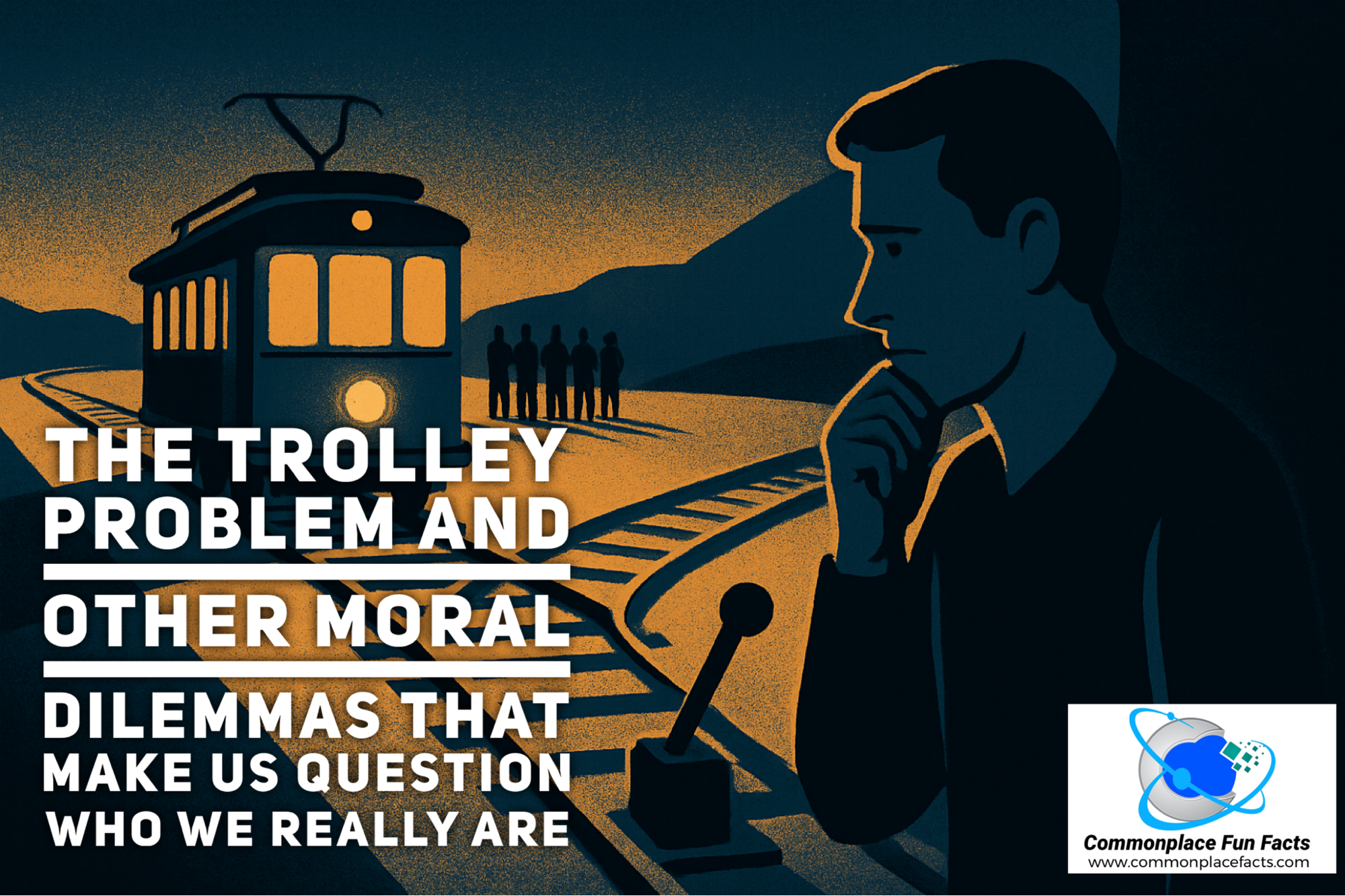

If you’ve ever stared at a multiple-choice question and thought, “I’m pretty sure the test author hates me,” congratulations. You’re emotionally prepared for the trolley problem, the world’s most famous exercise in ethical gymnastics. It’s the philosophical equivalent of someone saying, “Quick! Make a decision that determines whether you’re a good person or an absolute monster,” while giving you all the information except the parts that would actually help.
For more than fifty years, the trolley problem has become the go-to moral dilemma for professors, armchair philosophers, and aspiring supervillains who need inspiration. But the trolley’s only the beginning. Ethics has a whole theme park’s worth of uncomfortable hypotheticals, each designed to test the limits of human decency and the durability of your blood pressure.
Pull the lever. Or don’t. We’re not judging. (Just kidding; we are absolutely judging.)
Contents
The Original Trolley Problem: Your Brain’s First Stop on the Ethics Express
It is a day like any other until you find yourself in a waking nightmare. You witness a runaway trolley barreling down the tracks toward five people who, in a spectacular display of poor timing, have gathered on a section of railway currently supervised by absolutely no one. The entire traffic control system has apparently decided to take an unscheduled coffee break. You just happen to be standing beside a lever that can divert the trolley. If you pull it, the trolley will switch to the other track and will miss the five people who never learned that it is a bad idea to loiter on trolley tracks. Unfortunately, the other track isn’t vacant, either. If you pull the lever, the trolley will strike one lone soul who is obliviously standing on it.

Here is your moral dilemma: do you pull the lever and sacrifice one to save five? Or do nothing and let fate play out to do the dirty work?
Well, what would you do? Take your time—it’s not like anyone’s life is resting on your choice or anything.
Having a hard time with your options? Congratulations, you’ve just met the Trolley Problem. It presents you a couple of important ethical concepts:
- Utilitarianism: “Numbers don’t lie. Save the most people. Ignore your feelings. Also ignore how awkward Thanksgiving will be with the surviving family of that one person.”
- Deontology: “Actions matter more than outcomes. Pushing the lever makes you responsible. You don’t want that. Stick with clean, passive guilt instead.”
Admittedly, our first choice would be to yell, “Hey, there’s a trolley coming! Get your caboose off the tracks!” For some reason, this option is never given, so we’re back to deciding whether to pull the lever or leave it alone. This is where moral philosophers get that special sparkle in their eyes. They love this stuff. It’s their equivalent of a theme-park ride.
The Footbridge Variant: Ethics, But With Upper Body Strength
Just when you think you’ve made peace with your lever-pulling self, ethics cranks the difficulty up a notch.

Imagine the same trolley, same impending disaster, but you aren’t standing next to a lever that will divert the runaway vehicle. Instead, you’re on a footbridge over the track. Standing next to you is a very large individual whose mass would be more than sufficient to stop the trolley. If you act in the next few seconds, you could push that person off the bridge onto the track below. In so doing, you would stop the trolley and save the life of the five bystanders. You would also be ensuring that your heavy companion does not live to appreciate that he has played a role—albeit involuntarily—in saving five lives.
Of course, you could do nothing and just watch as five innocent people are, well… splat.
What would you do in this situation? Hurry up and decide; your overweight companion isn’t going to push himself.
Suddenly utilitarianism gets queasy. Deontologists start passing out. And everyone else wonders why philosophy can’t involve something normal for once, like ice cream.
Why We Choose Differently When It’s a Lever vs. a Push
One of the most fascinating things about the trolley problem is that, despite being a purely hypothetical scenario involving a runaway industrial vehicle and a highly questionable rail-safety department, people tend to answer it with remarkable consistency. Put a lever in front of someone and say, “Pull this to save five people, but one person will die,” and most folks reluctantly tug the lever. They don’t love it. They don’t put it on their résumé. But they’ll do it.
Yet if you take away the lever and replace it with the “footbridge variant” — the one where you must physically push a very large individual onto the tracks — the moral courage of humanity suddenly deflates like a punctured pool float. Almost everyone refuses. The number of people who will shove a stranger off a bridge for the greater good is roughly equivalent to the number of people who voluntarily read the entire terms and conditions before clicking “Accept.”
So what gives? Why does human nature happily endorse remote-controlled harm but slam on the brakes when things get hands-on?
The answer lies in the strange circuitry of our moral wiring. Pulling a lever feels indirect — like you’re adjusting the thermostat or changing TV channels, except with more screaming. It creates just enough distance that our brains can file it under “tragic but necessary.” We imagine ourselves as grim-faced train conductors making the hard call.
But pushing someone? That’s a whole different psychological category. Suddenly you’re not an observer with a decision to make — you’re the instrument of harm. Your hands, your muscles, your shove. That crosses into “personal force,” and human beings are deeply averse to being responsible for causing actual harm. We’ll tolerate abstract harm much more readily than up-close, tactile harm, even when the outcomes are identical.
Psychologists have a whole collection of fancy terms for this — action bias, omission bias, personal agency aversion — but boiled down, it’s incredibly simple: we’re built to feel worse about doing something harmful than about allowing something harmful. Even when the math is exactly the same. Even when the consequences are identical. Even when the person on the other track is giving off Big Villain Energy.
Human nature tilts toward the choice that lets us sleep at night. Pulling a lever lets us tell ourselves, “I saved five people.” Pushing a person off a bridge forces us to admit, “I killed someone,” which is far less catchy on a motivational poster. We like to imagine ourselves as heroes making tough calls — not as someone explaining to a jury why we shoved Carl to his death.
In short: people prefer moral dilemmas with ergonomic design. Give us distance, abstraction, and plausible deniability, and we’ll channel our inner utilitarian philosopher. Ask us to use our own hands, and we suddenly rediscover our deep commitment to pacifism.
Humanity: morally complicated, predictably inconsistent, and absolutely not to be trusted with access to levers or bridges.
Now that we’ve wrestled your conscience into submission with the Trolley Problem, let’s see how you hand a few other moral dilemmas:
The Transplant Problem: Doctors, Scalpel, Panic
Imagine a hospital with five patients on the brink of death, each needing a different organ. They’re hanging on by a thread, and time is running out. Now picture a perfectly healthy person strolling into the clinic for a routine checkup, whistling, blissfully unaware that he possess all five organs in mint condition.

You can see where this is going. You don’t like it. No one likes it. This is utilitarianism at its finest (or worst). Is it acceptable to forcibly take the healthy person’s organs (and life) to save the lives of five other people?
The transplant ethics dilemma takes the trolley problem and removes the convenient machinery. There’s no lever, no distance, no tidy little track diagrams. Instead, the problem places the scalpel in your hand and asks, with all the delicacy of a sledgehammer:
Is it morally acceptable to sacrifice one innocent person to save five?
If the trolley problem is philosophical discomfort, the transplant problem is full-blown ethical indigestion. It forces us to confront the raw, squishy truth about our moral instincts: we might be willing to redirect harm, but we’re far less eager to create it. Pulling a lever feels like adjusting the universe. Harvesting someone’s kidneys feels like starring in a crime documentary.
Does it change things if the unwilling donor is healthy, but not mentally competent. Perhaps he suffers from mental illness, has an abnormally low IQ, or possibly has suffered some kind of brain damage? It’s one thing if he is a voluntary organ donor, but if he hasn’t made that decision, are you prepared to be the one who decides whether someone’s life has reached the point where it’s less valuable than someone else’s?
And here’s the thing — we recoil not because the math changes (it doesn’t), but because the method changes. The cost becomes personal. Intimate. Hands-on. Suddenly it’s not about abstract ethics; it’s about you, standing in a white coat, making the kind of decision that haunts people into early retirement.
Even the most dedicated utilitarians feel their convictions wobble here. It’s one thing to save five by flipping a switch. It’s another to save five by violating someone’s autonomy, ending their life, and writing an incident report that begins with, “Well, the good news is…”
Most people reject the transplant scenario so forcefully they practically leave cartoon dust clouds behind them as they flee the thought experiment. Even philosophers — the same people who dream up this nightmare in the first place — often draw a hard line here.
Why? Because the transplant problem isn’t just about numbers. It’s about trust. It’s about the social contract that says walking into a hospital shouldn’t feel like auditioning for an involuntary organ donation program. And it’s about the creeping suspicion that if society allowed this kind of reasoning, none of us would ever get a physical again.
And yet, that very decision is at the heart of the societal and political debates about euthanasia, physician-assisted suicide, and whether government-funded health care should continue to pay for someone whose prospects for a productive life are not especially high.
The Lifeboat Problem: When “Women and Children First” Meets Spreadsheet Logic
You’re on a sinking ship. The lifeboat has room for some people, but not all. No one has told you about the Birkenhead drill where women and children get first dibs. You must decide who gets a seat and who gets to audition for Finding Nemo: Live Action.
How do you decide who gets to live and who gets to die?
Ethics classes adore this one because:
- It forces you to rank human value.
- Nobody likes ranking human value.
- No matter what you choose, someone ends up paying the price for your decision.
Utilitarianism fun and moral dilemmas for the whole family.
The Heinz Dilemma: Crime, Love, and Pharmacists You Instantly Dislike
Your spouse is dying. A drug exists that provides a guaranteed cure. The pharmacist demands a ridiculous amount of money, because a law called the Affordable Care Act shockingly doesn’t actually make health care at all affordable. You can’t afford to pay for the prescription. Is it ok to steal the medicine?
If you don’t want to steal the medicine directly, how do your ethics feel about stealing the money from your neighbor so you can afford to pay for the medicine?
This may feel like a tidy classroom hypothetical moral dilemma until you realize it sits smack in the middle of every social and political fistfight about ethics and health care. If you believe that life — especially your own and the lives of those you love — is so valuable that no obstacle should block access to treatment, you might naturally lean toward systems like universal health care, government subsidies, or some form of socialized medicine. But supporting that approach raises its own question about ethics: when you argue that everyone should have unlimited access to care funded by the public, are you effectively saying it’s acceptable to take the resources created, paid for, and provided by others, regardless of how much they personally value those resources? And if the instinctive answer is, “Well, the government pays for it,” it’s worth remembering that the government’s wallet is really a collection of your neighbors’ wallets stitched together. So the uncomfortable dilemma becomes this: is there a meaningful moral difference between taking money directly from your neighbor to pay for your treatment, and endorsing a system where the government takes that same money through taxes to accomplish the same end?
The Omelas Dilemma: Utopia, Brought to You by Existential Guilt
In Ursula K. Le Guin’s famous tale The Ones Who Walk Away From Omelas, the city of Omelas sparkles like a postcard from paradise. Happiness flows freely. Every citizen thrives. The sun always seems to hit the rooftops at just the right angle, as if the weather itself had been bribed.

There’s only one catch, and it’s a nasty one: the entire utopia depends on the ongoing misery of a single child locked in a basement. The citizens know it. They’re told about it. And yet the only options are to accept the bargain or walk away from the city entirely.
Would you stay in the perfect society? Or would you walk out, knowing your departure doesn’t actually free the child — it just keeps your own hands clean?
There is no tidy answer. That’s the point. Ethics once again taps us on the shoulder and whispers, “This is going to sting.”
But the Omelas moral dilemma isn’t just a literary exercise; it applies to real life far more than we’d like to admit. A hot political debate at the moment centers around the premise that we already live in systems where comfort, convenience, and prosperity built atop someone else’s unseen suffering. We enjoy cheap goods because someone, somewhere, worked for pennies. We scroll through endless tech products born from materials mined under grim conditions. We live in communities with hospitals, roads, schools, and services we didn’t personally build, often unaware of who sacrificed what so we could flourish.
Thinking about any of this pokes at the fragile idea that our comfort is something we’ve earned entirely on our own and not, at least in part, subsidized by invisible hardship carried by others. Just like in Omelas, our daily choices carry moral price tags we seldom notice. We buy the affordable option instead of the ethical one because it’s easier on the wallet. We support policies that help us while quietly shifting burdens onto people we’ll never meet. We look away from suffering when acknowledging it feels inconvenient or depressing. We enjoy safety, stability, and privilege built on labor, risk, or loss that took place far from our sight.
And here’s the uncomfortable truth: leaving Omelas doesn’t fix Omelas. Walking away only shields your conscience while the machine keeps running. That is exactly why Le Guin’s story lingers — it forces us to confront the chasm between thinking of ourselves as moral and actually behaving in a way that changes anything.
The dilemma presses deeper questions on us whether we like it or not. What do we owe the unseen people who make our comfort possible? At what point does benefiting from a system mean we share responsibility for its flaws? How accountable are we for suffering we didn’t personally cause but quietly profit from? And perhaps most troubling: how much injustice are we willing to tolerate as long as it keeps our own lives smooth and convenient?
It’s easy to scold the citizens of Omelas for accepting their paradise at such a cost. It’s far harder to admit that every society — including our own — has its basements. Some are economic, some historical, some institutional, and some, unsettlingly, are not metaphorical at all.
The child in the story is fictional. The basement isn’t.
Buridan’s Donkey: Netflix, but Make It Medieval
Picture a donkey standing between two identical piles of hay. Same size, same smell, same rustic charm. The poor creature stares left, then right, then left again, and — because the universe has a dark sense of humor — it can’t decide. No choice seems better than the other. And so, after dithering itself into oblivion, the donkey starves to death in the most underwhelming cautionary tale ever conceived.

Buridan’s Donkey is a little parable that has kept ethicists, philosophers, and more than a few very confused undergraduates entertained for centuries. On the surface, it’s just a donkey with decision paralysis. But underneath the hay dust, it prods at some uncomfortable truths about how we make choices when the options appear perfectly equal.
First, it pokes a stick at the idea of rationality. If a perfectly rational being has no reason to pick one option over another, then in theory, it should freeze like our medieval friend. That’s the unsettling bit: the donkey behaves exactly as pure logic dictates. Congratulations — perfect rationality just got our donkey killed.
Second, it digs into free will. If two choices are identical, what does it even mean to “choose” one? Are we really exercising freedom, or are we just flipping an internal coin and pretending it was a moral triumph?
Third — and this is where it hits modern readers right in the dignity — it highlights analysis paralysis, a phenomenon we all experience any time we open Netflix and are confronted with 400 different shows that look equally average. You scroll, you evaluate, you scroll some more, and at some point you give up and rewatch the same series for the sixth time. Buridan’s Donkey in sweatpants.
The deeper revelation? In real life, humans rarely choose based on pure rationality. We lean on emotion, impulse, habit, vibes, nostalgia, convenience, and occasionally the fact that the remote is across the room. The donkey starves because it tries to make a perfect decision. Humans rarely do that because we all apply some measure of utilitarianism into our decision-making processes — and thank heaven, because we’d all miss dinner.
In the end, Buridan’s Donkey is less about medieval farm animals and more about us: our fear of choosing wrong, our desire for the “best” option, and our unspoken hope that the universe will make choices for us so we don’t have to. It’s a reminder that overthinking is sometimes more dangerous than picking something — anything — and moving on.
Preferably before the hay goes stale.
Why Any of This Matters: Decision Paralysis, Comfortable Abstractions, and the Mess We Call Human Nature
If Buridan’s Donkey teaches us anything beyond “maybe medieval scholars should’ve taken their animals for a walk more often,” it’s that indecision isn’t harmless. It’s costly. The donkey didn’t perish because the world was cruel; he perished because he refused to choose between two equally acceptable paths. Replace the donkey with any of us and the hay with two job offers, two responsibilities, two hard truths, or two imperfect choices, and suddenly the fable stops feeling quaint and starts feeling uncomfortably autobiographical.
Then we add the trolley dilemmas to the mix — and the picture sharpens. With a lever safely at arm’s length, folks often feel confident. Heroic, even. We proclaim what must be done, bolstered by philosophical distance and a total absence of blood on our shirt sleeves. It’s easy to be righteous when all we’re really doing is choosing an option on a mental menu.
But the moment the scenario shifts — when the lever becomes a person we must physically push — our moral bravado melts like cheap chocolate on a summer day. The hypothetical becomes personal. The clean lines smudge. Suddenly we’re no longer debating abstract ethics; we’re deciding whether to use our own strength to kill someone, even if it saves others. Strangely, most of us retreat. It’s not logic that falters; it’s nerve.
And this brings us to Robert Nozick’s Experience Machine — the thought experiment that asks whether we’d happily plug into a device that offers lifelong bliss, perfectly simulated. No pain. No uncertainty. No miserable commutes or tragic footbridge decisions. Just endless, curated joy.
Nearly everyone says no. Real life, they insist, is better: messy, unpredictable, occasionally awful, but authentic. We crave meaning, they say, not comfort.
But do our reactions to the trolley problem, the footbridge variant, and the donkey’s dilemma actually support that noble claim? If we truly prefer real life, why do we behave so differently depending on how close the consequences feel? Why do we freeze when decisions become too equal? Why do we choose boldly only when we’re insulated by distance, slogans, or the comment section of a friend’s post? Why do we avoid stepping into complexity but gladly wave opinions from the bleachers?
There’s a tension there, one we don’t love admitting. We claim to want authenticity, but our behavior often screams, “Give me the illusion of moral clarity and a safe spectator seat, thanks.”
And here’s the part every one of these thought experiments hammers home:
not acting is still a choice. It carries its own consequences — often the worst ones.
In the trolley scenario, refusing to pull the lever doesn’t absolve you; it simply shifts the burden onto fate while you pretend your hands are clean. On the footbridge, stepping back is still deciding. In Nozick’s machine, unplugging means embracing uncertainty; staying plugged in means accepting illusion. And in Buridan’s field, the donkey’s “choice to wait” is the very thing that kills him.
Real life looks suspiciously similar. We stall instead of choosing, hoping the universe will make the decision for us. We sit between metaphorical haystacks — two jobs, two relationships, two responsibilities — waiting for a sign that never arrives. We treat inaction as safety when often it’s the most dangerous move we can make.
These dilemmas matter because they peel back our pretty self-portraits and show us the ethics that serve as the gears underneath. They reveal how we choose, when we freeze, what we fear, and why doing nothing feels deceptively virtuous.
And maybe that’s the real warning from these moral dilemmas — that when we refuse to choose, we are choosing. When we wait for perfect clarity, we starve in the middle of plenty. And when we tell ourselves that difficult decisions don’t count because we didn’t “really act,” philosophy gently taps us on the shoulder and says:
“Try telling that to the poor souls who just got squashed by a trolley.”
You may also enjoy…

Exploring the Monty Hall Problem: Will You Choose Door #1 or Door #2?
Should you pick Door #1 or Door #2? The Monty Hall Problem explored and explained.

Abraham Lincoln Wrestles With Dilemma of Representing a Guilty Client
Abraham Lincoln had quite a reputation as a trial lawyer. He represented many clients, including big businesses and indigent persons in both civil and criminal matters. He, like all lawyers, had to grapple with the question of whether he could represent someone he knew to be guilty. How do you defend a guilty person? Lincoln…

Einstein’s Riddle Solved: Who Owns the Fish?
Can you solve Einstein’s Riddle? Follow the 15 clues step by step to discover who owns the fish—and whether Einstein really wrote the puzzle.




Leave a Reply