

Rudolph the Red-Nosed Reindeer feels ancient. He sits on the same mental shelf as mistletoe, fruitcake (love it or quietly push it to the side), and that one ornament you inherited and are absolutely not allowed to throw away. He seems less like a character and more like a natural feature of December, as inevitable as cold weather and a sudden uptick in wrapping-paper-related injuries.
If you believe Rudolph has always been around, that’s honestly adorable. We respect that energy. We also hope Santa brings you everything you asked for this year.
The slightly less magical truth is that Rudolph is not a creature of folklore. He didn’t wander out of medieval Europe, nor was he whispered about in Scandinavian longhouses. He was invented in 1939, in Chicago, by a department store, because Christmas is expensive and management wanted something reusable.
Apologies for adding a bitter splash of reality into the eggnog, but none of this is our doing. We don’t make the news—we merely report back once history has finished rearranging the furniture.
Want to know more about the origin of the world’s most famous nighttime nasal navigator? Join us as we chart a careful course through the fog of Christmas lore.
Contents
A Reindeer Is Born in a Marketing Department
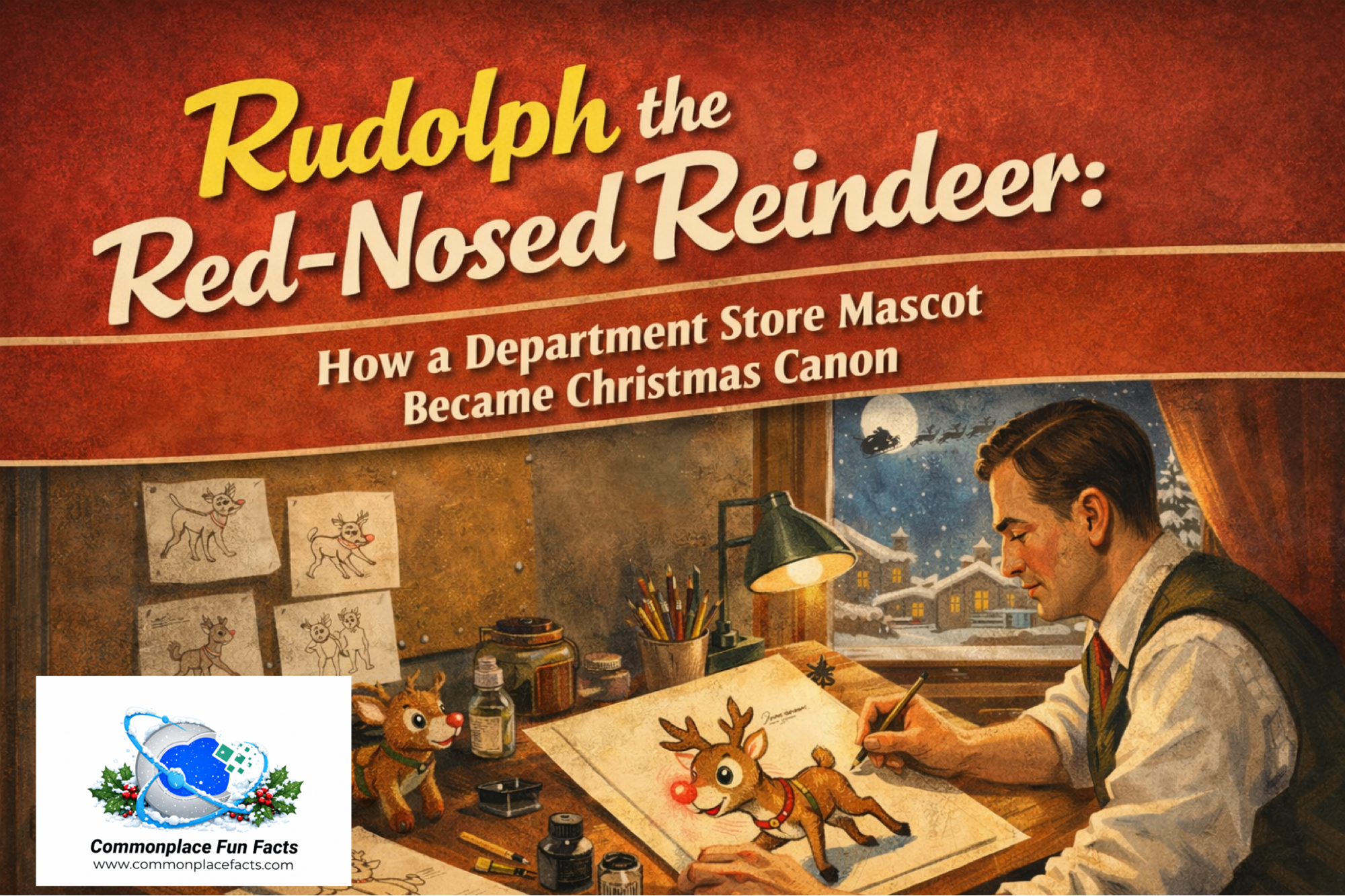
Rudolph’s origin story begins not in a magical Arctic sanctuary for four-footed, flight-certified freight haulers but in the more mundane world of a department store. Montgomery Ward spent the Great Depression doing what all retailers eventually do when money is tight: looking for cheaper ways to appear generous. For years, the store had given away store-bought toys to children at Christmas. This was nice, but also ruinously expensive if you’re trying to stay solvent during a global economic catastrophe.
The solution was a coloring book.
A single printed booklet could be produced by the hundreds of thousands, handed out for free, and taken home by children who would then associate the warm glow of Christmas with the place where their parents bought underwear. This is not cynical so much as efficient, which is completely consistent with 20th century holiday traditions.
To make this work, Montgomery Ward needed a character. Not an existing one—royalties were a thing even then—but something proprietary. Something wholesome. Something festive. Something that would not accidentally summon a German Christmas witch who punishes naughty children by slashing their bellies open.
Enter Robert L. May, a copywriter with a deadline.
Robert L. May, Deadline Warrior
The man handed this assignment was Robert L. May, a copywriter whose professional résumé up to that point consisted largely of describing men’s shirts in ways that suggested they were somehow aspirational. At thirty-five, May later admitted, he was still writing catalog copy instead of the Great American Novel, which is not how most people picture the road to Christmas immortality.

Life, meanwhile, was doing what it does best when you least have time for it. May was supporting a family, his wife was seriously ill, and medical bills were becoming an increasingly unwelcome recurring character in the household. He was not, in short, a man brimming with surplus cheer. He was a man with an assignment.
At one point, May’s boss suggested he hand the project off to someone else, given everything else going on in his life. This was a reasonable suggestion. May declined. Between office obligations and fatherhood, he wrote the story in roughly fifty hours. Apparently that’s all the time it takes to create immortality.
Montgomery Ward wanted a Christmas story. May responded by inventing a reindeer.
Not a majestic one. Not a mythic one. A reindeer who was visibly, awkwardly wrong. May didn’t reach for ancient symbolism or heroic archetypes; he reached for something much closer to home. The idea drew on his own childhood memories of being shy and perpetually out of step, combined with long afternoons at Chicago’s Lincoln Park Zoo, watching deer with his young daughter while carefully not thinking too hard about medical bills and the future in general.
The final piece fell into place one day in downtown Chicago, while May was staring out an office window and trying to imagine how a department store giveaway might pass for Christmas magic. A thick fog rolled in from Lake Michigan, swallowing the city outside. And suddenly—problem solved.
“Suddenly I had it,” May later recalled. “A nose! A bright red nose that would shine through fog like a spotlight.”
This is, it should be noted, not an anatomical feature commonly found in nature, even among flight-capable ungulates. But it was perfect for storytelling purposes. The red nose made Rudolph impossible to ignore, socially inconvenient, and immediately suspect—qualities that ensured it would be treated as a problem long before anyone thought to recognize it as an asset.
As he worked, May read the story aloud to his daughter, chapter by chapter, testing jokes, rhythms, and emotional beats on what may be the most honest editorial board imaginable. If she approved, it stayed. If not, it was revised. This is called market research, and it is still practiced today, just usually with worse results.
A Timeless Christmas Legend Is Born (And Is An Immediate Hit)
To say that May hit upon a winning idea is an understatement on the level of “the electric light might become somewhat popular someday.” Montgomery Ward printed about 2.4 million copies of the booklet that first year and gave them away to customers. Children loved it. No one involved had the slightest inkling that they had just launched one of the most enduring characters in Christmas history—or that May himself would soon leave the company to manage Rudolph full-time after the copyright was transferred to him in 1947.
It’s a fitting irony. A story created to be cheap, disposable, and seasonal turned out to be durable enough to outlast the very company that commissioned it. That’s not folklore. That’s corporate mythmaking firing far beyond its intended range.
The Weird Appeal of a Reindeer Nobody Likes
Rudolph does not arrive as a hero. He is not brave. He is not gifted. He is not secretly important in a way that will be revealed in Act Three. He is simply noticeable, and in a manner everyone else immediately agrees is unfortunate.
This turns out to be the entire appeal.
Rudolph’s problem isn’t something he needs to overcome internally. He’s not learning confidence or discovering hidden strength. His problem is external and very familiar: the group doesn’t like him. The other reindeer keep their distance. Authority figures offer no help. His father is less concerned with Rudolph’s happiness than with how all of this looks to the neighbors.
At this point, the North Pole starts to feel less like a magical wonderland and more like a high school with excellent snow removal and absolutely no tolerance for deviation.
In this version of Christmas, the gravest sin is not being cruel or unfair. It’s being different in a way that draws attention and cannot be politely ignored.
The fact that this framing stuck—unchallenged, unedited, and annually reinforced—would turn out to be remarkably durable.
The Song That Would Not Stay Put
Rudolph might have remained a charming retail footnote—one of those curiosities historians periodically dust off and gesture at—if not for music. But in 1949, a song happened, and suddenly the reindeer escaped containment.
This is the crucial upgrade. Once a character can be sung, he becomes portable. Once he can be sung by children who have no idea what a department store giveaway booklet is, he no longer belongs to the department store. He belongs to Christmas.
The transformation came courtesy of Robert May’s brother-in-law, Johnny Marks, who adapted Rudolph’s story into a song with a melody simple enough to survive caroling and lyrics sturdy enough to lodge permanently in the human brain. Gene Autry recorded it, and by Christmas week of 1949, “Rudolph the Red-Nosed Reindeer” had climbed to No. 1 on the Billboard pop singles chart.
The numbers alone are enough to make a marketing executive sit down. Autry’s recording sold 2.5 million copies in its first year. Over time, it moved roughly 25 million copies, becoming the second best-selling record of all time until the 1980s—a statistic that feels especially impressive given that it revolves entirely around a reindeer with a sinus condition.
Once Rudolph could be sung—on the radio, around pianos, by children who could not legally be trusted with scissors—he stopped being “that Montgomery Ward thing.” He became something far more durable and far more difficult to dislodge.
He became a tradition.
Television Made Rudolph Unavoidable
If the song freed Rudolph from Montgomery Ward, television finished the job and stapled him permanently to December. In 1964, producers Arthur Rankin Jr. and Jules Bass looked at the holiday schedule and decided it could use more stop-motion puppets with emotional baggage. The result was Rudolph the Red-Nosed Reindeer, a television special that debuted in early December and immediately began the slow, quiet process of becoming unavoidable.
This was not a simple retelling of the song. The special expanded Rudolph’s world considerably, adding new characters, side plots, and enough existential sadness to power a small indie film festival. We meet Hermey the elf, who dares to dream of dentistry in a toy-making economy, Yukon Cornelius, a prospector fueled entirely by optimism and bad planning, and an island full of misfit toys whose problem is not that they are broken but that no one wants them.
All of this was rendered in meticulously crafted stop-motion animation—tiny puppets filmed frame by frame—which somehow made the whole thing feel warmer and slightly more unsettling at the same time. The animation was produced overseas, the voices were recorded elsewhere, and the finished product emerged as a strangely international effort for a story that started life in a Chicago office building.
Burl Ives served as narrator, guiding viewers through the story as Sam the Snowman, a role that required him to be reassuring, folksy, and quietly unconcerned by the fact that nearly every character needed therapy. His songs, including “Silver and Gold” and “A Holly Jolly Christmas,” helped wrap the story in a sonic blanket thick enough to smooth over some fairly pointed social commentary.
The special was an immediate success, and more importantly, it never left. It aired the next year. Then the next year. And the next. Networks changed. Color television arrived. The cultural context shifted. Rudolph remained, calmly glowing through all of it. At some point, a holiday program that has aired annually since the Johnson administration stops being entertainment and starts being infrastructure.
This television version did what neither the booklet nor the song could accomplish alone: it turned Rudolph into ritual. Families didn’t just know the story; they scheduled around it. Children learned its beats by heart. Adults absorbed its aesthetic by osmosis. Arguments broke out over whether the Bumble was redeemed too easily.
By the time sequels and spin-offs arrived in the 1970s, it didn’t even matter whether they were good. The job was done. Television had taken a department store mascot and, through repetition and felt puppets, installed him firmly into Christmas canon. Not because he was ancient. Because he showed up every year, right on time, whether you asked him to or not.
Things You Didn’t Notice the First Time You Watched It
When you’re six years old, Rudolph the Red-Nosed Reindeer feels cozy. There’s snow. There’s music. Everyone is made of felt and goodwill. When you watch it again as an adult—ideally with the volume a little too low and a vague sense that something is off—you begin to notice that the North Pole has some workplace issues. Since none of us at Commonplace Fun Facts had the benefits of friends or hobbies, we had plenty of time to catalog the most egregious issues.
Let’s start with Santa Claus.
This Santa is not especially benevolent. He is not cruel, exactly, but he is unmistakably managerial. He may know who is naughty and who is nice, but he doesn’t seem to be particularly motivated to do anything about. His reaction to Rudolph’s glowing nose is not concern for a child being ostracized; it is alarm at a liability. The nose must be fixed, corrected, or concealed before it reflects poorly on the operation. This is not compassion. This is brand protection wrapped in fur trim.
And then there’s deer dear old dad.
Donner, Rudolph’s father, offers no meaningful refuge. His primary concern is not that his son is being mocked or excluded, but that other reindeer might talk. This is the emotional equivalent of telling a crying child to calm down because people are staring—a response that has never once helped anyone.
Crucially, acceptance does not come after reflection or apology. No one pauses to reconsider their behavior. No heartfelt lesson is learned about kindness. Acceptance arrives only after Rudolph’s difference becomes useful. When bad weather hits, the glowing nose is suddenly a feature rather than a flaw, and everyone adjusts their opinion accordingly.
This is not a flaw in the story. It is the story.
Congratulations, You Are Now Economically Useful
Rudolph is welcomed back not because bullying is wrong, but because exclusion turns out to be inefficient. Before his utility is revealed, difference is unacceptable. Afterward, it is celebrated with remarkable enthusiasm. No one revisits their earlier hostility. No one apologizes. They simply pivot.
The moral is not subtle. Be yourself—provided it eventually helps meet production goals. Otherwise, please consider fitting in more quietly.
The Supporting Cast Raises Additional Questions
Hermey the Elf wants to be a dentist. This desire is treated as open rebellion.
In a society apparently composed entirely of toy-makers, occupational curiosity is a fireable offense. There is no retraining, no accommodation, no gentle guidance. The solution is exile. You may pursue your dreams, but only far away, where they will not interfere with production schedules.

Hermey is labeled a misfit, though it’s unlikely this reputation stems solely from his dissatisfaction with toy manufacturing. His dental ambitions start out reasonable enough—read some books, help people—but they curdle quickly into something more unsettling.
This is where the questions quietly begin. Hermey displays an alarming supply of realistic teeth, which he inserts into dolls with great enthusiasm. These are not abstractions. These are not suggestions of teeth. These are actual teeth.
And when his moment finally arrives, it does not involve fillings, hygiene, or patient care. It involves restraining the Abominable Snowman and forcibly removing every tooth in his head. This is not dentistry. This is high-volume extraction. One does not simply wake up good at that.
The special moves on briskly after this, clearly uninterested in exploring Hermey’s apprenticeship years, which we are convinced involved methods best not examined too closely by a licensing board that clearly does not exist in the North Pole.
Yukon Cornelius wanders the North Pole obsessively searching for silver and gold, guided entirely by optimism and vibes. How he survives is never explained. Why everyone accepts this as normal is also never explained. The North Pole, after all, is completely snow and ice. There’s literally nothing but water underneath. Has no one explained this to the poor man?
The Abominable Snowman appears as a terrifying menace and is resolved by forcibly removing all of his teeth, after which he becomes docile and friendly. This is presented as character development, possibly via dentistry.
No one circles back to discuss this.
Years Pass. No One Talks About It.
Rudolph leaves the North Pole for years. He returns older, more capable, and emotionally self-sufficient—a development that raises several questions the story has no interest in answering.
His father undergoes a complete personality reversal without acknowledging his previous behavior. Santa becomes warm and approving once Rudolph’s usefulness is established. No apologies are exchanged. Closure is implied, not earned.
This, again, is consistent. The North Pole does not process its feelings. It simply moves forward, glowing noses and all.
A Tradition, Carefully Maintained
Rudolph was never folklore reclaimed by corporations. He was corporate from birth. His image and story have been carefully managed ever since, refined just enough to feel timeless without ever becoming messy.
This is why he hasn’t changed much. The glow works. The message works. The merchandise works.
And that’s fine.
A Pause for Scientific Explanations
Brief scientific aside, because someone is already asking: if you’ve ever wondered what’s actually going on with Rudolph’s nose, the leading explanation is not magic, shame, or excessive proximity to Santa’s punch bowl. The most respectable theory is vascular. Reindeer noses, according to researchers who evidently had an excellent grant proposal, are packed with an unusually dense network of blood vessels. In Rudolph’s case, an overabundance of red blood cells in a highly vascularized nasal mucosa—about 25 percent denser than a human’s—would produce a nose that is not only conspicuously red but exceptionally good at regulating heat in extreme cold. In other words, it’s less “holiday mutation” and more “excellent circulation.” Not everyone is convinced. Alternative theories have pointed to parasites, seasonal illness, or festive overindulgence, though these explanations tend to say more about the theorist than the reindeer. Still, if your job involves flying overnight through Arctic temperatures, a nose engineered like a high-performance radiator suddenly seems less embarrassing and more OSHA-compliant.
So What Are We Supposed to Do With All This?
None of this is meant to ruin Rudolph the Red-Nosed Reindeer. If anything, it explains why he’s lasted. Christmas traditions do not survive on moral clarity alone. They survive because they repeat well, sing easily, and make us feel something familiar at the exact moment the calendar demands it.
Rudolph wasn’t born of ancient folklore, and he doesn’t deliver a particularly elegant lesson. He emerged from a marketing department, picked up a deeply questionable workplace culture, and was embalmed in stop-motion felt sometime during the Johnson administration. And yet—there he is, every December, glowing obligingly on schedule.
That glow is doing a lot of work. It bridges nostalgia and convenience. It smooths over the fact that acceptance arrives late and apologies never do. It lets us root for the misfit without asking too many questions about the system that created him.
And maybe that’s why he still works. Rudolph doesn’t ask us to fix the North Pole. He just asks us to believe—briefly—that being different will eventually be rewarded, preferably before bedtime.
So yes, Rudolph was invented. He was commercial. He was carefully managed. None of that makes him less real in December. Traditions don’t need ancient roots. They need timing, repetition, and a red light bright enough to cut through fog.
His nose still does that.
And most years, that turns out to be enough.
You may also enjoy…

Unwrapping 31 Fascinating Christmas Eve Traditions Around the World
Explore festive traditions across the globe—from Australia’s BBQs to Iceland’s book-gifting. Learn how different cultures celebrate Christmas Eve with food, fun, and unique customs.

O Holy Night — Merry Christmas to All
Among the most beloved Christmas carols is “O Holy Night. It was written to commemorate the renovation of the church organ in Roquemaure, France. Town native Placide Cappeau wrote the lyrics in 1843. The music was composed by Adolphe Adam. Opera singer Emily Lauren gave the first public performance in Roquemaure in 1847. John Dwight…

Finland’s Reflecting Reindeer Plan … And How It Turned Out
Once upon a time, there was a reindeer. It was a very special reindeer because part of its body glowed brightly in the night. If it weren’t for that unnatural light source, Christmas might never happen. The glowing reindeer was the only thing that could prevent the specter of a Christmas morning with a bloody,…






Leave a Reply