
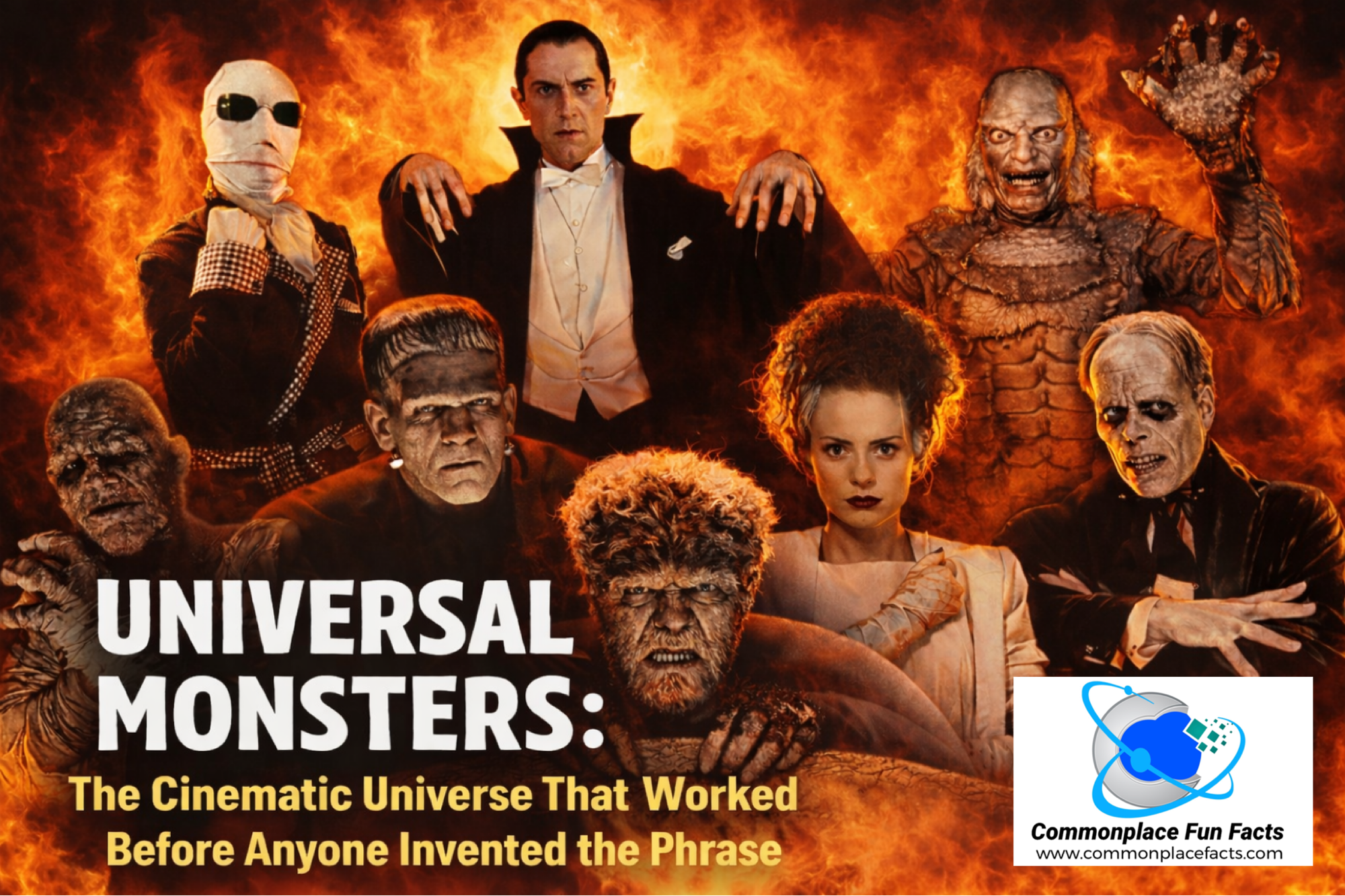

Universal Pictures did not set out to create a “cinematic universe.” The phrase did not exist yet, mostly because nobody in 1931 was doing PowerPoint presentations about “brand synergy.” People were too busy smoking indoors and treating indoor plumbing like a rumor.
Universal did set out to make movies that sold tickets. The studio discovered—more or less by accident—that audiences will happily pay to watch a tragic creature wander through fog, suffer for ninety minutes, and then get chased by a village that seems to have an unlimited torch budget. Repeat this often enough, and you do not just make a few successful pictures. You invent a visual language. You build a roster. You create a set of monsters so recognizable that they become shorthand for the entire concept of “monster movie,” the way “bandage-wrapped guy” means “mummy” even to people who have never watched a single film from the 1930s.
These are the Universal Monsters: Dracula, Frankenstein’s Monster, the Mummy, the Invisible Man, the Wolf Man, the Bride, and (arriving fashionably late) the Creature from the Black Lagoon. They are not the first screen monsters, and they are not the only great ones. They are simply the monsters who won the branding war. They became the default settings on the world’s imagination.
Table of Contents
Before Dracula: The Proto-Monsters of the Silent Era
When people talk about the “Universal Monsters,” they usually start in 1931 with Dracula and Frankenstein. That is fair. Those two films essentially launched the Golden Age of Universal horror and established the studio as the official supplier of gothic nightmares to the American public.
But Universal did not simply wake up one morning in 1931 and decide to invent horror cinema. The studio had been quietly experimenting with monstrous characters for years during the silent-film era. These earlier productions laid the creative groundwork for what would eventually become the Universal monster lineup. Think of them as the cinematic equivalent of the rehearsal dinner before the wedding where everyone starts throwing lightning around.
One of the earliest entries in this proto-monster period was a silent adaptation of Dr. Jekyll and Mr. Hyde in 1913, based on Robert Louis Stevenson’s famous novella, which was based on the real-life Deacon William Brodie (read this article to learn about that). Even at this early stage, Universal recognized something useful about horror: audiences enjoy watching respectable people transform into something alarming. This theme would later become a central ingredient in the studio’s monster formula.
The real breakthrough arrived in the 1920s with a performer who seemed almost designed for horror films: Lon Chaney. Nicknamed “The Man of a Thousand Faces,” Chaney was not just an actor but a master of self-applied makeup and physical transformation. His performances demonstrated how much atmosphere and emotional impact a “monster” could carry.

In The Hunchback of Notre Dame (1923), Chaney portrayed Quasimodo, the deformed bell-ringer of Notre Dame Cathedral. The character’s grotesque appearance made him frightening at first glance, but the story framed him as tragic and misunderstood. The film was a massive production for its time and proved that audiences would show up in large numbers for dark, gothic spectacle.
Two years later came another milestone: The Phantom of the Opera (1925). Once again, Chaney created his own makeup—this time a skull-like face so startling that early audiences reportedly gasped when it first appeared on screen. The Phantom was not merely a villain lurking beneath the Paris Opera House. Like many later Universal monsters, he was a wounded outsider whose pain drove him toward obsession and revenge.
These silent-era films established several patterns that would define Universal’s later horror classics. They drew from well-known literary works to give the films prestige, emphasized elaborate makeup and visual design, and—most importantly—treated their monsters as tragic figures rather than simple villains. Universal discovered that audiences were far more invested in a monster who could make them feel sympathy as well as fear.
By the end of the 1920s, the studio had learned two important lessons. First, gothic horror could be spectacular box-office entertainment. Second, audiences loved monsters who looked terrifying but carried a hint of sadness beneath the makeup. When sound cinema arrived, Universal was ready to push those ideas even further.
And in 1931, with the arrival of Dracula and Frankenstein, the monsters finally began speaking—and the horror genre would never sound the same again.
Dracula: The Vampire That Turned a Studio Into a Monster Factory
When Dracula arrived in 1931, it did not just introduce audiences to a famous vampire. It introduced them to a new kind of horror movie. Universal had produced dark and gothic films before, but Dracula proved that horror could be a commercial engine powerful enough to reshape an entire studio’s identity.

The film was based on the enormously successful stage adaptation of Bram Stoker’s 1897 novel. (See “Makt Myrkranna: Iceland’s Powers of Darkness That Rewrote Dracula With Nordic Weirdness” for a little-known chapter of Dracula’s history). That theatrical version had already turned the vampire into a cultural phenomenon, and one of its biggest attractions was the actor playing the Count: Bela Lugosi. Lugosi had performed the role on Broadway and touring productions hundreds of times, perfecting a performance built on deliberate pacing, hypnotic eye contact, and a thick Hungarian accent that made ordinary sentences sound vaguely threatening.
Universal originally hesitated to cast him. The studio briefly considered more established Hollywood actors, including Lon Chaney, who had been their silent-era horror superstar before his death in 1930. Lugosi was not yet a major film name, and his accent worried studio executives who were still figuring out how audiences would react to sound cinema. In the end, Lugosi secured the role largely because he had already proven he could carry the character on stage—and because he was willing to work for a relatively modest salary.
The gamble paid off immediately.
When Dracula premiered in February 1931, audiences were captivated. The film’s eerie atmosphere, shadowy castle interiors, and Lugosi’s unsettling calm created something that felt genuinely different from the crime dramas and musicals dominating early sound cinema. Viewers had seen monsters before, but they had rarely heard them speak so elegantly while planning murder.
The reception ranged from fascination to outright alarm. Some theaters reported nervous audiences who shrieked during certain scenes. Newspapers described viewers fainting or leaving the theater early—stories that may have been exaggerated for publicity but certainly helped the film’s reputation. Horror had suddenly become an event.
Financially, Dracula was exactly what Universal needed. The studio had struggled during the late silent era, and the success of the film demonstrated that horror could be both inexpensive to produce and highly profitable. Universal quickly realized that it had stumbled onto a reliable formula: take a famous monster from literature, build an atmospheric world around it, and give audiences something eerie they could not see anywhere else.
Lugosi’s performance also reshaped the cultural image of vampires almost overnight. Before 1931, vampires in fiction appeared in many forms—sometimes grotesque, sometimes animalistic. Lugosi’s Count Dracula established the template that still echoes through popular culture today: the aristocratic predator with a cape, formal mannerisms, and an unsettling ability to make danger look sophisticated.
The performance was so distinctive that it effectively became the public’s idea of what a vampire should look and sound like. Even people who have never seen the film can imitate Lugosi’s slow cadence and theatrical stare. The character became shorthand for vampirism itself.
For Bela Lugosi personally, however, the success of Dracula created a complicated legacy.
The role made him famous almost instantly. His name became permanently linked with horror, and audiences adored his portrayal of the Count. But Hollywood also developed a habit that would follow him for the rest of his career: typecasting.
Studio executives struggled to imagine Lugosi in roles that were not sinister, mysterious, or vaguely supernatural. Offers arrived for villains, mad scientists, and assorted characters who looked like they might keep bats as pets. While he continued working steadily in horror films and eventually became one of the genre’s most recognizable stars, the very performance that made him famous also limited the range of parts he was offered.
Still, the cultural impact of Dracula is difficult to overstate. The film helped establish horror as a major Hollywood genre, defined the cinematic vampire for generations, and launched a monster cycle that would dominate Universal’s output for the next two decades.
In practical terms, it also proved something important to studio executives: audiences would absolutely pay money to watch elegant monsters stalk through foggy castles while speaking in a foreign accent.
Universal would spend the next twenty years happily proving that lesson over and over again.
The Secret Second Dracula: A Night-Shift Masterpiece
Universal shot a Spanish-language version of Dracula on the same sets. The English-language crew filmed during the day, and the Spanish-language crew came in at night and used the same castle, the same staircases, the same general atmosphere of “someone should really check the basement.”
This is one of the most delightful pieces of early-Hollywood weirdness. Imagine showing up for work, finding out you are the second shift on the same film, and realizing the day crew has already used all the good candles. The Spanish version developed a reputation over time for having more dynamic staging and camera work in places. The night crew had the advantage of watching what the day crew did and deciding whether to match it or improve it, which is basically the first recorded instance of “competitive Dracula.”
Modern audiences tend to assume alternate-language versions are a minor footnote. This one is not. It is a full parallel universe, created because dubbing had not taken over and the studio wanted international markets without international hesitation.
Frankenstein: The Monster Who Became the Face of Horror
If Dracula proved that horror could fill theaters, Frankenstein proved that it could define a studio.
Released later in 1931, Universal’s Frankenstein built on the success of Dracula but pushed the genre further in almost every direction. It was louder, more dramatic, more visually striking, and far more shocking for audiences of the time. Instead of a suave aristocratic villain lurking in shadows, Frankenstein presented viewers with something raw and unsettling: a creature stitched together from corpses and brought to life by electricity.

The film was loosely inspired by Mary Shelley’s 1818 novel Frankenstein; or, The Modern Prometheus. Read this article to learn how the novel was inspired by a volcano and a year without a summer. Universal’s adaptation reshaped the story in ways that would permanently alter the public’s imagination. In the novel, the creature is articulate and philosophical. In the film, he is largely silent, physically imposing, and emotionally childlike. The transformation was deliberate. Universal was not aiming for a literary lecture. It wanted a monster audiences could instantly recognize.
Ironically, the man who had just become famous as Dracula—Bela Lugosi—was originally offered the role of the creature.
Lugosi declined.
The decision is one of the most famous “what if” moments in horror history. Lugosi reportedly disliked the idea of spending the entire film hidden beneath heavy makeup, especially for a role that required little dialogue and offered few opportunities to showcase the hypnotic presence that had made his Dracula so memorable. For an actor who had just achieved stardom through voice and mannerisms, the thought of playing a silent figure under layers of prosthetics was understandably unappealing.
The part instead went to Boris Karloff, a British actor who had spent years in Hollywood playing minor roles without attracting much attention. That changed overnight.
Karloff’s portrayal of the creature turned the character into one of the most recognizable figures in cinema history. With his heavy eyelids, stiff movements, and haunting expression of confused suffering, Karloff transformed the monster from a simple horror villain into something far more tragic.
The visual design played an enormous role in that transformation. Universal makeup artist Jack Pierce created the now-famous look: the flattened skull, the heavy brow, the sunken cheeks, and the bolts protruding from the neck. These details were originally intended to suggest surgical experimentation and electrical conduction, but they quickly became something even more powerful—an instantly recognizable symbol.
Today, when most people picture “Frankenstein,” they are actually picturing Karloff’s creature rather than the scientist from Mary Shelley’s novel. The design became so definitive that it effectively replaced the original literary description in popular culture.
The production itself required remarkable patience from its star. Karloff reportedly spent hours each day undergoing the painstaking makeup process, which involved layers of cotton, collodion, greasepaint, and carefully applied prosthetics. The costume added additional weight and restricted movement, forcing Karloff to develop the creature’s distinctive, lumbering walk simply because the boots made it difficult to move normally.
Instead of fighting these limitations, Karloff turned them into part of the performance. His creature moves slowly and awkwardly not because it is meant to be frightening, but because it is newly alive and still learning how its body works. The result is strangely sympathetic. The monster is terrifying, but he is also confused, lonely, and painfully aware that the world fears him.
Audiences responded strongly to this mixture of horror and tragedy. The film’s famous laboratory sequence—where Dr. Henry Frankenstein shouts “It’s alive!” as the creature awakens—became one of the most iconic scenes in cinema. For viewers in 1931, the moment captured both the excitement and the terror of modern science. Electricity, experimentation, and the possibility of creating life were thrilling ideas, but they also raised unsettling questions about what might happen if human ambition outran human wisdom.
The film’s darker moments also sparked controversy. One scene, in which the creature accidentally throws a young girl into a lake after innocently playing with flowers, disturbed audiences and censors alike. The moment was later trimmed in some prints because of concerns about its emotional impact. Today it is often cited as one of the most powerful examples of tragic misunderstanding in early horror cinema.
Commercially, Frankenstein was another enormous success for Universal. The film confirmed that Dracula had not been a fluke. Horror was now a reliable box-office draw, and Universal possessed a stable of monsters that audiences wanted to see again and again.
For Boris Karloff, the film was life-changing. The role transformed him from an obscure character actor into one of the most famous figures in horror cinema. Much like Lugosi with Dracula, Karloff would forever be associated with the creature he helped bring to life.
The difference was that Karloff embraced the association. Over the years he returned to the role in several sequels and remained a beloved figure in the horror genre for decades.
In hindsight, Lugosi’s decision to turn down the role helped shape the entire monster legacy of Universal. Had he accepted it, the studio’s horror lineup—and perhaps Lugosi’s own career—might have looked very different.
Instead, the refusal opened the door for Boris Karloff to create one of cinema’s most enduring icons.
And once audiences met Frankenstein’s Monster, Universal’s horror empire truly came to life.
The Mummy: Eternal Love, Ancient Curses, and the Slowest Walk in Cinema
In 1932, Universal unwrapped another cornerstone of its monster lineup with The Mummy. And unlike later versions that treat the concept like an action movie with bandages, the original film is patient, eerie, and surprisingly romantic in a deeply unhealthy way.

Boris Karloff—who had already helped immortalize Frankenstein’s Monster—stepped into the role of Imhotep, an ancient Egyptian priest resurrected after thousands of years because a modern archaeologist decided it was a good idea to read forbidden text out loud. Archaeology in early horror films operates on the principle that if something is sealed in a tomb, it is probably fine to open it immediately.
The brilliance of The Mummy is that Karloff does not spend most of the movie shuffling around wrapped in gauze. That iconic bandaged look appears briefly at the beginning. For much of the film, Imhotep moves through society in modern dress, operating with calm, hypnotic menace. This is not a rampaging monster story. It is obsession stretched across millennia.
The core idea is unsettling in the most poetic way. Imhotep is not trying to conquer the world. He is trying to reclaim a lost love. He believes a modern woman is the reincarnation of Princess Anck-su-namun and intends to resume a romance interrupted by execution three thousand years earlier. If your dating history includes “ancient curse” and “ritual sacrifice,” it may be time to reconsider your boundaries.
The film’s tone is quieter than Dracula and less explosive than Frankenstein, but its atmosphere is suffocating. Universal leaned heavily into mood: incense-like lighting, shadows, and a sense that time itself is unstable. The horror here is not just resurrection. It is fixation. The idea that love, when distorted by ego and power, becomes something predatory.
The production itself has its own legend. Karloff’s full mummy makeup reportedly required extensive preparation, especially for the early unwrapping scene. In an era before lightweight prosthetics and breathable materials, actors endured layers of plaster, cotton, and spirit gum under scorching studio lights. Cinema has always required sacrifice. In this case, occasionally literal comfort.
The Mummy also reflects a very specific moment in cultural history. The early 1930s saw intense fascination with Egypt following the discovery of Tutankhamun’s tomb in 1922. Public imagination was primed for curses, ancient secrets, and warnings about disturbing the past. Universal simply asked: “What if the curse has excellent posture and unfinished business?”
The character proved durable. Later sequels leaned harder into the lumbering, bandage-heavy incarnation most people picture. But the original remains striking because it presents the Mummy not just as a monster—but as a tragic figure consumed by devotion twisted into dominance.
In classic Universal fashion, the real horror is not that something ancient came back. It’s that it came back exactly as possessive as before.
The Invisible Man: When Horror Grins and You Suddenly Realize That’s Worse
If some Universal monsters are tragic, the Invisible Man is something else entirely: a warning label with a sense of humor.
The concept is simple and immediately horrifying. A man becomes invisible and discovers that the ability to do anything with no consequences is not a gift. It is a personality test. The results are not encouraging.
The 1935 film’s enduring appeal comes from the tone. The Invisible Man is frightening, but the story has a dark, cruel playfulness. It understands that invisibility is not just a supernatural condition. It is the fantasy of getting away with whatever you want. The movie shows what that does to a person who already has issues, and it turns out the answer is, “It gives him more issues, now with extra yelling.”
These films often work best when the monster reflects a human flaw rather than replacing it. Universal did that repeatedly, and it is why the movies feel less dated than they “should.” The anxieties are still modern. The eyebrows are not, but the anxieties are.
Bride of Frankenstein: The Sequel That Decided to Be Better Than Everything

Sequels have a reputation. The reputation is not fair in every case, but it is earned in enough cases that the world now treats sequels the way you treat a friend who says, “I have a great new business idea.” You nod politely and prepare for disappointment.
Bride of Frankenstein (1935) did not get that memo. It took the existing story and cranked up the artistry, the humor, the queasy moral questions, and the emotional punch. The Bride herself became an icon with a look that feels like science fiction and fashion and menace all at once. Her hair is not just hair. It is a lightning bolt turned into a hairstyle.
The story also has a wonderful structural audacity: it treats the monster’s desire for companionship as a central human need, not a sentimental subplot. The movie asks what happens when you build a creature, deny him community, and then act shocked when things go badly. It is an ethics lesson delivered with electric machinery.
Universal, to its credit, let its monster movies get weird and smart when it could have played it safe. This is one reason people still talk about Bride as a high point of the entire cycle.
The Wolf Man: The Monster Who Could Not Escape Himself
By the early 1940s, Universal’s horror lineup already included vampires, reanimated corpses, mummies, and invisible madmen. What the studio still lacked was a definitive cinematic werewolf. Folklore had been full of wolf-men for centuries, but Hollywood had not yet produced a version that stuck in the public imagination the way Dracula or Frankenstein’s Monster had.
That changed in December 1941 with the release of The Wolf Man.

The timing was extraordinary. The film premiered in the United States on December 9, 1941—just two days after the attack on Pearl Harbor pulled the United States into World War II. Audiences walking into theaters that week were stepping into a country that had suddenly shifted from uneasy peace to global conflict.
Strangely enough, the themes of The Wolf Man resonated with that moment. The story is not about a villain plotting evil schemes. It is about a man who discovers that something dangerous lives inside him and that he cannot fully control it. That sense of unavoidable transformation—of ordinary life suddenly turning into something darker—had a haunting parallel in a world that had just entered wartime.
The film introduced audiences to Larry Talbot, played by Lon Chaney Jr. Talbot returns to his ancestral home in Wales after years away, hoping to reconnect with his father and perhaps rebuild a life that has drifted off course. Instead, he encounters a traveling fortune teller, a wolf attack, and a curse that will transform him into a killer under the full moon.
The role made Lon Chaney Jr. one of Universal’s most recognizable horror stars, but his casting carried an extra layer of historical significance. His father, Lon Chaney Sr., had been Universal’s great silent-era master of monstrous transformation. The elder Chaney’s performances in films like The Hunchback of Notre Dame and The Phantom of the Opera had essentially established the studio’s early reputation for gothic spectacle.
In other words, the son who became the Wolf Man was stepping directly into the shadow of the man who had helped invent Universal horror.
Lon Chaney Jr. did not share his father’s reputation as a makeup innovator, but he brought something equally important to the role: emotional vulnerability. Larry Talbot is not arrogant or sinister. He is painfully aware that he is losing control of himself, and the film emphasizes the tragedy of that realization.
The result is one of the most sympathetic monsters in Universal’s entire lineup. Dracula chooses his predation. Frankenstein’s Monster struggles with abandonment. But the Wolf Man suffers from something closer to a supernatural illness. Talbot knows what he becomes, and he fears it long before anyone else does.
The film also introduced one of the most famous pieces of werewolf folklore in cinema:
“Even a man who is pure in heart
And says his prayers by night
May become a wolf when the wolfsbane blooms
And the autumn moon is bright.”
That poetic warning, repeated throughout the film, helped solidify many elements of the werewolf mythology that audiences still recognize today. Silver bullets, wolfsbane, and the idea of the full moon as the trigger for transformation all became closely associated with the cinematic werewolf after Universal’s version took hold.
The transformation scenes themselves were technical marvels for their time. Instead of using animation or sudden cuts, the filmmakers relied on a painstaking technique involving incremental makeup changes photographed one frame at a time. Actor Lon Chaney Jr. would remain perfectly still while additional layers of hair and makeup were applied between exposures. When the footage was played back at normal speed, the effect created the illusion that the wolfish features were slowly emerging from beneath the skin.
Makeup artist Jack Pierce once again played a crucial role in shaping the monster’s appearance. His design emphasized heavy brows, thick facial hair, and animalistic features that made the Wolf Man recognizable while still leaving enough of Chaney’s face visible to convey emotion. Unlike the Frankenstein Monster’s rigid mask-like design, the Wolf Man needed to look both human and beastly at the same time.
Audiences responded strongly. The Wolf Man became a major success and turned Larry Talbot into one of the most enduring characters in the Universal monster cycle. Chaney would reprise the role several times, including in crossover films such as Frankenstein Meets the Wolf Man and House of Frankenstein.
Those sequels helped cement the Wolf Man as a permanent member of Universal’s monster ensemble, but the original film remains the most powerful. Its story is intimate, tragic, and unsettling in a way that still resonates decades later.
After all, many monsters threaten humanity from the outside.
The Wolf Man reminds us that sometimes the monster is already inside the house.
The Makeup Wars: How Monsters Were Built in an Era Before Anyone Could “Fix It in Post”
It is impossible to talk about the Universal Monsters without talking about the craft that made them believable. These designs were not just costumes. They were engineering problems. Makeup artists had to create faces that read on black-and-white film, under hot lights, and from a distance, while still allowing actors to perform.
Jack Pierce—Universal’s legendary makeup artist—became one of the key architects of the monster look. The Frankenstein Monster and the Wolf Man are not just performances. They are collaborations between an actor’s physical choices and a makeup process that could take hours. Some of it was notoriously uncomfortable. The result, unfortunately for the actors and fortunately for cinema history, was immortality.
Modern viewers sometimes assume these looks were easy because they are familiar. Familiarity makes genius look inevitable. It was not inevitable. It was invented, piece by piece, in a studio chair, while someone tried not to blink for longer than most of us can maintain a New Year’s resolution.
Monster Mash: Universal Invents the Crossover Because It Already Owned the Costumes

Universal did not just make standalone monster movies. It also created the early template for a shared monster world, partly because it made financial sense and partly because the studio realized audiences enjoyed watching these characters collide.
This is how you get films like Frankenstein Meets the Wolf Man and the various “House of” entries where the monsters begin stacking up like guests at a very haunted dinner party. The logic is not always airtight. The continuity sometimes looks like it was assembled in the same laboratory as Frankenstein’s Monster. None of this mattered, because the audience came for the spectacle of seeing iconic creatures share the screen.
The purest expression of this crossover era might be Abbott and Costello Meet Frankenstein, which sounds like a joke until you realize it is a cultural milestone. Universal’s monsters were popular enough, and flexible enough, to enter comedy without losing their identity. Dracula still feels like Dracula. The Wolf Man still feels like the Wolf Man. Abbott and Costello feel like two men who wandered into the wrong movie, which is the point.
When monsters can survive comedy, they have become icons. The studio had essentially moved from “scary character” to “mythic figure.” That is a different category of fame.
Creature from the Black Lagoon: The Last New Classic Monster and the One That Feels Like a Dream
By the 1950s, horror was shifting. Science fiction was surging. Atomic anxieties were everywhere. Universal’s classic cycle had already produced sequels, crossovers, and enough villagers to populate a small nation.

Creature from the Black Lagoon (1954) arrived and still felt fresh. The Gill-man is a monster with a striking, elegant design—part prehistoric, part humanoid, part nightmare you remember in detail for no reason. The underwater sequences gave the film a hypnotic quality. The Creature does not just attack. He glides. He watches. He becomes an element of the environment, like the lagoon itself decided to develop an opinion about humans.
Behind the scenes, the Creature required specialized performance work. Underwater movement is not simply “swim around.” It is choreography in slow motion, under pressure, with a suit that was not designed for comfort. The production used different performers for different conditions, which is the kind of practical solution that classic Hollywood quietly excelled at. No one put it in a press release. Everyone just did what worked.
The Creature also carries that familiar Universal theme: the monster is terrifying, and the monster is also lonely. He is not simply evil. He is an outsider in his own habitat, reacting to intrusion. That ambiguity makes the story linger.
The Universal Formula: Fog, Faces, and Feelings
Universal’s classic monsters endure because they are built from a few repeatable ingredients:
Iconic silhouettes. You can recognize them instantly. The cape. The flat head. The bandages. The wolfish brow. The gills and the fins. These designs are so clean they could be sketched on a napkin and still work.
Atmosphere. Universal knew how to build a world that felt haunted even when nothing supernatural was happening. Gothic sets, shadowy corridors, stormy nights, laboratories full of questionable ethics—these were not just backgrounds. They were mood.
Sympathy. Universal monsters are often victims first and threats second. The tragedy is not an add-on. It is the core emotion. Even Dracula, who is more predator than victim, carries a sense of ancient loneliness because immortality has the vibe of a punishment once you have watched enough humans die.
Practical craft. These movies were made with makeup, lighting, editing, and effects tricks that required ingenuity instead of rendering farms. The limitations shaped the style. The style became the legend.
The Credit Politics of Monsters: Who Gets to Be Remembered?
The Universal monster legacy is not only about actors and directors. It is also about designers, makeup artists, and craftspeople whose names were not always treated with the same reverence as the stars on the poster.
One of the most discussed examples involves the design work behind the Creature and the complicated question of who received credit at the time versus who has been recognized later. Hollywood has a long tradition of being selective about whose contributions become public history, especially when the contributor does not fit the era’s preferred image of “genius.”

Monster-making is collaborative art. The finished icon is often the result of many hands. The history of these films is richer—and sometimes messier—once you look at the people behind the latex and the lighting.
Why These Monsters Refuse to Stay Dead
Universal’s classic monsters endure for the same reason myths endure: they are simple enough to recognize instantly and deep enough to reinterpret forever.
Dracula is desire and predation with a velvet collar. Frankenstein’s Monster is abandonment and rage with bolts. The Mummy is obsession wrapped in bandages. The Invisible Man is power without accountability. The Wolf Man is the fear that you cannot control what you become. The Creature is the outsider staring back from the water.
Those are not old fears. Those are permanent fears. The sets and the fashions date the films, but the emotional engines do not. That is why these characters keep returning in reboots, homages, merchandise, costumes, theme park attractions, and the general background radiation of pop culture.
Universal did not just create monsters. Universal created templates—faces and stories that became the baseline for how modern audiences picture the supernatural. The studio’s monsters are not relics. They are the architecture of horror.
Also, the studio created a business model in which a cape, a laboratory, and some fog can remain profitable long after everyone involved has turned to dust. That is not just cinema. That is alchemy.
Some people chase immortality through fame. Universal achieved it by identifying the monsters all of us know personally.
You may also enjoy…

Scams, Shag Carpets, and Sci-Fi: The Shady Secrets Behind “The Creeping Terror”
The Creeping Terror, a 1964 sci-fi horror film, defied traditional cinema standards with its comically atrocious alien monster made from shaggy rugs, created by inexperienced director and actor Vic Savage. Despite financial troubles and lack of editing, the film gained a cult following for its “so-bad-it’s-good” charm, solidifying its place in cinematic history.

Makt Myrkranna: Iceland’s Powers of Darkness That Rewrote Dracula With Nordic Weirdness
Discover the bizarre tale of Makt Myrkranna, Iceland’s mysterious “translation” of Dracula that rewrites the classic with political intrigue, erotic tension, and a whole lot of vampire weirdness.

The Six Million Dollar Mummy: The True Story Behind Hollywood’s Gruesome Prop
Discover the shocking true story behind The Six Million Dollar Mummy — a Hollywood prop that turned out to be a real mummified body with a bizarre criminal past.




Leave a Reply to Commonplace Fun FactsCancel reply