

Students of history may notice that Commonplace Fun Facts has developed a modest specialty in wars that sound less like geopolitical crises and more like items on a grocery list. Readers may recall the Egg War, in which armed men in San Francisco found themselves battling over seabird eggs, and the Flour War, which proved that bread ingredients can occasionally provoke revolutionary enthusiasm.
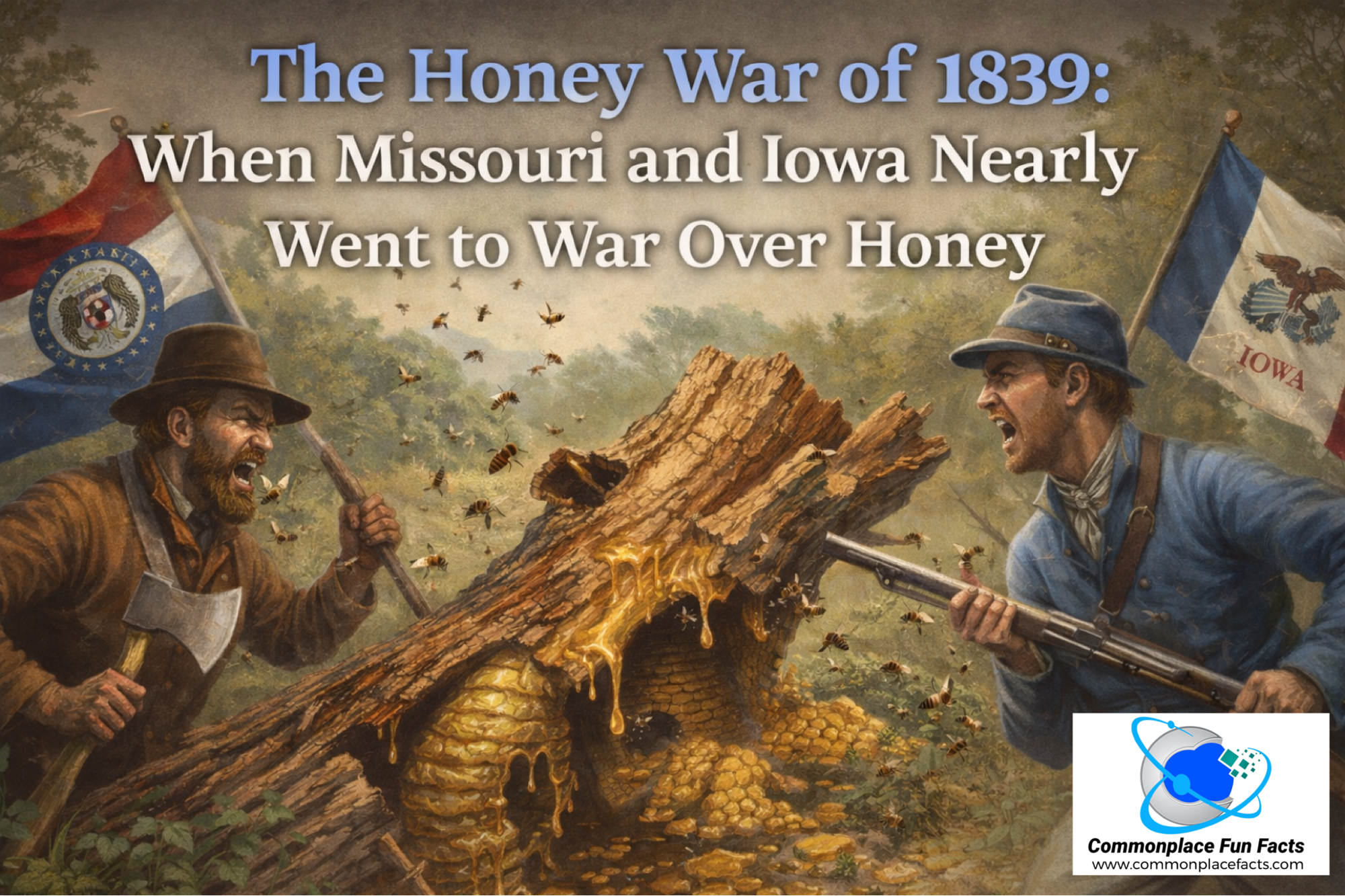
Adding to that distinguished culinary tradition is another conflict that sounds suspiciously like a pantry inventory gone wrong: the Honey War. In 1839, Missouri and the Iowa Territory managed to mobilize militias, arrest officials, and threaten armed confrontation over a disputed border and several unfortunate trees full of bees.
Despite the whimsical name, the Honey War involved genuine political tension, armed militias, and enough frontier stubbornness to power a dozen Western movies. The fact that no one was killed was largely due to the rare, distinctly Great Plains approach to life known as “everyone eventually realizing how ridiculous the situation had become.”
Contents
How a Surveying Problem Turned into a Border Crisis
The roots of the Honey War go back to one of the great villains of early American geography: vague descriptions.
Just as in the Toledo War, where Ohio and Michigan nearly came to blows over a strip of land that most maps had trouble noticing, the Honey War’s origins come out of ambiguous lines on a map.
When Missouri became a state in 1821, its northern boundary was described using language that seemed perfectly reasonable at the time but later proved to be about as precise as saying, “Somewhere over there near the river.”
The northern Missouri border was defined as running east from the “rapids of the Des Moines River.” That sounds clear enough until one remembers that the Des Moines River is hundreds of miles long and contains an alarming number of places that might plausibly be described as “rapids.”
To make matters worse, the line had originally been surveyed in 1816 by surveyor John C. Sullivan. His line—known ever since as the Sullivan Line—marked the boundary between Native American lands and what would later become Missouri.
The problem was that Sullivan was surveying frontier wilderness using early nineteenth-century equipment. Magnetic readings were imperfect. Terrain was difficult. Trees were plentiful, but convenient landmarks were not.
Under the circumstances, the fact that he managed to draw a line at all was impressive.
Unfortunately, several decades later, Missouri decided that Sullivan’s line might not be correct.
Missouri Decides the Border Is in the Wrong Place
In the 1830s, Missouri officials commissioned a new survey. This time the work fell to surveyor Joseph C. Brown, who examined the old line and concluded that it was—how shall we put this delicately—wrong.
Brown’s interpretation placed Missouri’s northern border (and, by definition, the southern Iowa border) roughly nine miles farther north than the Sullivan Line.
Nine miles may not sound like much until one realizes that the disputed strip ran across the entire width of the border. Suddenly thousands of acres of land—and the people living on it—were being claimed by a different government.
Missouri took the perfectly reasonable position that the new survey was correct.
Iowa settlers took the equally reasonable position that Missouri could go pound sand.

Taxes: The Spark That Started the Honey War
The dispute might have remained an academic argument between surveyors if Missouri had not attempted to collect taxes in the disputed territory.
This is a move that governments throughout history have discovered tends to provoke strong reactions.
In 1839, Missouri officials sent a sheriff named Uriah “Sandy” Gregory into the disputed area to assess property taxes.
The settlers living there—who believed they were residents of the Iowa Territory—responded by politely explaining that they had no intention whatsoever of paying taxes to Missouri.
Negotiations were brief.
The sheriff was chased out of the region by angry locals, and Iowa authorities promptly arrested him when he attempted to return.
Diplomatic relations between Missouri and Iowa deteriorated rapidly from there.
The Honey That Named the War
The strange name of the conflict came from an incident that occurred during this escalating dispute.

Missouri officials reportedly cut down several trees containing wild bee hives in the disputed territory.
Wild honey was a valuable commodity on the frontier. Before refined sugar became widely available, honey served as a major sweetener.
Destroying trees full of bees was therefore not merely vandalism. It was the nineteenth-century equivalent of smashing someone’s refrigerator and pouring maple syrup into the carpet.
The incident quickly became a symbol of Missouri’s intrusion into the territory.
Locals began referring to the whole affair as the Honey War.
The name stuck.
Incidentally, this would not be the last time a tree became the rallying symbol for a potential military conflict. For a twentieth-century example, see The Panmunjom Axe Murder Incident (1976): The Tree That Nearly Started a Second Korean War, which proves that sometimes the most dangerous object in international relations is a tree that someone decides needs trimming.
The Militias Mobilize
At this point things escalated in the traditional American way: both sides called out their militias.
Missouri’s governor, Lilburn Boggs (a name perfectly suited, by the way, for a corrupt political bigwig in a TV series about two good ol’ boys who never mean no harm), ordered troops to prepare for action along the border.
Iowa’s territorial governor, Robert Lucas, responded by mobilizing the Iowa militia.
Reports suggest that Iowa managed to assemble around a thousand volunteers.
The word “army” might be technically correct, although the equipment list suggests something closer to a heavily armed Neighborhood Watch group.
Accounts describe volunteers arriving with:
- old muskets
- hunting rifles
- swords that had been hanging above fireplaces since the War of 1812
- farming tools that had clearly not been designed with battlefield efficiency in mind
One volunteer allegedly carried a sausage stuffer as a weapon. Frankly, that fact alone would have guaranteed that this story ended up in Commonplace Fun Facts. History is silent on whether this was intended for close combat or merely as a morale-boosting snack dispenser.
The War That Almost Happened
For several tense days in 1839, militias from both sides gathered near the disputed border.
Armed men faced each other across farmland and timberland.
Officials traded angry messages.
The potential for violence was real.
Fortunately, cooler heads eventually intervened.
Leaders on both sides realized that starting an actual shooting war between Americans over a surveying disagreement might look slightly embarrassing when reported to Washington.
The militias were gradually stood down.
No shots were fired.
The Honey War ended without a single casualty.
Unless one counts the unfortunate bees.
The Supreme Court Finally Draws the Line
The dispute did not disappear, however.

For years the border question remained unresolved.
Eventually the matter reached the United States Supreme Court in the case Missouri v. Iowa in 1849.
The Court examined the surveys, the historical documents, and the original intent of the boundary description.
After sorting through the mess, the justices ruled that the original Sullivan Line should stand.
Missouri’s claim to the additional nine miles was rejected.
The border was re-surveyed and marked with permanent monuments.
And just like that, one of America’s strangest almost-wars officially came to an end.
The Border Today
If you look at a modern map, you can still see the legacy of the Honey War.
The border between Missouri and Iowa follows the slightly irregular Sullivan Line.
It is not perfectly straight, which serves as a subtle reminder that early American surveyors were doing their best with compasses, chains, and an impressive tolerance for uncertainty.
It is also a reminder that the smallest ambiguities can sometimes produce the largest arguments.
A War Worth Remembering
The Honey War never produced a battle, a casualty list, or a famous general.
What it did produce was a wonderful piece of frontier history that illustrates how easily minor disputes can spiral into major confrontations.
Two governments disagreed about a line on a map.
Taxes were demanded.
Sheriffs were arrested.
Militias were mobilized.
Bee trees were cut down.
And for a brief moment in 1839, the United States nearly witnessed armed conflict between two states over honey, but it was resolved when those states decided there were more civilized ways to work things out.
Iowans and Missourians will tell you that’s still the best policy between neighbors.
You may also enjoy…

The Toledo War and the Michigan Border Drama: How the Upper Peninsula Became a Consolation Prize
Explore dramatic story of the Michigan Border and statehood, from post-1812 border disputes with Ohio over the Toledo Strip to gaining the Upper Peninsula. Learn how Michigan lost Toledo but won statehood in 1837 amid heated territorial conflicts.

The French Flour Wars: How Rising Bread Prices Nearly Sparked the French Revolution 14 Years Early
Before the French Revolution, rising bread prices sparked riots across France. Discover the Flour Wars of 1775 and how food shortages nearly toppled the monarchy.

The Egg War of 1863: When San Francisco Went to Battle Over Breakfast
A deadly battle over breakfast? Discover the bizarre true story of the 1863 Egg War, when armed rivals fought on California’s Farallon Islands for control of a lucrative seabird egg industry.





Leave a Reply to Commonplace Fun FactsCancel reply