
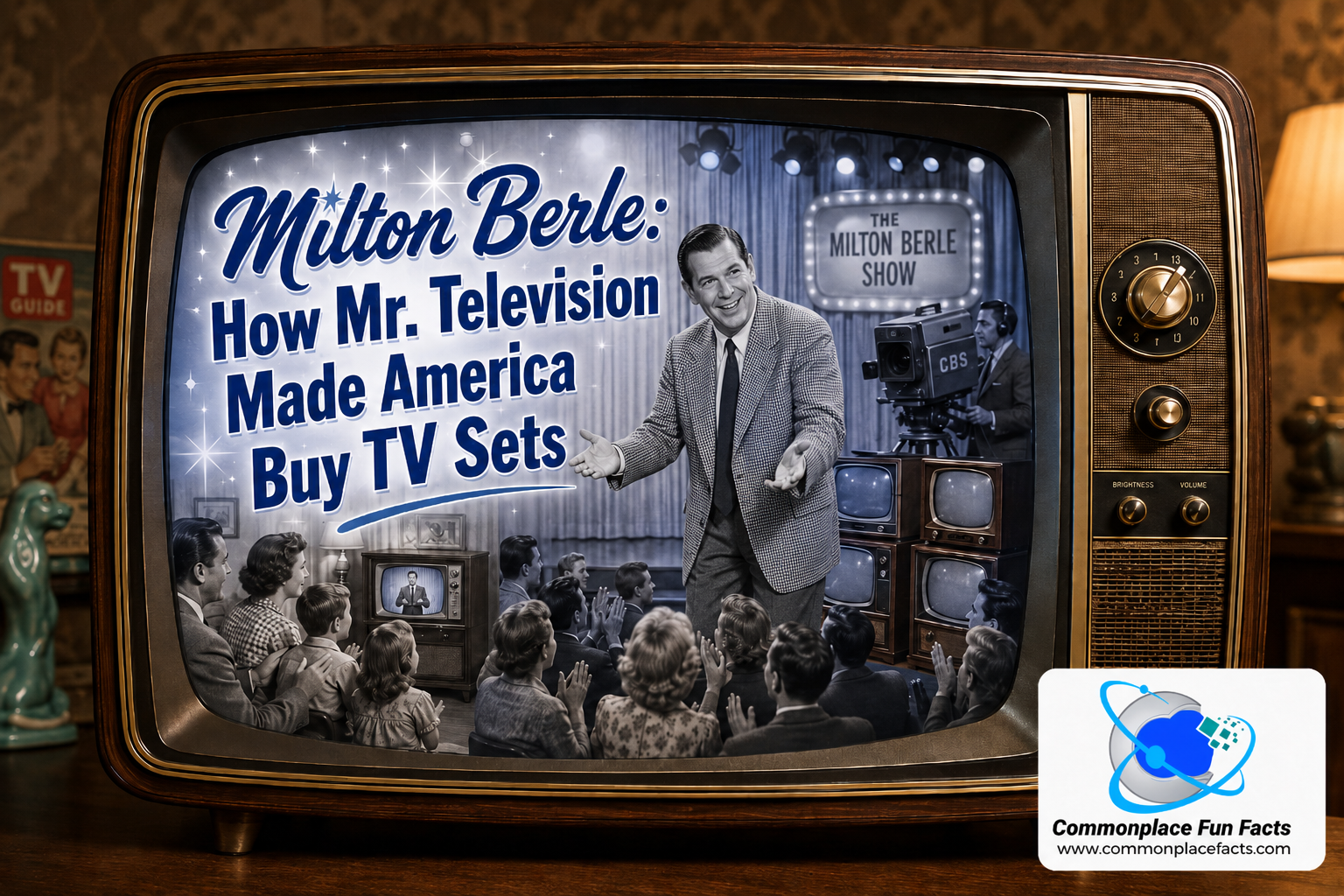

Today, there is no shortage of celebrities or entertainment choices. Television offers endless personalities, countless platforms, and more on-demand programming than any healthy civilization should probably admit to needing.
It wasn’t always that way.
Once, America’s Tuesday nights belonged to one man, one network, one sponsor, and approximately 4,000 jokes that may or may not have originally belonged to someone else.
That man was Milton Berle.
To modern viewers, Berle can be a difficult figure to explain. He was not the first comedian. He was not the first performer to appear on television. He certainly was not the most subtle comic presence ever to step in front of a camera, unless your definition of “subtle” includes wearing a dress, mugging into the lens, and attacking a punchline with the delicacy of a rhinoceros discovering tap shoes.
Yet for a brief, astonishing stretch in the late 1940s and early 1950s, Milton Berle was not merely a television star. He was the television star. He was “Uncle Miltie.” He was “Mr. Television.” He was the man who made Americans rearrange their evenings, crowd into neighbors’ living rooms, and seriously consider buying one of those expensive glowing boxes that promised entertainment, eye strain, and the eventual collapse of productive family conversation.
Berle did not invent television, but he did something almost as important: he convinced America that television mattered.
Contents
Before Television Had a Mr., Milton Berle Had a Resume
Milton Berle was born Mendel Berlinger in New York City on July 12, 1908. Show business got hold of him early and, like most things that got hold of Milton Berle, never fully recovered.

He began performing as a child, appearing in silent films and stage productions when most children are still trying to master the complex art of not eating crayons. By the time he reached adulthood, Berle had worked in vaudeville, Broadway, radio, nightclubs, and film. He was not some fresh-faced comic plucked from obscurity by television. He was a veteran of practically every entertainment medium that existed before people started arguing about streaming subscriptions.
This mattered. Early television was not a polished medium. It was live, awkward, temperamental, technically unpredictable, and often held together with optimism, cigarette smoke, and men in headsets frantically pointing at things. Performers had to know how to fill time, recover from mistakes, play to a live audience, hit marks, read a room, and keep the show moving when scenery collapsed, microphones failed, or a guest forgot what human speech was supposed to sound like.
Milton Berle could do all of that.
Vaudeville had trained him to be fast, visual, loud, shameless, adaptable, and relentless. If one joke failed, another was already on the way. If that one failed, he could put on a costume. If the costume failed, he could fall down. If falling down failed, he could flirt with the camera, insult the bandleader, kiss a guest, or simply keep talking until surrender seemed easier than resistance.
He was not built for quiet understatement. He was built for survival.
Television Was Waiting for Someone Exactly Like Him
In the years after World War II, television was still more promise than household fixture. Radio was the reigning monarch of home entertainment. Movies had glamour. Newspapers had authority. Television had potential, but also a screen the size of a salad plate and enough technical problems to generate an entire field of TV repair.
The networks knew television could be big. They just did not yet know exactly what it was supposed to be. Much early TV borrowed heavily from radio, theater, vaudeville, and nightclub acts. Some of it worked. Some of it looked like radio performers had wandered into a camera studio by accident and were trying not to make eye contact with the future.
Berle understood something important: television was visual. That seems obvious now, but early television had to learn it. Radio stars could survive on voice, timing, and imagination. Television needed faces, motion, bodies, reactions, costumes, chaos, and performers who could command the screen even when the picture was fuzzy enough to make everyone look like they were broadcasting from the bottom of a soup bowl.
Berle’s comedy was broad because early television practically demanded broadness. Subtle eyebrow work does not do much when half the audience is watching on a tiny black-and-white set with questionable reception. A man in a ridiculous outfit, however, comes through just fine.
That was Milton Berle’s natural habitat.
Enter Texaco Star Theater
Berle’s great television breakthrough came with Texaco Star Theater, which began on NBC television in 1948. The program had roots in radio, but television transformed it into something bigger, louder, and much more culturally disruptive.
At first, Berle was not supposed to be the show’s permanent host, but just one among a rotating selection of emcees. He hosted the premiere television broadcast on June 8, 1948, and soon became the show’s regular star. Once he took command, Texaco Star Theater became the program that defined early television variety. It had comedy sketches, musical numbers, celebrity guests, slapstick, monologues, and a sponsor whose presence was so deeply integrated into the show that modern product placement looks shy by comparison.
Today, commercials interrupt programs. In early television, the sponsor often seemed like a co-star with better billing. Texaco’s name was in the title, Texaco service station attendants appeared in musical numbers, and viewers were reminded with impressive frequency that high-quality petroleum products were somehow spiritually connected to Milton Berle wearing a wig.
The show was live, which gave it an energy that later television often struggled to replicate. Anything could go wrong. Frequently it did. That was part of the appeal. Berle thrived in that environment because he came from traditions where live performance was not a challenge but a way of life. If a bit collapsed, he could bulldoze through it. If a guest missed a cue, he could fill the gap. If an audience was slow to respond, he could attack harder.
His comic style was not elegant. It was not refined. It was not the sort of thing one describes while sipping tea and using the word “droll.” It was show business with the volume knob broken off.
And America loved it.
When Uncle Miltie Became a National Habit
It is hard to overstate how big Milton Berle became. We live in an age of fragmented audiences, niche streaming platforms, and viewers who can spend forty minutes choosing something to watch before giving up and going to bed spiritually defeated. Berle belonged to a different world.

In the late 1940s and early 1950s, television ownership was exploding, and Berle became one of the medium’s greatest salesmen. Just as Amos ’n’ Andy helped turn early radio into a national scheduling ritual, Berle’s Tuesday night show became a television event. People who owned televisions invited friends and neighbors over. People who did not own televisions gathered in bars, appliance stores, and public spaces. Berle’s face, voice, and comic rhythms became part of American domestic life.
He was called “Uncle Miltie,” a nickname that captured the strange intimacy of early television. Movie stars were larger than life. Radio voices floated invisibly through the air. Television performers entered the living room. They stood there in the corner, flickering in black and white, becoming familiar in a way no previous entertainers quite had.
Berle understood that relationship. He played directly to the home audience. He winked, mugged, shouted, and performed as if he had personally dropped by to make sure Tuesday night did not become too dignified.
His impact was so great that he became known as “Mr. Television.” This was not just a nickname. It was practically a job description. For a few years, when Americans thought of television, they thought of Milton Berle. He was the face of the medium, the proof of concept, the man who made the new technology feel necessary.
That is a peculiar kind of fame. Plenty of entertainers become popular because of a medium. Berle helped make the medium popular because of him. That is not stardom. That is infrastructure with a punchline.
The Lifetime Contract That Wasn’t Quite Lifetime-Proof
NBC noticed, as networks occasionally do when money begins entering the building in wheelbarrows.
In 1951, NBC signed Milton Berle to a 30-year exclusive contract. It was widely described as a lifetime contract, which was not technically accurate unless NBC’s legal department had adopted a surprisingly pessimistic view of Berle’s actuarial prospects. Still, by entertainment standards, thirty years was close enough. Television itself had barely learned to walk, and NBC was already making long-term custody arrangements.

The deal reportedly paid Berle $200,000 per year, which works out to roughly $2.5 million a year in today’s money — not bad for a man whose principal business model involved yelling into a camera and occasionally wearing a dress. That was an enormous sum at the time and a clear sign of how important the network believed he was. NBC was not just signing a comedian. It was securing the man it considered central to television’s future.
From the network’s point of view, the logic made sense. Berle had helped build the audience. He had helped sell sets. He had made NBC the place to be on Tuesday nights. He was television’s first superstar, and if you own the first superstar, you have a pretty good head start in the future.
There was only one problem.
The future was not planning to stay put.
Television was evolving quickly. What felt fresh in 1948 could feel old by 1953. Audiences became more experienced. Production became smoother. Competition increased. New performers arrived. New formats developed. Situation comedies, dramas, filmed programs, panel shows, game shows, and more sophisticated variety programs began carving up the audience. Television was no longer a novelty that needed one loud uncle to explain it to the nation.
NBC thought it had bought the future. In reality, it had bought a very large piece of television’s childhood.
What Happened to the Show?
The decline of Berle’s television empire did not happen because he suddenly stopped being talented. It happened because television changed, and because Berle’s greatest strengths became less essential as the medium matured.
Texaco Star Theater dominated early television partly because Berle’s style fit the moment perfectly. He was fast, big, physical, and visually unmistakable. That was ideal when television was new, sets were small, and audiences were still thrilled by the simple miracle of live entertainment appearing in their homes.
But novelty has a short shelf life. Once Americans had televisions, they began wanting more from them. They wanted characters, stories, polish, variety, intimacy, realism, and comedy that did not always arrive wearing false eyelashes and swinging a prop purse.
Texaco ended its sponsorship in 1953, and the show was rebranded as The Buick-Berle Show. Later it became The Milton Berle Show. The name changes tell their own story. The original magic had been a combination of star, sponsor, timing, and national curiosity. Once that combination began to weaken, the show struggled to maintain its dominance.
Berle’s ratings declined. His humor began to look dated beside newer styles. Television was becoming less like vaudeville on a screen and more like its own medium. Performers such as Sid Caesar brought a different kind of sketch comedy to television, with sharper writing and more ensemble sophistication. Lucille Ball helped demonstrate the power of filmed sitcoms. Edward R. Murrow showed what television journalism could be. Anthology dramas showed television could aspire to serious storytelling.
Berle, meanwhile, remained Berle.
That was both his glory and his problem.
He had been exactly what early television needed. Unfortunately for him, early television did not remain early television. It grew up, changed clothes, went to college, and came home with opinions about cinematic language.
Elvis, Hound Dog, and the Future Kicking Down the Door
One of the most symbolic moments in Berle’s later television run came in 1956, when Elvis Presley appeared on The Milton Berle Show.
On June 5, 1956, Elvis performed “Hound Dog” on Berle’s program. The performance became famous, scandalous, and, depending on the viewer, either thrilling evidence of a new cultural era or proof that Western civilization had finally been defeated by pelvis-based insurgency.
It is a fascinating moment because it places two entertainment ages on the same stage. Berle represented the vaudeville-rooted, gag-driven, variety-show world that had helped birth television. Elvis represented youth culture, rock and roll, sexuality, rebellion, and the terrifying possibility that America’s teenagers were no longer taking entertainment recommendations from their parents’ favorite cigar-chomping comedian.
Berle was still famous. He was still important. He was still “Mr. Television.” But Elvis was something else. Elvis was the future kicking the door open, tracking mud on the carpet, and making network executives wonder whether they should be excited or call a minister.
Berle’s show ended later that year. That does not mean Elvis personally killed it, of course. Television history is rarely that tidy, and if it were, lawyers would have ruined it. But the symbolism is irresistible. Milton Berle had once embodied the shocking newness of television. By 1956, he was sharing the stage with a younger figure who made Berle’s brand of showbiz seem like something from an earlier geological layer.
Mr. Television had introduced America to television. Now television was introducing him to the next America.
Life After Being the Biggest Thing on Television
Berle did not disappear after his show ended. He continued performing for decades, appearing on television, in films, in nightclubs, and on variety programs. He made guest appearances. He acted. He turned up as a familiar show-business elder, the sort of performer everyone knew even if younger viewers were not entirely sure why.
That is one of the strange things about being a pioneer. If you succeed too well, later generations inherit the world you helped create and then wonder why you seem so old-fashioned inside it.
Berle’s later career never matched the phenomenon of his Texaco Star Theater years. How could it? That moment was tied to a specific cultural and technological transformation. He was the right performer at the right time in the right medium, and those alignments do not come with renewable warranties.
He also sometimes struggled to adapt to newer comedy environments. One famous example came in 1979, when Berle hosted Saturday Night Live. The appearance became notorious behind the scenes because Berle’s old-school instincts reportedly clashed with the show’s ensemble-driven, anti-showbiz, irony-soaked atmosphere. Berle came from a tradition where the star dominated the stage. SNL came from a tradition where the old star dominating the stage was exactly the kind of thing the show enjoyed skewering.
It was not merely a bad fit. It was an archaeological collision.
Berle was a creature of applause, timing, and command. The newer comedy world prized awkwardness, satire, collaboration, and the ability to look like you were not trying too hard. Milton Berle always looked like he was trying hard. That was part of the act. He was not interested in pretending comedy had accidentally happened near him. He grabbed it by the collar and dragged it into the spotlight.
The Joke-Stealing Problem
No discussion of Milton Berle is complete without mentioning his long-standing reputation for stealing jokes.

Berle was famous for it. Or infamous. Or famous for being infamous, which is show business’ most efficient filing system. Comics joked about it. Berle joked about it. His nickname “The Thief of Bad Gags” was not bestowed upon him because everyone thought he was unusually respectful of intellectual property.
To be fair, the world Berle came from had different rules. Vaudeville comics borrowed, recycled, adapted, traded, lifted, and repurposed material with a freedom that would make modern stand-up comedians call emergency meetings. Joke ownership existed, but it was murky, inconsistently enforced, and often governed by reputation, intimidation, or who could get to the stage first.
That does not make joke theft admirable. It just puts Berle in context. He came from a rough-and-tumble entertainment ecosystem where material circulated constantly and originality sometimes meant remembering where you stole something and changing the hat.
The reputation stuck because it fit Berle’s larger personality: aggressive, competitive, domineering, hungry, and utterly committed to the laugh. He was not a delicate craftsman quietly polishing gems in a workshop. He was a comic scavenger with a spotlight and a stopwatch.
That makes him complicated. It also makes him more interesting. Saints are rarely as useful to history as talented disasters.
The Legacy of Mr. Television
Milton Berle’s comedy does not always play easily today. Some of it feels broad. Some of it feels frantic. Some of it depends on performance traditions that modern viewers may recognize only from parodies of old variety shows. His mugging, costumes, and relentless energy can seem exhausting, like being trapped in an elevator with a man determined to win a talent contest no one announced.
But judging Berle only by whether every joke still works misses the point. His legacy is not merely that he was funny. His legacy is that he showed what television could do.
He proved that television could create national stars. He proved that a performer could become a weekly visitor in millions of homes. He proved that television could shape schedules, sell products, move appliances, and create shared cultural moments. He helped establish the variety show as one of early television’s defining forms. He brought vaudeville into the living room and, for better or worse, made television feel immediate, intimate, and alive.
Before Berle, television was a curiosity. During Berle’s reign, it became a habit.
For more on Berle’s long career, personality, and some of the lines attributed to him, see our companion piece, Who Was Milton Berle? The Man, the Myths, and the Philosophy Behind Mr. Television.
Berle’s is an extraordinary legacy. The medium would evolve far beyond him, but it evolved partly because he helped build the audience that made evolution worthwhile. Without the early excitement generated by performers like Berle, television might still have grown, but perhaps more slowly and with less theatrical electricity.
Berle was honored for that role. He received two stars on the Hollywood Walk of Fame, one for radio and one for television. He was inducted into the Television Academy Hall of Fame as part of its first class in 1984. His nickname, “Mr. Television,” remained attached to him for the rest of his life, which is both a compliment and a reminder that history sometimes chooses one version of a person and refuses to update the software.
So What Do We Do With Milton Berle Now?
Milton Berle died on March 27, 2002, at the age of 93. By then, television had become something almost unrecognizable from the medium he helped popularize. It had gone from live black-and-white broadcasts to cable channels, color programming, satellite distribution, videotape, reruns, prestige drama, remote controls, and the early tremors of the digital age.
Berle had lived long enough to see television grow from novelty to institution to background noise. He also joked that he lived long enough to see his “lifetime contract” with NBC expire. That is quite a journey for a man who once helped persuade Americans to buy the box in the first place.
His career invites a useful distinction between being timeless and being foundational. Berle was not always timeless. His style belonged to a particular era, and some of it aged about as gracefully as a refrigerator full of unrefrigerated mayonnaise. But he was foundational. He helped establish the grammar of television stardom. He showed networks what a hit could look like. He helped viewers understand television as a regular part of domestic life.
There is also something deeply human in his rise and decline. Berle became enormous because he fit the needs of a brand-new medium. Then the medium changed. The very thing that made him essential eventually made him seem outdated. That has happened to countless entertainers, technologies, formats, and, if we are honest, home office printers.
The difference is that Berle’s moment came at the birth of television itself. He was standing there when America first looked into the glowing box and decided it wanted more. He made people laugh, sold them on the medium, and helped create the shared national habit that would define the second half of the twentieth century.
Milton Berle did not simply appear on television. For a few crucial years, he made television appear necessary.
That is why he was called “Mr. Television.” Not because he owned the medium forever, and certainly not because the medium stopped growing after him. He earned the title because when television was young, awkward, loud, and desperate to prove itself, Milton Berle marched in with a cigar, a dress, a borrowed joke, and enough confidence to power a transmitter.
America tuned in.
Then it bought the set.
You may also enjoy…

Red Skelton: The Clown Who Laughed Through It All
Red Skelton brought America laughter, heart, and a few gentle lessons about life. From his radio days to The Red Skelton Show, discover his unforgettable characters, timeless jokes, and the clown who never stopped smiling—even when life gave him tears.

The Jack Benny Program: How Silence, Timing, and Character Transformed American Comedy
The Jack Benny Program transformed American comedy using silence, timing, and unforgettable characters—proving that the loudest joke on radio could be saying nothing at all.

Here’s Looking at You, Casablanca: The Accidental Magic of a Movie Classic
Discover the surprising history, unforgettable quotes, and behind-the-scenes chaos that made Casablanca a timeless movie classic. From Bogart’s improvised lines to fog machines and a fake piano player, this article reveals the accidental magic behind the legend.






Leave a Reply