
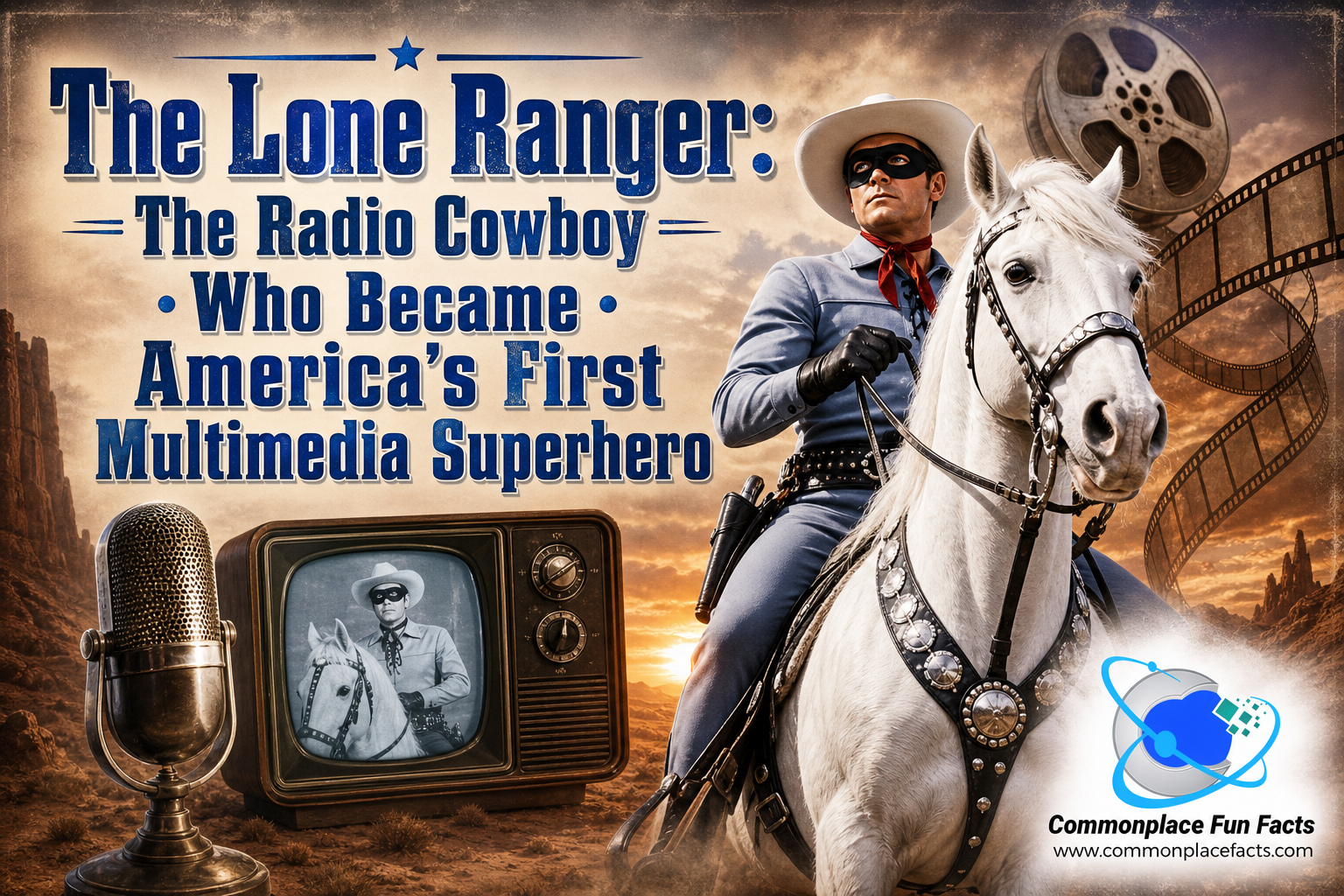

Before Batman brooded over Gotham, before Superman started treating gravity as a polite suggestion, and before every superhero needed a cinematic universe, a merchandising strategy, and a post-credits scene, America had the Lone Ranger.
He had a mask. He had a secret identity. He had a tragic origin story. He had a loyal companion, a moral code, a signature vehicle, and theme music everyone recognized within three notes. Granted, the vehicle was a horse, but Silver was basically the Batmobile with hay requirements.
The history of the Lone Ranger is not merely the story of a cowboy hero. It is the story of one of America’s first truly modern media franchises. The Lone Ranger began as a radio character in Depression-era Detroit, galloped into movie serials, became a television icon through Clayton Moore and Jay Silverheels, tangled with Hollywood, inspired the creation of the Green Hornet, and somehow ended up in court over whether one man could keep wearing a black mask.
Return with us now to those thrilling days of yesteryear as we explore the massive cultural significance of a character whose most famous exit line was shouted at a horse.
Contents
The Lone Ranger Was Born in Detroit, Which Is Not Usually How Western Legends Begin
The Lone Ranger made his radio debut on January 30, 1933, on WXYZ in Detroit. Ironcially, the character most closely associated with the mythic American West was created in Michigan by radio professionals who were not, strictly speaking, grizzled frontier veterans. They were men of microphones, scripts, advertising slots, and production deadlines.

The character is generally credited to George W. Trendle, the owner and manager of WXYZ, and writer Fran Striker, with director James Jewell also playing an important role in the early development of the program. Together, they helped create a masked Western hero designed for radio audiences at a time when the country desperately needed heroes who were incorruptible, brave, and not visibly standing in a breadline.
The United States was in the depths of the Great Depression. Banks had failed. Jobs had vanished. Confidence was not so much low as hiding under the porch with a blanket over its head. Into that grim national mood came a masked man who always did the right thing, never took credit, never gave up, and rode away before anyone could pin a medal on him or ask him to chair a committee.
The origin story was pure adventure melodrama, which is another way of saying it was exactly what radio needed. A group of Texas Rangers is ambushed by outlaws. Only one survives: John Reid. He is nursed back to health by Tonto, a Native American companion from his past. Reid then fashions a mask from the vest of his dead brother, adopts the identity of the Lone Ranger, and dedicates his life to fighting injustice.
Subtle? Not especially. Effective? Absolutely.
The Lone Ranger radio show had everything a listener could want: danger, mystery, galloping hoofbeats, gunfire, noble speeches, and the thrilling sense that justice would always arrive just in time, wearing a mask and maintaining excellent posture.
You can listen to a reenactment of the original episode here.
A Western Hero Built Like a Superhero
One reason the Lone Ranger endured is that he was not merely a cowboy. He was a superhero before the superhero formula had fully hardened into capes, secret lairs, origin reboots, and arguments on the internet.
Consider the evidence. He had a secret identity. He wore a mask. He had a tragic backstory involving murdered loved ones. He fought crime under an assumed name. He had a loyal partner. He had a code against killing. He used silver bullets as a symbol. He had a magnificent white horse named Silver. He had theme music so famous that Rossini’s “William Tell Overture” became, for generations of Americans, less “classical composition” and more “cowboy incoming.”
The Lone Ranger did not smoke, drink, swear, or shoot to kill. He did not use slang. He treated women with respect, honored the law, defended the weak, and generally behaved as if someone had turned the Boy Scout Law into a masked rider with a revolver.
This moral code was not accidental. It made the character acceptable to parents and attractive to sponsors. Children could listen to gunfights, ambushes, robberies, and frontier violence, secure in the knowledge that the hero would speak properly and avoid tobacco. American entertainment has always had its priorities.
The Lone Ranger’s silver bullets also carried symbolic weight. They reminded him that life was precious and that bullets should not be wasted. This is a noble sentiment, although one suspects it also helped make the merchandise more interesting. A regular bullet is ammunition. A silver bullet is branding.
Tonto, Silver, and the Problem of Early Pop-Culture Representation
No history of the Lone Ranger can ignore Tonto. From the beginning, Tonto was central to the story. He rescues John Reid, helps create the Lone Ranger identity, rides with him, fights beside him, and serves as the hero’s closest companion.

That said, the character also came from the racial assumptions of early 20th-century popular entertainment, and those assumptions were not exactly subtle. Early portrayals of Tonto often used stereotyped speech patterns and simplified Native identity in ways that reflected more about white radio writers than about any real Indigenous culture. The result was a character who was both essential to the mythology and burdened by the limitations of the era that created him.
Jay Silverheels, who played Tonto on television, brought dignity and presence to the role, but even he was working within scripts and conventions that had already boxed the character into a narrow form. The Lone Ranger franchise gave American audiences one of the most recognizable Native characters in entertainment history, but it also showed how mainstream media often treated Native people as symbols, sidekicks, or plot devices rather than fully developed human beings.
That tension is part of the story. The Lone Ranger and Tonto were presented as partners, and many viewers loved them that way. At the same time, modern audiences can recognize that the partnership was shaped by the blind spots of its creators and its time. History, as usual, refuses to fit neatly into a lunchbox.
The Lone Ranger Radio Show Becomes a National Phenomenon
As we explored in the story of the first radio broadcast, radio had already come a long way from experimental wireless transmissions to full-blown entertainment empires. The Lone Ranger radio show became one of the most successful programs of the old-time radio era. It ran for decades, producing nearly 3,000 episodes and embedding its sounds, phrases, and rhythms into American culture.

Audiences knew the formula. The thundering hoofbeats. The swelling strains of the “William Tell Overture.” The announcer’s voice: “A fiery horse with the speed of light, a cloud of dust, and a hearty ‘Hi-Yo, Silver!’” Then came the invitation to “return with us now to those thrilling days of yesteryear.” What followed was frontier danger, noble speeches, last-minute rescues, and the dramatic saving of the day. Each episode ended with grateful townspeople asking, “Who was that masked man?” as the hero disappeared into the distance. Apparently, no one ever thought to ask a follow-up question before he left, which seems like a recurring failure in local law enforcement procedure.
This was the heyday of radio, and it could do remarkable things with nothing more than voices, music, and imagination, as later programs like “Sorry, Wrong Number” would demonstrate with considerably fewer horses and considerably more panic.
Several actors voiced the Lone Ranger during the radio years, but two became especially important. Earle Graser played the role for much of the early run until his death in 1941. Brace Beemer then became the voice most associated with the later radio version. John Todd played Tonto for the full radio run, while announcer Fred Foy became one of the great voices of radio drama.
The show’s success also turned the Lone Ranger into a merchandising force. There were books, toys, costumes, comics, and promotional items. Children did not simply listen to the Lone Ranger. They wanted to become him, preferably with a cap pistol, a mask, and a household object that could be pressed into service as Silver. Parents of the era may have believed they were buying harmless toys. In reality, they were funding one of the earliest examples of character-based mass marketing.
From Radio Waves to Movie Serials
The Lone Ranger did not stay confined to radio for long. A character that popular was bound to make the leap to the screen, because Hollywood has never seen a successful property without immediately wondering how many tickets it could sell.
Republic Pictures produced “The Lone Ranger” movie serial in 1938, followed by “The Lone Ranger Rides Again” in 1939. These serials brought the masked rider to theater audiences in cliffhanger form, complete with action sequences, perilous escapes, and the kind of chapter-ending suspense that encouraged children to return the next week with coins in hand and impatience in their souls.
The serials did not always follow the radio mythology precisely. Hollywood adaptations rarely do. The 1938 serial even played with the identity of the Lone Ranger, keeping audiences guessing about which man was actually behind the mask. This may have added suspense, but it also demonstrated a truth that would follow the character for decades: producers loved the Lone Ranger, but they also loved tinkering with him.
This is understandable. The Lone Ranger formula is simple, and simplicity makes executives nervous. Someone, somewhere, always feels compelled to add a twist, a darker tone, a new mythology, or a baffling creative choice that makes fans stare into the distance like a rancher watching storm clouds gather.
Clayton Moore and the Television Lone Ranger
For most Americans, the definitive Lone Ranger was not the radio voice or the serial version. It was Clayton Moore.

“The Lone Ranger” television series premiered in 1949 on ABC and ran until 1957. It starred Clayton Moore as the Lone Ranger and Jay Silverheels as Tonto. The series produced 221 episodes and became one of the early defining hits of television Westerns. If radio made the Lone Ranger famous, television made him visible, repeatable, and permanently lodged in the memory of anyone who grew up near a black-and-white set.
Moore looked the part so completely that the role practically absorbed him. He had the square jaw, the upright bearing, the calm voice, and the physical presence of a man who could make “I’ll handle this” sound like a constitutional principle.
Jay Silverheels gave Tonto an equally memorable screen presence. His role remained constrained by the writing of the period, but his performance gave the character gravity and loyalty. Together, Moore and Silverheels became one of television’s most recognizable duos.
There was, however, a brief interruption. Clayton Moore played the Lone Ranger in the first two seasons, but he was replaced by John Hart for a season during a contract dispute. Hart had the unenviable task of stepping into one of the most recognizable masks on television. He did the job, but audiences never embraced him the same way. Moore returned for the final seasons, including the color episodes, and history more or less decided that Clayton Moore was the Lone Ranger.
That kind of identification can be a blessing. It can also be a legal trapdoor, as Moore would later discover.
Clayton Moore Did Not Merely Play the Lone Ranger
That trapdoor opened in 1979.
After the television series ended, Clayton Moore continued to appear publicly as the Lone Ranger. He wore the costume, greeted fans, signed autographs, spoke to children, and carried himself as a living embodiment of the character’s code.
This could have been corny. It was not. By all accounts, Moore took the role seriously. He understood that children believed in the Lone Ranger, and he seemed determined not to disappoint them. He lived long enough with the character that the line between actor and icon became blurry.
There are actors who resent being typecast. Moore embraced it. He seemed genuinely proud to be associated with a hero who stood for honesty, decency, courage, and restraint. Hollywood, naturally, eventually responded to this loyalty by suing him over his face.
That brings us to one of the strangest chapters in Lone Ranger history: the mask controversy.
The Lone Ranger Mask Lawsuit: When Clayton Moore Was Ordered to Unmask
Clayton Moore did more than just play a character. He adopted the role as a personal operating system. He was often quoted as saying he had “fallen in love with the Lone Ranger character,” and he tried to take the Lone Ranger Creed seriously in his own life. To Moore, the role was not just a costume, a paycheck, or a convenient way to get recognized at airports. It was a standard to live up to.
That sincerity helped explain why audiences never fully separated Moore from the masked man. He appeared at public events in costume, greeted fans, spoke to children, and carried himself as a living representative of the character’s values.
Even offscreen, Moore had a way of drifting into Lone Ranger territory. In 1964, he moved with his wife and daughter to Golden Valley, Minnesota, to be closer to his wife’s family in Minneapolis. He earned a Minnesota real estate license, established Ranger Realty, and helped develop the area north of what is now Interstate 394 near the Louisiana Avenue exit. During that period, Moore reportedly came upon the scene of a grocery store robbery and untied the store manager after the thieves had fled. According to the story, he quipped, “You have just been rescued by the Lone Ranger.” Most real estate agents are content to hand out refrigerator magnets. Clayton Moore opted for frontier justice.
The connection became so complete that his star on the Hollywood Walk of Fame includes both his name and the role that defined him: “Clayton Moore — The Lone Ranger.” As of this writing, his is the only star in the Walk of Fame that includes his character along with his name.

All of that made what happened in 1979 feel less like a routine intellectual-property dispute and more like someone had tried to repossess Santa’s beard.
That year, the owners of the Lone Ranger property were preparing a new film version of the character. They did not want the public confused by Moore continuing to appear in costume while a younger actor was being introduced as the new Lone Ranger. Moore was in his sixties by then, and the production wanted a clean break between the television icon of the past and the movie hero they hoped would gallop profitably into the future.
So the rights holders went to court and obtained an order preventing Moore from appearing publicly in the Lone Ranger mask.
It is hard to overstate how badly this landed with fans. Clayton Moore had spent decades representing the character. He had been the Lone Ranger for millions of children. Then, suddenly, he was told he could no longer wear the mask that had become part of his public identity.
The legal argument may have made sense from a trademark and licensing standpoint. The emotional argument was a stampede in the opposite direction. Fans saw the order as an insult to the man who had kept the character alive long after the television series ended. Moore reportedly felt deeply hurt by the decision, and it is not difficult to see why.
Moore complied, but in the most Clayton Moore way possible. Instead of wearing the mask, he appeared in oversized wraparound sunglasses. This was technically not the Lone Ranger mask, but everyone understood the message. It was legal compliance with a raised eyebrow.
The new film, The Legend of the Lone Ranger, was released in 1981 and became a notorious disappointment. The public had not forgotten Moore. It also had not forgiven the unmasking controversy. The movie was supposed to revive the character for a new generation. Instead, it became a cautionary tale in how not to treat the beloved face of your franchise.
In 1984, Moore was allowed to wear the mask again. By then, the damage had already been done, but the restoration mattered. Clayton Moore once again appeared as the Lone Ranger, and fans once again saw the man they believed had earned the right to ride with Silver in public.
The episode remains one of the oddest intersections of intellectual property law and pop-culture sentiment. A corporation owned the character. Clayton Moore owned the public’s affection. The court could regulate the mask, but it could not make people stop seeing him as the Lone Ranger.
That is the kind of legal distinction that keeps lawyers employed and fans annoyed.
The Green Hornet Connection: Masked Justice Apparently Runs in the Family
The Lone Ranger’s influence did not stop with Westerns. It also helped create another famous masked crimefighter: the Green Hornet.

The Green Hornet debuted on WXYZ radio in 1936, just three years after the Lone Ranger. He was created by the same creative world: George W. Trendle and Fran Striker. The idea was to build on the success of the Lone Ranger while updating the concept for a modern urban setting.
Instead of a masked rider in the Old West, the Green Hornet was Britt Reid, a newspaper publisher who fought crime in the city. Instead of Silver, he had the Black Beauty, a technologically advanced car. Instead of Tonto, he had Kato. Instead of being seen as an obvious hero, the Green Hornet pretended to be a criminal so he could infiltrate the underworld.
Same basic idea. New century. Better garage.
The similarities extended even to the soundtrack. The Lone Ranger charged into American living rooms to Rossini’s “William Tell Overture,” while the Green Hornet buzzed in to Rimsky-Korsakov’s “Flight of the Bumblebee,” meaning generations of children received a stealth education in classical music while thinking they were merely listening to masked vigilantes solve crime with horses, cars, and excellent branding.
The family connection is where things get especially fun. The Lone Ranger’s real name is usually given as John Reid. His brother, Dan Reid, dies in the ambush that creates the Lone Ranger. Dan’s son, Dan Reid Jr., appears in Lone Ranger stories as the Ranger’s nephew. That younger Dan Reid eventually becomes part of the backstory leading to Britt Reid, the Green Hornet.
In other words, Britt Reid is commonly treated as the grand-nephew of the Lone Ranger.
This makes the Green Hornet a kind of modern descendant of the Lone Ranger legacy. The Lone Ranger fights frontier outlaws from horseback. The Green Hornet fights racketeers, gangsters, and corrupt officials from behind the wheel of a high-powered car. One rides across plains. The other speeds through city streets. One leaves silver bullets. The other leaves criminals wondering whether they were just beaten up by a villain, a hero, or a very aggressive newspaper executive.
The connection also means that the Lone Ranger and the Green Hornet belong to one of the earliest shared hero mythologies in American popular culture. Before sprawling superhero universes became standard entertainment machinery, Trendle and Striker had already linked a Western masked hero to a modern masked vigilante through family bloodlines.
The Lone Ranger in Later Movies
The Lone Ranger’s later film history has been uneven, which is a polite way of saying Hollywood has repeatedly approached the property, saddled up, and ridden directly into a cactus.
Clayton Moore and Jay Silverheels appeared in theatrical Lone Ranger films during the 1950s, including “The Lone Ranger” in 1956 and “The Lone Ranger and the Lost City of Gold” in 1958. These films were extensions of the television version and benefited from having the familiar actors audiences already loved.
The 1981 film “The Legend of the Lone Ranger” attempted to relaunch the character with a new cast. Unfortunately, it became tangled in the Clayton Moore controversy and failed to connect with audiences. The movie had the burden of replacing the man many fans still considered the true Lone Ranger, which is a bit like trying to sell a new Santa Claus immediately after suing the old one over the beard.
Then came Disney’s 2013 “The Lone Ranger,” starring Armie Hammer as John Reid and Johnny Depp as Tonto. The film was large, expensive, visually ambitious, and divisive. It tried to reinvent the mythology for a modern blockbuster audience, mixing action, comedy, revisionism, spectacle, and enough tonal confusion to make a horse request script approval.
The problem with reviving the Lone Ranger is that the character works best when treated sincerely. He belongs to an older heroic tradition: clean lines, moral clarity, symbolic justice, and a hero who does not need to be ironic about everything. Modern filmmakers often struggle with that. They either darken the story, mock the premise, or overcomplicate the mythology.
The Lone Ranger is not impossible to update, but he resists embarrassment. The character can survive new settings, deeper characterization, and modern reflection. What he cannot survive is a creative team that seems faintly ashamed of him.
Why the Lone Ranger Still Matters
The history of the Lone Ranger matters because the character helped define what American hero franchises could become.
He began on radio, moved into film serials, exploded on television, filled comic books and children’s merchandise, inspired related heroes, and became a symbol recognizable even to people who never watched a full episode. That is the pattern later followed by superheroes, science-fiction franchises, and every entertainment property now expected to produce movies, streaming shows, collectibles, lunchboxes, and at least one disappointing reboot.
The Lone Ranger also helped establish the masked hero as a moral figure. He did not wear the mask to hide from responsibility. He wore it to serve justice without seeking personal glory. That idea runs through later superheroes in countless forms. Batman, the Green Hornet, Zorro, the Shadow, and the Lone Ranger all belong to the same broad family of masked justice figures. Some are darker. Some are stranger. Some have better gadgets. Few are as cleanly noble as the man on Silver.
There is also something deeply American about the Lone Ranger’s contradictions. He is a lawman who operates outside normal law enforcement. He is a peaceful moralist who carries guns. He is a humble servant of justice who has one of the most dramatic personal brands in entertainment history. He rejects fame but announces his presence with thundering hoofbeats and orchestral fanfare.
A Fiery Horse, a Cloud of Dust, and a Very Complicated Legacy
The Lone Ranger is easy to parody because the surface details are so familiar: the mask, the horse, the silver bullets, the music, the noble speeches, the townspeople squinting into the distance and asking the obvious question five seconds too late.
Yet beneath the parody is a character who genuinely shaped American popular culture. The Lone Ranger radio show proved that a masked hero could capture a national audience. The television series made Clayton Moore and Jay Silverheels permanent fixtures in the public imagination. The Green Hornet connection showed that the concept could evolve from Western adventure into modern crimefighting. The Clayton Moore mask lawsuit revealed how deeply audiences could identify an actor with a role, even when the lawyers insisted the matter was more complicated.
The Lone Ranger’s legacy is not simple. It includes thrilling adventure, sincere moral clarity, outdated stereotypes, brilliant marketing, legal absurdity, and one of the most recognizable hero formulas in American entertainment.
He was a cowboy, a radio icon, a television legend, a proto-superhero, a merchandising powerhouse, and the great-uncle of another masked vigilante. Not bad for a man whose primary retirement plan appeared to involve riding away before anyone could ask his name.
So who was that masked man?
He was the Lone Ranger: born in Detroit, raised on radio, immortalized on television, embodied by Clayton Moore, connected to the Green Hornet, and still riding somewhere through the dusty backroads of American pop culture.
Hi-Yo, Silver. Away.
You may also enjoy…

The Shadow: The Fedora-Wearing Phantom Who Paved the Way for Superheroes
Discover the mysterious legacy of The Shadow—radio’s original dark avenger who laid the foundation for modern superheroes. From pulp fiction roots to influencing Batman, this vigilante knew what evil lurked in the hearts of men.

Universal Monsters: The Cinematic Universe That Worked Before Anyone Invented the Phrase
Explore the rise of Universal Monsters—Dracula, Frankenstein, The Mummy, and more—and how Universal Studios created a shared cinematic universe decades before the term existed. Discover the stories, secrets, and legacy behind horror’s most iconic legends.

John Wayne: How a Kid Named Marion Became America’s Toughest Cowboy
Discover the incredible life of John Wayne — from his humble beginnings as Marion Morrison to his rise as Hollywood’s ultimate cowboy. Explore his legendary career, controversial politics, unforgettable fun facts, and the wild story of Stalin’s alleged plot to kill him.




Leave a Reply