
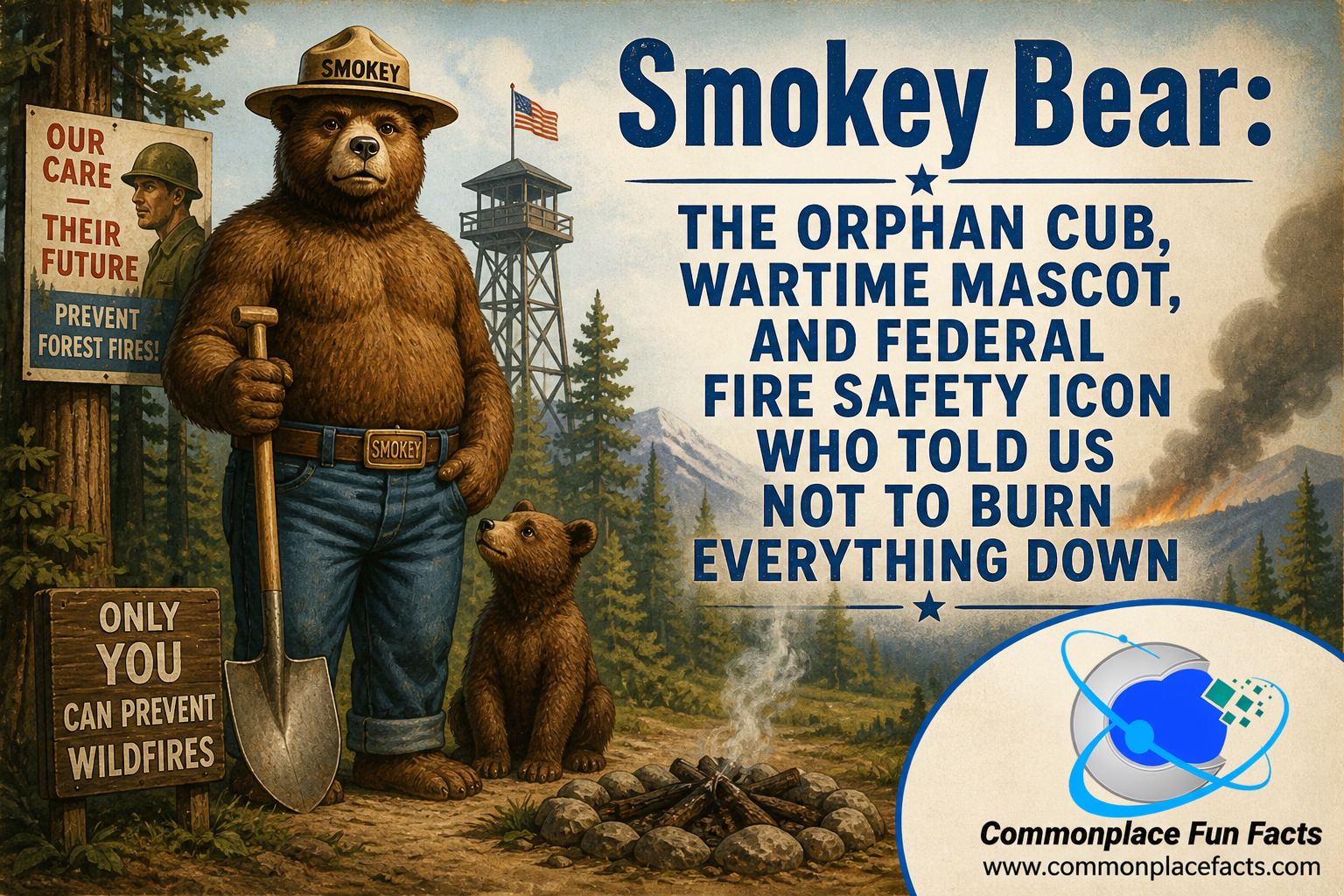

Let us begin with a small but important correction before the grammar patrol shows up wearing park ranger hats: his name is Smokey Bear, not Smokey the Bear.
Yes, we know. You have probably called him Smokey the Bear your entire life. So have millions of other Americans. The confusion mostly comes from the popular 1952 song, “Smokey the Bear,” which added the extra word because it made the lyrics flow better. That is how one little syllable wandered into American culture and refused to leave, like a raccoon in a campground dumpster.
Officially, however, he is Smokey Bear. No “the.” Just Smokey Bear. Strong. Direct. Efficient. Exactly what you want from a bear who carries a shovel and looks like he is judging your camping routine.
Smokey Bear is one of the most recognizable public service mascots in American history. He has appeared on posters, television, radio, billboards, lunchboxes, comic books, school materials, stamps, and multiple elementary school assemblies where a sweating forest ranger tried to explain wildfire prevention to a room full of children who really just wanted to see a talking bear.
But Smokey’s story is much more interesting than “cartoon animal tells people to put out campfires.” His origins are tangled up with World War II, wartime propaganda, Japanese submarine attacks, Disney’s Bambi, a badly burned bear cub from New Mexico, congressional action, federal trademark protection, ecological debate, and the awkward discovery that maybe—just maybe—not all fire in the forest is bad.
In other words, Smokey Bear is not just a mascot. He is a furry gateway into one of America’s most complicated relationships: our long, emotional, and occasionally misguided war against fire.
Contents
Before Smokey, There Was War
Smokey Bear was born during World War II, which may seem odd until we remember that World War II had a way of getting into absolutely everything. Rubber, gasoline, food, aluminum, nylons, baseball, Hollywood, and even woodland creatures were all drafted into the national effort. If your toaster could have worn a helmet, someone in Washington would have issued one.

After the attack on Pearl Harbor on December 7, 1941, Americans feared that the West Coast might be vulnerable to enemy attacks. This was not entirely imaginary. In February 1942, a Japanese submarine surfaced off the coast of California and shelled the Ellwood oil field near Santa Barbara. The attack caused little actual damage, but it produced a great deal of anxiety, which is one of the most reliable fuels in American public policy.
Government officials worried that enemy action—or plain old domestic carelessness—could ignite massive forest fires. Timber was a vital wartime resource. Wood was needed for military construction, shipping crates, railroad ties, paper, and other supplies. Meanwhile, many experienced firefighters and able-bodied men were serving in the armed forces. The forests were valuable, the country was nervous, and the manpower shortage was real.
That made fire prevention a patriotic duty. Posters warned Americans that “Forest Fires Aid the Enemy” and “Our Carelessness, Their Secret Weapon.” The message was not subtle. If you tossed a cigarette into the dry brush, you were not merely careless. You were practically handing a matchbook to Emperor Hirohito.
This was the atmosphere in which the Cooperative Forest Fire Prevention campaign began. The U.S. Forest Service, the Wartime Advertising Council, and the National Association of State Foresters joined forces to persuade Americans that preventing forest fires was part of defending the nation. Because apparently even pine trees had to do their bit.
The Bambi Phase
Before Smokey Bear took up his shovel and began giving America the stern woodland side-eye, the government briefly borrowed another forest celebrity: Bambi. That campaign carried its own surprising backstory, since the young voice behind Disney’s wide-eyed deer was Donnie Dunagan, who later traded childhood movie fame for a career as a hard-edged United States Marine. We have looked at that wonderfully unlikely career pivot before in our article about Donnie Dunagan, the voice of Bambi, because apparently the Disney-to-drill-instructor pipeline was more robust than anyone expected.
Walt Disney’s Bambi had been released in 1942, and the film’s forest creatures made an obvious emotional appeal. Disney allowed the government to use Bambi and friends in fire prevention materials for a limited time. This made sense. If Americans would not listen to a federal agency, perhaps they would listen to an adorable deer whose mother’s murder had already caused enough collective childhood trauma to power a small city.
The Bambi campaign was successful, but there was a problem: Disney’s permission was temporary. The government needed a permanent mascot it could use without renegotiating rights every time someone wanted to print a poster. That prompted officials to create their own animal symbol.
They chose a bear.
This was a good choice. Bears are associated with forests. Bears are memorable. Bears are strong. Bears are also large enough that, if one tells you to extinguish your campfire properly, you are likely to take the suggestion seriously. A squirrel might ask politely. A talking bear implies there will be consequences if you ignore him.
Smokey Makes His Debut
Smokey Bear first appeared in 1944. Artist Albert Staehle created the first poster, showing Smokey wearing jeans and a campaign hat while pouring a bucket of water on a campfire. The message read: “Smokey says — Care will prevent 9 out of 10 woods fires!”

The character’s name was inspired by “Smokey Joe” Martin, a New York City firefighter who had been badly burned and blinded in the line of duty. That connection gave the new mascot a heroic association from the start. Smokey was not merely a cute animal. He was tied to courage, sacrifice, and the serious business of fire prevention.
The famous slogan “Remember… Only YOU Can Prevent Forest Fires” came in 1947. That line became one of the most enduring public service messages in American history. It was direct, personal, and mildly accusatory. “Only you” is a powerful phrase. It makes a person feel important while also implying that if the whole forest goes up in flames, the bear knows exactly whom to visit.
This slogan had a powerful effect on generations of children. Speaking personally, when I was a little boy and heard Smokey Bear say those words, I interpreted them to mean that I was the sole person on the planet who had been imbued with this great power and responsibility. I took the bear at his word. For years, I labored under the crushing burden of this unwanted destiny. Every time a forest fire appeared on the evening news, I felt a small pang of personal failure. Somewhere, a woodland was burning, and apparently I had dropped the ball. It was a lot to put on one nearsighted, colorblind, socially awkward child who could barely be trusted to operate a toaster. Nevertheless, the message got through.
Over time, Smokey’s appearance evolved. Forest Service artist Rudolph Wendelin helped shape the familiar version of the character: blue jeans, ranger hat, shovel, and a face that somehow manages to communicate both public service and deep disappointment. He is not angry. He is just very aware that you left those embers unattended. He will leave it to you to form the logical conclusion.
Enter the Real Smokey
The cartoon Smokey came first. The real bear came later.
In May 1950, a wildfire broke out in the Capitan Mountains of New Mexico, in Lincoln National Forest. The fire became known as the Capitan Gap Fire. Firefighters battled dangerous conditions as high winds pushed flames through the area. During the fire, crews discovered a small American black bear cub that had survived by climbing a tree.

The cub was badly burned. His paws and hind legs were injured, and he was frightened, weak, and alone. He had survived the fire, but only barely.
At first, he was nicknamed “Hotfoot Teddy,” which was accurate, but sort of like naming your child “The Kid Whose Birth Interrupted Our Plans to Travel and Live In Financial Comfort.” Fortunately for everyone involved, better judgment prevailed, and he was renamed Smokey after the fire prevention mascot.
The cub was taken for treatment. New Mexico game warden Ray Bell helped arrange his care, and veterinarian Dr. Ed Smith treated his burns. Bell’s family helped nurse the cub back to health. Photographs of the recovering bear circulated widely, and the public immediately fell in love with him. Americans who had already embraced the cartoon Smokey now had a real living bear to attach to the story.
That real Smokey became the living symbol of the campaign.
There is also an important part of the story that has often been overlooked. Members of the Taos Pueblo Snowball crew, a Native American firefighting crew, were involved in fighting the fire and in the events surrounding the cub’s rescue. For years, many accounts focused on other agencies and rescuers while giving little attention to the tribal crew. More recent accounts have worked to restore their role to the story, which is not just a footnote. It is part of the actual history, and history has enough missing footnotes already without us helping it misplace another one.
Smokey Goes to Washington
Once he recovered, the real Smokey was sent to the National Zoo in Washington, D.C. There he became one of the zoo’s most famous residents. Children wrote to him. Adults wrote to him. People sent gifts. Like another of his species, Wojtek, the hero bear of World War II, Smokey became a celebrity.

He received so much mail that the U.S. Postal Service eventually gave him his own ZIP code: 20252. This is one of those facts that sounds made up but is not. Smokey Bear had his own ZIP code. Most of us have to share ours with dentists, hardware stores, and that one neighbor who still has Christmas lights up in April. Smokey got his own.
He lived at the National Zoo for 26 years. During that time, he helped give the campaign a living, breathing symbol. Children who saw his posters could also know that there was a real Smokey somewhere in Washington, recovering from the very kind of fire the campaign warned against. It was brilliant public messaging because it connected the abstract danger of wildfire to a specific injured animal.
Smokey died in 1976. His remains were returned to Capitan, New Mexico, where he was buried at what is now Smokey Bear Historical Park. It was a fitting end for a bear who began life in the New Mexico mountains, became a national icon, and spent a quarter century gently reminding Americans not to turn the woods into a charcoal briquette.
Congress Protects the Bear
Smokey Bear became so popular that Congress stepped in to protect him. In 1952, Congress passed the Smokey Bear Act, which removed Smokey’s name and image from the public domain and placed them under the control of the Secretary of Agriculture.
This meant that people could not simply slap Smokey’s face on random products and profit from him. Unauthorized use of Smokey’s name or likeness could be penalized, and official licensing fees would support wildfire prevention education.
Smokey Bear is not merely a mascot. He is a federally protected intellectual property asset. Somewhere in the vast machinery of American government, there is a legal framework for a bear in jeans. The republic has known stranger things, but not many.
This protection made sense. Smokey was not just popular; he was useful. His image carried a public safety message. If everyone had been free to use him however they pleased, he might have ended up selling cigarettes, barbecue grills, or novelty flamethrowers. The 1950s were a different time. We cannot rule anything out.
The Most Successful Bear in Advertising History
As public service campaigns go, Smokey Bear has been astonishingly successful. He is the centerpiece of the longest-running public service advertising campaign in American history. Generations of Americans grew up with his face, his hat, and his warning.
The genius of the campaign was its simplicity. Smokey did not require people to understand complex forestry policy. He did not ask children to memorize fuel moisture levels, canopy density, or the difference between surface fires and crown fires. He simply said, in effect, “Please do not be careless with fire.”
That is a message most people can understand, even if some of them still insist on shooting fireworks into dry grass every July and then acting surprised when nature responds with enthusiasm.
Smokey’s message also placed responsibility on the individual. “Only YOU Can Prevent Forest Fires” was not a vague institutional slogan. It did not say, “A properly funded interagency management framework can reduce the statistical likelihood of ignition events.” That may be true, but nobody is putting it on a lunchbox.
Instead, Smokey pointed directly at the person hearing the message. You. The camper. The smoker. The hiker. The person dragging chains from a trailer. The person burning yard waste on a windy day because apparently the weather forecast was too subtle. Smokey made fire prevention personal.
That was the point. Many wildfires are caused by human activity. Campfires, cigarettes, equipment sparks, vehicles, debris burning, power tools, and fireworks can all start fires. Smokey’s message reminded people that carelessness has consequences, and those consequences do not stay politely contained within the original bad decision.
From Forest Fires to Wildfires
For decades, Smokey’s slogan was “Only YOU Can Prevent Forest Fires.” In 2001, the wording changed to “Only You Can Prevent Wildfires.”
That change may sound minor, but it matters. Not all wildfires occur in forests. Grasslands, shrublands, prairies, and other landscapes can burn too. The updated language broadened the message beyond trees. It also helped clarify something that had become increasingly important: Smokey was warning against unwanted, human-caused wildfires. He was not condemning every flame that ever touched the outdoors.
This distinction is essential because fire is not always the villain in the story. Sometimes fire is part of the natural process. Some ecosystems depend on periodic burns. Fire can clear accumulated fuel, return nutrients to the soil, help certain plants germinate, reduce disease, and maintain habitat. Properly managed prescribed fire can be a tool, not a disaster.
This is where Smokey’s legacy gets complicated.
The Problem with Winning Too Well
Smokey Bear was very good at his job. Possibly too good.
For much of the 20th century, American forest policy emphasized aggressive fire suppression. Fires were to be put out quickly. The Forest Service had already developed its famous “10 a.m. policy,” which aimed to control fires by 10 a.m. the day after they were reported whenever possible. Smokey’s campaign fit neatly into this broader mindset: fire was bad, fire was dangerous, fire must be stopped.

There were good reasons for this. Wildfires can kill people, destroy homes, wipe out timber resources, damage watersheds, and devastate communities. Nobody wants a cheerful lecture about ecological renewal while their house is turning into a chimney.
But over time, scientists and land managers came to understand that suppressing nearly all fire could create new problems. In some forests, decades of fire exclusion allowed dead wood, brush, and other fuels to accumulate. When fires eventually did occur, they could burn hotter and more destructively than fires that had historically moved through the landscape more frequently.
In other words, preventing every fire did not necessarily make forests safer. Sometimes it helped build the conditions for worse fires later. This is the kind of policy irony that makes historians reach for coffee and emergency sarcasm.
To be fair, Smokey himself was not out there writing fire management doctrine. He was not chairing committee meetings or drafting fuel-treatment budgets. He was a bear in a hat telling people not to leave campfires smoldering. That is a perfectly reasonable assignment. The problem was not the basic message. The problem was that the public often absorbed a simplified version: fire equals bad.
The more accurate message is: careless, unwanted, human-caused wildfire is bad; prescribed fire and naturally occurring fire can sometimes be necessary; and land management is more complicated than a poster can explain unless we are prepared to give Smokey a PowerPoint deck and a laser pointer.
Smokey Was Right—But Not Complete
It would be easy to say Smokey was wrong, but that would be unfair. Smokey was not wrong. Careless fires are dangerous. Human-caused wildfires remain a major problem. Campfires should be extinguished completely. Cigarettes should not be tossed into dry vegetation. Vehicles and equipment should be used responsibly. Fireworks and drought conditions should not be treated as a team-building exercise.
Smokey’s core message still matters.
What changed was our understanding of fire ecology. Modern fire management recognizes that fire can be both destructive and beneficial. It depends on the place, timing, intensity, weather, vegetation, and human context. A prescribed burn conducted by trained professionals under controlled conditions is not the same thing as Uncle Gary deciding to burn a brush pile during a wind advisory because he “knows what he’s doing.” Uncle Gary rarely knows what he is doing. This is why insurance adjusters take blood pressure medication.
Today, even official Smokey Bear materials acknowledge the benefits of prescribed fire. That does not erase Smokey’s message; it refines it. The goal is not to prevent all fire everywhere forever. The goal is to prevent careless fires that endanger lives, property, wildlife, and landscapes.
Smokey’s modern challenge is that nuance does not fit easily on a poster. “Only You Can Prevent Wildfires” is clean and memorable. “Only You Can Prevent Unwanted Human-Caused Wildfires While Recognizing the Ecological Importance of Professionally Managed Prescribed Burns” is accurate, but by the time you finish saying it, the picnic table has already caught fire.
A Cultural Icon with a Shovel
Smokey Bear’s cultural staying power is remarkable. Most advertising characters fade away. They sell cereal for a decade, become nostalgic trivia, and eventually wind up on retro T-shirts purchased by people who were not alive when the character mattered.

Smokey is different. He remains active, recognizable, and relevant. His campaign has adapted from print posters to radio, television, school programs, websites, social media, and digital advertising. He has survived changes in media, changes in science, changes in public policy, and changes in how Americans spend time outdoors. Not bad for a bear whose primary accessory is a shovel and whose emotional range generally runs from “sternly disappointed” to “deeply concerned about your campfire choices.”
Smokey eventually gained a feathered colleague in the public-service mascot business. In 1971, the U.S. Forest Service introduced Woodsy Owl, whose memorable slogan, “Give a Hoot! Don’t Pollute,” encouraged Americans—especially children—to stop treating the outdoors like a municipal junk drawer. While Smokey focused on wildfire prevention, Woodsy took aim at litter, pollution, and environmental care more broadly. Together, they formed a kind of woodland public-relations department: one bear warning us not to ignite the forest, and one owl asking us not to decorate it with soda cans, candy wrappers, and the remains of our questionable picnic choices.
Smokey occupies a rare place in American memory. He is official without feeling bureaucratic. He is educational without being dull. He is sentimental without being entirely soft. He is a cartoon bear who can make adults feel mildly guilty about campfire ashes. That is no small achievement.
Smokey also benefits from a genuinely moving origin story. The real bear cub from New Mexico gave the campaign emotional weight. People did not just see an invented mascot. They saw a survivor. His burned paws made the danger real. The fact that he recovered and became the living face of fire prevention gave the campaign a story that children could understand and adults could remember.
Public relations departments spend fortunes trying to create that kind of connection. Smokey got there by being a real bear who had the terrible misfortune of wandering through a wildfire and the good fortune of being rescued by people who understood what he could represent.
The Legacy of Smokey Bear
Smokey Bear’s legacy is both simple and complicated, which is usually how you know history is doing its job.

The simple part is this: Smokey helped teach Americans to be careful with fire. His message reached millions of children and adults. He became one of the most successful public safety icons ever created. He gave wildfire prevention a face, a voice, and a stern but approachable personality. He made fire safety memorable.
The complicated part is that Smokey also became associated with an era of aggressive fire suppression that modern science has had to reconsider. The campaign’s message was useful, but the broader culture sometimes treated all fire as the enemy. We now know that some landscapes and species need fire, and that suppressing fire for too long can create dangerous fuel buildups and ecological imbalance.
That does not make Smokey a villain. It makes him a very successful messenger whose message had to grow up along with our understanding of the natural world.
Smokey began as a wartime symbol. He became a cartoon. Then he became a real bear. Then he became a celebrity. Then he became a federally protected icon. Then he became part of a national conversation about fire ecology, public policy, and how humans should live with landscapes that were burning long before we arrived with cabins, roads, power lines, and recreational marshmallows.
That is quite a career for a bear who never asked for any of this.
In the end, Smokey Bear still matters because his basic warning remains true. Fire is powerful. Carelessness is dangerous. One abandoned campfire, one tossed cigarette, one spark from equipment, or one ill-advised backyard burn can do enormous damage. Only you can prevent wildfires, as the saying goes.
But perhaps Smokey’s fuller legacy is this: only we can learn to live intelligently with fire.
That means preventing the fires we should prevent, allowing or managing the fires that ecosystems need, and resisting the deeply human urge to turn every complicated issue into a slogan, even when the slogan comes from a beloved bear with excellent brand recognition.
Smokey Bear was right to warn us.
We just had to learn that the forest sometimes has something to say, too.
You may also enjoy…

Wojtek the Soldier Bear of WWII
Learn about Corporal Wojtek, the heroic bear of World War II

The Great Fire of London (1666): Strange Facts Behind the Famous Disaster
The Great Fire of London wasn’t just a disaster—it was full of odd decisions and strange moments. Here are the quirkiest facts from 1666.

The Great Chicago Fire of 1871: Was Mrs. O’Leary’s Cow the Culprit?
Discover the real story behind the Great Chicago Fire of 1871 — from Mrs. O’Leary’s unfairly blamed cow to wild theories about meteors, dice games, and Pegleg Sullivan. Learn what truly fueled the fire that reshaped Chicago.



Leave a Reply