
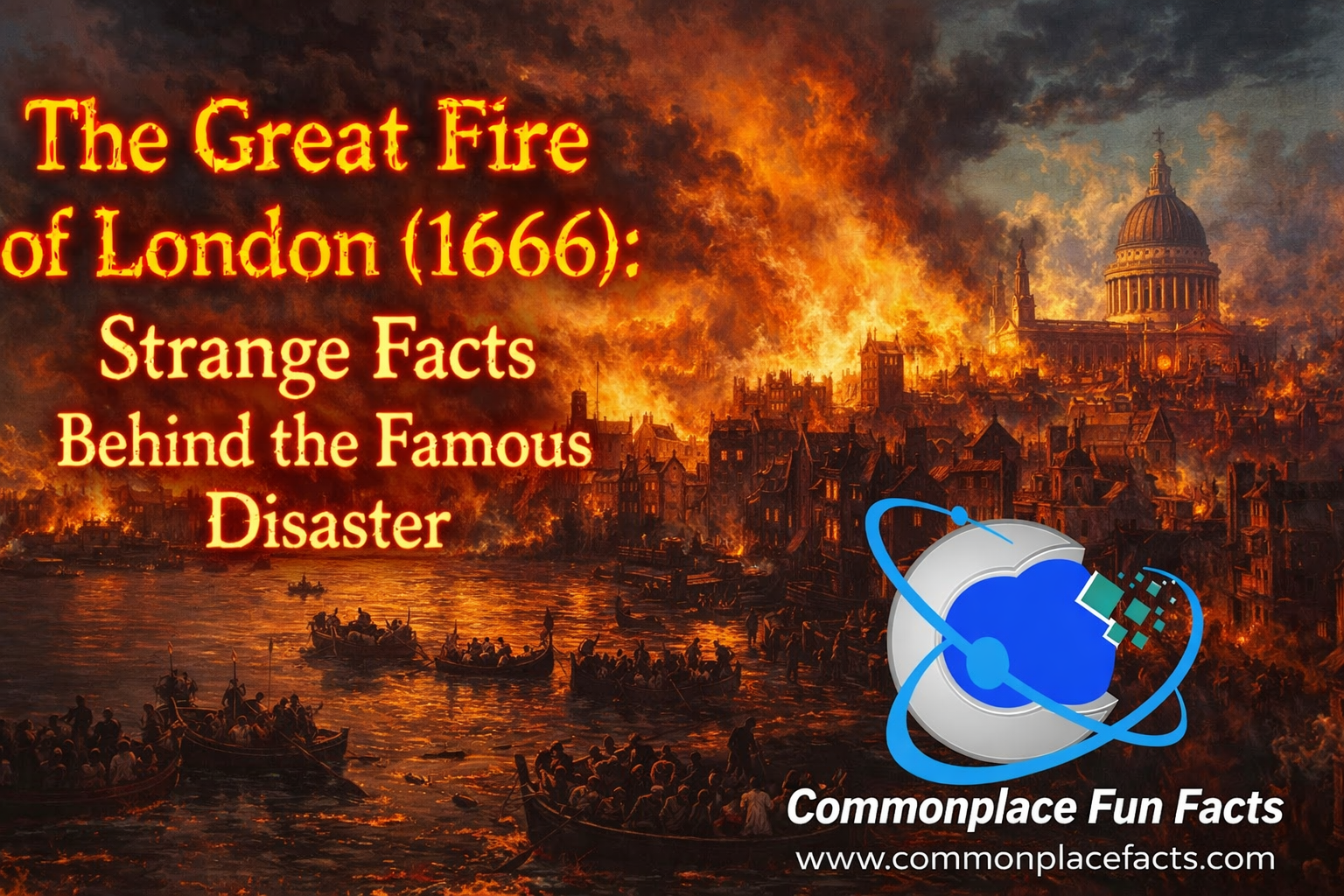

There are some historical events that sound solemn the moment you say them out loud. The Great Fire of London is one of those. It has the kind of name that practically arrives in a powdered wig carrying a violin soundtrack. It sounds grim, immense, and drenched in tragedy, which, to be fair, it was. In September of 1666, a fire started in a bakery on Pudding Lane and burned for days, destroying much of medieval London, including thousands of houses, dozens of churches, and old St. Paul’s Cathedral.
It was a genuine disaster. It displaced huge numbers of people, ruined businesses, turned neighborhoods into ash, and helped redraw one of the most famous cities in the world. At the same time, because history is contractually forbidden from behaving in a tidy and dignified manner, the story is also packed with strange details, bad decisions, improbable rumors, one very memorable cheese-saving maneuver, and the sort of civic leadership that makes you want to hand everyone involved a modern emergency management manual and a stress ball.
In other words, if you are looking for a serious historical event with a surprising amount of oddball material hiding in the rubble, this one is an absolute gold mine. Or perhaps, given the subject matter, a charcoal mine.
Contents
It Started on Pudding Lane, Which Sounds Fake but Isn’t
Unlike the Great Chicago Fire of 1871—where Mrs. O’Leary’s cow has been defending its reputation ever since—there is very little disagreement about where the Great Fire of London began. It started shortly after 1:00 a.m. on Sunday, September 2, 1666, in the bakery of Thomas Farriner on Pudding Lane. That sentence has everything. A baker. A lane named after food. A catastrophe that altered a capital city. It feels less like real history and more like the setup to a nursery rhyme that got badly out of hand. The likely cause was a spark from Farriner’s oven, though, like many people standing suspiciously close to the origin point of a disaster, Farriner denied having done anything wrong.
Farriner and his family escaped by climbing out an upstairs window into a neighboring house. One servant did not make it out and became the fire’s first known victim. That detail alone is enough to remind us that this was not some quaint little mishap involving a singed loaf and the lingering aroma of burnt toast. It was terrifying from the beginning. Still, the setting remains one of history’s more unfortunate branding choices. If your city’s most famous inferno starts on Pudding Lane, future generations are going to remember that part forever.

The Mayor Responded with the 1666 Version of “It’ll Probably Be Fine”
As the flames began spreading, the obvious solution was to pull down nearby houses to create firebreaks. This was a common method at the time, and in a city packed with timber buildings, overhanging upper stories, narrow lanes, warehouses, and a long spell of dry weather, speed mattered. Unfortunately, speed was not the dominant feature of the official response. The Lord Mayor of London, Sir Thomas Bloodworth, hesitated to authorize demolition, reportedly worrying over compensation and ownership questions while the city was busy becoming a bonfire.
Bloodworth is also remembered for one of history’s less successful off-the-cuff assessments, allegedly dismissing the blaze as so minor that “a woman might piss it out.” This observation did not age well. In fact, it aged so badly that it is still dragged out centuries later whenever anyone wants an example of leadership failing to read the room, the weather, the city, and indeed the giant advancing wall of flame.
There is something almost painfully modern about this part of the story. A problem appears. It is clearly growing. Experts recommend immediate unpleasant action. An authority figure stalls, minimizes, and hopes events will become less eventful on their own. They do not. Before long, everyone is running around carrying their possessions and wondering why no one acted sooner. Civilization changes its costume, but the script often remains alarmingly familiar.
London Was Basically Built Out of Kindling and Bad Luck
To be fair to the people of 1666, London was practically designed to lose a fight with fire. Much of the city consisted of tightly packed wooden houses, many with upper floors jutting out over the street so that neighbors could probably borrow sugar through opposite windows without too much effort. Add in a hot, dry summer and strong winds, and the whole place was one spark away from becoming an argument in favor of brick. Warehouses along the Thames were filled with flammable goods, including coal, wood, oils, and tallow, which did not exactly calm the situation.
Once the fire reached those riverside stores, it spread with spectacular efficiency. This was not a polite local blaze moving door to door and waiting its turn. The wind drove it forward so fiercely that the fire created its own chaos, overwhelming bucket brigades, primitive engines, and human optimism. This is one of the details that helps explain why the Great Fire of London feels so outsized in memory. It was not merely large. It was unstoppable in the way only a disaster can be when nature, infrastructure, and human hesitation all decide to join forces.
Samuel Pepys Responded Like a Man Who Understood the Real Stakes: Save the Cheese
No discussion of the Great Fire is complete without Samuel Pepys, the diarist who left one of the most vivid accounts of the event. Pepys watched the fire, reported on it, carried news to the king, observed the panic in the streets, and did what any sensible man of the seventeenth century apparently did in a civic catastrophe: he buried his Parmesan cheese and wine in the garden for safekeeping.

His diary for September 4, 1666, contains the following:
Sir W. Pen and I to Tower-streete, and there met the fire burning three or four doors beyond Mr. Howell’s, whose goods, poor man, his trayes, and dishes, shovells, &c., were flung all along Tower-street in the kennels, and people working therewith from one end to the other; the fire coming on in that narrow streete, on both sides, with infinite fury. Sir W. Batten not knowing how to remove his wine, did dig a pit in the garden, and laid it in there; and I took the opportunity of laying all the papers of my office that I could not otherwise dispose of. And in the evening Sir W. Pen and I did dig another, and put our wine in it; and I my Parmazan cheese, as well as my wine and some other things.
We admire this. Not because it was noble, exactly, but because it was so magnificently human. London may be burning. Government may be faltering. Entire neighborhoods may be turning into smoke. Yet somewhere amid all that, Samuel Pepys thought, “I should probably keep my cheese safe.” It is one of those details that instantly collapses the distance between us and the past. People in 1666 were not abstract historical units wandering around in buckled shoes waiting to become textbook material. They were people. Frazzled, practical, anxious people with favorite foods.
Pepys’ decision to bury his Parmesan and wine makes a lot more sense when you remember that, in 1666, a disaster did not just threaten your house—it threatened your entire supply of food, drink, and anything remotely valuable that could not be quickly replaced. Hard cheeses like Parmesan were imported, expensive, and remarkably durable, making them one of the few foods worth saving in a crisis. With London descending into chaos, shops destroyed, and no reliable way to restock provisions, Pepys was essentially safeguarding a compact, long-lasting store of wealth and calories. In other words, this was not culinary eccentricity; it was practical crisis management—albeit crisis management that happened to involve burying cheese in the backyard like a very refined squirrel.
If you are looking for quirky historical texture in a disaster, Pepys alone scratches that itch. He saw the fire from the river, described the destruction, recorded the confusion, and preserved for posterity one of the most unintentionally funny side notes in disaster history. Generations of historians have studied politics, urban planning, religion, architecture, and class tensions in the Great Fire. The public, meanwhile, has never entirely recovered from the sentence about burying cheese. Nor should it.
Old St. Paul’s Cathedral Was Supposed to Be Safe. It Was Extremely Not Safe.
One of the more dramatic ironies of the fire involves old St. Paul’s Cathedral. Because it was built of stone, many assumed it would be secure. Stone, after all, has an excellent reputation in the not-being-flammable department. Unfortunately, old St. Paul’s was covered in wooden scaffolding during restoration work, which is the sort of detail that causes firefighters to close their eyes and sigh before continuing.

As if that were not enough, the cathedral’s crypt had become a storage place for books and paper belonging to printers and booksellers who also assumed the building was a safe refuge. So when the fire reached it, London did not merely lose a cathedral. It lost a cathedral wrapped in kindling and stuffed with literature. The result was spectacularly awful. Pepys and others described the sight of St. Paul’s in flames, and the destruction of the old cathedral became one of the defining images of the disaster.
It is hard to imagine a more aggressively doomed set of decisions. “Let us protect our books by storing them inside the giant building covered in wood during a citywide fire.” History occasionally behaves like a dark comedy written by someone with very strong feelings about overconfidence.
People Immediately Blamed Foreigners, Because Panic Loves a Villain
As the city burned, fear rapidly turned into suspicion. England was at war with the Dutch, anti-French sentiment was common, anti-Catholic sentiment was already simmering, and Londoners were very ready to believe the fire had been deliberately set by foreigners. In the chaos, mobs attacked outsiders and rumors spread faster than facts. This is another depressingly modern feature of the event: when people do not understand something terrifying, they often decide to understand it incorrectly but with great enthusiasm.
The strangest and saddest example was Robert Hubert, a French watchmaker who confessed to starting the fire even though the evidence against him was absurdly weak and accounts indicated he had not even been in the right place at the right time. He was executed anyway. That part of the story is not quirky so much as grimly revealing. A city in shock wanted a culprit more than it wanted a coherent investigation. One of the odder facts about the Great Fire is that its mythology began forming while the ashes were still warm.
The Monument Spent Years Throwing Shade at Catholics

After the fire, London commemorated the disaster with what is now known simply as the Monument, designed by Christopher Wren and Robert Hooke. It stands 202 feet tall and was placed 202 feet from the site on Pudding Lane where the fire began, which is the kind of architectural symmetry that makes historians nod approvingly. The Monument is itself a wonderful article topic because it is not merely a memorial. It is a giant stone reminder that London enjoys turning trauma into very assertive public art.
For a time, the Monument did more than commemorate the disaster—it pointed fingers. An inscription on the east side confidently blamed Roman Catholics for the fire, describing it as the “burning of this protestant city, begun and carried on by the treachery and malice of the popish faction.” This was less a conclusion based on evidence and more a reflection of the anti-Catholic hysteria of the era. The wording remained in place long enough to attract criticism, including a sharp poetic jab from Alexander Pope—who, being Catholic himself, was understandably unimpressed:
Where London’s column, pointing at the skies,
Like a tall bully, lifts the head, and lies.
The accusation was eventually removed, but not before the Monument had spent years serving as both memorial and misinformation campaign. Modern falsehoods tend to circulate online. Seventeenth-century falsehoods, by contrast, were carved into stone and given a prominent place on the skyline.
The Official Death Toll Is Weirdly Low
One of the oddest facts about the Great Fire is the traditional death toll. Officially, only a small number of deaths were recorded, often given as six. For an inferno that destroyed 13,200 houses, 87 churches, and a huge section of the city, that figure has long struck people as suspiciously tidy. Many historians have argued that the true number was probably higher, especially among the poor, the elderly, and those whose deaths would not have been carefully documented.
This is one of those places where the “fun facts” angle has to be handled with care. The weirdness lies in the records, not in the suffering. London lost enormous amounts of property and displaced masses of people, and the neat little death figure probably says more about seventeenth-century recordkeeping than about the actual mercy of the flames. Sometimes official numbers can be less a final answer than a surviving shrug.
Did Nostradamus Predict the Great Fire of London?
No historical disaster is complete without someone eventually asking, “Yes, but did Nostradamus see this coming?” The Great Fire of London is no exception. Supporters of the 16th-century French seer point to one of his famously cryptic quatrains, which includes references to London, fire, and a puzzling phrase that can be interpreted—if you are feeling generous with arithmetic—as the number 66. On the surface, it sounds impressive. Fire. London. 1666. Case closed, right?

Not exactly. The problem, as with most Nostradamus “predictions,” is that the wording is so vague that it can be retrofitted to almost anything after the fact. Scholars consistently note that his prophecies are ambiguous and open to wide interpretation, which is precisely why they seem so accurate in hindsight. Even in this case, the details don’t line up particularly well. The fire wasn’t caused by lightning, as the quatrain suggests, and many of the other references require creative interpretation at best and wishful thinking at worst.
In other words, Nostradamus didn’t so much predict the Great Fire of London as provide a poetic Rorschach test that later readers eagerly matched to a famous event. If you would like a deeper dive into how these “predictions” tend to work—and why they keep seeming convincing long after the fact—you can read our full breakdown here: “Nostradamus: Plague Doctor, Jam Enthusiast, and the World’s Most Successful Ambiguity Machine.” Spoiler alert: the real magic trick isn’t prophecy—it’s hindsight.
The Fire Was a Disaster, but Also a Brutal Urban Reset
As devastating as the blaze was, it also transformed London. The fire cleared out much of the old medieval city and helped lead to rebuilding in brick and stone, stricter building regulations, and eventually the new St. Paul’s Cathedral. Grand redesign schemes were proposed, including more rational street plans, though many of the most ambitious ideas proved too impractical because property rights, ownership claims, and the basic human desire to get back to normal tend to ruin even the prettiest urban blueprint.
That, too, is part of the strange appeal of this story. The Great Fire is not just about destruction. It is about what happens when a city is forced, violently and suddenly, to confront the weaknesses it had been living with for years. London did not choose modernization in a calm and orderly meeting. It got there by way of flames, rubble, arguments, emergency demolition, and a very memorable diary entry about buried cheese. History rarely takes the scenic route.
As if one disaster weren’t enough, nearly 150 years later London was back at it again—this time with the London Beer Flood of 1814. Some cities just seem to have a talent for memorable catastrophes.
Final Thoughts: A City Burns, Humanity Remains Predictably Human
The Great Fire of London was, without question, a catastrophe. It destroyed homes, displaced tens of thousands of people, and reduced much of the city to ash in a matter of days. It also managed to reveal something far more enduring than the buildings it consumed: people, when faced with crisis, tend to respond in ways that are equal parts practical, irrational, admirable, and occasionally baffling.
One man underestimated the danger. Others hesitated when speed mattered most. Crowds looked for someone—anyone—to blame. A cathedral assumed to be safe turned into a spectacular liability. Meanwhile, Samuel Pepys quietly secured his cheese like a man who understood that although civilization may collapse, that doesn’t mean the Apocalypse has to be endured without some comfort food.
There is a temptation to look back on 1666 and assume we would have handled things better, more efficiently, more rationally, preferably with fewer baked goods involved. History, however, has a way of gently clearing its throat and reminding us that human nature has not undergone a dramatic software update in the intervening centuries. We still delay. We still speculate wildly. We still cling to what matters to us, whether that is a home, a reputation, or, apparently, a well-aged wedge of Parmesan.
In the end, the Great Fire did more than destroy London. It rebuilt it. Out of the chaos came new building standards, new designs, and a city that would eventually rise stronger and more resilient than before. It is a story of loss, certainly, but also of adaptation, stubbornness, and the peculiar ability of human beings to carry on—even when everything around them is on fire.
And if there is a lesson to be taken from it, perhaps it is this: take disasters seriously, act quickly when things begin to go wrong, and if you must bury something in the garden during a crisis, at least make sure it is worth digging up later.
You may also enjoy…

The Great Chicago Fire of 1871: Was Mrs. O’Leary’s Cow the Culprit?
Discover the real story behind the Great Chicago Fire of 1871 — from Mrs. O’Leary’s unfairly blamed cow to wild theories about meteors, dice games, and Pegleg Sullivan. Learn what truly fueled the fire that reshaped Chicago.

The Lord Mayor of London: Modern Money, Medieval Rules, and One Square Mile of Territory
The Lord Mayor of London governs one square mile with medieval ceremony and modern finance. It’s not democracy as you know it.

The London Beer Flood of 1814: History’s Most Absurd Industrial Disaster
Discover the bizarre tale of the 1814 London Beer Flood, a tragic industrial accident that turned porter into a deadly wave.





Leave a Reply to Commonplace Fun FactsCancel reply