

Military history is full of battles remembered for grand strategy, heroic sacrifice, and the bold maneuvering of armies across the map of destiny.
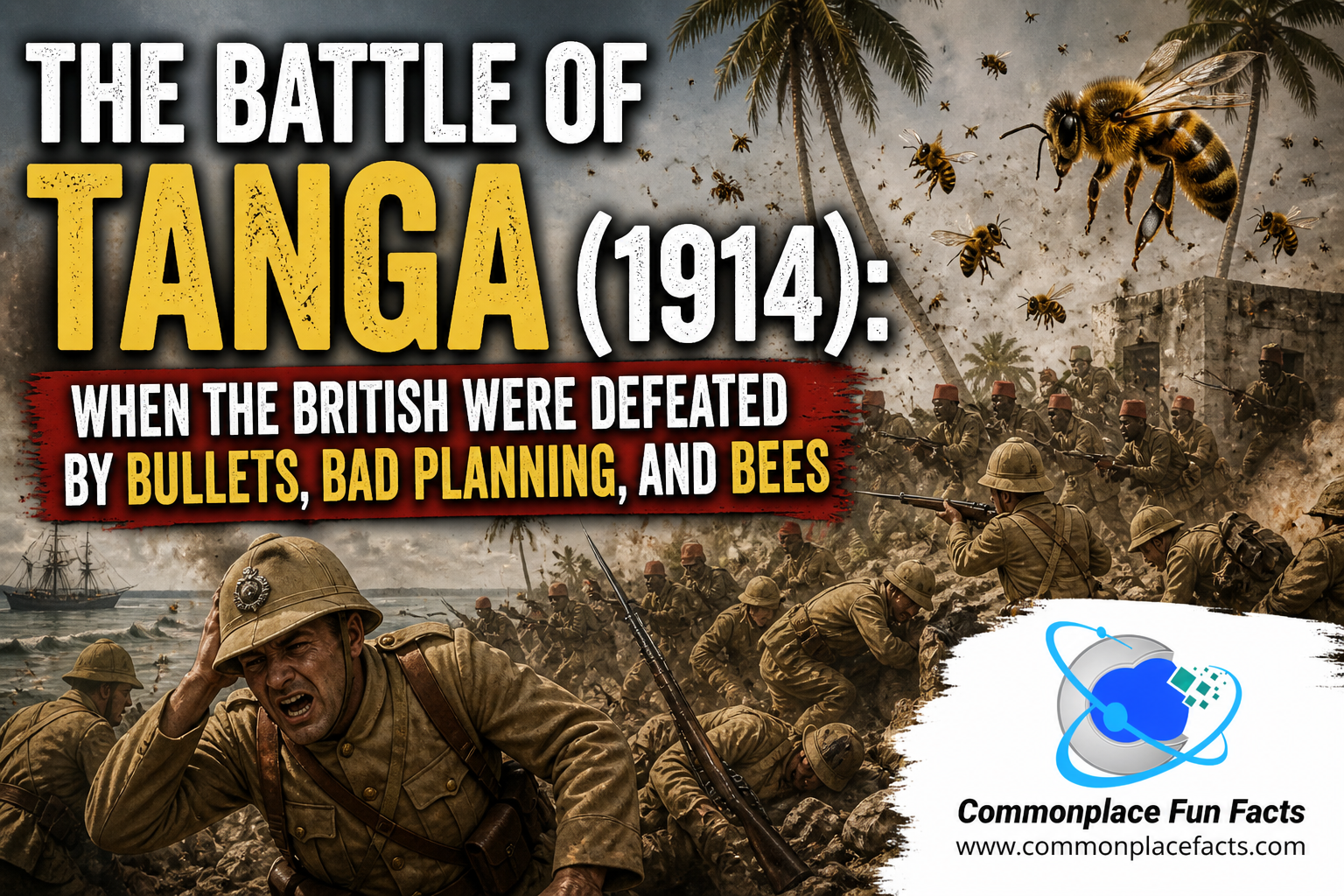
Then there is the Battle of Tanga, which is remembered because a British invasion force got into a fight with German colonial troops, lost control of the situation, and then, as if the universe felt the humiliation needed a garnish, was attacked by bees.
No, that’s not a typo, and it’s not a reference to the Seabees. These were the actual honey-producing, sting-inflicting, wing-bearing insects.
In November 1914, during the opening months of World War I, Britain launched an amphibious assault against the port town of Tanga in German East Africa, the territory that roughly corresponds to modern Tanzania, Rwanda, and Burundi. The plan was to strike quickly, seize the port, disrupt German operations, and show everyone that Britain could wrap up colonial side quests with the same brisk efficiency with which it expected to handle the main war in Europe.
Instead, the whole thing became one of the most embarrassing British defeats of the early war. The Germans won. The British withdrew. Supplies were abandoned. Reputations were bruised. And somewhere in the middle of the chaos, angry African bees earned themselves an immortal footnote in military history.
It was the sort of battle that proves war is not only hell. Sometimes it is hell with wings and a stinger.
Contents
The War Comes to East Africa
When World War I broke out in August 1914, most people naturally focused on Europe. Germany invaded Belgium. Britain entered the war. France fought for survival. Russia mobilized. Austria-Hungary began discovering, with some urgency, that managing a multiethnic empire through vibes and moustache wax was not a long-term strategy.
However, the empires fighting in Europe were also empires everywhere else. Britain, France, Germany, Belgium, and Portugal had colonies scattered across Africa, Asia, and the Pacific. Once the war began, those colonies became targets, bases, supply depots, recruiting grounds, and sources of strategic headaches.
Germany’s African colonies included Togoland, Kamerun, German South West Africa, and German East Africa. Britain and its allies wanted those territories neutralized. They feared German wireless stations, raiders, and colonial forces that could threaten neighboring British possessions.
German East Africa was especially troublesome because of one man: Colonel Paul von Lettow-Vorbeck.

Lettow-Vorbeck was the commander of Germany’s colonial forces there, known as the Schutztruppe. He understood something that many officials back in Europe did not: Germany could not realistically hold East Africa forever against the British Empire. Britain had more ships, more troops, more money, and more everything. In the long run, the German position was about as sustainable as a paper mâché submarine.
This understanding led Lettow-Vorbeck to adopt a different strategy. Instead of trying to defend every inch of territory, he would keep fighting, keep moving, and force Britain to divert men and resources away from the main war. If he could not win East Africa, he could at least make the British pay attention to it. That was annoying, inconvenient, and strategically useful.
The British, understandably, wanted to remove this problem early.
The Target: Tanga
Tanga was an important port on the coast of German East Africa, near the border with British East Africa. It had a harbor, railway connections, and strategic value. Capturing it would give the British a useful base and disrupt German communications inland.

On paper, this seemed reasonable. The British Empire knew how to move troops by sea. It knew how to seize ports. It had done this sort of thing before. A landing at Tanga should have been a manageable operation.
That, of course, was the first warning sign.
The British expedition was led by Major General Arthur Aitken. His force included thousands of troops, many of them from the Indian Army. The plan was to arrive by sea, demand the town’s surrender, land troops, and take possession of the port before the Germans could properly respond.
It had the makings of a clean little imperial operation. The kind that looks terrific on a map, especially if the map cannot talk back.
Unfortunately for Aitken, maps have a nasty habit of omitting such details as enemy competence, difficult terrain, exhausted soldiers, poor communication, and bees.
The Polite Invasion
One of the first problems was that the British did not exactly achieve surprise.
When the British ships arrived off Tanga, they did not immediately storm ashore. Instead, a British officer went into town and demanded surrender. This was very civilized. It was also militarily helpful to the Germans, because it gave them warning that an invasion was underway.
The German defenders at Tanga were initially limited in number, but the delay allowed Lettow-Vorbeck to move reinforcements toward the town. He was outnumbered, but he was also energetic, alert, and not burdened by the assumption that the British would win merely because they believed that they would.
The British, meanwhile, had trouble getting ashore. The landing was slow and confused. Troops were cramped aboard ships, then moved into unfamiliar terrain. Many were tired, seasick, and unprepared for the conditions they were about to face.
The expedition had also suffered from poor intelligence. British planners underestimated German strength and overestimated their own ability to coordinate the operation. The result was a force that looked impressive in total numbers but functioned poorly when actually asked to do the difficult business of invading a defended town.
They also carried a built-in communication challenge that became far more serious once things began to go wrong. Much of the invasion force came from the Indian Army, bringing together units whose soldiers spoke a wide range of languages—Punjabi, Urdu, Hindi, Gurkhali, Tamil, and others—while British officers often relied on intermediaries or a shared lingua franca to issue orders. Under normal circumstances, that system functioned well enough. At Tanga, however, “normal circumstances” packed their bags and left early. Units were mixed during the landing, officers were unfamiliar with their men, orders were delayed or unclear, and the noise and confusion of combat did the rest. Communication did not completely collapse, but it frayed at exactly the moment clarity mattered most. In a battle already suffering from poor planning and mounting chaos, linguistic diversity did not cause the defeat—but it certainly helped ensure that confusion traveled faster than any official order ever could.
That is one of the cruel little truths of military history: an army is not just a headcount. It is training, leadership, supply, communication, terrain, morale, timing, and luck. Remove enough of those and “we have more men” becomes less of a plan and more of a logistical burden.
The Germans Strike Back
Lettow-Vorbeck quickly assessed the situation and moved his troops into position. His force was made up of German officers and African soldiers known as askaris. These askaris were highly trained, disciplined, and accustomed to local conditions. They knew the terrain. They were not wandering around wondering why the shrubbery was shooting back.

As the British advanced toward Tanga, they encountered increasingly determined resistance. The Germans used the cover of buildings, vegetation, and broken ground to slow and disrupt the attack. British units became confused. Command and control deteriorated. Troops fired at shadows, moved without clear coordination, and struggled to maintain formation.
The fighting became especially chaotic around the town itself. At several points, the British appeared to be close to success. Parts of the force pushed forward. German positions were threatened. The defenders were under pressure.
Then the battle began to unravel.
Some British units were inexperienced. Others were tired. Many were operating in unfamiliar tropical conditions. Communications were poor. Officers struggled to understand what was happening. Units lost contact with one another. Rumors spread. Panic flickered through formations that had not expected such a hard fight.
In short, the British operation began to experience that classic military condition known as “everything is going splendidly except for all the things that are happening.”
Enter the Bees
The Battle of Tanga is often called the “Battle of the Bees,” and for once this is not a nickname invented by someone desperately trying to make military history more clickable. Bees really did play a role.

During the fighting, swarms of wild bees were disturbed, apparently by gunfire and the movement of troops through the brush. They attacked soldiers on the battlefield, especially men of the British Indian units. The 98th Infantry was reportedly badly affected. Soldiers were stung, scattered, and thrown into confusion.
There is something almost mythological about this moment. One can imagine the bees surveying the battlefield and deciding that German East Africa had enough problems without British amphibious operations being added to the list.
The bee attack did not single-handedly decide the battle. That is the fun version, but it is not quite fair to the Germans, who did the bulk of the fighting, or to the British planners, who had already done considerable damage to themselves without insect assistance.
Still, the bees mattered. They contributed to disorder at a critical time. They helped break up already strained units. They added pain, panic, and confusion to troops who were already under fire and struggling to understand what was happening.
Imagine being a soldier advancing through unfamiliar terrain while being shot at by an enemy you cannot clearly see. Now add a cloud of furious bees. This is not the moment when calm tactical reflection flourishes. This is the moment when the human brain resigns from the committee and lets the legs make all future decisions.
The Germans were also stung in places, but the story became attached to the British defeat because the British were the ones whose assault collapsed. History is written by the victors, but embarrassing anecdotes tend to be assigned to the losers.
The Retreat
By November 4, the British position had become untenable. The assault had failed. Casualties were mounting. Units were disorganized. The Germans, though far fewer in number, had held the town and inflicted a humiliating defeat.
Aitken ordered a withdrawal. The British reembarked, leaving behind weapons, ammunition, supplies, and medical stores. The Germans captured useful equipment, which was especially valuable given their isolated position in East Africa. Lettow-Vorbeck, who had begun the campaign short of supplies, suddenly received a British-sponsored care package. It was thoughtful of them, really, in the way that leaving your wallet behind during a burglary is thoughtful.
The defeat was bad enough on its own. What made it worse was the scale of British expectations. This was supposed to be a relatively quick operation against a supposedly vulnerable colonial port. Instead, a smaller German force had repelled a much larger British landing force.
The British suffered hundreds of casualties. German losses were much lower. The bees, unfortunately, failed to report their numbers. The exact numbers vary by account, but the result was clear: the invasion had failed, and failed spectacularly.
For Lettow-Vorbeck, Tanga was a major victory. It boosted morale, strengthened his reputation, and supplied his campaign with captured weapons and equipment. For the British, it became a case study in how not to conduct an amphibious landing unless the goal is to provide future historians with material.
Why the British Really Lost
The bees are the memorable part. They are not the whole explanation.
The British defeat at Tanga resulted from a long chain of mistakes and disadvantages. The operation was poorly planned. Intelligence was inadequate. The landing was delayed. The demand for surrender ruined any chance of surprise. The troops were not properly prepared for the terrain. Communication failed. Leadership was uncertain. The Germans reacted quickly and fought effectively.
It was not that the British lacked courage. Many soldiers fought hard under terrible conditions. The problem was that bravery cannot compensate forever for bad planning. Courage is useful, but it is not a substitute for logistics, reconnaissance, leadership, and knowing whether the area into which you are advancing contains hostile insects with air superiority.
The British also underestimated their opponent. This was a common imperial mistake. Colonial forces were often dismissed by European planners who assumed that wars outside Europe would be secondary affairs handled with minimal fuss. Lettow-Vorbeck and his askaris proved otherwise.
The German commander understood mobile warfare in East Africa better than the British expeditionary leadership did. His troops were well trained for local conditions. They fought with discipline and confidence. The British had numbers, but the Germans had cohesion, terrain, and command effectiveness.
The bees helped turn confusion into chaos. They did not create the chaos from nothing.
This would not be the last time the British suffered from mistakes of this nature during World War I. The same combination of overconfidence, flawed planning, and grim reality would reappear on an even larger and more tragic scale at the Somme in 1916, where tens of thousands of soldiers were cut down in a single day and the campaign ultimately produced staggering losses for minimal territorial gain. Read “The Glorious Folly of the Battle of the Somme: A Million Casualties for Six Miles” for a deeper look at how those same patterns played out with devastating consequences.
Lettow-Vorbeck’s Long War
The victory at Tanga set the tone for Lettow-Vorbeck’s East African campaign. He would continue fighting for the rest of the war, tying down Allied forces in a long, frustrating campaign that stretched across East Africa. His army moved through German East Africa, Portuguese East Africa, and Northern Rhodesia, avoiding destruction and forcing the Allies to keep chasing him.

Remarkably, Lettow-Vorbeck did not formally surrender until after the armistice in Europe in November 1918. In practical terms, his campaign did exactly what he intended. It diverted Allied attention and resources. It did not change the outcome of the war, but it made Germany’s small colonial force in East Africa a persistent nuisance.
That is not to romanticize the campaign. East Africa suffered enormously. The fighting brought disease, displacement, famine, forced labor, and hardship to civilian populations. Porters, carriers, and local communities bore a terrible burden. European commanders made decisions, and African civilians paid much of the price. As usual, empire found a way to make its problems everyone else’s emergency.
Tanga, with its comic-opera bee episode, can seem almost funny from a distance. It is funny in the narrow sense that humans planned an invasion and insects made a surprise appearance in the after-action report. It is less funny when placed within the broader East African campaign, which was brutal, exhausting, and devastating for the people living there.
History has a habit of doing that. It gives us one absurd detail, then quietly reminds us that the absurdity took place inside something grim.
Was It the First Major Action of World War I in Africa?
Tanga was one of the first major actions in German East Africa, and it was certainly the first major British attempt to seize a German East African port. However, fighting in Africa had already begun elsewhere. The Togoland campaign started in August 1914, shortly after Britain entered the war. Allied forces moved quickly against Germany’s colony of Togoland, and that campaign ended before Tanga took place.
So it is more accurate to say that Tanga was one of the first major battles of World War I in East Africa, not the first major action in Africa as a whole.
This distinction matters because history is already confusing enough without letting geography wander off unsupervised. Africa was not a single theater with one opening act. It was a continent of separate colonial campaigns, each with its own causes, commanders, timelines, and catastrophes. Tanga belongs specifically to the East African campaign.
The Legend of the Battle of the Bees
Over time, the Battle of Tanga became famous less for its strategic implications and more for the bees. This is understandable. “British amphibious operation defeated after poor planning and German resistance” is historically accurate. “British invasion defeated by bees” is what people remember.
The bee version has the advantage of being vivid, strange, and slightly humiliating. It also compresses a complicated military failure into a single image: imperial troops advancing confidently into Africa, only to be routed by nature’s smallest air force.
That image is not entirely fair, but it is not entirely wrong either.
The bees did attack. They did cause confusion. They did contribute to the collapse of parts of the British force. Soldiers who had already been pushed to the edge by gunfire, heat, exhaustion, and uncertainty suddenly found themselves under attack from insects. One does not need to exaggerate this to understand its effect. Anyone who has ever walked into one angry bee knows the tactical situation deteriorates quickly.
The real story is better than the simplified version because it has layers. Tanga was not merely a freakish episode in which bees saved Germany. It was a battle where overconfidence, poor planning, and underestimation of the enemy combined with battlefield confusion, local conditions, and yes, bees, to produce disaster.
In other words, the bees were not the whole cause. They were the punctuation mark.
Why Tanga Still Matters
The Battle of Tanga matters because it reveals several truths about World War I that are often lost when we focus only on the Western Front.
First, the war was global from the beginning. It was not just trenches in France and Belgium. It was fought in Africa, Asia, the Pacific, and the Middle East. Colonial troops and colonized peoples were drawn into a European conflict that quickly became worldwide.
Second, the battle shows how imperial assumptions could lead to disaster. British planners believed they could quickly seize Tanga with a large expeditionary force. They underestimated the Germans, underestimated the terrain, and overestimated their own readiness. That is a dangerous combination, though admittedly a very popular one among people who own maps.
Third, Tanga highlights the skill and importance of African soldiers in the campaign. Lettow-Vorbeck’s askaris were central to the German victory. They were not background figures in a European contest. They were disciplined, effective fighters whose role deserves more attention than the bee story usually allows.
Finally, Tanga reminds us that history is often shaped by things that do not fit neatly into official plans. Weather, disease, terrain, animals, insects, accidents, rumors, delays, and plain human confusion all matter. Generals may draft orders, but reality gets a vote. At Tanga, reality voted with stingers.
A Defeat with a Sting
The British invasion of Tanga in November 1914 was a humiliating failure. It was intended to be a swift amphibious victory against German East Africa. Instead, it became a confused, costly defeat at the hands of a smaller but better-led German colonial force.
The bees were real. They attacked soldiers during the fighting and helped deepen the confusion. They were not, by themselves, the reason the British lost. The British lost because of poor planning, poor intelligence, poor execution, and a German commander who knew what he was doing.
Still, the bees deserve their place in the story. Not as the sole victors, perhaps, but as history’s most aggressively literal reminder that invading armies should never assume they are only fighting the enemy listed on the order of battle.
At Tanga, the British faced German bullets, German askaris, tropical terrain, bad luck, bad planning, and a swarm of furious bees.
For an empire that prided itself on ruling the waves, it was a rough day to be defeated by the buzz.
You may also enjoy…

Honeybee Sting Pain Index: Exploring the Most Painful Places on the Body to Get Stung
Discover Michael L. Smith’s research on the Honeybee Sting Pain Index, ranking pain from stings on different body parts. Find out which sting hurts the most.

Mad Honey Warfare: The Strange History of Hallucinogenic Honey in Battle
Discover mad honey—how toxic rhododendron nectar creates hallucinogenic honey used in ancient warfare, medicine, and modern curiosity.

The Tanganyika Groundnut Scheme: Britain’s Billion-Pound Peanut Disaster
Discover how Britain’s Tanganyika Groundnut Scheme turned into a billion-pound disaster, revealing the dangers of colonial arrogance and poor planning.






Leave a Reply