
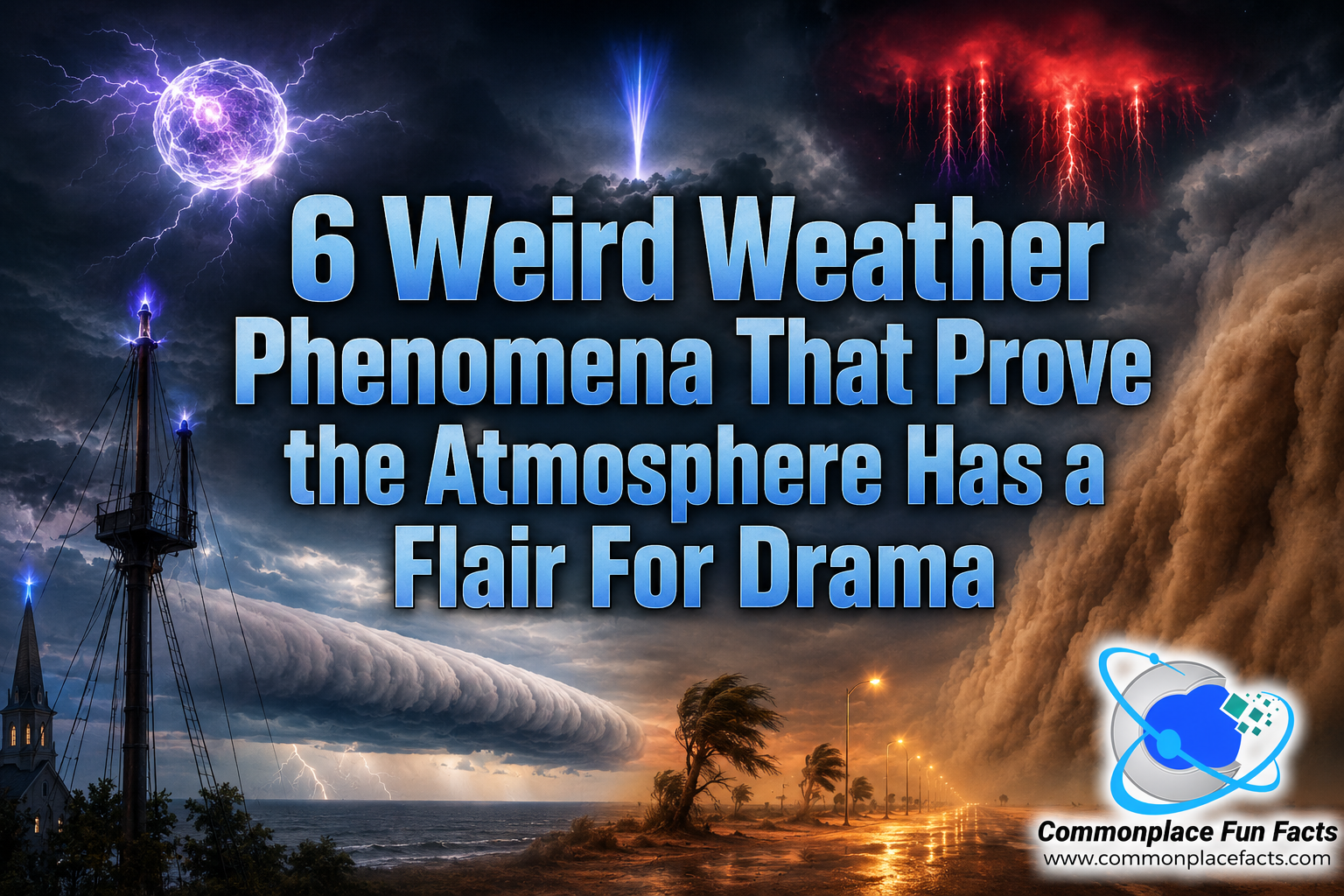

Weather is supposed to be one of the sensible sciences. Air gets warm, air rises, water condenses, rain falls, someone on television points at a map, and the rest of us pretend we understand the difference between “partly cloudy” and “mostly sunny.”
Then, every so often, the sky loses interest in behaving like a responsible adult.
This is how we get frogs falling from the clouds, fish appearing where no fish had any business applying for residency, and mysterious showers of meat that seem less like meteorology and more like a rejected Old Testament plague with catering concerns.
Those, however, are only the appetizers on the buffet table of weird weather phenomona. The weather has an entire menu of strange behavior, and not all of it involves gravity-assisted livestock. Sometimes the sky glows. Sometimes lightning crawls into your house. Sometimes the night suddenly gets hotter for no apparent reason. Sometimes the atmosphere produces something called a “haboob,” a scientific term that cannot be taught to twelve-year-olds without generating unsuppressed giggles.
So let us take a tour through six weather phenomena that sound like folklore, comic book villains, or emergency room explanations no one wants to give twice. Pack an umbrella, a grounding rod, goggles, and whatever emotional support item you use when the sky starts acting theatrical.
Contents
Ball Lightning: The Glowing Orb Nobody Invited
Lightning, in its normal form, is already plenty dramatic. It splits the sky, explodes the air into thunder, and occasionally turns trees into charcoal sculptures. It does not need improvement. It is already the diva of atmospheric electricity.

Ball lightning, however, is what happens when lightning apparently decides that a brief flash is too modest and instead becomes a wandering glowing orb with boundary issues.
Witnesses have described ball lightning as a luminous sphere, usually appearing during or shortly after thunderstorms. It may be white, yellow, orange, red, blue, or some other color from the “Things You Do Not Want Floating Through Your Kitchen” palette. Reports vary wildly, because ball lightning has never been courteous enough to appear in a laboratory on schedule while wearing a name tag. Some accounts describe it as hovering. Others say it drifts sideways, floats through windows, moves along fences or wires, or vanishes with a pop, hiss, bang, or sulfurous smell.
In other words, it behaves less like lightning and more like a paranormal hamster.
The truly maddening part is that ball lightning has been reported for centuries, but scientists still have not fully nailed down what it is. There are theories. Many theories. Theories involving plasma, vaporized silicon, microwaves trapped inside bubbles of ionized air, electrical fields, hallucinations, misidentified ordinary lightning, and possibly the universe just messing with graduate students. The difficulty is that ball lightning is rare, brief, unpredictable, and usually observed by startled people whose first thought is not, “Ah, excellent, I should calmly collect high-quality spectral data.”
This has left ball lightning in that wonderful scientific category of “probably real, but still deeply annoying.”
Unlike ordinary lightning, which appears and disappears in a fraction of a second, reported ball lightning can last several seconds or longer. That is long enough for a person to stop saying, “What was that?” and begin saying, “Why is it coming this way?”
Ball lightning lives right at the intersection of science and ghost story. It is not supernatural, but it has the manners of something that wants you to think it is. A glowing sphere entering a room during a thunderstorm does not inspire calm curiosity. It inspires the kind of ancestral fear normally reserved for tax audits and unexplained basement noises.
Historical accounts are full of unsettling little details. Balls of light have reportedly entered buildings, passed near people, elicited cries of horror, exploded, scorched objects, and vanished without explanation. Much like that girl we dated briefly in college. Some accounts are almost certainly exaggerated, confused, or contaminated by folklore. Others are harder to wave away. That is the charm. Ball lightning refuses to stay politely in one category. It is a weather phenomenon, a physics puzzle, a campfire story, and a reminder that the atmosphere still has hobbies we do not fully understand.
It is also a useful corrective to human arrogance. We like to think we have conquered nature because we have satellites, Doppler radar, and apps that can incorrectly predict rain with impressive confidence. Then the sky says, “Here is a glowing ball of electricity drifting through your living room,” and suddenly we are back to standing in the doorway with a candle, wondering whether Mother Nature is finally paying us back for pulling the wings off a butterfly.
St. Elmo’s Fire: The Patron Saint of Spooky Ship Lighting
If ball lightning is the uninvited glowing orb, St. Elmo’s fire is the atmospheric equivalent of mood lighting for people who are already having a bad evening.

For centuries, sailors reported eerie blue or violet flames dancing around the masts of ships during storms. To ancient and medieval observers, this looked less like a neat electrical discharge and more like the supernatural world had decided to install decorative fixtures. Depending on the circumstances, sailors interpreted it as either a good omen or a bad omen, which is the kind of interpretive flexibility that folklore offers when no one wants to admit they are guessing.
The name comes from St. Erasmus of Formia, also known as St. Elmo, one of the patron saints of sailors. If glowing fire appeared on a mast during a storm, sailors might take it as a sign that St. Elmo was watching over them. This was comforting, assuming one overlooked the fact that the saint’s chosen method of reassurance involved making the ship appear to be haunted by electrical goblins.
The science is less mystical but still impressive. St. Elmo’s fire is a form of corona discharge. When a sharp object, such as a ship’s mast, church steeple, airplane wing, or even the horns of cattle, sits in a strong electrical field, the air around it can become ionized. Electrons get excited. The air glows. The result can look like blue fire, violet flame, or a strange brush of light clinging to pointed objects.
There may also be hissing or crackling sounds, because apparently the phenomenon felt that glowing ominously was not theatrical enough.
St. Elmo’s fire is not the same as lightning, although it is related to the electrical conditions that can produce lightning. Think of lightning as the sky violently paying off an electrical debt all at once. St. Elmo’s fire is more like the sky nervously leaking electricity through the nearest pointy thing.
This explains why it has been seen not only on ships but also on aircraft. Pilots have reported glowing discharges around windshields, propellers, antennas, and wing tips when flying through highly charged storm environments. This is one of those facts that sounds fascinating from a comfortable chair and somewhat less charming if you are currently inside the airplane.
St. Elmo’s fire also has deep literary and historical appeal. It appears in accounts from sailors, explorers, and writers who had no modern vocabulary for atmospheric electricity but plenty of vocabulary for terror. Julius Caesar’s troops reportedly saw something like it on spear tips. Sailors watched it dance above ships in violent seas. Mountain climbers have reported their ice axes or hair crackling in charged air, which is nature’s subtle way of saying, “You may wish to reconsider your position.”
St. Elmo’s fire is one of those phenomena once explained through the language of ancient superstition but not made any less mysterious by modern science. Sailors saw glowing flame on ship masts during storms. Their interpretation was wrong, but their alarm was reasonable. If you are on a wooden ship in a black ocean while the mast starts glowing blue, “patron saint” is not the strangest explanation available. It is certainly better than “electrons,” which would not be invented as a useful dinner conversation topic for quite some time.
And, frankly, even now, “the mast is surrounded by ionized plasma” does not sound much more comforting than “the saint is here.”
Sprites, Blue Jets, and ELVES: Lightning’s Weird Upstairs Neighbors
For most of human history, we assumed lightning was something that happened between clouds and the ground, or between clouds and other clouds, or between clouds and whatever Benjamin Franklin was trying to do with a kite before workplace safety committees existed.
Then scientists discovered that thunderstorms also shoot strange flashes of light upward into the upper atmosphere.
These forms of upper-atmosphere lightning are called transient luminous events, which is a sober scientific phrase meaning “we saw something weird above a thunderstorm and would prefer not to sound like we are writing fantasy novels.” Unfortunately for scientific dignity, the individual types are called sprites, blue jets, gigantic jets, halos, and ELVES.

At this point, meteorology seems to have created a new branch of low-budget airlines run by fans of J.R.R. Tolkien.
Sprites are perhaps the most famous. They are enormous reddish flashes that appear high above thunderstorms, sometimes shaped like jellyfish, carrots, columns, or ghostly curtains. They occur far above ordinary lightning, often in the mesosphere, and may stretch tens of miles upward. They are usually very brief, lasting only milliseconds to a few seconds. That makes them difficult to see from the ground unless conditions are perfect and the observer is lucky.
Blue jets are different. They appear to shoot upward from the tops of thunderstorm clouds, like the storm is trying to fire a warning shot into space. They are blue because of the way atmospheric molecules emit light under those electrical conditions. Gigantic jets are even more dramatic, extending from thunderclouds toward the lower ionosphere.
ELVES, because someone in the naming department had either a sense of humor or insufficient supervision, are expanding rings of light produced high above thunderstorms by electromagnetic pulses from lightning.
Yes, ELVES is an acronym. It stands for “Emission of Light and Very Low Frequency perturbations due to Electromagnetic pulse Sources.” This is a magnificent example of scientists creating a phrase backward from the cool word they wanted. We respect the effort.
For a long time, pilots reported seeing strange flashes above thunderstorms, but such reports were treated cautiously. This was partly because pilots were busy flying aircraft and partly because “I saw a giant red jellyfish above the clouds” sounds like the sort of thing that leads to a quiet conversation with medical personnel. The scientific study of sprites took off after they were accidentally captured on camera in 1989. That is an important detail. One of the most visually spectacular atmospheric phenomena known to science entered the modern record because a camera happened to be pointed in the right direction.
Science: occasionally just being lucky with equipment.
Today, sprites and related phenomena are studied from the ground, from aircraft, and from space. Astronauts aboard the International Space Station have photographed them from above, which is arguably the best seat available if one insists on watching thunderstorms behave like electrical sea monsters.
These upper-atmosphere flashes are useful reminders that thunderstorms are much larger systems than they appear from the ground. When we see lightning, we are seeing the visible downstairs portion of a much taller electrical structure. Above the cloud tops, the storm may be sending faint, enormous, short-lived pulses of light into regions of the atmosphere we rarely think about unless a science teacher is threatening us with a quiz.
It is not every day the opportunity arises to write, with complete seriousness, that scientists are studying ELVES above thunderstorms. Writing Commonplace Fun Facts may not bring wealth, fame, or even decent dental insurance, but there are some perks.
Heat Bursts: When the Night Suddenly Turns Into a Hair Dryer
Most people understand, at least generally, that temperatures tend to fall at night. The sun goes down. The ground cools. The air relaxes. Humans step outside and say useful things like, “At least it cooled off,” because we are simple creatures who enjoy pretending the atmosphere signed a contract.
Then comes the heat burst, which responds, “That is adorable.”
A heat burst is a strange and relatively rare weather event in which the temperature suddenly rises, the humidity drops, and winds may become strong or even damaging, often at night. Imagine sitting in your home after midnight, expecting the air to cool, when suddenly the temperature jumps by ten, fifteen, or even more degrees. The wind kicks up. The air dries out. It feels as though someone opened the door to a giant oven and then, for reasons best known to the atmosphere, aimed it at your neighborhood.
In human terms, it is a little like what we understand menopausal hot flashes are supposed to feel like: an abrupt, deeply unfair internal climate event in which the body apparently decides, without consulting management, that now would be an excellent time to recreate Death Valley under a wool blanket. Except a heat burst does this to an entire town. It is not so much a hot flash as a municipal hot flash, complete with wind gusts, falling humidity, and the possibility that someone’s lawn furniture may relocate three blocks east.
Heat bursts are usually associated with decaying thunderstorms. A thunderstorm that is dying out may still have air descending from it. As rain falls into very dry air beneath the storm, the rain evaporates. Evaporation cools the descending air at first, making it heavier and encouraging it to sink faster. As that air plunges toward the ground, it compresses. Compression warms it. If enough of the moisture evaporates before reaching the surface, what finally arrives is a rush of hot, dry, fast-moving air.
In other words, the storm collapses, and the atmosphere rage-quits downward.
Heat bursts can be startlingly dramatic. The National Weather Service has documented cases where temperatures shot above 100 degrees after midnight. In one often-cited example from Wichita, Kansas, on June 9, 2011, the temperature rose from 85 degrees to 102 degrees in about twenty minutes. That is not weather. That is a prank by an HVAC system with legal immunity.
The winds can be serious, too. Heat bursts have produced damaging gusts strong enough to rip roofs, damage trees, and send patio furniture on unauthorized interstate travel. This is one of the reasons meteorologists are careful not to treat them as mere curiosities. They are fascinating, yes, but so is a bear strung out on cocaine. Fascination is not the same thing as safety.
Heat bursts are particularly interesting because they feel counterintuitive. Storms usually bring cooler air, rain, and relief from heat. A heat burst does the opposite. It comes from a dying storm and delivers heat, dryness, and wind. It is the meteorological equivalent of a restaurant bringing you the wrong order, spilling it in your lap, and then charging extra for the confusion.
The Morning Glory Cloud: Australia’s Giant Rolling Sky Tube
Australia has a reputation for producing wildlife that seems assembled by a committee of pranksters. Venomous snakes, enormous spiders, cassowaries, crocodiles, jellyfish, mammals that lay eggs, and massive Vegemite-fearing bears that drop out of trees all contribute to the impression that the continent was designed after the phrase “What if we made it worse?” was written on a planning board.
Not content with alarming the world at ground level, Australia also offers one of the strangest cloud formations on Earth: the Morning Glory cloud.

The Morning Glory is a type of roll cloud, a long, low, horizontal tube-shaped cloud that can stretch for hundreds of miles. It is most famously associated with the Gulf of Carpentaria in northern Australia, especially near Burketown, Queensland. Under the right conditions, it appears around dawn as an immense rolling cylinder moving across the sky, sometimes in a series of parallel bands.
It looks less like a cloud and more like the atmosphere is unrolling a carpet for some enormous invisible monarch.
The formation involves complicated interactions between sea breezes, temperature inversions, humidity, and atmospheric waves. In simplified terms, air masses interact in such a way that a wave forms in the lower atmosphere. Moist air rises at the leading edge of the wave and condenses into cloud. Then, as the air sinks behind the wave, the cloud evaporates. The result is a cloud that appears to roll forward as the wave travels.
This is not technically a cloud rolling like a log, although it certainly looks like one. The cloud forms and disappears continuously along the moving wave. It is a little like watching a stadium wave made of water vapor, except the stadium is Australia and the fans are invisible physics.
The Morning Glory can be spectacularly long. Some have been observed stretching hundreds of kilometers. They can travel at highway speeds. Their arrival may be accompanied by sudden wind shifts or changes in air pressure. Pilots, particularly glider and microlight pilots, have long been fascinated by them because the rising air associated with the cloud can allow for extended flight along the wave. Some pilots essentially surf the cloud.
This is the point at which normal people say, “That is fascinating,” while Australians apparently say, “Let us fly directly beside the scary sky tube.”
To be fair, pilots who chase Morning Glory clouds are usually skilled and experienced. Still, the phrase “cloud surfing near dawn over northern Australia” sounds like something that warrants much more than a cool phrase on a T-shirt. Those are words that should be permanently tattooed on one’s chest.
Haboobs: The Dust Storms That Earned Their Place on the List
Now we come to haboobs.
Let us be mature about this.
A haboob is a large, intense dust storm caused by strong winds, often from thunderstorm outflows. The word comes from Arabic, and it originally referred to the powerful dust storms of Sudan and surrounding desert regions. In modern meteorology, it is also used for similar dust storms elsewhere, including the American Southwest.

The name is perfectly respectable. It has linguistic history. It has scientific legitimacy. It appears in National Weather Service materials. It is a real word used by real professionals with degrees and laminated identification badges.
It is also “haboob.”
We do not choose the comedy. Sometimes the comedy arrives as a wall of dust.
Haboobs form when strong thunderstorm winds rush downward and outward, hitting the ground and spreading rapidly. In dry, dusty regions, that outflow can scoop up enormous amounts of dust and sand, pushing it forward as a towering wall. The result can look apocalyptic: a brown or reddish cloud swallowing roads, buildings, vehicles, and entire skylines.
If you have ever seen footage of Phoenix being engulfed by a haboob, you know the visual effect. One moment there is a city. The next moment there is a gigantic advancing wall of airborne dirt, and everyone suddenly understands why ancient people invented omens.
Haboobs are dangerous primarily because they can reduce visibility to near zero. That is especially hazardous for drivers. On a highway, a fast-moving wall of dust can turn clear conditions into blindness in seconds. The National Weather Service advises drivers caught in dust storms to pull off the road, turn off lights, set the parking brake, and keep their foot off the brake pedal so other drivers do not mistakenly follow tail lights into danger.
This is another example of weather being educational in the least convenient possible way.
Haboobs can also create respiratory hazards, damage property, disrupt airports, and cover everything in a fine layer of dust. The cleanup afterward must be demoralizing. It is one thing to dust your furniture. It is another thing to dust your furniture because the atmosphere dumped a county’s worth of desert into your living room.
They are most common in arid and semi-arid regions, particularly where thunderstorms occur over loose, dry soil. In the United States, that means places like Arizona, New Mexico, Texas, and other parts of the Southwest are prime candidates. During monsoon season, thunderstorms can produce powerful outflows, and those outflows can generate dust walls that move quickly across the landscape.
Why Weird Weather Captures the Imagination
What unites all these weird weather phenomena is not that they are the same kind of event. They are not. Ball lightning is an unresolved electrical mystery. St. Elmo’s fire is corona discharge. Sprites and ELVES occur high above thunderstorms. Heat bursts come from collapsing storm downdrafts. Morning Glory clouds are atmospheric waves made visible. Haboobs are dust walls driven by thunderstorm outflow.
Scientifically, they are quite different.
Emotionally, however, they all hit the same nerve: the sky is doing something it is not supposed to do.
That is why stories about frog rain, fish rain, meat showers, blood rain, glowing masts, fireballs, red lightning jellyfish, midnight heat blasts, and rolling cloud tubes endure. They remind us that the natural world is not boring just because it is explainable. Explanation does not cancel wonder. It often increases it.
Knowing that St. Elmo’s fire is an electrical discharge does not make it less astonishing that ship masts can glow blue during storms. Understanding that a heat burst involves descending air warming by compression does not make it less bizarre when the temperature jumps after midnight. Learning that sprites are upper-atmospheric electrical discharges does not make giant red jellyfish above thunderstorms any less delightful as a phrase.
Science does not ruin the magic. It simply tells us what kind of magic we are dealing with, then hands us a diagram and ruins one or two perfectly good superstitions.
That is a fair trade.
Human beings have always looked to the sky for signs. We have seen gods, omens, warnings, blessings, punishments, portents, and occasionally fish. Modern meteorology has replaced many of those interpretations with explanations involving pressure, temperature, humidity, electricity, particulates, inversions, and airflow. This is progress. It is also slightly less poetic.
Yet the strangeness remains. The atmosphere is not merely a blanket of gases. It is a restless, electrically charged, moisture-laden, dust-flinging, cloud-sculpting machine wrapped around the planet. Most days it produces ordinary weather. Some days it produces a forecast that sounds like it was written by a committee of Victorian spiritualists, desert survival instructors, and underfunded fantasy authors.
“Chance of thunderstorms, possible sprites, isolated heat burst, and a haboob by evening.”
That is not a forecast. That is a plot outline.
The Forecast Calls for Weird
Weather is one of those subjects that becomes more interesting the closer you look. From a distance, it is small talk. Up close, it is chaos with equations. Clouds become fluid dynamics. Lightning becomes atmospheric electricity. Dust storms become outflow boundaries. Glowing ship masts become plasma. A harmless-looking thunderstorm becomes a machine capable of shooting red flashes toward space and blasting hot air toward the ground.
And occasionally, yes, something falls from the sky that absolutely should not have been airborne in the first place.
The six phenomena here are only a sampling of the sky’s stranger hobbies. There are also blood rains, fire whirls, thundersnow, green flashes, noctilucent clouds, sun dogs, ice halos, volcanic lightning, lenticular clouds, and enough other atmospheric oddities to keep meteorologists busy and bloggers happily distracted until the next inexplicable animal shower.
For now, we can be grateful for two things.
First, most weird weather is rare enough that daily life can continue without constantly checking whether the horizon is glowing, rolling, exploding, or approaching as a wall of dust.
Second, when the atmosphere does behave strangely, there is usually a scientific explanation.
And sometimes the explanation involves a word that brings out the 12-year-old in all of us.
You may also enjoy…

Did Charles Hatfield Really Make It Rain in San Diego? The Strange Tale of a Sewing‑Machine Salesman Turned Rainmaker
Dive into the fascinating true story of Charles Hatfield, the self-proclaimed rainmaker who convinced San Diego he could end a drought in 1916. Discover what he claimed, what actually happened, and whether he really caused the historic floods that followed.

The Kentucky Meat Shower: The Day It Rained Meat in Olympia Springs
In 1876, chunks of raw meat rained down over Olympia Springs, Kentucky. Discover the bizarre “Kentucky Meat Shower,” theories from vulture vomit to divine delivery, and other strange cases of raining frogs and fish.

Can It Really Rain Fish?
Can the weather really cause it to rain fish? Uncover the surprising answer.





Leave a Reply