
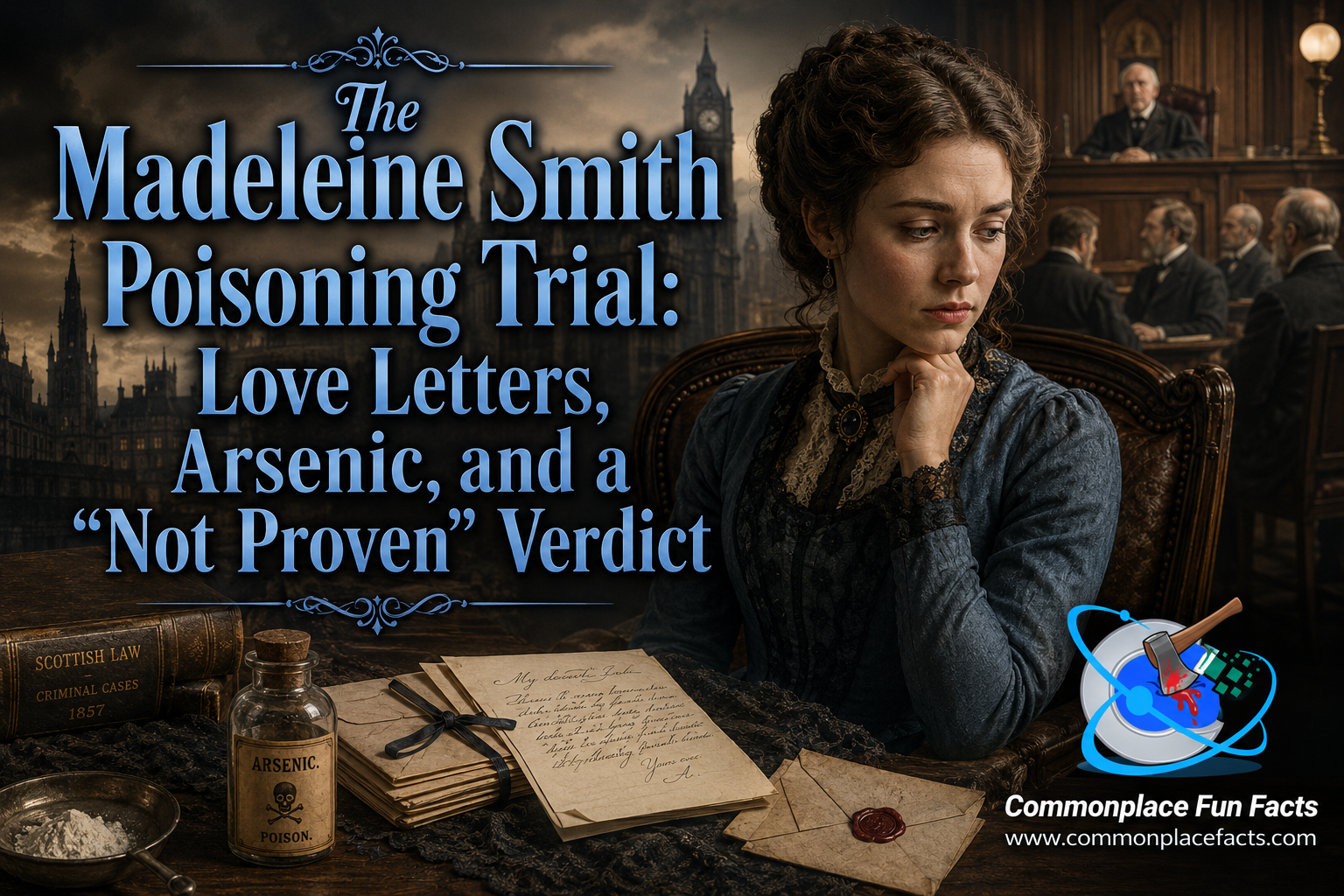

Madeleine Smith: An Exception to Victorian Expectations
Let’s see … Over the past week, we have brought you cheerful and wholesome topics: mythological creatures hiding in a science book, freaky weather phenomena, a beloved cowboy hero, the first Fourth of July, and other subjects carefully selected to bring a smile to your face and perhaps restore a small amount of faith in civilization.
So naturally, it is time for another ghastly murder story.
No need to thank us.
When we think of the Victorian Age, we typically picture society built on propriety, restraint, and furniture heavy enough to survive a minor siege. Then, every so often, a scandal came along and reminded everyone that beneath all those bustles, waistcoats, antimacassars, and moral lectures, people were still people.
Which is to say: messy.
In 1857, Scotland was treated to one of the most sensational criminal trials of the century when Madeleine Hamilton Smith, the daughter of a wealthy Glasgow family, was accused of poisoning her secret lover, Pierre Emile L’Angelier, with arsenic.
The case had everything Victorian newspapers could possibly want: forbidden romance, social climbing, class anxiety, incriminating letters, suspicious pharmacy visits, a dead lover, and a beautiful young woman whose private life did not match the approved instruction manual for Respectable Female Conduct, Volume VII: Sit Quietly and Embroider Something.
The jury ultimately returned a verdict of “Not Proven,” which, in Scotland, meant Madeleine walked free. It also meant polite society was allowed to spend the next 170 years whispering, “Yes, but come on.”
Contents
A Respectable Young Woman, Which Is Always How Trouble Starts
Madeleine Smith was born in 1835 into a prosperous Glasgow family. Her father, James Smith, was a successful architect, and Madeleine moved within the comfortable world of upper-middle-class respectability. In other words, she belonged to the kind of family that expected its daughters to marry well, behave properly, and avoid generating newspaper headlines involving toxicology.

That last part would become an issue.
In 1855, Madeleine met Pierre Emile L’Angelier, a young man from Jersey who worked as a clerk in Glasgow. He was handsome, romantic, emotional, and socially beneath her. That final detail mattered enormously. Victorian courtship was not merely about affection. It was about family approval, social position, money, manners, and ensuring that nobody at dinner had to pretend not to notice that the prospective son-in-law earned less than the household budget for doilies.
Madeleine and L’Angelier began a secret relationship. They exchanged letters. Lots of letters. Mountains of letters. Enough letters to make one suspect that the real victim in this case was the postal system.
Their relationship was passionate, intimate, and deeply imprudent. Madeleine wrote to him in terms that, when read aloud in court, caused Victorian society to clutch its pearls so violently that the national oyster population should have filed a grievance.
To modern readers, the letters may not seem especially shocking. There are no lurid anatomical descriptions, no breathless passages that would trouble a modern streaming service, and nothing that requires anyone to hide the children behind the fainting couch. But in 1857, lines such as “I am your wife,” “won’t I kiss you, my love,” and the especially eyebrow-launching reference to seeing her in her nightdress were enough to scandalize polite society. Madeleine was unmarried, respectable, and supposed to be safely contained within the approved Victorian categories of daughter, future wife, and decorative moral example. Instead, her letters revealed passion, secrecy, physical intimacy, and a deeply inconvenient familiarity with midnight arrangements.
Victorian society was prepared to believe many things about young women. It was not prepared to believe they had inner lives, romantic appetites, and a scandalous use of stationery.
Enter the Proper Suitor
Eventually, Madeleine’s family found her a more suitable match: William Harper Minnoch, a prosperous Glasgow merchant. He had the great advantage of being socially appropriate, financially respectable, and apparently not in possession of a bundle of compromising letters.
Madeleine accepted Minnoch’s proposal. This created a problem, because she had previously promised herself, or at least something very close to herself, to L’Angelier.
L’Angelier did not take the news well.
According to the prosecution’s theory, he refused to return Madeleine’s letters and threatened to expose her if she did not marry him. In the world Madeleine inhabited, exposure would have been catastrophic. Her engagement could collapse. Her family would be humiliated. Her reputation would be permanently damaged. She would not merely be embarrassed; she would be socially ruined.
And Victorian social ruin was not like modern embarrassment, where someone completely butchers a song at a karaoke bar and everyone forgets by Thursday morning. In Madeleine’s world, reputation was infrastructure. Lose it, and the whole building came down.
This is what prosecutors would later call “motive.”
And then came the arsenic.
Arsenic: The Victorian Household Product That Kept Detectives Busy
Arsenic was one of the nineteenth century’s favorite poisons, which says less about arsenic’s charm than about the nineteenth century’s alarming relationship with chemical safety.

It was used in medicines, cosmetics, dyes, wallpapers, rat poison, and various household products. It was available from chemists. It was deadly. It could mimic natural illness. It could be administered gradually. It was, from the murderer’s perspective, disturbingly convenient.
From the victim’s perspective, of course, the reviews were less favorable.
Madeleine purchased arsenic in the weeks before L’Angelier’s death. She said she needed it for cosmetic purposes, reportedly to wash her arms and face. This sounds absurd to modern ears, but arsenic did have a long and horrifying association with beauty products. The nineteenth century occasionally treated “glowing complexion” and “slow poisoning” as if they were neighboring departments in the same store.
The prosecution alleged that Madeleine administered poison to L’Angelier on multiple occasions in February and March 1857. He suffered episodes of severe illness. Then, in the early hours of March 23, 1857, Pierre Emile L’Angelier died.
An examination found arsenic in his body.
At that point, the situation began to look very bad for Madeleine Smith.
The Letters Come Back to Haunt Everyone
After L’Angelier’s death, investigators discovered Madeleine’s letters among his possessions. This was the moment when a private scandal became a public feast.
The letters were central to the prosecution. They helped establish the nature of the relationship, the intensity of the attachment, the shift in Madeleine’s feelings, and the possible motive for murder. If L’Angelier had threatened to reveal them, then Madeleine had a powerful reason to want him silenced.
But the letters did something else, too. They turned the trial into a national sensation.
The public was not merely interested in whether Madeleine had poisoned L’Angelier. The public wanted to read the letters. The case became part murder trial, part morality play, part tabloid circus, and part extremely uncomfortable family meeting conducted on a national scale.
The letters were read aloud in court. Newspapers printed them. Readers devoured them. Everyone pretended to be shocked for moral reasons, which is usually how people describe their enjoyment of scandal when they do not want to admit they are enjoying scandal.
Madeleine’s words revealed an intimate relationship that respectable society believed should not exist, or at least should not exist in writing. The letters showed passion, longing, conflict, and emotional dependence. They also showed that Madeleine had not been the passive innocent some might have preferred her to be.
This mattered. In a murder trial, the question should have been whether she killed L’Angelier. But in public opinion, another question hovered over the proceedings: What kind of woman was she?
That is always a dangerous question, because once society starts measuring a woman against its preferred idea of womanhood, evidence can get tangled up with moral judgment. Madeleine was accused of murder, but she was also put on trial for being sexual, secretive, clever, and inconveniently human.
The Prosecution’s Case: Motive, Means, and a Very Suspicious Timeline
The Crown’s argument was straightforward enough.
Madeleine had motive. L’Angelier had letters that could destroy her future. She was engaged to another man. She needed the problem to go away.

She had means. She purchased arsenic shortly before L’Angelier’s death.
There appeared to be opportunity, or at least the prosecution wanted there to be. L’Angelier had been ill before. He had received communications from Madeleine. He had gone out on the night before his death. He returned terribly sick. He died of arsenic poisoning.
That is a grim chain of facts. It is not, however, the same thing as proof beyond reasonable doubt.
And that was the Crown’s problem.
No one could definitively prove that Madeleine and L’Angelier met on the fatal night. No witness saw her give him poison. No servant brought forward the fatal cup of cocoa, tea, coffee, or whatever sinister beverage the imagination prefers. The case depended on inference: motive plus arsenic purchase plus death by arsenic plus suspicious correspondence.
That may be enough to make a crowd mutter darkly. It is not always enough to hang someone.
And in 1857, hanging was very much on the table. This was not a symbolic legal exercise. If convicted, Madeleine Smith could have faced execution. Victorian criminal law was not known for its warm, restorative approach to people accused of poisoning former lovers.
The Defense: Doubt, Doubt, and More Doubt
Madeleine’s defense team did not have to prove that she was innocent. They had to show that the Crown had not proved she was guilty.
That distinction mattered enormously.
The defense attacked the gaps in the timeline. They challenged the interpretation of the letters. They emphasized the absence of direct proof that Madeleine administered poison. They raised the possibility that L’Angelier had taken arsenic himself, either accidentally or intentionally.

There was evidence that L’Angelier had been emotionally distressed. He had threatened exposure. He felt rejected. He may have had reason to dramatize his suffering, punish Madeleine, or even take his own life. Whether that theory was likely is one question. Whether it was possible enough to create reasonable doubt was another.
The defense also benefited from practical difficulties in reconstructing the correspondence. Many of Madeleine’s letters were undated. Some were separated from their envelopes. Establishing exactly when certain letters were written, received, and answered became maddeningly difficult. For a case that depended heavily on sequence, this was not a small problem.
Chronology is the quiet accountant of criminal trials. It does not make dramatic speeches, but when it refuses to balance, everyone has trouble.
In the end, the jury had to decide whether the Crown had proved that Madeleine Smith had murdered Pierre Emile L’Angelier. The evidence was suggestive. It was troubling. It was morally explosive. But was it legally conclusive?
The jury said no.
“Not Proven”: Scotland’s Great Legal Shrug
On July 9, 1857, the jury returned its verdict.
Not Proven.
In Scots law, “Not Proven” was an acquittal. It had the same legal effect as “Not Guilty.” Madeleine could not be punished for the crime. She walked free.
But “Not Proven” carried a different social flavor. It did not declare innocence in ringing tones. It did not say, “This person clearly did not do it.” It said, in effect, “The prosecution failed to prove it.”
Or, in the less formal version: “We are backing away slowly and refusing to make eye contact.”
The verdict became one of the most famous examples of Scotland’s third verdict. It suited the Madeleine Smith case almost too perfectly. The jury did not convict her, because the evidence had holes. But society did not fully acquit her either, because the circumstances smelled strongly of arsenic and bad decisions.
That ambiguity is part of why the case endured. Had she been convicted, the story would have become a grim tale of passion and punishment. Had she been found plainly not guilty, it might have faded faster. “Not Proven” preserved the mystery in legal amber. It gave everyone permission to keep arguing forever, which historians and true crime enthusiasts have nobly done, because someone has to keep the kettle boiling.
Was She Guilty?
This is the question that has followed Madeleine Smith ever since.

The evidence against her was serious. She had motive. She bought arsenic. L’Angelier died of arsenic poisoning. The relationship had deteriorated. His possession of her letters threatened her future. The prosecution’s theory was not ridiculous. It was, in fact, deeply plausible.
But plausibility is not proof.
The missing link remained the fatal administration. How did the arsenic get into L’Angelier? Did Madeleine give it to him? Did he take it himself? Was it suicide? Was it an attempt to frighten or manipulate her that went wrong? Was there another explanation lost to time?
We do not know.
That is unsatisfying, of course. True crime stories usually train us to expect a final answer, preferably delivered in the last ten minutes with ominous music and a slow zoom on a teacup. The Madeleine Smith case refuses to cooperate. It gives us evidence, motive, scandal, and atmosphere, then leaves the most important fact just out of reach.
This may be why the case still feels so modern. We are used to trials becoming cultural events. We know what it looks like when the public decides it is watching not just a legal proceeding, but a referendum on gender, class, sexuality, and morality. We know how quickly evidence can become entertainment. We know how eagerly people read private messages once a scandal gives them permission.
The technology has changed. The appetite has not.
Life After the Trial
After her acquittal, Madeleine Smith left Glasgow. Her reputation, while legally preserved from conviction, was socially radioactive. The verdict allowed her to live, but not to resume her old life as if nothing had happened.
In 1861, she married George Wardle, an artist associated with William Morris. She later lived in England and eventually in the United States. She used other names and appears to have guarded her past carefully. This was understandable. “Once accused of poisoning former lover after scandalous correspondence” is a difficult item to manage on a social calling card.
Madeleine lived a long life, dying in 1928 at the age of 92 in New York City. By then, the world had changed almost beyond recognition. Queen Victoria was long gone. The First World War had come and gone. Women had gained voting rights in Britain. Automobiles, telephones, and motion pictures had altered daily life. But the Madeleine Smith case remained lodged in the public imagination.
Some scandals fade because they are too simple. This one endured because it was never simple enough.
Why the Madeleine Smith Trial Still Fascinates Us
The Madeleine Smith case is not merely interesting because of the arsenic. Though, to be fair, arsenic does tend to command attention. It has a way of entering a story and refusing to be a background character.
The case fascinates because it sits at the intersection of several Victorian anxieties.
There was anxiety about class. L’Angelier was not the man Madeleine was supposed to marry. Their relationship crossed social boundaries her family would never have approved.
There was anxiety about women’s sexuality. Madeleine’s letters revealed that she was not the innocent ornamental daughter Victorian society wanted her to be. She desired. She schemed. She chose. She regretted. She tried to escape consequences. In other words, she behaved like a person, which was apparently frowned upon.
There was anxiety about poison. Arsenic represented the terrifying possibility that murder could happen quietly, domestically, invisibly. No pistol. No dagger. No dramatic duel at dawn. Just a powder, a cup, a stomachache, and a death certificate that might not tell the full story.
And there was anxiety about proof. Everyone wanted certainty. The law could not supply it.
That may be the most haunting part of the case. Madeleine Smith’s story reminds us that trials are not machines that produce truth. They are human systems that weigh evidence according to rules. Sometimes the truth is obvious. Sometimes it is hidden. Sometimes it is buried under bad recordkeeping, unreliable witnesses, missing envelopes, social prejudice, and enough emotional chaos to power a three-volume Victorian novel.
The Verdict That Became the Story
In the end, Madeleine Smith was neither convicted nor cleared in the public mind. She was acquitted under a verdict that sounded like an unfinished sentence.
Not Proven.
Two words. Legally decisive. Socially evasive. Historically irresistible.
It was the perfect ending to a case built on uncertainty. Did she poison L’Angelier? Did he poison himself? Were the letters proof of motive or merely proof that young people in the nineteenth century were every bit as reckless as young people in every other century, just with better penmanship?
The answer remains elusive.
What we can say is that the Madeleine Smith trial exposed the fault lines beneath Victorian respectability. It showed how quickly private passion could become public spectacle. It showed how class and gender shaped the way evidence was interpreted. It showed that a woman could escape the gallows and still be sentenced to a lifetime of suspicion.
And it gave Scotland one of its most famous legal mysteries: a dead lover, a stack of letters, a young woman with arsenic, and a verdict that managed to acquit her while leaving everyone in the room deeply uncomfortable.
Which may be the most Victorian ending imaginable.
You may also enjoy…

Half-Hangit Maggie Dickson: The Bizarre Story of the Woman Who Survived Her Own Execution
The true story of Half-Hangit Maggie Dickson, the 18th-century Scottish woman who survived her own execution—and changed legal history.

William Brodie: The Deacon, the Double Life, and the Original Jekyll & Hyde
Discover the true story of William Brodie, Edinburgh’s respectable Deacon who secretly led a life of burglary — and inspired Robert Louis Stevenson’s Dr. Jekyll and Mr. Hyde. A tale of double identities, scandal, and poetic justice.

The Burke and Hare Murders: The Shocking Cadaver Scheme That Transformed 19th Century Medicine
Explore the Burke and Hare murders, the shocking 1828 Edinburgh crimes in which two men killed to supply cadavers to medical schools—sparking outrage and helping lead to the Anatomy Act of 1832.





Leave a Reply