

There are some phrases that should make every sensible person pause.
“Experimental surgery.”
“Budget-friendly parachute.”
“The badger seems friendly.”
And then there is the magnificent Cold War phrase: peaceful nuclear explosion.
This was not satire. It was not a phrase invented by a screenwriter who had just been told to make Dr. Strangelove “a little more subtle.” During the Cold War, both the United States and the Soviet Union spent years seriously investigating whether nuclear bombs could be used for peaceful purposes. Dig a canal. Create a harbor. Stimulate natural gas production. Make underground storage cavities. Put out fires. Propel ships through space. Possibly improve agriculture, mining, geology, and the general mood of the Ministry of Extremely Loud Ideas.
The American version was called Project Plowshare, named after the biblical image of beating swords into plowshares. It was a lovely phrase, though one suspects Isaiah did not have in mind, “Let us detonate a thermonuclear device under Nevada and see if the resulting crater is useful.”
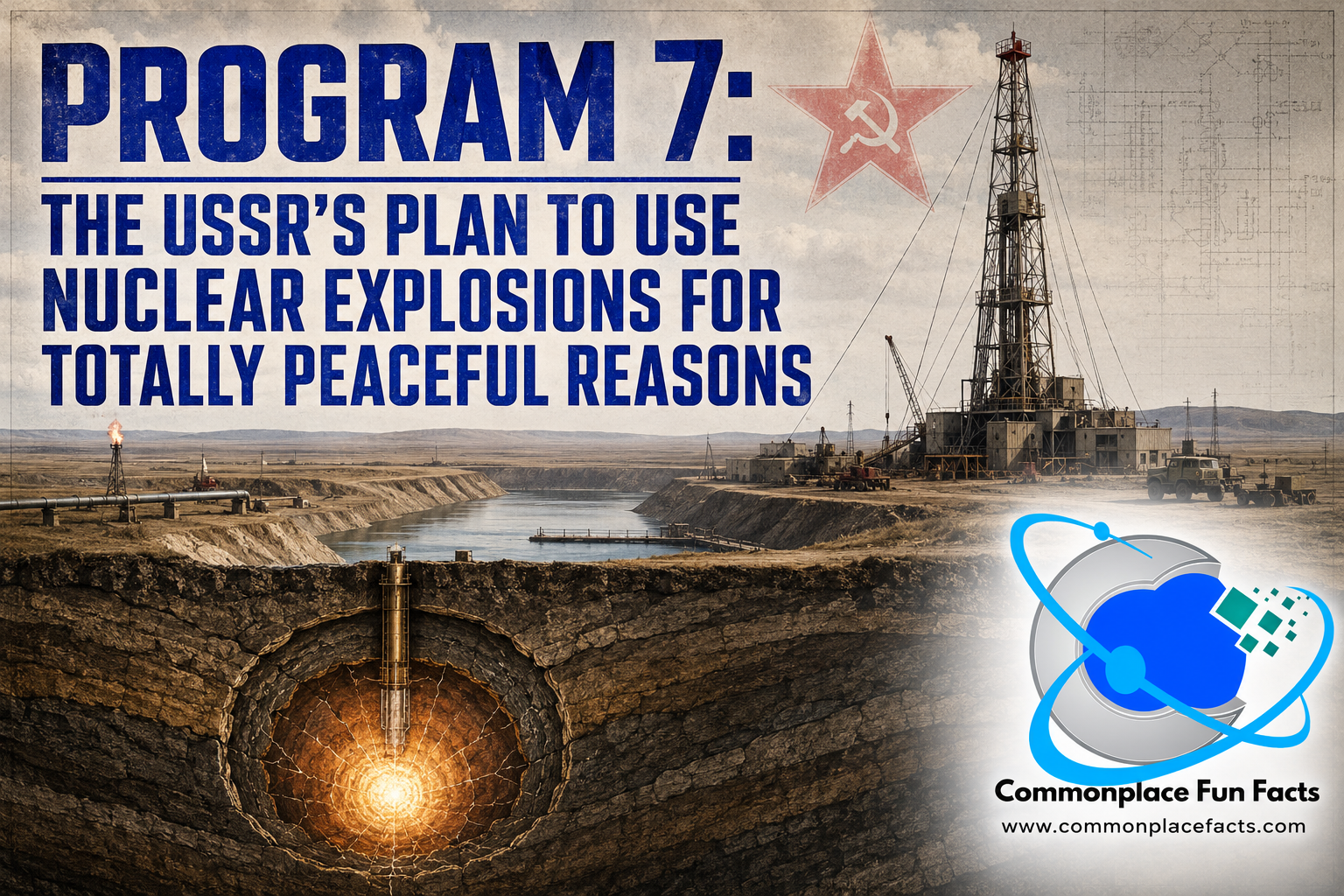
The Soviet version was even more ambitious. Under a program commonly known as Nuclear Explosions for the National Economy—with Program 7 specifically devoted to peaceful nuclear explosions for industrial and scientific use—the USSR carried out scores of nuclear detonations between 1965 and 1988. Depending on how one counts related programs, device-development tests, simultaneous explosions, and industrial applications, the total is usually given at roughly 124 Soviet peaceful nuclear tests, with Program 7 often described as involving 115 to 119 explosions.
In other words, the Soviet Union looked at the most destructive technology ever devised by humankind and said, “Yes, but can it help with drilling?”
Contents
The Atomic Age Discovers the Suggestion Box
To understand how anyone thought this was reasonable, we need to visit the early Atomic Age, a period when nuclear energy was not merely a technology but a mood. After Hiroshima and Nagasaki demonstrated that atomic weapons could destroy cities, governments and scientists became eager to show that nuclear power could be more than a terrifying geopolitical murder button.

Nuclear reactors could make electricity. Nuclear isotopes could help medicine. Nuclear science could teach us about physics, agriculture, industry, and the universe. These were real and often beneficial developments.
Then someone took the next logical—or perhaps deeply illogical—step: if a nuclear reactor could help humanity, maybe a nuclear bomb could too.
The idea was not completely absurd from an engineering standpoint. Nuclear explosives release enormous energy in a tiny fraction of a second. If you need to move a mountain, fracture rock, collapse a runaway gas well, or create a massive underground cavity, a nuclear device can certainly do the “moving things around” part of the job. The difficulty is that it also brings along several uninvited guests, including radiation, fallout, seismic shock, political alarm, and the small public-relations challenge of explaining why your infrastructure plan appears on a mushroom-cloud-shaped letterhead.
The Soviet Union, never shy about large-scale engineering projects, found the concept appealing. It had enormous territory, vast mineral resources, hard-to-reach oil and gas fields, and a government structure that did not always pause for local town hall meetings. If something required a large hole in the ground, the Soviet state was perfectly capable of providing one.
Sometimes with a shovel.
Sometimes with a nuclear device.
Because apparently there are levels of enthusiasm.
Program 7: Nukes for the National Economy
Program 7 began in the mid-1960s and was devoted to testing industrial nuclear charges for supposedly peaceful activities. It was part of the broader Soviet effort to turn nuclear explosions into tools of economic development.
The applications were varied, which is a polite way of saying the program resembled a brainstorming session where no one was allowed to say, “Perhaps we should use regular explosives, comrades.”
Program 7 included explosions for geological exploration, oil and gas production, creation of underground storage cavities, excavation of reservoirs and canals, ore crushing, toxic waste storage, coal mining assistance, research into radioactive migration, and the extinguishing of runaway gas fountains.
The numbers commonly associated with Program 7 break down roughly this way:
- 39 explosions for geological exploration, using seismic waves from nuclear blasts to study underground structures and search for natural gas deposits.
- 25 explosions to intensify oil and gas production.
- 22 explosions to create underground storage cavities for natural gas.
- 5 explosions to extinguish large natural gas fountains or blowouts.
- 4 explosions for channels, reservoirs, or dams, including the famous Chagan test in Kazakhstan and the Taiga test connected to the proposed Pechora–Kama Canal.
- 2 explosions for crushing ore in open-pit mines.
- 2 explosions for creating underground storage for toxic waste.
- 1 explosion to help coal mining in an underground mine.
- 19 research explosions, many focused on how radioactivity migrated after the blasts.
If this sounds like the Soviet Union created an entire Department of “What If We Used a Nuke for That?”, then yes. That is basically the article.
Chagan: Let’s Make a Lake the Hard Way
The first major Soviet peaceful nuclear explosion was Chagan, conducted on January 15, 1965, near the Semipalatinsk Test Site in what is now Kazakhstan. The goal was to create a reservoir by blasting a crater near the dry bed of the Chagan River.
The device had a yield of about 140 kilotons, making it much more powerful than the bomb dropped on Hiroshima. It was placed underground and detonated to create a large crater. The idea was that the crater’s rim would help dam the river during high-water periods, forming an artificial lake.
Technically, it worked.
This is where we must be careful with the word “worked,” because “the nuclear bomb successfully made a hole” is not the same as “great news for municipal planning.”
The explosion threw a tremendous amount of earth into the air and created a crater roughly 400 meters across and about 100 meters deep. Water eventually filled it, forming what became known as Lake Chagan—or, more ominously and accurately, “Atomic Lake.”
There were obvious problems. Shallow nuclear excavation releases radioactive material much more readily than deeply contained underground blasts. Chagan produced a radioactive plume detected far away, reportedly even over Japan. This raised international complaints because the 1963 Partial Test Ban Treaty prohibited nuclear tests that spread radioactive debris outside national boundaries.
In short, the Soviets tried to create a peaceful lake and accidentally created a diplomatic incident with shoreline.
The reservoir remained, and so did the contamination concerns. The Soviet promotional film footage of officials swimming in the lake has become one of those Cold War images that causes the modern viewer to say, “I am not a nuclear physicist, but I have questions.”
Urtabulak: Fighting Fire with Nuclear Fire
If Chagan was the Soviet attempt to make a lake with a nuke, Urtabulak was the attempt to put out a fire with one.
And here, astonishingly, the story becomes slightly less ridiculous because this one actually did what it was supposed to do.
In 1963, a natural gas well at the Urtabulak field in southern Uzbekistan suffered a catastrophic blowout. High-pressure gas escaped, ignited, and became an enormous roaring flame. Conventional attempts to stop it failed. The fire burned for nearly three years, consuming vast quantities of natural gas every day.
At some point, Soviet engineers proposed a plan that sounded like what would happen if Wile E. Coyote had access to classified weapons design.
They would drill a slanted relief well near the burning gas well, lower a specially designed nuclear device into position, and detonate it underground. The explosion would crush and shift the surrounding rock, sealing the gas flow.
On September 30, 1966, the Soviets detonated a roughly 30-kiloton nuclear device about 1,500 meters underground. The explosion collapsed the rock around the well. The gas stopped. The fire went out within seconds.
This was the first known successful use of a nuclear explosion to extinguish a runaway gas well, and it was successful enough that the Soviets repeated the method several times. Of five such attempts, most reportedly succeeded, though not every case went according to plan. One does not like to be picky when the category is “nuclear firefighting,” but there it is.
The Urtabulak case is probably the strongest argument the peaceful-nuke advocates ever had. The blast was deep underground, the geology helped contain the radioactivity, and the practical result was immediate. A fire that had resisted every conventional effort for years was snuffed out by one carefully placed underground nuclear explosion.
Still, even when the method worked, it had the slight drawback of requiring someone to write the sentence, “We recommend detonating an atomic bomb under the gas field.” That is not the sort of memo one wants to accidentally leave in the copier.
Geology by Detonation
The largest category of Program 7 explosions involved geological exploration. This sounds more scientific and less alarming than “lake-making by thermonuclear landscaping,” and in some ways it was.
The principle was straightforward. When an underground nuclear device detonates, it sends seismic waves through the earth. By measuring how those waves travel, reflect, and refract through underground layers, scientists can learn about deep geological structures.
In theory, this could help locate natural gas deposits, map the crust, and improve understanding of the earth’s interior. Nuclear explosions provided extremely strong seismic signals, allowing researchers to gather data over vast distances.
In practice, however, it still meant using nuclear weapons as geological flashlights.
The Soviet Union’s geography made this tempting. It had immense remote regions where conventional seismic surveys could be difficult, expensive, or limited. A small underground nuclear blast could produce a seismic signal far stronger than chemical explosives.
The problem, as usual, was containment. A properly designed underground test could trap radioactive materials below the surface. A poorly contained one could vent contamination into the environment. Even when the blast itself remained underground, later drilling, groundwater movement, or geological instability could create long-term concerns.
This is the recurring theme of peaceful nuclear explosions: the engineering idea is often understandable, while the aftercare feels like leaving a dragon in the basement because it is technically useful for heating the house.
Oil, Gas, and Underground Cavities
Program 7 also explored ways to use nuclear explosions to stimulate oil and gas production. The concept resembled hydraulic fracturing in the broadest possible sense, except instead of pumping fluid under pressure to crack rock, the plan was to set off a nuclear device underground and let physics do the yelling.

The explosion would fracture surrounding rock, increasing permeability and allowing oil or gas to flow more freely. In some cases, it could create cavities that might help collect gas or fluids.
The Soviets also used nuclear blasts to create underground cavities for gas storage, especially in salt formations. Salt is useful because it can deform and seal itself over time, making it suitable for storage caverns. Conventional methods can create such cavities too, but nuclear explosives offered speed and scale.
Again, the idea was not stupid in the sense of “no engineer could explain this.” It was stupid in the sense of “the explanation contains the phrase ‘acceptable levels of radioactive contamination’ much earlier than most of us would prefer.”
Oil and gas stimulation produced mixed results. Some tests increased production. Others produced gas contaminated with radioactive isotopes, making it difficult or impossible to use commercially. This same problem helped doom America’s Project Plowshare gas-stimulation experiments. It turns out that consumers are surprisingly unenthusiastic about heating their homes with gas that glows in the résumé, if not literally in the pipeline.
Taiga and the Canal That Wasn’t
One of the grandest Soviet dreams was to use nuclear explosions to dig canals.
This was not unique to the USSR. American planners under Project Plowshare considered using nuclear devices for harbors, canals, road cuts, and other civil engineering projects. If you need to remove millions of tons of earth, nuclear explosives can move the earth. They are very persuasive.
The Soviet version focused in part on the proposed Pechora–Kama Canal, a massive water-diversion project that would have redirected northern river water toward the Volga basin and the Caspian Sea. The plan envisioned a canal more than 100 kilometers long, with nuclear explosions potentially used to excavate sections of the route.
The Taiga test in 1971 was intended to evaluate whether nuclear excavation could work for this project. Three nuclear devices were detonated simultaneously underground in the Perm region. The test created a trench-like crater, but it also demonstrated the familiar problems of radioactive contamination, environmental disruption, and the general difficulty of using nuclear explosions as if they were very energetic bulldozers.
The canal was never built. By the mid-1980s, the broader project was abandoned.
This was probably for the best. Any infrastructure plan that begins with “First, detonate several hundred nuclear devices” deserves a second look, and possibly a locked filing cabinet.
Mining, Waste Storage, and Other Ideas from the Department of Please Reconsider
Some Program 7 tests investigated mining applications. Nuclear blasts could crush ore, fracture rock, or assist underground extraction. One explosion was used in connection with coal mining. Others examined whether nuclear-created cavities could store toxic waste.
That last idea has a certain bleak Cold War elegance: create a radioactive underground chamber with a nuclear explosion, then use it to store toxic waste. It is the kind of plan that seems efficient until one remembers that future generations may also wish to use the planet.
The Soviets also conducted research explosions to study how radioactivity moved through geological formations. These tests were necessary because if you are going to set off nuclear devices for industrial purposes, you need to know whether the radioactive byproducts stay politely where you left them or decide to take up a career in groundwater migration.
The answer varied by site. Some explosions appear to have been well-contained. Others created contamination problems that lingered for decades.
One notorious example associated with the broader Soviet peaceful nuclear program was Kraton-3 in Yakutia, conducted in 1978 as part of geological exploration connected to diamond-bearing formations. It produced environmental contamination, including plutonium and cesium concerns, and became one of the examples critics point to when arguing that “peaceful nuclear explosion” is a phrase doing heroic amounts of public-relations work.
The Treaty Problem: When Peaceful Looks Suspiciously Explosive
Peaceful nuclear explosions also created a diplomatic problem. A nuclear explosion is still a nuclear explosion, whether it is meant to destroy a city, dig a canal, or impress a room full of ministers with charts.
How could one country verify that another country’s “peaceful” test was not actually a weapons test? How could yields be monitored? How could radioactive release be prevented? How many peaceful explosions could be fired at once before everyone else began nervously adjusting their missile silos?
The 1963 Partial Test Ban Treaty prohibited nuclear explosions in the atmosphere, underwater, and in outer space, as well as underground tests that caused radioactive debris outside the testing country’s borders. That made shallow excavation blasts especially troublesome. Chagan’s radioactive plume did not exactly help calm anyone’s nerves.
Later treaties attempted to regulate underground nuclear explosions, including peaceful ones. The 1976 Peaceful Nuclear Explosions Treaty between the United States and the Soviet Union placed limits on yields and verification procedures. Eventually, the logic of arms control moved toward banning all nuclear explosions, peaceful or otherwise, under the Comprehensive Nuclear-Test-Ban Treaty framework, though that treaty has not entered into force globally.
The broader lesson was simple: once nuclear explosives exist, it becomes extremely hard to separate “civilian application” from “military capability.” The bomb may be wearing a hard hat, but it is still a bomb.
Did Any of This Actually Work?
The maddening answer is: sometimes.
Some Soviet peaceful nuclear explosions achieved their immediate technical objectives. Urtabulak really did extinguish a catastrophic gas fire. Some underground cavities were created. Some geological data were gathered. Some oil and gas experiments produced results that looked promising on paper.
But “worked” is not the only question. A flamethrower can light a birthday candle. That does not make it the recommended tool unless the party theme is “Emergency Room Field Trip.”
The larger issues were economic, environmental, political, and practical. Conventional methods often proved safer and more flexible. Radioactive contamination could turn a successful engineering project into a long-term hazard. Public acceptance was understandably limited. International verification was complicated. Cleanup costs could swamp the supposed savings.
And then there was the problem of scale. Nuclear explosions are not subtle. They are not adjustable in the way ordinary tools are. They are the engineering equivalent of solving a stuck jar lid with artillery.
The Soviet Union’s peaceful nuclear program lasted longer and went further than the American version, but by the late 1980s it had effectively ended. The final Program 7 explosion took place in 1988, and the changing political climate under Mikhail Gorbachev helped bring the era to a close.
The Glorious Madness of “Peaceful” Megatons
The story of Soviet peaceful nuclear explosions is not merely a tale of reckless Cold War lunacy, though let us be honest, it does have a generous frosting of that.

It is also a reminder of how technology can seduce smart people into strange places. Nuclear weapons represented a new kind of power. They seemed to offer shortcuts around ordinary limits: move mountains, seal fires, open the earth, map the crust, fracture rock, create reservoirs, store gas, and bend nature to the state’s will.
That phrase—bend nature to the state’s will—may be the most Soviet sentence ever assembled without mentioning wheat quotas.
The scientists and engineers involved were not cartoon villains. Many were serious people trying to solve real industrial and geological problems. Some of their ideas were technically sophisticated. Some of their results were impressive. A few were undeniably successful.
But nuclear explosions carry consequences that do not fit neatly into a project budget. Radiation does not care whether the blast was patriotic. Fallout does not become wholesome because the paperwork says “national economy.” A crater made for peaceful purposes is still a crater made by a nuclear device.
In the end, peaceful nuclear explosions belong to that strange Atomic Age category of ideas that were both visionary and deranged. They came from a time when humanity had discovered a terrifying new power and immediately began asking whether it could also help with landscaping.
The answer was yes.
Technically.
But only in the same way that a rhinoceros can help rearrange your living room furniture.
The Bottom Line
Between 1965 and 1988, the Soviet Union conducted one of history’s most ambitious efforts to use nuclear explosions for non-military purposes. Program 7 explored geological surveying, oil and gas stimulation, underground storage, mining, canal construction, reservoir creation, waste storage, and gas-well firefighting.
Some experiments succeeded. Some failed. Some left contamination. Some left craters. All of them left us with one of the most astonishing phrases in the history of modern technology: peaceful nuclear explosion.
It sounds like an oxymoron because it is one. It is also a monument to Cold War optimism, scientific ambition, bureaucratic confidence, and mankind’s recurring belief that any problem can be solved by adding enough energy, paperwork, and insufficient humility.
The Soviet Union did not invent the idea of peaceful nuclear explosions, but it pursued the concept with remarkable seriousness. It tried to turn the bomb into a tool. A pickaxe. A drill. A fire extinguisher. A seismic instrument. A canal digger.
And for a brief, strange moment in the twentieth century, governments looked at nuclear weapons and thought: “These may yet be useful around the house.”
You may also enjoy…

Project Orion: The Wild Cold War Plan to Launch Spaceships with Nuclear Bombs
Discover the jaw-dropping history of Project Orion, the Cold War plan to propel spacecraft using nuclear explosions. Brilliant, bold, and utterly outrageous.

Lake Karachay: An Hour at The World’s Most Polluted Lake Will Kill You
Find out why an hour spent in Russia’s Lake Karachay will kill you. This is the incredible story of the most polluted lake in the world.

Project Sundial: The Doomsday Bomb That Could Have Wiped Out Humanity
Discover the chilling story of Project Sundial, a 1950s U.S. plan to build a nuclear bomb so powerful it could destroy humanity. Learn why it never happened and its lasting legacy on global security.




Leave a Reply