

Soviet Male Mortality: Digging Into the Numbers
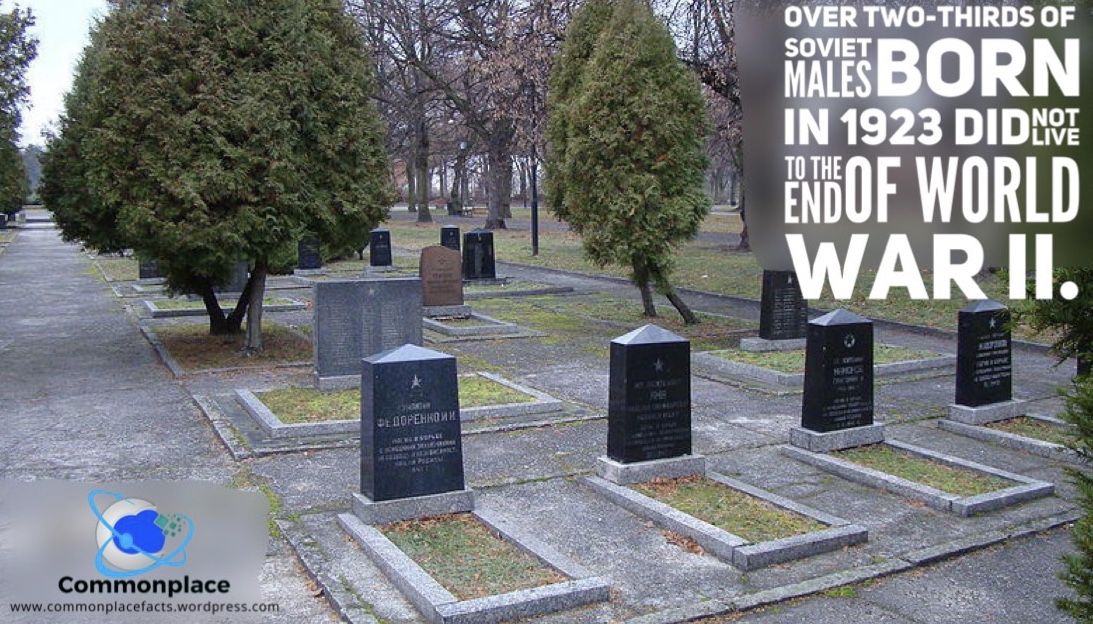
A fun fact on another site recently proclaimed that 80% of the males born in the 1923 generation in the Soviet Union did not survive World War II. This seemed like a good fact to share for Commonplace Fun Facts, but before we could do that, this information needed to be independently verified. As it turns out, the snippet of information did not stand up to scrutiny, but it wasn’t that far off.
The Census Data for the 1923 Generation
Census data shows the following with regard to baby boys born in 1923:
- Males born in the Soviet Union in 1923: 3,400,000
- Infant (0-1) mortality: 800,000
- Childhood (1-18) mortality, famine, and terror: 800,000
- Surviving to 1941: 1,800,000
- Wartime mortality: 700,000
- Surviving to 1946: 1,100,000
As you can see, only 32% of the boys born in 1923 were still alive at the beginning of 1946. A 68% mortality rate is still ghastly, even if it falls short of the 80% figure that is circulating through the internet. Interestingly, though, the primary cause of death for that generation was not World War II. One out of five died due to the violence of the Second World War. Twenty-three percent died in infancy, and an equal number died from the horrific conditions of life in the Soviet Union between 1923 and 1941.
That generation had it particularly bad. Not only did they face a major famine in 1932, but they also lived through Stalin’s Great Terror in 1937. They became adults in the year their country went to war with Germany.
World War II packed a wallop to the Soviet population. In the first six months of the war, three million Soviet troops were killed or taken prisoner. Most prisoners did not survive. In all, the Soviet Union suffered around 25 million war deaths, plus or minus a million. This, out of a total population in 1939 of just under 171 million.
To get a better idea of what these numbers actually mean, look at this powerful video that helps visualize the sheer number of deaths in World War II:
You may also enjoy…

The Great Lunik Heist: That Time the CIA Kidnapped a Soviet Spacecraft
Learn about the time the CIA kidnapped a Soviet spacecraft! The outrageous Lunik Heist of the Cold War!

How a U.S. President Enabled a Soviet General’s Coke Addiction
Georgy Zhukov was a hero of the Soviet Union, but he had an embarrassing secret. He was an addict. What made it worse was that his addiction, if known, would be especially shameful. Addiction to something as ordinary as alcohol would scarcely have raised an eyebrow. For Zhukov, it wasn’t vodka that preoccupied his waking…

The Crazy Story of Aimo Koivunen, the Soldier Who O.D.’d on Speed, Stepped On a Mine, Skied 250 Miles, and Outmaneuvered the Soviet Army
Discover the extraordinary survival story of Aimo Koivunen, the Finnish soldier who skied 250 miles under the influence of amphetamines during WWII.
You may also enjoy…

The 11 Strangest Supreme Court Cases in American History: Tomatoes, Stolen Airplanes, and Terrified Chickens
Explore 11 of the strangest Supreme Court cases involving tomatoes, stolen airplanes, baseball, homegrown wheat, nervous chickens, and other legal oddities.

The Ryōkichi Sagane Letter: The Atomic Bomb Warning That Arrived Too Late
On August 9, 1945, American scientists sent a handwritten warning to Japanese physicist Ryōkichi Sagane. Their delivery method was unusual: they attached it to instruments dropped by parachute during the atomic bombing of Nagasaki. The letter survived. Unfortunately, the bomb arrived first.

Queen Victoria’s Hemophilia Gene: The Mutation Mystery That Changed Royal History
Queen Victoria spread hemophilia through Europe’s royal families. DNA found the mutation—but where Victoria got the hemophilia gene remains a mystery.
You may also enjoy…

Reginald Bray’s 40 Years of Ridiculous Postal Experiments—and the Astonishing Results
Reginald Bray treated Britain’s postal regulations less like rules and more like a list of challenges. Over four decades, he mailed turnips, rabbit skulls, clothing, his dog—and even himself—while testing just how far the Post Office would go to deliver the seemingly undeliverable.

Olympic Art Competitions: When You Could Win Gold for Poetry, Painting—and Architecture
For more than three decades, Olympic medals were awarded for architecture, literature, music, painting, and sculpture. Meet the poets, artists, architects—and one suspiciously successful Olympic founder—who competed for gold without breaking a sweat.

The Sting Behind The Sting: Fun Facts and Strange Stories from the Classic Movie
A real injury became a character trait, the “period” music was decades out of date, Chicago was often California, and the screenplay about con men wound up in a real dispute over who borrowed what. Here are the strange true stories behind The Sting.





Leave a Reply