
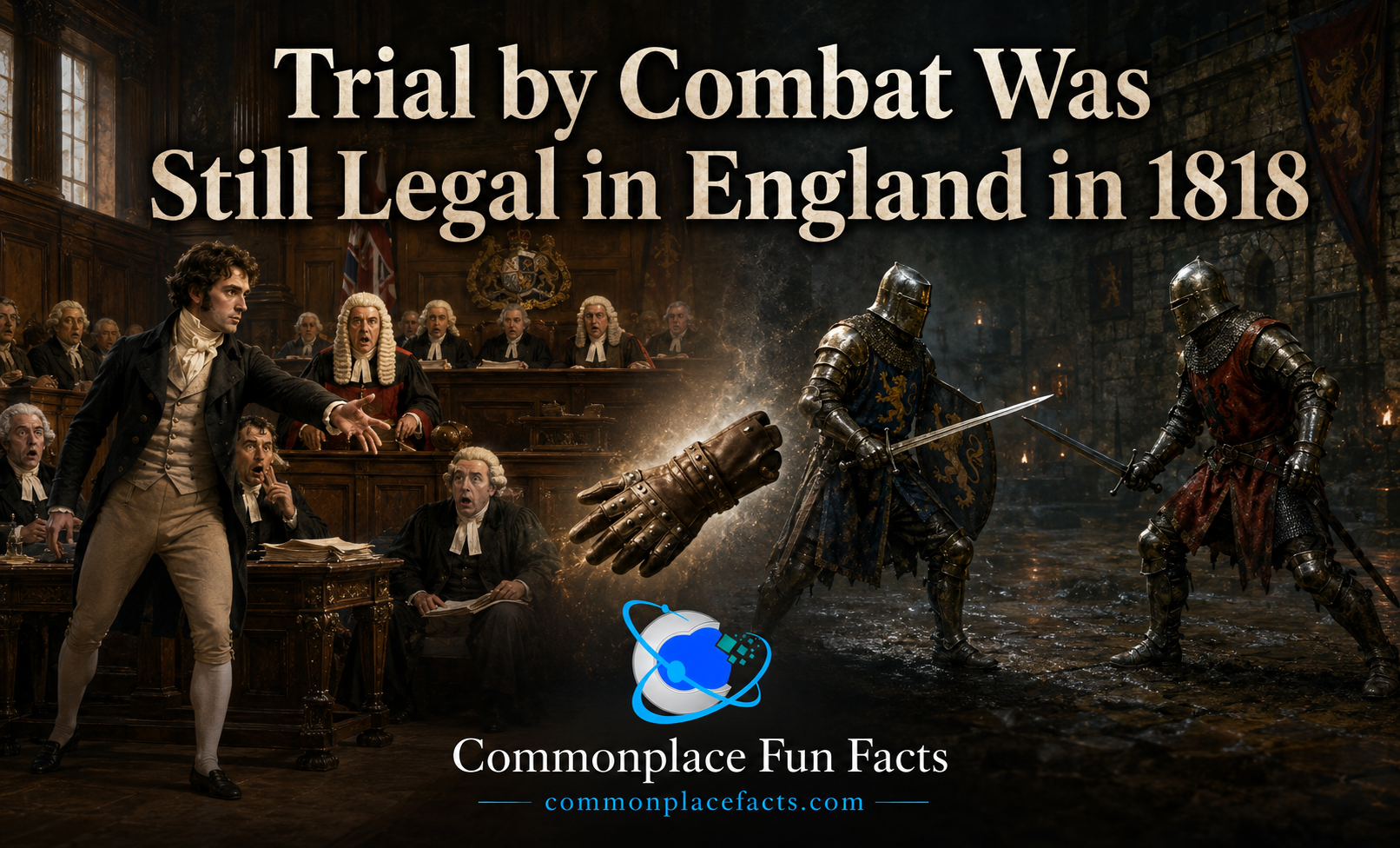

In 1818, the Court of King’s Bench in England found itself confronting a legal question that probably did not appear on anyone’s agenda for the day:
“Is trial by combat still legal?”
The answer, somewhat embarrassingly, turned out to be yes.
The question arose not because a sadistic law professor (technically a redundant term) decided to give his students a research project intentionally designed to ruin spring break. It happened because a man accused of murder appeared before one of England’s highest courts, threw down a leather gauntlet, and demanded the right to settle the case by fighting his accuser.
The judges checked the law.
Then they checked it again, presumably hoping that the first time they had missed the part where someone had abolished the ancient rule allowing a murder case to be settled by hitting people with weapons.
Nobody had.
Contents
The Death of Mary Ashford
The remarkable case began with a tragedy.
On May 26, 1817, 20-year-old Mary Ashford attended a dance near Erdington, then a village outside Birmingham. Among the people there was Abraham Thornton, a young bricklayer who spent part of the evening with her.

Early the following morning, Mary’s body was discovered in a water-filled pit. Evidence suggested that she had been sexually assaulted before her death.
Suspicion quickly fell on Thornton. He had been seen with Mary, and witnesses knew the two had spent time together after the dance. Thornton was arrested and charged with rape and murder.
The case attracted enormous public attention. The facts were sensational, the victim was young, and Thornton was widely assumed to be guilty long before a jury was given the opportunity to develop an opinion of its own.
Then the prosecution encountered a problem: Thornton had an alibi.
Or, more precisely, he had evidence placing him far enough away at a sufficiently inconvenient time that the prosecution’s proposed timeline became difficult to sustain. After a one-day trial, the jury took just six minutes to acquit him of murder. The prosecution then offered no evidence on the separate rape charge, and Thornton was acquitted of that as well.
The verdict was extremely unpopular.
Today, that would normally be the end of the criminal case. An acquittal carries considerable finality, because governments generally do not get to keep retrying defendants until they finally locate a jury willing to cooperate.
Early nineteenth-century English law, however, still contained a few procedural antiques. England had a remarkable talent for allowing ancient legal procedures to linger long past their sell-by date, as demonstrated by the equally strange “benefit of clergy,” which once allowed defendants to escape harsher punishment by proving they could read a prescribed passage from the Latin Bible—or, eventually, simply by memorizing it.
One of those quirky remnants of the past was about to crawl out of the attic.
The Appeal of Murder
Mary Ashford’s brother, William, invoked an ancient legal procedure known as an appeal of murder.
Despite the name, this was not an “appeal” in the modern sense of asking a higher court to review mistakes made by a lower court. It was a private criminal prosecution with roots reaching back into medieval English law.
Long before criminal prosecution became primarily the responsibility of the state, certain serious offenses could be pursued privately by victims or their relatives. The appeal of murder was a survivor from that much older system.
It was rarely used by the nineteenth century, which should have been the first warning that unpleasant things tend to happen whenever someone begins a legal argument with, “I found this procedure from the Middle Ages.”
William Ashford brought his appeal against Thornton, effectively placing him in jeopardy again despite the earlier acquittal.
Thornton’s lawyers responded by reaching even deeper into the medieval toolbox.
Thornton Throws Down the Gauntlet
Under the ancient law governing certain private appeals, the accused could sometimes demand wager of battle, also known as trial by battle. Today, the procedure is more commonly described as trial by combat.
This is one of the rare legal terms that actually means what it says.
On November 16, 1817, Thornton appeared in court and pleaded: “Not guilty; and I am ready to defend the same with my body.”
He then threw down a leather gauntlet.
There are moments in legal history when one suspects everyone in the courtroom quietly looked at everyone else to see whether anyone was going to admit that things had gotten out of hand.
This was one of those moments.
Thornton was demanding that the case be decided not by another jury but through physical combat with William Ashford.
The court now had to determine whether this ancient right still existed.
Surely Someone Had Abolished This
The case eventually came before the Court of King’s Bench as Ashford v. Thornton.

The judges were not particularly enthusiastic about reviving judicial combat. Unfortunately, enthusiasm is not normally one of the elements required for recognizing a legal right.
Lord Chief Justice Ellenborough and his colleagues examined the law and reached a rather awkward conclusion: wager of battle had never been abolished.
It had fallen into disuse. It was ancient. It was absurdly out of place in an era of steam engines, factories, newspapers, and increasingly modern courts.
But it was still law.
Ellenborough acknowledged that trial by battle was undesirable but explained that the court had to administer the law as it existed, not as the judges might prefer it to exist.
This is one of those principles that sounds reassuringly sensible right up until the existing law requires two men to settle a murder case by beating each other.
There was one potential escape hatch. Ashford could defeat Thornton’s demand if the evidence against Thornton was so overwhelming that it left no possible doubt of his guilt. The court concluded that the evidence created strong suspicions, but not enough to meet that extraordinarily high standard.
The court therefore upheld Thornton’s right to demand battle.
So What Would the Fight Have Looked Like?
Trial by battle had elaborate rules developed during the medieval period. It was not simply a matter of putting both parties in a room, handing them weapons, and telling them to try not to damage the furniture.

Historically, judicial combat could take place within a designated area before judges and officials. Depending on the particular period and type of proceeding, combatants might use prescribed weapons and equipment. The battle could continue for hours, with victory potentially determined by surrender, inability to continue, or other legally recognized outcome.
By 1818, however, nobody was entirely certain how such a proceeding should be conducted after centuries of neglect.
That alone raises some entertaining administrative questions.
Who supplied the weapons? Was there a government form? Did the court have a designated combat field tucked behind the records office? Was some unfortunate clerk going to be assigned the task of researching fourteenth-century fight regulations?
Fortunately for the administrative staff, they never had to find out.
William Ashford Declines
William Ashford did not accept Thornton’s challenge.
That was understandable. He had sought a legal proceeding, not an opportunity to discover whether the defendant had spent his childhood developing an unexpectedly useful talent with medieval weaponry.
Because Ashford declined battle and was unable to overcome Thornton’s legal claim to it, the prosecution collapsed.
Thornton was discharged.
He had therefore been acquitted once by a jury and then escaped a second prosecution because English law still recognized trial by combat.
At this point Parliament finally noticed the problem.
Parliament Discovers the Middle Ages Are Still Open
The spectacle of Ashford v. Thornton demonstrated that legal doctrines can survive for an astonishingly long time simply because nobody has bothered to remove them.
English constitutional history contains plenty of other examples of important legal rules surviving through decidedly less-than-orderly means, including the wonderfully persistent story that the Habeas Corpus Act passed because someone miscounted an especially large member of the House of Lords.
In the case of trial by combat, disuse of the law may have made it obscure. It may have made the law impractical. It may even have caused generations of lawyers to forget that it existed.
What disuse did not do was repeal it.
Parliament responded quickly. In 1819, it abolished private appeals of murder, treason, felony, and other offenses and expressly abolished wager of battle and trial by battle as legal procedures.
England had entered the nineteenth century with trial by combat technically available and left 1819 with legislators agreeing that perhaps courtroom procedure should no longer require a working knowledge of medieval melee combat.
The Gauntlet Survived
The story comes with one particularly satisfying relic.
One of the leather gauntlets associated with Thornton’s challenge remained in the possession of his solicitor’s family for generations. In 2019, Christie’s offered it for sale together with legal papers connected to Thornton’s case. It sold for £6,875, or roughly $8,600 USD.

It is difficult to imagine a better conversation piece for a lawyer’s office.
“What’s that?”
“Oh, just the glove somebody threw down when he demanded trial by combat in a murder case.”
Suddenly the framed diploma seems a little underwhelming.
If you are picturing some hulking piece of iron gauntlet worthy of a medieval knight, however, the reality is considerably less intimidating. Thornton’s surviving gauntlet looks less like something designed for mortal combat and more like an unusually decorative oven mitt. It is pale leather, trimmed with embroidery and fringe, with long cords dangling from the wrist.
Which somehow makes the whole episode better.
This delicate-looking little glove was enough to resurrect a medieval legal procedure, confound the Court of King’s Bench, and help persuade Parliament that perhaps it was finally time to remove “fight your accuser” from the menu of available legal remedies.
A Legal Loophole, but Not Quite the One You Think
It is tempting to describe Thornton as having discovered a “loophole.” That is close, but the word does not quite capture what happened.
Thornton did not exploit a drafting error or manipulate an ambiguous statute. His lawyers invoked an actual, recognized part of English law that had simply become so archaic that almost everyone assumed it no longer mattered.
Britain remains unusually good at preserving legal fossils. Even today, the King James Bible is subject in the United Kingdom to an ancient royal publishing privilege that operates outside ordinary copyright law.
The judges could have been forgiven for wanting to declare the whole thing ridiculous and move along. Instead, they concluded that courts did not possess the authority simply to erase an existing legal right because it had become embarrassing.
If the law was bad, Parliament needed to change it.
Parliament did.
That makes Ashford v. Thornton more than a wonderfully bizarre historical footnote. It illustrates something important about legal systems: forgotten laws do not necessarily cease to exist just because society has moved on.
Sometimes somebody has to stumble across them first.
And occasionally that somebody is carrying a gauntlet.
The Last Trial by Combat That Never Happened
Abraham Thornton never fought William Ashford, so Ashford v. Thornton was not technically England’s last trial by combat. It was something stranger: the last successful demand for one.
For a brief moment in 1818, English judges were forced to acknowledge that a procedure descended from medieval judicial combat was still sitting there in the law, perfectly available to anyone sufficiently determined—and sufficiently well advised—to use it.
The case began with the tragic death of Mary Ashford, proceeded through a controversial murder acquittal, resurrected a medieval private prosecution, produced a leather gauntlet in the Court of King’s Bench, and ended with Parliament hurriedly rewriting English law.
All because, despite centuries of opportunities to do so, nobody had actually managed to cross out “trial by battle.”
There may be a lesson here for the rest of us. The next time you find yourself facing a legal challenge, perhaps you should not immediately assume that the obvious remedies are the only ones available. Do a deep dive into the law books. Check the old statutes. Examine the dusty precedents nobody has cited since powdered wigs were everyday office attire.
Somewhere in there, you may discover that the legislature forgot to repeal your right to defend your property with a battle wolverine, resolve contract disputes through an enthusiastic round of thumb wars, or settle boundary disagreements by requiring both parties to stand on one leg while reciting Magna Carta.
Probably not.
But Abraham Thornton probably did not expect to find “throw down a gauntlet and demand mortal combat” among his legal options either.
You may also enjoy…

The Last Sword Duel in France Took Place in 1967
Imagine what it was like in days of yore, when a gentleman’s honor was defended with the razor-sharp steel of a sword. In those long ago days, an insulting word might very well be met with a challenge to duel to the death. Those were the days of chivalry. Those were the days of honor.…

The Neck Verse: How to Escape Execution With a Little Latin
Explore the fascinating story of Ben Jonson, the ‘Benefit of Clergy,’ or ‘Neck Verse,’ and how his Latin skills saved him from execution in 1598 after a duel with Gabriel Spencer.

It is Illegal to Sell Infants in Pennsylvania
The Commonplace Fun Facts Legal Department tells us that laws are supposed to be reasonable. Apparently, this concept doesn’t apply to legal advice, however. That one sentence generated a bill for $362.11. If, by “reasonable,” that means that laws should encourage desired behavior, that’s one thing. If it refers to the severity of punishment for…





Leave a Reply